Category Archives: Toddler

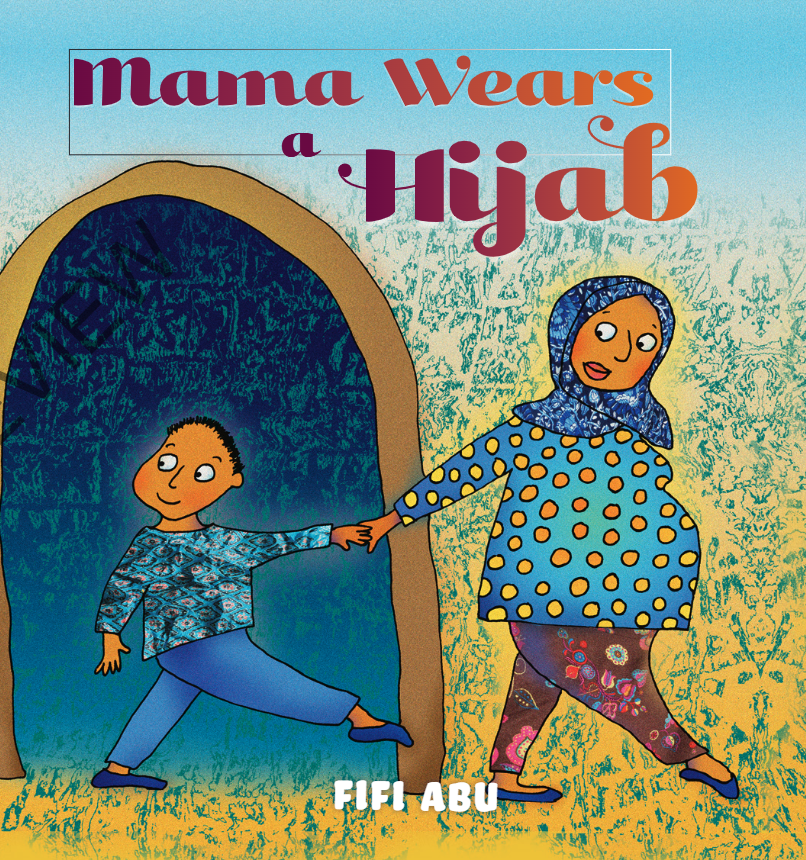
Mama Wears a Hijab by Fifi Abu

Standard
Mama Wears a Hijab by Fifi Abu

I don’t understand this 24 page 10 x 10 board book. I don’t get it literary wise, or Islamic rep value wise, and if someone can explain it to me, I will be happy to listen.  I’m figuring it is a “me” problem because the author has multiple masters, one in children’s literature and has even been on the Caldecott committee, so I don’t know why I can’t make heads or tales of the metaphors.  At times it seems they are describing the hijab, but maybe the parent child relationship, on one spread the pregnancy, possibly motherhood in general.  A few pages are beautiful, and I like the illustrations, but the continuity is lacking and makes me a little uncomfortable.  Islamically, I understand that women who cover their head often do wear makeup and perfume, but they are not part of hijab, so to have that be articulated is both erroneous and odd.

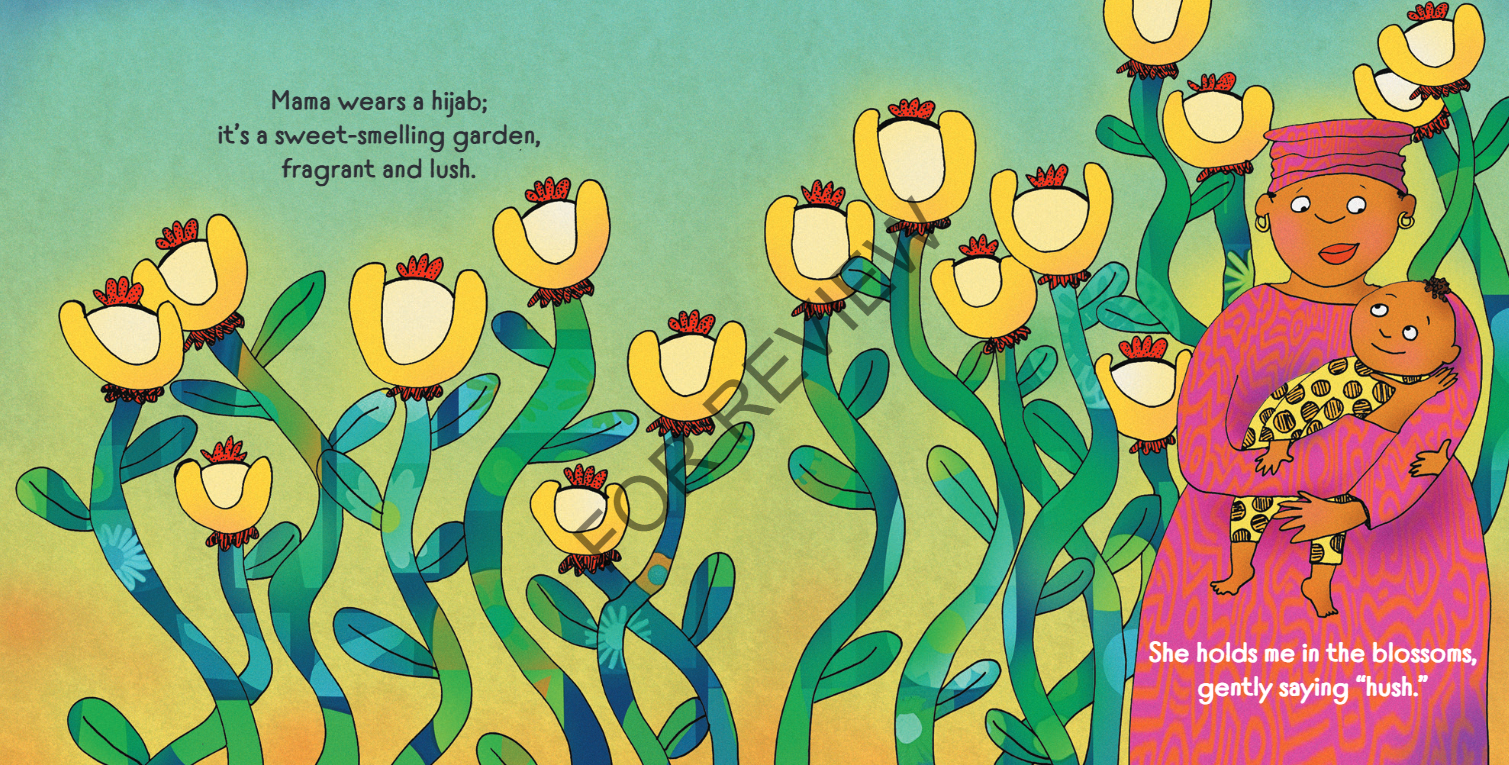
The illustrations show hijab, niqab, a duputta style, and everything in between.  The characters shown are families in a variety of skin tones, clothing styles, body shapes, and cultural settings.

The book is not a story, it functions in two page spreads of rhyme that take an abstract concept and ground it so to speak, but what the connection is, is by and large lost on me.  I know I have included more inside pages than normal, but I feel that I can’t really review it, so perhaps the least I can do is provide enough peeks for people to come to their own conclusions.

The Prophet;s Sunnah by Ayesha N. Rahmaan illustrated by Laila Ramadhani Ritonga

Standard
The Prophet;s Sunnah by Ayesha N. Rahmaan illustrated by Laila Ramadhani Ritonga

This joyful 20 page board book shows our littlest (and biggest) Muslims some of the Prophet’s sunnahs in a way that they can also do in their lives.  The adorable illustrations appeal to kids and the simple text showing the acts are relatable and engaging.  I did cringe at times with the changing size of the basic font and the perspective of some of the lines being told to the reader as “your” and others as “our,” but I’m a bit of a sucker for kid’s books about Rasulullah.  Some of the vocabulary might need some explaining, but overall my little ones enjoyed the book when I read it, and I have caught them looking through it on their own, so yes I’m aware that I’m over looking a few basics.

The book starts with a hadith on the dedication page and is then followed by an ayat in Arabic and English meaning of the translation about following Prophet Muhammad (saw) if you love Allah swt.  It  introduces Prophet Muahmmad saw to the little readers, not stressing the call to Prophethood and revelation, but him as a “neighbor, friend, father, husband, leader and teacher.” Starting with Bismillah, sharing, and helping, visiting the sick, being humble, some pages are filled with multiple images, and others a single scene.  Some have Arabic transliteration and one has Arabic script accompanying the English.

The illustrations show different sizes, colors, abilities.  Some of the girls wearing hijab, some not.  Readers are bound to find someone in the book that looks like them.  The binding quality and page thickness is well done and the 8.5 square size makes it great for story time or reading in small groups.

First Words from the Qur’an by Jenny Molendyk Divleli illustrated by Sena Aydogan

Standard
First Words from the Qur’an by Jenny Molendyk Divleli illustrated by Sena Aydogan

img_7527-1

This large, LARGE (10 x 13.5), 16 page board book is joyful and informative for our little Muslims to look through.  Each two page spread starts with a topic that is followed by an ayat from the Quran and then adorable illustrations are splattered around with comments, questions, facts, or definitions.  In some ways it reminds me of the Richard Scarry books that don’t have a story, and don’t have to be read front to back. You can, or you can just pore over the pages and point things out to your little ones.  The book also helps caregivers that might not do voices and Broadway style productions at story time, by offering little prompts with each picture that allow the child to engage, have their attention directed, or offer up their connections in an intuitive manner.  The size and quality definitely make the book stand out on the shelf, and I think for babies to early elementary the Islam centered focus will appeal to more than just toddlers.

The book features Animals in the Qu’ran, Plants in the Qur’an, People in the Qur’an, Nature in the Qur’an, Places in the Qur’an, Objects in the Qur’an, Blessings int he Qur’an, and  Color’s and Shapes in the Qur’an. The last page features a baby safe reflective “mirror.”

I AM: A-Z of Positive Affirmations for Muslim Kids by Barakah Kemi Hassan illustrated by Mariam Poppins

Standard
I AM: A-Z of Positive Affirmations for Muslim Kids by Barakah Kemi Hassan illustrated by Mariam Poppins

img_7168-1

This alphabet framed book combines the English alphabet with correlating affirmations, but then also ties the sentiment in with one of Allah’s swt 99 names.  The names do not correlate with the alphabet, but ground the book by building on that connection to Allah swt and the peace and reassurance of knowing He is there.  The faceless illustrations are colorful and warm, blending wonderfully with the text, as does the font and style of the large soft cover picture book.  After the alphabet there are tips on how to use the book along with the 99 names in Arabic, English, and the meaning in English. The book was nominated for the Muslim Bookstagram Awards 2024 and had it not been, I don’t know that I would have spent time with it.  I can see this book working really well in a classroom setting, in addition to in a home. I’ve seen my own children’s teachers use affirmations, and to have this Islamic centered, alphabet organized one, really is a great tool for building our little Muslims up and strengthening their awareness of Allah swt in all we do.

Momo & Bronty’s first book about Prophet Muhammad (saw) by Zanib Mian illustrated by Laila Ramadhani

Standard
Momo & Bronty’s first book about Prophet Muhammad (saw) by Zanib Mian illustrated by Laila Ramadhani

I’ve mentioned it numerous times over the years how few children’s books there are about Prophet Muhammad (saw), and I love that this new book by Zanib Mian is a wonderfully illustrated 14 page board book for toddlers introducing them to some of the basics about our beloved Rasulallah. Momo and his toy dinosaur Bronty are featured in the illustrations, but do not dominate the text, which keeps the focus on Prophet Muhammad (saw) being the last of Allah’s messengers sent to tell us Allah is One, that the salutation is said after his name, and that he is always smiling, truthful, and making duas for us all, his ummah. I read the book a few times to myself and stumbled over some of the short sentences, but oddly enough when I read it aloud to my kindergartner it flowed fine. I always read picture books aloud before writing my reviews, as I was taught to read my essays aloud in school before submitting them, to effectively find errors. So, I’m not sure why for this book, I stumbled when reading to myself, but not aloud, a first for everything I suppose. The last spread though I did benefit from reading beforehand, as the order of what text comes next is not clear on first look. The pictures contain a lot of accessible details and discussion points and even early elementary aged children will find themselves drawn to the book, the reminders, the messaging and the simple text.

The board book is not just a list of facts, but doesn’t have a plot either, it is somewhere in between as it stays on level and flows between ideas, keeping the readers engaged. It starts by explaining that Allah swt sent Prophet Muhammad to us, the Qur’an through him, the message he carried, and why we love him. It shows that he exemplifies what a Muslim is and gives some examples, it then highlights that “His face was more beautiful than the full shining moon” and that “he played with little ones and made them laugh.” It concludes with connecting us, his ummah, as being important to him as he knew “the message he brought from Allah,” would spread.

Hilwa’s Gift by Safa Suleiman illustrated by Anait Semirdzhyan

Standard
Hilwa’s Gift by Safa Suleiman illustrated by Anait Semirdzhyan

img_6526-1

I’ve read a few children’s picture books about harvesting olives, and even some about Palestine’s olives, but this one really stands out because it is just so very joyful.  There is information about picking the fruit, processing, and making soap and oil with olives, but the book’s take away is just sore cheeks from smiling, and a full heart from feeling the importance, love, and tradition of olives, family, and being together.  The text and illustrations combine beautifully allowing the story of Hilwa, the olive tree, Ali and his Seedo to say a lot without having to spell it all out. And that it is traditionally published at such a critical time, is truly a gift.  There is nothing religious in the text, there are a few #Muslimsintheillustrations, and the author is Muslim. Additionally there is nothing about the current situation, the politics, the upheaval, or the occupation. The book follows Ali as he arrives after a long journey to his Grandparent’s home, it is harvesting season and  he is about to see all of the gifts that come from olives with the guidance of his grandfather, the cheering of his cousins, and the offerings of his beloved Hilwa.

The book starts with Ali and his parents arriving exhausted after their long flight to Palestine.  Greeted by Seedo, when Ali sees Hilwa, the olive tree his grandfather planted with his grandfather, the tiredness disappears.  When he hears Sitty whacking the trees and his cousins singing, “Zaytoon, ya zaytoon.”  He is ready to help harvest.  But, he doesn’t want to hurt Hilwa and decides to pick the olives one by one.  After his arms are tired and the basket is empty, he gently tries the traditional method and makes the zaytoon rain down with his grandparents and cousins cheering him on.

Hilwa has many gifts, and the next day they load up the olives to be taken to the press, they then prepare and enjoy the olives being pressed in to oil.  They bring the oil home to cook with, eat, turn in to soap, and the pulp is used to build the fire.  The best gift of all however, is the family, friends, and neighbors gathering to share and be together.

I read an early copy, and hope that the beginning will be smoothed out a bit.  It actually read as if a page was missing.  If the family had just arrived from overseas, and the grandfather was so excited, why wouldn’t the grandmother and cousins also leave what they are doing to great the just arrived family? It seemed a bit off, but once the story recovered, the text and story flowed without incident, so perhaps the disjointedness has been resolved.

img_6527-1

It is so important to show the richness of cultures to those that might be unaware, for a culture that is relentlessly villainized, even more so.  This 40 page picture book is great for ages 3 and up, and while it doesn’t detail Palestinian culture, it highlights a central component and shows the vibrancy and warmth of a people and their relationship to the land and the importance of olives and olive trees.  There is a glossary at the end with words in English and written in Arabic scripts as well as an Author’s Note.

Aisha’s Colors by Nabila Adani

Standard
Aisha’s Colors by Nabila Adani

img_6445-1

On first glance it seems this 32 page picture book is going to focus on colors from the perspective of a little Muslim girl in Indonesia, but it isn’t a basic color book, in fact only three colors are even explored.  The book is also not religious, aside from the hijab wearing mother and grandmother in the illustrations. And the writing isn’t really noteworthy, but yet, the book is endearing, and I can’t wait for my physical copy to arrive so I can share it with my kids and some classes for story time. The book has a plot, a little girl wishing she was spending her summer vacation seeing and going fun place like her friends.  Instead she is going to her Grandma’s house, the same place they always go.  She throws a bit of a tantrum, and then cools off and gains some perspective.  It is sweet, it is realistic, it shows growth and life lessons of appreciating the beauty around you, and not worrying about other people, all without preaching or talking down to the reader in the simple text.  It is joyful and highlights bits of Indonesian culture with beautiful images by the author-illustrator, a solid addition on bookshelves for ages 3 and up.

The book starts with Aisha bemoaning that her friends are going to fun far away places over the holidays, and she is going where they always go, from their home in Jakarta, to their Grandma’s village.  She tells her parents about her friend Jennie going to see snow this year, and imagines the cold white crispness that she doesn’t know.  Her parents respond by taking her to get es campur.  

She then laments about Dimas floating in turquoise water looking up at a blue sky, to which her father encourages her to look out the window.  When their car breaks down, and Aisha is encouraged to go cool down after her tantrum, her mom works on fixing the car, and a sky of kites shakes Aisha’s melancholy mood.  By the time they arrive at Grandma’s Aisha is seeing her own vacation in a different way, surrounded by colors, love, and family.

The book warms your heart, Aisha is grumpy, but not annoying, and the yellow warmth of Grandma is palpable.  I wish a few more colors were included and more culture shown that way, and I stumbled repeatedly over a few awkward sentences, not that they were wrong, but they just didn’t seem to flow when read aloud.  Overall, a good book. Preorder today, it releases September 3, 2024. 

Sami’s Special Gift: An Eid al-Adha Story by M.O. Yuksel illustrated by Huseyin Sonmezay

Standard
Sami’s Special Gift: An Eid al-Adha Story by M.O. Yuksel illustrated by Huseyin Sonmezay

img_5215-1

This sweet 32 page story, blends themes of loss, grief, giving, homelessness, Islam, Eid al Adha, and joy with simple early reader level text and beautiful illustrations. The book never gets preachy and doesn’t other, making it a great addition to all shelves, everywhere. There is information about Eid al Adha and what a homeless shelter is in the backmatter along with a glossary that explains, Islamic and Turkish terms.

Sami loves Eid and celebrating at the carnival with Dede, his grandfather, but this year, Dede is not there, and Sami is sad. When a package from Nene arrives from Turkiye with Dede’s favorite sheep decorated Eid tie for Sami, things start to look up. Sami never wants to take it off, and even wears it over his new Eid clothes as they head to the mosque for prayers. After salat and before the carnival, the family visits a local butcher and picks up meat to take to the homeless shelter.

Sami has never been to a homeless shelter and has only heard of his parents going and helping there. He asks his parents about it on their way and once they arrive heads off to play ball with a boy, as his sister shares her doll with a little girl. When it is time to leave for the carnival, Sami imagines what the his life would be like if he lost his home and belongings, and makes a decision, knowing exactly what his Dede would do.

img_5218-1

I love how the book weaves in information about Islam by having the family praying, listening to the imam, wearing new clothes, and giving in charity, without pulling out of the story. Same for the Turkish cultural inclusions of food and words. I also like that in the illustrations the mom wears hijab when out of the house, but not inside. It all comes together smoothly and is unapologetic, even while handling the sadness of his grandfather no longer being with him, the empathy at the homeless shelter, and joy at the carnival.

My only concern is when it says both in the text and in the backmatter that meat is given: one third to friends, one third to family and one third to the poor. I don’t know that it is wrong, but to clarify you keep one third for yourself (and family), and distribute one third to friends, and one third to the poor. Additionally, I also know a lot of people might not love the illustration style, but the picture of them in the mosque, won me over.

Sheba: The Good Muslim Cat by Carima Elfarrah illustrated by Aaron Yusuf

Standard
Sheba: The Good Muslim Cat by Carima Elfarrah illustrated by Aaron Yusuf

img_4999-1

I was really looking forward to this book about Muslims and cats.  Every masjid seems to have cats all over the world, and while feline friends often sneak into Islamic fiction books about other things, I liked the idea of giving a cat the spotlight.  Alas, the rhyming text, the examples given, the inspiration shared in the backmatter, the angel imagery, and the ambitious glossary made this small 8×8 inch 32 page picture book rather off putting and ultimately forgettable unfortunately. The cat remains at the family home, and basically just hangs out with the family when they read Quran, pray, get up for fajr, and the cat is patient when waiting for food or water.  Sure it makes it a nice cat, but with a title implying this cat is a “Good Muslim,” I really expected more.  I appreciate the hadith at the end, but it is not sourced, and the cat with a halo and wings signals Christian imagery, that doesn’t align with the tone of the book.  Additionally, the idea of the book comes from a story of a Syrian scholar who had a conversation with a cat. I’m not saying it did or did not happen, but it seems a little bit of a stretch for my cynical brain.  The book reads for toddler and preschool Muslims, but the glossary reads copy and pasted from Wikipedia for non Muslim adults.  The small size makes the book impossible for group story times, and it can be hard to read at times because the text often runs over the pictures making it hard to see.  Ultimately though, while my toddler enjoyed it well enough the first time, he has not asked for the book again despite it sitting on my side table for weeks, which is probably more insightful than my review.

The book starts with a young boy introducing his family cat, Sheba, who has sapphire eyes. The family is Muslim and the boy is confident his cat is too because she hangs around his dad when he reads Quran, she comes running when salah time comes, she plays with the imam (the dad) after the last salaam, and she waits patiently for food and water when her bowls are empty.  She cries at fajr to wake the boy up and he hopes that on the day of judgement she will attest to the good the family did for her.

The backmatter includes the story of Shiekh Shukari, a scholar in Damascus that spoke to a cat, then a two page spread glossary, and author and illustrator bios. The illustrations aren’t particularly spectacular, the boy at the beginning seems much older on some of the pages compared to others, although his clothes stay the same.  I didn’t like the angel imagery, perhaps I’m erroneous, but none-the-less it felt off to me.

Busy Eid illustrated by Campbell Books illustrated by Debby Rahmalia

Standard
Busy Eid illustrated by Campbell Books illustrated by Debby Rahmalia

img_5008-1

I put this book on hold at the library during Ramadan, but there was a waiting list and I just got it.  No worries though, the 8 page board book with moveable parts can be fun for babies and toddlers all year long, and if you skip over the welcoming of the new moon on the first page, the rest of the book will work for Eid al Adha just the same.  The book doesn’t have an author, it seems to be written by committee by Campbell Books or Macmillan which is fine, since their are only eight rhyming lines. The speaking bubbles that ask the reader to do something however, are about off.  For example asking what color the domes on the mosque are, to which my overthinking brain can’t discern, are they gold…en? tan…ish? on the first page it wants you to move the moon, then asks you to point to the stars and moon, but then on a later spread wants you to guess what’s in the present before you slide the scene to reveal it, with only four spreads, at the very least there should be consistency.  As for the illustrations though, they are lovely and inclusive.  There are smiling warm faces of all colors, shapes, sizes, cats a plenty, a blind gentleman, old young, different styles of hijabis, some non hijabis too.

img_5009-1

The book starts as they all seem to, with the sighting of the new moon, there is cheering, wearing one’s best clothes, and going to pray, gift giving, and food, and pullouts, pushups, and slides on each spread to engage little hands.

img_5011-1

The book is sweet, I’m glad we have representation in toddler board books for Eid joy.  There is nothing religious, or educational.  A Muslim family will perhaps see some of their Eid activities mirrored in the pages, but there is no real grounding or insight for those unfamiliar with Eid to understand why Eid is special, what it is celebrating, or who celebrates the holiday.

img_5010-1

I got my book at the library, but it is available here on Amazon or here at Crescent Moon where my initials ISL at checkout will save you 10%.