Category Archives: Picture book

Yo Soy Muslim: A Father’s Letter to His Daughter by Mark Gonzales illustrated by Mehrdokht Amini

Standard
Yo Soy Muslim: A Father’s Letter to His Daughter by Mark Gonzales illustrated by Mehrdokht Amini

yo soy muslim

I feel like I preordered this book years ago, I have been so anxious to see what all the hype was about. When it arrived I tore open the box and read it on the short walk from the mailbox to the house, read it again standing in the kitchen, left it for a few days, and reread it now to write the review. SubhanAllah, it didn’t disappoint.

yousoy4

It reads, as intended, as a powerful letter to a child.  There aren’t long winded morals or overly fancy words. It is direct in its many ways of telling you, that you matter, where you come from matters, that your foundation matters. That you are strong, and beautiful, always, even when the world may not think so. That you are Muslim, that you are from Allah, that you speak in Arabic and Spanish and dreams.  The verses become poetry that dance on the page with the illustrations telling the story as powerfully as the words.  The words in turn float and lilt around images as old as time and as innocent as dancing in the wind.

soy

The 32 pages fly by that you can’t help but read it again, slowly, savoring all the harnessed power and hope of a multi culture world, a multi cultural faith, that is truly beautiful.  Recognizing the humanity that we all share, yet feeling pride in your own unique skin is a balancing act that doesn’t need to be apologized for, and should be celebrated.

yo soy2

I love that this book exists.  That it is available on Amazon.  That it is bold and colorful and hardbound, and so well done.  There is diversity in Islam.  There is diversity of belief in Indigenous populations, that there is so much inspiration in the world around us and in our past.  Are all messages that come through even for the youngest readers.

yosoy3

yo soy1


The Farmer’s Wife by Idries Shah illustrated by Rose Mary Santiago

Standard
The Farmer’s Wife by Idries Shah illustrated by Rose Mary Santiago

farmers-wife.jpg

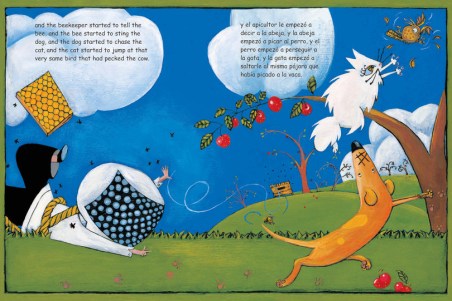
The book reads very much like the western children’s story/song, “I know an old lady who swallowed a fly,” but in this Sufi inspired repetitive story, An old Farmer’s wife can’t get an apple out of a hole.  

The silliness starts right away when she wants to get a bird to fly down the hole to get it for her.  When the bird says, “tweet,” which means no, she deems him naughty and then moves on to asking a cat to jump on the bird, to get the bird to get the apple.  The funny thing is the chain of events is funny and illogical at points. She wants water in a puddle, to put out a fire to burn a rope, the rope to tie up a bee keeper, and so on.  Luckily the wind finally blows the apple out of the hole and they all live happily ever after.

farmer2.jpg

The book supposedly is to teach patience, I am hoping to use it when I do a lesson on thinking outside the box and how sometimes that is great, but the trick is knowing when it might also be easier to reach down and pick up the apple.  

The book is AR 3.4 and 32 pages.  Many versions are dual languages.  The pictures are great with the abiya wearing woman and the chunky cartoonish side characters making the silly story fun to read a loud.  There is nothing “islamic” other than the illustrations showing the woman in hijab, and the author being a well known sufi writer who uses lessons from the Sufi tradition to teach lessons to children.

farmer1


A Little Tree Goes for Hajj by Eman Salem

Standard
A Little Tree Goes for Hajj by Eman Salem

little tree

A friend loaned me this book with a bit of hesitation as to its quality, and although I needed one more Hajj book for an upcoming story time, it seemed that it was yet another book about the steps for Hajj, so I wasn’t stressing about acquiring it. Luckily we were both wrong, at least from my perspective.  The book is so sweet, and not so much about the steps and details of Hajj, but more about the longing to go.  To seal the sweetness deal, it is about the friendship between a man, and a tree, and perfect for 3 year olds and up.

tree1`

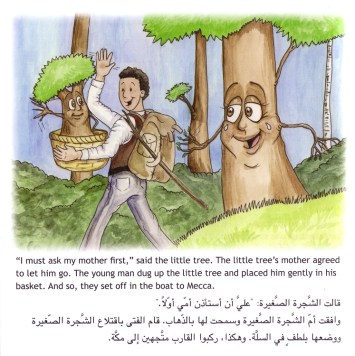
The little tree dreams of traveling, but more than anything he dreams of going to see the Ka’aba.  Noting the logistical struggles of travel with roots, his mother encourages him to make duaa for his heart’s desires.  After a lot of patience and a lot of duaas, (alhumdulillah, it shows duaas take time and are not a magical instant granting of a wish) a young man walks by on his way to the coast to catch a boat for Mecca.  Startled by a talking tree, the clever boy just happens to have a basket and he uproots the tree and they head out together.

tree2

The book shows the two doing all the steps in a large two page illustration, keeping the text to a minimum.   On the next page though, it highlight the two praying and trimming their hair and leaves. When the tree is returned to his mother, she is watered with Zam Zam water and “they agree it is the sweetest water ever tasted.”

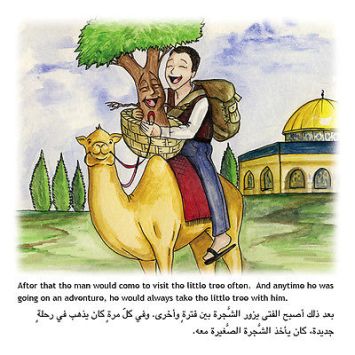
The friendship continues, as they journey on countless adventures, and in the end, when the man is old and the tree is too big, the old man returns to rest on the tree’s roots and tell stories to the nearby saplings.

a-little-tree-goes-for-hajj-islamic-story-book-for-muslim-children-in-arb-eng-8252bfb5e194e76cc8e2190c5c691211

Written in both English and Arabic, the story is a fast read that holds even the little one’s attention as they look at the expressive illustrations.  There is additional information on the Hajj rituals page, but it can be used according to need, like the glossary in the back.  The story is for Muslim children and families as it does not explain the requirements of Hajj, importance of the Ka’aba, or history of the rituals.


Hamza Learns About Eid-ul-Adha by Asna Chaudhry

Standard
Hamza Learns About Eid-ul-Adha by Asna Chaudhry


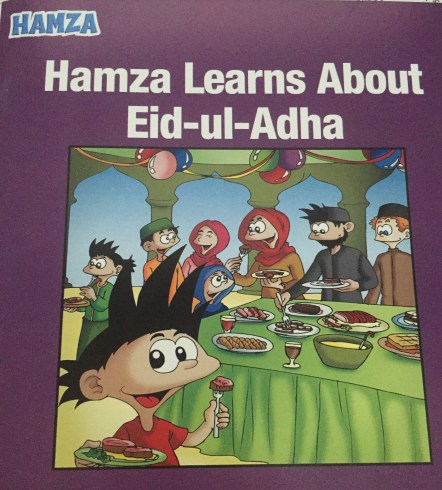
FullSizeRender (20)Hamza returns in this book to learn about Eid-ul-Adha, and the story is hilarious, and on point for ages three and up.  The sentences and paragraphs are short, the pictures are bright and colorful like always, and the basics of Eid are conveyed.  The age of the reader or listener will greatly depend on what they get out of the story, as some may need help understanding concepts like sacrifice, slaughter, sacred, commemorate, counting sheep to sleep, and why the book is silly.
FullSizeRender (21)

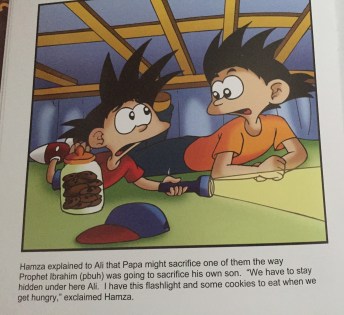
Hamza sees his older sister Aisha decorating the house for Eid-ul-Adha and wants to learn more about the holiday.  He goes to find his mom who starts to explain that it is a day of feasting “to commemorate when Prophet Ibrahim (pbuh) was going to sacrifice his son according to Allah’s command.”  Unfortunately for Hamza, mom then gets a phone call and Hamza runs for his life thinking that he too will be sacrificed.  When Hamza’s brother Ali finds him hiding under the bed, Ali explains that only animals are sacrificed, and tells him about how Allah swt commanded Prophet Ibrahim to sacrifice his son Ismail.  

FullSizeRender (19)

Hamza then worries about the animals that are sacrificed and Ali explains that when done in an Islamic manner, they feel little pain and that the meat is to be shared.  With his heart at ease, Hamza is ready to enjoy Eid-ul-Adha.

Hamza Learns About Hajj by Ameena Chaudhry

Standard
Hamza Learns About Hajj by Ameena Chaudhry

FullSizeRender (18)

This isn’t my favorite Hamza book, which is unfortunate, because it presents some really good information in a way different than all the other children’s Hajj books I’ve read. Hamza want’s to know if there is a swimming pool at Hajj or if big machines were used to build the Kabaa.  All pretty accurate questions for how a 4 year old processes what is going on, but it takes Hamza and the reader forever to get any information.  He hears about Hajj from his parents, then goes to ask his sister Aisha who tells him its one of the pillars, then goes to ask grandpa, then is glad he has learned so much about hajj, then eager to learn more…it seems like all the book does up until this point is have Hamza asking to learn, wanting to learn, and glad he has learned, but nothing he is learning is being shared with the reader!

Eventually we do learn that the Kabba is a house of worship built thousands of years ago, that it is the direction that we pray, and that Prophet Ibrahim (pbuh) and his son built it.  About Hajj we learn that you have to wear white two-piece outfits, that millions of people go, and that you can only go during a special time of year.  Not a lot of information, but at the same time, for little ones, that can be a good thing.  Sometimes learning  all the names of places and rituals is cumbersome and off-putting. 

FullSizeRender (16)

The amount of text on the pages is minimal, and the pictures, as always, are endearing, Hamza even imagines himself bald!  I do question when the book claims, that going to Medina to visit Masjid al Nabawi is part of Hajj.

Hamza gets excited for Hajj and I think that is conveyed to the readers.  Little kids will giggle and remember that the Kabba was built by people’s hands, and that it is far away. Not bad for 3 and 4 year olds, but not enough to engage older kids, or those with some understanding of Hajj.

FullSizeRender (17)

Stepping Stones: A Refugee Family’s Journey by Margriet Ruus Artwork by Nizar Ali Badr

Standard
Stepping Stones: A Refugee Family’s Journey by Margriet Ruus Artwork by Nizar Ali Badr

stepping stones

I usually have a running lists of books to check and see if the library has in their catalogue, and another list for when I have a few extra dollars and/or a reason/excuse to purchase books for my own.  I’ve seen this book recommend by countless critics, educators, refugee resettlement volunteers etc., and was thrilled that I could get it from the local public library.  However, it isn’t enough to have this book and mull over the artwork and prose for three weeks, it deserves a permanent place on the shelf.  Or better yet, open hands to pass the book around to within your home, to reflect on the humanity that binds us all, and the plight of so many in the world.

FullSizeRender (12)

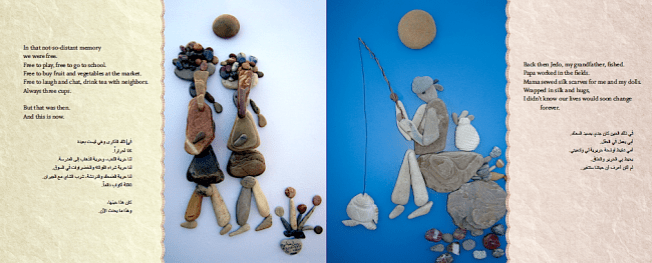
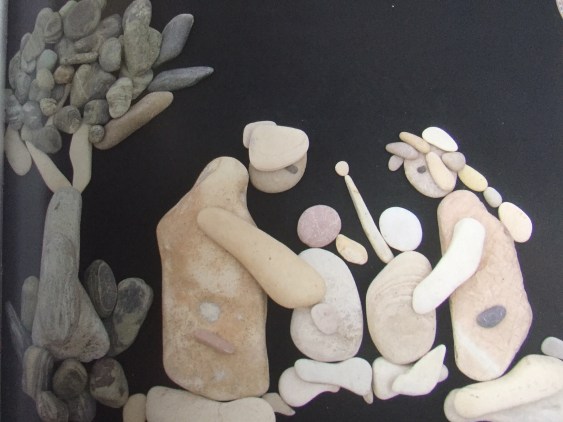
The story is fairly simple, Rama and her family have a good life in Syria and the war changes that, forcing her and her family to flee on foot to Europe with what they can carry.  The emotions on the other hand, are not that simple.  The book is illustrated in stone, but the reader would have to have a heart of stone to not be moved.  Written on an AR 3.2 with 28 pages, the book is written in both English and Arabic.  The book is not sensational, but it does discuss the shortage of food, and going hungry, how they are not free, not really, how bombs fall and kill people going to the market,  and it does show that people were lost in crossing the sea.  The family has to walk, there is no going to the airport or cars to take them across borders so easily, this is contrasted to the beginning of the book where Rama was free to play and go to school, things the reader can relate too.

stones

Ultimately the book is full of hope.  The fictionalized account of a horrific reality still on going, pales only to the story of how the book came to be.  The Foreword is wonderful and gives the book so much more warmth and heart.  How the author saw the artisans work, sought him out, and built the story around his pieces, gives even the youngest reader a sense of reality for an unfathomable situation.  After the story is more information about the author and the illustrator, as well as a list of resources to volunteer, donate and help.  Portions of the book sales go to help resettlement organizations across North America.

stones2

The publishers page gives info and has a youtube book trailer as well: https://steppingstonesthebook.com/

FullSizeRender (11)

The book would be great at story time or in a classroom setting followed by an activity with making pictures with stones previously collected.  At bedtime the book is great to read aloud and let the words sweep your listener toward empathy and compassion.  Check your library first, and if it isn’t there, I don’t think you’ll regret your purchase.

Zaahir & Jamel The Camel: At the Mosque by Amatullah AlMarwani illustrated by Sudha Choudhary

Standard
Zaahir & Jamel The Camel: At the Mosque by Amatullah AlMarwani illustrated by Sudha Choudhary

zahir and jamel

Another book in the Zaahir and Jamel the Camel series, this book explains to children how to behave at the mosque.  The pictures are colorful and busy, engaging children 2 and a half and up.  Younger children can enjoy the bolder aspects, and older children will enjoy the details.  Some of the text seems to hide behind the geometric shapes, but I would imagine the story is usually read aloud and not independently, so it isn’t too much of a problem.

zaahir 1

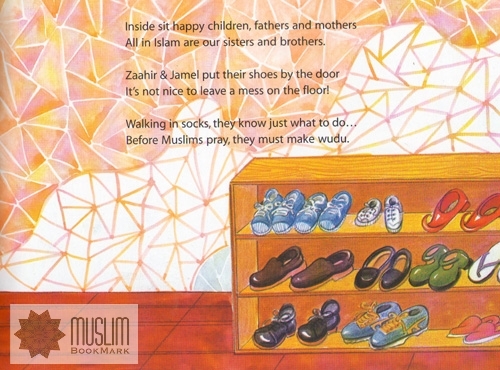
Just like when Zaahir and Jamel went for Hajj, the short rhyming sentences go step by step on what to expect as the story follows Zaahir and Jamel through the process: they take off their shoes, they make wudu, they stand for salat, they make du’aa, they stay quiet and respectful.

zaahir2

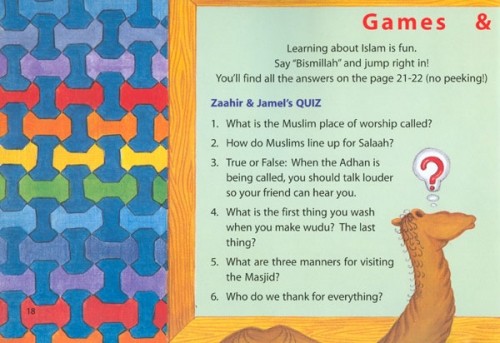
The book is 23 pages, but the story is really only 17 pages.  The story is followed by Games and Activities including a quiz and a crossword puzzle, and then a Glossary.  The quiz is great when reading aloud to a group or even just at bed time to make sure the children understood the key points.

zaahir3

The book is small and rectangular, which makes it work better in smaller groups (6.6 x 9.5), but for a book that cost less than a dollar online, it really should be in every child’s library.  Its a great review for little ones before Jumaah or just as a gentle reminder that praying in the mosque is something that all Muslims have in common.  It also works well for parents of non muslim kids that might be coming to the mosque and want to know what to expect, and how to act.

zaahir4


Alana’s Bananas by Mariam Hussein illustrated by Saima Riaz

Standard
Alana’s Bananas by Mariam Hussein illustrated by Saima Riaz

alanabanana

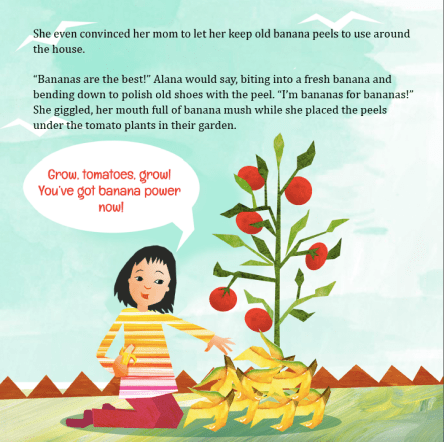
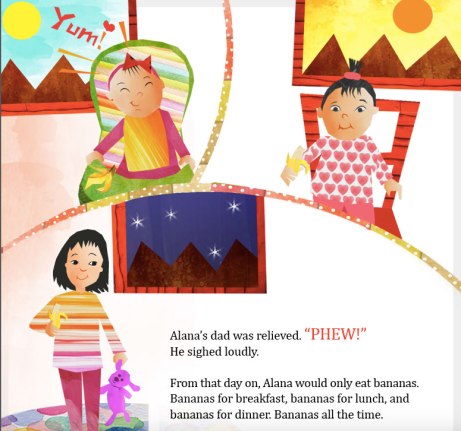
A silly, silly book about a girl’s love of bananas and her despair when a storm wipes out the banana crops in Costa Rica.  The moral of the story is to try new foods, and in 36 pages I think the reader will grasp just how over the top Alana’s obsession with bananas truly is and the lesson will be learned.

alana3

My only stumbling block is I’m not sure what age the book is for.  The bright silly pictures work well for ages 3 and up.  The theme works well for ages 4 and up.  The amount of text on the page, however, is more 6 or 7 and up, and the concepts of where banana’s come from, multiple uses for banana peels is about the same.  The character in the book, Alana, is eight and goes to the library and reads cook books and cooks independently, but the way her parents trick her into eating other foods is to hide eggs, peanut butter, rice, avocados and anything else they could find in banana peels, which keeps with the silliness of it all, but seems a bit off for 8 years old. Also talk about very patient parents allowing their 8 year old to only eat bananas for so long, and then not being upset when they have to resort to extreme levels of trickery.

alana1

There is nothing islamic in the text, and the only islamic elements are the author, illustrator, and the family based on the illustrations.  The mom wears hijab, but it is neither mentioned or referenced and no islamic vocabulary or phrases are in the story. In a scene at school, the girl sitting next to Alana is wearing hijab.

alana2

The book is about 10×10 and sturdy in its construction.  The back cover has a recipe for Alana’s Banana Breakfast Muffins. Enjoy!

A Bedtime Prayer for Peace by Akila Dada & Sukaina Dada illustrated by Michael Wagstaffe

Standard
A Bedtime Prayer for Peace by Akila Dada & Sukaina Dada illustrated by Michael Wagstaffe

MKPLC308-Bedtime-Front-Cover_frontzoom

This is a slow, deliberate, thoughtful book, that does a good job or setting a prayerful tone with short rhyming sentences.  Intended for preschool age children, early elementary children also will enjoy this book in rotation at bedtime or nap time.  

FullSizeRender (9)

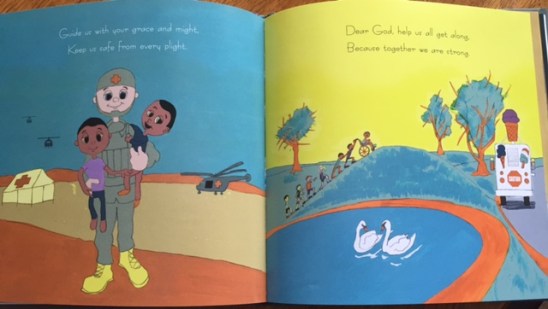
The book thanks the creator and asks for protection for all things small and large, seen and unseen, in a gentle dreamlike manner that really could go on for so much longer than the 32 pages present.  Some items mentioned like the plants and trees a preschooler will know, but some of the concepts introduce little ones to something bigger, “Give shelter to families who need a home, Help all the people who feel alone,” “Guide us with your grace and might, keep us safe from every plight.”  

FullSizeRender (8)

The prayer is voiced by a mom to her young boy, Esa, and the illustrations show traditional subcontinent dress as well as western clothes being worn.  The author’s are Muslim but the book is not overtly Islamic.  Sometimes the mom is in hijab, but when in the home she is not.  More distinctly, the word Allah is not used, only God is, and thus the book and prayer, really would work for any monotheistic child as the book does say, “Dear God, protect my beautiful son, You are the Truth. You are the One.”

FullSizeRender (10)

The true treasure of this book is that the main character is in a wheelchair.  Showing different abled characters is always such a blessing as it normalizes it and inshaAllah makes us more accepting when out and about.  The illustrations don’t wow me, but their quiet simplicity keeps the pace of the book, and don’t scream for attention.  Some of the smaller details are endearing and help sleepy eyes linger on page without feeling rushed.

With a hard 8×8 cover, the book is a good size for little hands to read over and over again, alhumdulillah. 


My Special Angels: The Two Noble Scribes by Razana Noor illustrated by Omar Burgess

Standard
My Special Angels: The Two Noble Scribes by Razana Noor illustrated by Omar Burgess

angels

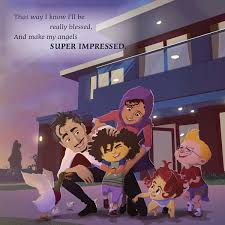
The book starts with a brief introduction to Kiraman Katibin, the two recording angels, and reminds parents that before the age of maturity only the good deeds are recorded. That being established the book then works to develop the conscientiousness of having all of our actions recorded, so that we train ourselves from a young age to be mindful of what we do and say.

angel1

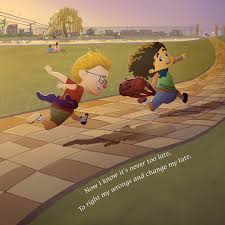
Following a precious little boy with fantastic hair, and a bit of a mischievous smile, the reader learns how we each have an angel on our right and left side.  We learn how sharing makes the angel on the right happy, as does stopping ourselves from getting mad.  We learn that its the little things and the big things, the stuff we do in public and the stuff that we think no one sees that get written down.  The angel on the left notes down all the mistakes too, and these make the angel sad.  But alhumdulillah apologies and forgiveness can rub away good deeds, guiding us on the path to jannah, inshaAllah.

angel22

The beautiful full color pictures are beyond adorable, and the rhyming couplets work perfect for preschoolers.  The font, the playfulness of the text on each of the 24 pages, the hardbound book and the 10 x 10 size make this book absolutely perfect for books shelves and for story time.  There is a glossary at the back that defines not just the Arabic words, but also some of the english vocabulary words that might need some explaining:  glee, deeds, angels.  My only complaint is that there isn’t a whole series of books by this author and illustrator coaching and guiding our little muslims in manners and basic belief.

angel 4