Category Archives: Non Fiction

Nasreen’s Secret School: A True Story From Afghanistan by Jeanette Winter

Standard

nasreens secret school.jpg

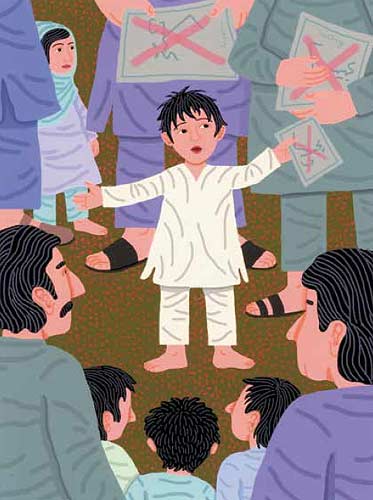
It is widely written about, even amongst children’s literature, that in parts of the world, girls are not allowed to go to school, but that many find ways to do so anyway.  What sets this book apart is that it is based on a true story, and while there is some hope for Nasreen, overall it is a really melancholy tale without a happy ending.  At 40 pages, author Jeanette Winter once again conveys a story that shows compassion instead of judgement and undeniable admiration for her characters.  Written on a 4.2 level, the story packs a lot into small, simple sentences, and her illustrations do not shy away from the realities of Afghanistan.  While I was surprised to see that twice the book was challenged, in 2014 and 2016, for showing Muslims praying and for violence, I was glad that it was never banned.   The strength and determination of Afghani women should not be silenced, it should be shared and celebrated.


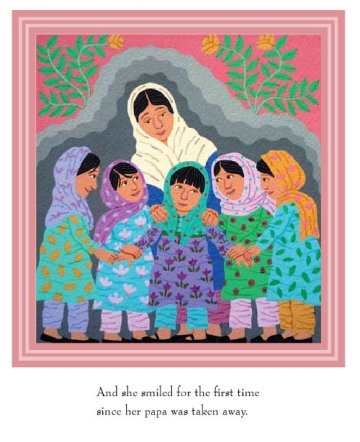
The story is told from the point of view of Nasreen’s grandmother.  She is heartbroken that her granddaughter is not allowed to attend school and practice the arts as she was, and even her daughter-in-law, were able to do as children.  Since the Taliban has come things are dark.  Things get worse when one night soldiers come and take Nasreen’s father with no explanation.  When he doesn’t return, Nasreen’s mother leaves to find him, displaying her own strength to independently take on a society that doesn’t permit her to go out alone.  Unfortunately she does not return either, and Nasreen stops speaking.  Grandma learns of a secret school for girls.  Determined that Nasreen should know of the outside world, great risks are taken for many girls to learn in a private home a few doors down.  Dodging Taliban soldiers and neighborhood boys helping keep their school a distraction starts to pay off as Nasreen finds a friend and starts to open her heart.  The book ends with mom and dad still missing, but hope for Nasreen to see through the window education has opened for her, inshaAllah.

secret2


Malcolm Little: The Boy Who Grew Up to Become Malcolm X by Ilyasah Shabazz illustrated by AG Ford

Standard
Malcolm Little: The Boy Who Grew Up to Become Malcolm X by Ilyasah Shabazz illustrated by AG Ford

malcolm-little-9781442412163_hr.jpg

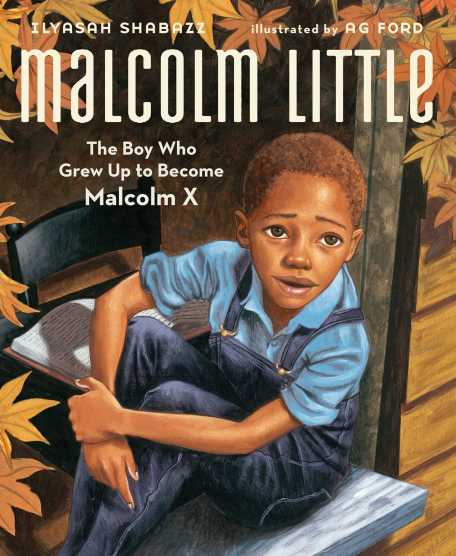
I had hoped to have a handful of selections to review for Black History Month, but alas I started too late in collecting titles, inshaAllah next year I will be better organized.  I did want to share this beautiful book though, as a great story of hope and love, that I don’t think is often included when we study Malcolm X or talk about him today.  This is the story of his parents and the philosophy of equality they tried to raise him in before hatred and bigotry destroyed his family, before he went to prison, before he became “Detroit Red,” a member of the Nation of Islam, before he became a civil rights leader, a Muslim, before he became Malcolm X.  This is a story, based on love, written by his daughter to give children of all ages something to think about.

malcolm-louise-300x300

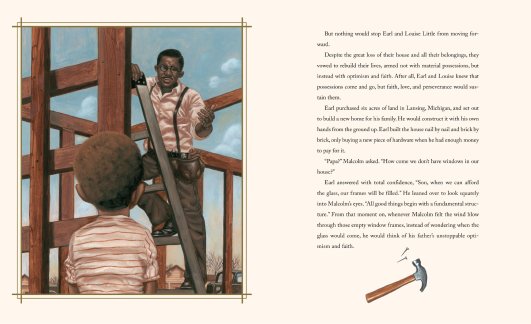
The story of Malcolm Little, is a story that I feel cannot be rushed, it is very heavy in text and at 48 pages, the warm beautiful pictures make it accessible in pieces to younger children, but it is written on an AR 6.5 level (sixth grade fifth month).  The book tells about how his mother and father met, believed in universal equality and justice, and started a family where these values took center stage.  The family suffered for their beliefs and their home was burnt down, but they rebuilt and the family continued to find strength and see the power of possibility.  The books shows the lessons taught in everyday activities such as raising a garden, doing laundry, reading books, doing homework, and even fishing.

When Malcolm’s father was killed, however, and his mother taken away, the family was forced to separate and Malcolm to deal with an unwelcoming world, more or less alone.  The book ends with Malcolm in 7th grade so, to young readers who have maybe only heard his name in passing the book is full of hope and roots for the man he would become.  It is almost a fairytale start to a man who would be cut down in his prime years later.  They will understand how unfair society treated his family, how warm and educated and strong his mother, Louise was, and how inspiring his father as a preacher was. The takeaway will be how Malcolm’s upbringing and personality allowed for him to rise up and refuse to stay down during horrific events in his life.

malcolmx.jpg

For older elementary and middle schoolers it is a story of possibility, of how quickly things can change, and the effect of hate.  They should also see how institutionalized and normative the oppression of African Americans was and how it really wasn’t that long ago.  When Malcolm’s English teacher Mr. Ostrowski tells Malcolm that he as an African American should not have such high expectations, readers should realize that the acts of the Ku Klux Klan may be viewed as “extreme” but society as a whole was systematically enabling such bigoted acts.  The lessons passed on to Malcolm by his parents are universal themes of hope and love and equality that still have to be stood up for today, and even young listeners can grasp that, and also grasp that because of their skin color alone they were seen as second class citizens.

The book shows depth to a historical character that gives some insight to what made him so dynamic.  Many young readers will be surprised at how quickly Malcolm’s world unraveled, and some of the reasons why, while empathizing with the injustice of it.  The Author’s Note at the end is also fascinating as it details the family members and their stories about the characters in the book.   I liked the softness of the book and the smaller lessons for children that it presented.  It didn’t shy away from the violence and prejudice that the Little family faced, but presented it through a lens of optimism to hopefully inspire children to carry on with the social activism that still needs to be done.


The Complete Persepolis by Marjane Satrapi

Standard

Persepolis cover.jpg

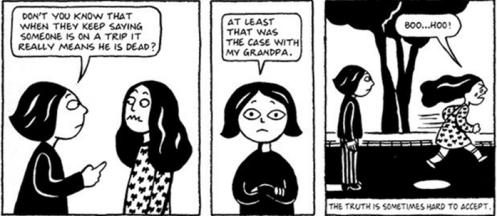
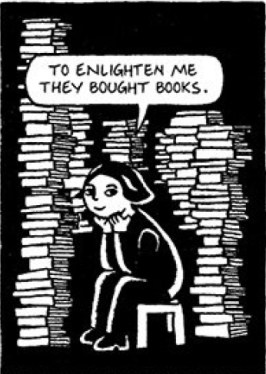
The Complete Persepolis is both Satrapi’s volume one and two of her memoir about growing up in Iran during the revolution.  At 341 pages of black and white graphic novel intense story telling I was fascinated by its 3.3 AR level for volume 1 and 3.9 for volume 2. Clearly this is once again a loophole in the AR system rating a book for word and sentence difficulty and not content.  The book is for high school and above, despite the simplistic style it is presented in.  The content of multiple wars and coming of age,  provides detailed political commentary not tempting to many elementary and middle school children, and her coming of age narrative is no way appropriate for third or fourth graders.

SYNOPSIS:

Marjane is an only child in Iran growing up with a loving liberal family in a time of change.  She comes across as being very entitled, very financially well off, and very deeply engaged even as a child.  As her society changes and becomes more religious with the revolution, she shows the contradiction in people and their attitudes as they use religion as a power and political tool.  Her retelling of the torture and horrors family and friends go through, is kept light by her universal coming of age musings and struggles.  She is encouraged to be vocal and outspoken about social issues, with her parents boundless support for whatever consequences her actions bring on.  In the second volume Marjane has gone to Austria for school to get away from the confinements of Iran.  Here she finds different struggles as she finds it hard to fit in, hard to conform, and hard to be away from home.  She experiments with drugs, and boys, and ideologies, but alas returns home after she finds herself homeless, friendless, and in poor health.  Back in Iran she finds she has now joined the contradictory world she left behind, and being back in school and married to a man she doesn’t love forces her once again to leave her homeland, and take all her life lessons to rebuild herself as someone she wants to be.

persepolis-1

WHY I LIKE IT:

I like that it is a graphic novel. In many ways it makes the political influence of her country on her life easier to understand.  Iran’s political history is complex and to take a reader unfamiliar with it and use it as a narrative in shaping her and her thought process, it works surprisingly well.

I primarily wanted to read the book to see how Islam is presented.  Obviously it would be a major factor in the book, and obviously the author is not a practicing Muslim in favor of the revolution.  So, I was equal parts nervous and curious to see how such a popular book would show such a religious society.  And to be honest, I feel like she handled it in a very secular way.  She never seemed to attack the doctrine of the faith, but more its presentation as a tool to oppress or control Iranians.  Her rebellion in clothing and alcohol and drugs and promiscuity is presented as a rebellion against a society that is using Islam and the contradictions people have with it in public as opposed as to behind closed doors. For example she doesn’t support the veil or hijab, but it didn’t seem that she was opposed to someone wanting to wear it, she was opposed to it being forced upon women, and she pointed out the hypocrisy of people not wearing it one day then wearing it and policing other woman’s manner of wearing it the next.  I felt this was made a bit clear when she meets a religious man, who passes her on her ideology test.  She refers to him as a “true religious man” who respects her honesty.  In my mind I saw this as her not being a religious person and not being surrounded by people who were religious for the sake of belief, but rather for their own personal gain and agenda.  When she critiques her country’s laws about boys and girls being together, or consumption of alcohol she doesn’t go into the verses in the Quran or hadith, but rather how she is able to skirt the law with a fine or deceit.  She doesn’t pray, but also makes clear she doesn’t know how to pray, she doesn’t know how to read Arabic, etc.. Thus the idea of being Muslim is foreign to her, she simply lives in a country that claims to enforce Islamic rules.  By her then going to Austria and having “freedom” but not finding happiness I also found it made the nuances of what is religion and what is culture and what is politics a little bit easier to see.  Ultimately it is a girl finding her self and defining her self irregardless of what country she is in and what religion that culture follows.  Whether people learning of Iran of Islam for the first time would see the shades of gray within the novel I don’t know, but I truly don’t believe Satrapi based on this book hates Islam or is trying to get others to view the faith as a whole negatively.  And even despite her feeling confined in Iran I think she has a deep love of her country and her people.

732c8f4f6e49237b963aee4bbe0faee3

FLAGS:

Violence, language (lots), sex, drugs, alcohol.

TOOLS FOR LEADING THE DISCUSSION:

I would never use this book as a book club book at an Islamic school.  The themes are just too mature to justify the coming of age story aspect of it, or even as a historical supplement to Iranian culture.  That being said, I personally as an adult would love to be in a book club with this book.  I know a lot of Iranian and Iranian Americans who are religious, but I have never inquired as to their personal political views, and vice versa. I know even more secular Persians, many with disdain for Islam, but again not for practicing Muslims, and never have dared ask how their political and socio-economic status may have influenced them and their views.  I think it would be fascinating, both to hear their stories and to solidify my own views on such a contentious issue.

Owl & Cat Islam is… by Emma Apple

Standard
Owl & Cat Islam is… by Emma Apple

img_2935

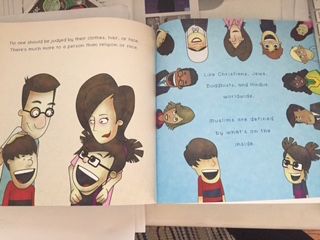
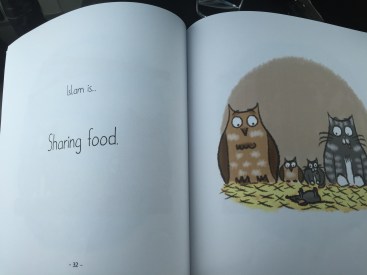
The book’s charm is its simplicity.  The text is minimal and the illustrations a small portion of the page.  But at 59 pages the book finds power in showing what Islam is to muslim and non muslim children alike.

img_2936

To say that I liked the book is an understatement, I loved it! It is perfect for bedtime and story time for kids 1 to 4.  Ages 5 and up can read it themselves in mere minutes.  The pictures not only are the story, but add a wonderful sprinkling of humor.  I mean really lets eat a mouse, better yet lets share it! EEEW! Oh wait animals and cats do eat mice!

img_2939

But why I really like the book, is because while it reminds Muslim children of all the subtle things that make up what Islam is.  It also builds bridges for children who know Muslims, or whose parents want them to widen their knowledge, as it lends it self so effortlessly to seeing how we are all the same.  Yes it mentions the names of Islamic Prayers and that Muslims read the Quran, and tells the five pillars in a non preachy way, but it also says, “Islam is Family,” and “Islam is Respecting our parents” and “Islam is Telling the truth.”  Much more alike than different.  A lesson even the littlest reader can understand and hopefully remember.

Malala: A Brave Girl from Pakistan/Iqbal: A Brave Boy from Pakistan by Jeanette Winters

Standard

Malala Iqbal

Again I break from my fiction preference to review another book about these two remarkable individuals: Malala and Iqbal.  In this beautiful book linking two brave children from Pakistan, Jeanette Winter’s brings their stories to a young audience in a powerfully simplistic way.  Written on an AR 3.6 level, each story is 20 pages and presented in a flip book format.  Before each story there is a brief Author’s Note about each character in a broader view, for context to be given as needed to the adults to share with the children listening to the book, or for older children to read and deepen their understanding and appreciation.  The sentences are short and the font and presentation is inviting to even early readers.  The pictures are wonderful and do a tremendous job showing the intensity of the environment Malala and Iqbal face, while not frightening the reader.

The Malala portion of the book starts with the Taliban asking for her on the bus and like her biography, then takes the reader to the threats and deterrents they made to girls in school, but on an audience appropriate level.  It tells how they stopped wearing uniforms so that they could be harder to identify and how even burning the girls school didn’t stop them. It then returns to her being shot and going from the hospital in Swat to one in England.  It concludes with her speaking to the U.N. on her 16th birthday.

Malala

The story of Iqbal is a bit harder I think for children to understand as they may not know what a loom is or have ever thought about who makes carpets.  Also the words bondage, Peshgi, outlawed, and mourners are not in their vocabulary .  They should understand that he is sold for an unpaid $12 debt, but that too may need to be stressed and explained. If the kids can grasp this, I really think children as young as kindergarten can appreciate his story.  I love that the author didn’t shy away from the fact that he was shot and killed.   Even if they do not understand all the facets that make Iqbal’s work so incredible.  They will feel inspired that someone so young was so brave.  Iqbal


Saladin: Noble Prince of Islam by Diane Stanley

Standard

saladin

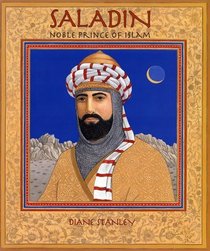
This is a beautiful historical biography of Salah al-Din, known in the west as Saladin, that I felt worth sharing despite it not being fiction.  Written on an AR Level of 7.0 the 48 pages are highly wordy, and cover a lot of historical ground.  There is a post script, a glossary and bibliography at the end.  The pictures are detailed and bright and inviting, but even for a 7th grader, I think the book would be a challenge.  If one has an interest in the time, or has studied it and knows some of the supporting characters, the book in fantastically interesting, and insightful for the format.  To an average middle school or even high school student, they might thumb through it and keep it on the shelf as a reference tool, but that might be about it.

Saladin inside page

With any historical account, particularly those trying to simplify and appeal to children, the author gets to pick in what historical light to present the events.  The book starts with an Author’s Note detailing the fight for Jerusalem up until the first crusade. It then begins with the story of Saladin’s life.  Born in 1138, he was named Yusuf ibn Ayyub, and then tells a bit about his upbringing and the basic tenants of Islam.  It explains how he came to power and how the truce with the Franks was broken by Reginald.  It then details the battles, the follies and plans of both sides.  It shows the honor that Saladin had for his enemies and even the respect he had from Richard the Lionheart.  It shows the politicking in Europe and the toll of the Crusades on the people there and in the Middle East.  The book also tries to show Saladin outside of his battle armor as a family man who was devoted to his wife Ismat.  “When she (Ismat) died, Saladin was lying in his tent, seriously ill.  His advisors kept the news from him for three months, until he was fully recovered, for fear the shock might kill him.”

Saladin died in 1193 and  knowing that he was dying he passed on advice to his son oh how to be king.  “Win the hearts of your people and watch over their prosperity; for it is to secure their happiness that you are appointed by God and by me. . . I have become as great as I am because I have won men’s heart’s by gentleness and kindness.”  The book states that he was so generous and unconcerned with money and luxury that when he died he didn’t even have money to pay for his simple burial.  

Admittedly I know very little about the historical accuracies or slant of the author.  I do know that it does inspire pride for Muslims and hope that people of different faiths can one day again co-exist in Palestine and the world, inshaAllah.


The Grand Mosque of Paris: A Story of How Muslims Rescued Jews During the Holocaust by Karen Gray Ruelle and Deborah Durland Desaix

Standard

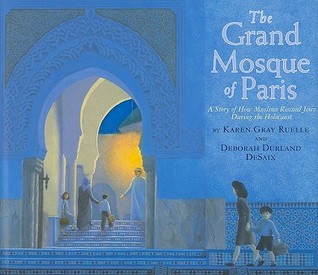
The Grand Mosque of ParisThis beautiful, beautiful book tells of a little and sparsely known event in history.  During the holocaust The Grand Mosque of Paris served as a place of refuge for many North African Jews.  Many who passed through the vast gardens and beautiful Mosque were given fake documents of conversion, tombstones with their family names inscribed, and access to truly underground passageways (subterranean mazes), as the Muslims of Paris offered assistance to keep their Jewish brother’s and sister’s safe from the Nazi regime. Many of the stories were recently uncovered and with the passage of time, so much of the information has been lost.  As a result the book is a bit choppy, each page tells what is known about the Muslims’ assistance in some capacity, but does not flow to the next page.  So there are generalized recountings of children being hidden with other families, the efforts of the Kabyle Ressistance (Berbers from Algeria) to smuggle Jews to safety, etc.. There are also a few specific examples of Salim Halali, a young Berber Jew from Algeria, two friends one a Muslim the other a Jew seeking shelter, a Tunisian Jew who stayed at the Mosque for over two years,and a few others, but with the exception of the use of the Grand Mosque and a Doctor Ahmed Somia very little flows throughout the book.  Thus making it more of a historical account than a story.

Truly the book would not work for story time, it is geared for children (and adults) ages 12 and up,  it has an AR level of 7.1.  I would imagine it would be an amazing addition to any class studying World War II and finding the humanity offered in one of the bleakest times of our world.  It should, in my opinion, be standard required reading in Islamic School curriculum to supplement WWII study.  The hope and pride one feels when reading this book, shows how rich our faith’s are in coming together.  It would also work in understanding how history is lost, and the importance of perserving it.  There is an Afterword on page 34 that is very informative and interesting.  It is followed by a Glossary, Acknowledgements, References, Bibliography, Recommended Book and Films, and an Index.

The book also sparked my interest to know more about, not just how Muslim’s helped Jews during the Holocaust, but also how Muslims were treated in France.  The book says, “The Grand Mosque shimmered like a mirage, the white domes and the glittering mosaics of the minaret in stark contrast to the muted colors of Paris.  When the mosque was built in 1926, the North African countries of Algeria, Morocco, and Tunisia were under French rule, and many Muslims had come to Paris from those countries.  The land for the mosque was given by the French government, in exchange for a symbolic payment of one franc, to thank the half-million Muslim soldiers who had fought for France during the First World War.”

The Grand Mosque of Paris1.jpg

I have already read the book more then once, and gone back and read passages multiple times.  It is as fascinating as it is informative, and a great addition on any book shelf.


Thura’s Diary: My Life in Wartime Iraq by Thura Al-Windawi Translated by Robin Bray

Standard

Thura's Diary

It has been a while since I’ve read a wartime diary from a young woman’s perspective, but if memory serves, both Anne Frank: The Diary of a Young Girl and Zlata’s Diary: A Child’s Life in Sarajevo, not only enlightened me to what living through the atrocities was like, but also emotionally established a connection of how horrific the truth of war really is; this book unfortunately, did neither.  To give it the benefit of the doubt I am now reading it as an adult, which may have changed my expectations and hardened my understanding of war, but very little in this 136 page book was memorable to me.  An AR level 6.1 the book is a quick read with some odd footnotes and definitions on each page.  I’m assuming the translator wanted to make sure the book flowed, but for some reason the bold words and obvious definitions annoyed me.  The center of the book is filled with pictures of Thura and her friends and family in both England and Iraq, which I found misleading since she never really introduces us to her friends so frequently pictured.  Overall I felt like I had more questions about what her life was like during 2003 then she answered.  I understand that it reads like a rough draft, because it is presumably her true diary, but it seems if you were going to publish it you would flesh it out a bit, explain why you ended up not going to the countryside on various occasions, explain your father’s role in the Baath party, what happened with your BBC interviews, explain why you feel that women have no rights, did you feel this way before shock and awe? What did you come to America to study? etc..

SUMMARY:

Nineteen year old Thura is in Pharmacy School when news breaks that the coalition forces are going to start bombing Iraq.  Her family is middle class, religious, but liberal, and as they prepare for the inevitable their lives become uncertain to say the least.  The oldest of three daughters Thura attempts to articulate the fear of bombs falling, the anxiousness of what will happen to their homes, friends, and families, while not necessarily being “adult” enough to be privy to all information to share insight into the rational that is now her life.  At times she seems to whine about her situation, and at other instances she has patience and maturity to appreciate that they are safe and together. The choppiness of why one day she is able to go to the journalist’s hotel, but the next day can’t leave, and her back and forth feelings about school are never explained and leave holes in her narrative.  If the intent is to explain what life in wartime Iraq was like, relying on the readers to fill in the gaps is counter productive and inaccurate.

WHY I LIKE IT:

I like that it is written by a young, modern girl, and is a conflict that in many ways is still ongoing, and providers children today with some insight beyond the headlines.  The book on the surface will allow a dialogue to take place potentially forcing students to imagine what their lives would be like in a similar situation, and how quickly the safety and security you feel can be uprooted.  She is a relate-able figure in that she is in college and she worries about her friends and family.  It is also a fairly easy read.  Non-fiction for many is dry and factual and this book reads more like a story, which I think would appeal to many students, particularly those with ties to Iraq.

FLAGS:

The book does use strong language on a few occasions: hell and bastard.  It also mentions pornography a few times, in the context that once Saddam is overthrown pornographic magazines and films are becoming commonplace and it makes her uncomfortable.  She mentions that culturally growing up she is even “embarrassed just to hear the word ‘sex’.”

She is very anti hijab and it isn’t explained why.  She discusses religion in a more cultural way, but does discuss reading Quran on one occasion, and mentions the masjid. As a whole, it doesn’t seem to be a big part of her life, but obviously is a part of her environment.  She mentions the lack of women’s rights and her frustration with her own people preventing her from moving about uncovered after the soldiers occupy Baghdad, but not knowing why she is against hijab specifically leaves a lot of guesswork that could be taken many ways in the reader’s mind.

TOOLS FOR LEADING THE DISCUSSION:

I don’t know if I would do this as a Book Club book.  I would probably discuss it with the Middle School Social Studies teacher and see if it could supplement a lesson or be offered as extra credit perhaps, but because there are such holes in the narrative I would be nervous to be presumptuous about what she means, or what was going on in certain places, being that it is a work of non-fiction.

A 7th grade lesson plan: http://chippewavalleyela.pbworks.com/f/Gr+7+Unit+3+Teacher+Lesson+Plan.pdf

The copy I read has questions and things to consider every few pages and an “Exchange” on the back inside cover with ideas, questions, and reflections outlined.

How to Get Hijab Ready: A Guide for Muslim Girls Ages 8 to 11 by Aisha Elwan & Megan Wyatt illustrated by Sarah Hafeez

Standard

How-to-get-Hijab-Ready

Yes I know it isn’t fiction, but How to Get Hijab Ready is such a fabulous and much needed book that any positive attention I can direct toward it, I feel is effort well spent, Alhumdulillah.  The book is obviously meant for 8 to 11 year old girls contemplating hijab.  The beauty of this how-to book is that it answers everything from how to accessorize one’s hijab to dealing with bullies in a beautiful manner.  Not only are the pictures bright and colorful, but the presentation is clear, precise and inspiring.  The authors do not talk down to the readers, nor do they make it seem like a burden as they discuss hadith, ayats from the Qur’an, challenges and fashion sense.  The book is divided into sections: The Basics, Getting Started, Having Conversations,  Worries and Concerns, and finally Your Reward for Good Deeds. Each section addresses different topics and “Aisha’s Tips” are scattered throughout to give 12-and-a-half-year-old Aisha’s tips on the subject at hand.

Aishas-Tip-275x300

Truly this book is a gift to moms and daughters alike.  I plan to let my daughter look through it for a few days and then sit down with her to discuss.  It functions as both a how-to manual as well as a reference guide and I can see it being looked at A LOT.  Additionally I can see my daughter discussing it with both Muslim and non-Muslim peers.  I think the book offers confidence, direction, and pride as young girls will find inspiration from young Aisha while having many of their concerns about hijab answered in a fun, hip way.

My only criticism is that it wasn’t around when I was a young girl.  For some hijab is an unknown, for some it is a stress, and for some it is a natural expression of faith, and subhanAllah this book in just 51 colorful pages manages to convey information, smiles, and excitement irregardless of your background.

project-708-body-Screen_Shot_2015-02-21_at_11.49_.38_AM_

Iqbal by Francesco D’Adamo

Standard
Iqbal by Francesco D’Adamo

iqbal

Iqbal is the fictionalized story of the young Iqbal Masih, a real boy who escaped virtual slavery in a carpet factory to fight against child labor in Pakistan.  Although the book is a short read at only 120 pages, it is heavy in content.  The description of the children who work all day often tied to their looms to make the beautiful carpets desired all over the world, is both incredibly gut wrenching as well as inspiring.  The book has an AR level 5.1 and while the author and main character are not Muslim, most of the minor characters presumably are, as is the environment.  I am using this book for our new Book Club book because the message and determination of young Iqbal is something middle school students should feel empowered by, inshaAllah.

“So long as there’s a child in this world who is deprived of his childhood, a child who is beaten, violated, or exploited, nobody can say it’s not my business.”                                 …Iqbal

SYNOPSIS:

The story is told from the voice of a young girl, Fatima, bonded to a carpet weaver where Iqbal joins her and a handful of other children who are forced to make carpets to pay off their parents’ debts.  Iqbal has a reputation as being the best carpet maker and is rumored to have made one of the most difficult designs for a former master.  While good at what he does, Iqbal combats the naivety of the other children by pointing out that they will never be allowed to leave, even if they manage to pay off their debt.  This slow realization empowers all the children with Iqbal as their leader to dream of freedom, and to stand behind Iqbal as he dares to do more than just dream.

WHY I LIKE IT:

I like this book because it is vivid in detail and really takes the reader to a place they have never seen, nor thought about.  To read about another’s life paves the way for the reader to develop understanding and empathy, characteristics most middle school students rarely exhibit.  The fact that it is based on a true story, in the recent past, really hammers these concepts into the reader and changes the way one looks at hand tied carpets, and child labor in general.  I think it also makes the reader appreciate their own life, their own freedom, and educational opportunities even more.

FLAGS:

The book is clean, but the concepts are for older kids.

TOOLS FOR LEADING THE DISCUSSION:

Unit Plan:

Click to access iqbal-unit-plan.pdf


Summary with pictures:

http://desk2.sd8.bc.ca/web1/Elementary/Iqbal/iqbal.htm


A