Category Archives: Muslim Author

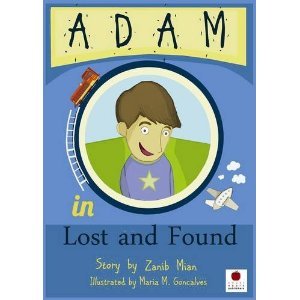
Adam in Lost and Found by Zanib Mian illustrated by Maria M. Goncalves

Standard
Adam in Lost and Found by Zanib Mian illustrated by Maria M. Goncalves

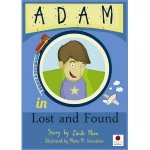
Adam in Lost and Found

This book resembles kindergarten and 1st grade leveled readers in both appearance (shape and size) and appeal.  It very easily could have been a picture book, with its sparse words and simple linear story, but by making it a smaller size, with a variety of playful fonts, it really excites beginning readers who pick it up and are thrilled to see Muslim characters in an Islamic book on their level.  The book is 32 pages and has nice large age appropriate pictures that work very well, even when reading the book aloud to small groups.

adam 1

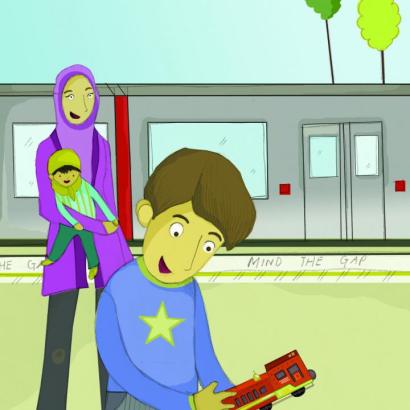
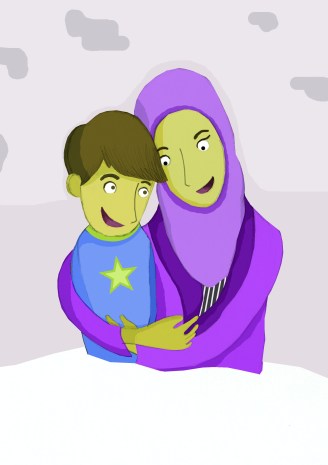
The  story explores the concept of “finders keepers losers weepers” in a fulfilling way.  Adam, a young boy on a train with his family, finds a toy train and desperately wants to keep it.  His father kindly explains to him the two options before him and lets him choose.  Adam, Alhumdulillah,  chooses to give the train to the lost and found man and earn Allah’s reward.  Later, Adam realizes after much searching and help from his family, that when he found the train, he left his toy airplane.  The moral is cemented in the readers, as they too hope, with Adam, that whomever found his plane, also did the right thing and gave it to the lost and found. By coming full circle the message is conveyed, and a happy ending is had by all.

The book takes place in Britain and is book two in the Adam series.adam 2


Ms. Marvel No Normal & Generation Why by G. Willow Wilson illustrated byAdrian Alphona & Jacob Wyatt

Standard
Ms. Marvel No Normal & Generation Why by G. Willow Wilson illustrated byAdrian Alphona & Jacob Wyatt

I have to be completely honest these are the first comic books I’ve ever read from cover to cover.  So, while I’m in no position to review the art work, or historical role of the original Ms. Marvel or even have a valid opinion on the superhero story lines, I do want to cover the Islamic elements because even as someone as outside the comic book world as I am, I knew that Marvel’s new Ms. Marvel is a Pakistani-American Muslim girl from Jersey and that’s pretty big.

I was intimidated to read No Normal, I ordered it from Scholastic and have had it on my shelf for a while, I was excited, but nervous. But then I ordered the second one, which is also a collection of 5 comic books, and thought, let’s do this.  Both collections are easy reads, and the text and what to read first in each story frame is clear.  As with comics and graphic novels the pictures convey much of the story so there isn’t a lot of “explanation,” but the story is compelling enough, that even a novice like me didn’t get too hung up on what was going on and how it could be possible.   While it may tempt younger children, I would hold off until the reader is a teen, especially if the reader is Muslim.  There is a bit of drug use and alcohol in No Normal and obviously violence, but at it’s core it is a story of a girl trying to discover who she is and there is some angsty teenage stuff that someone who hasn’t gone through the emotions, might take as attacks on Islam, parents, and culture.

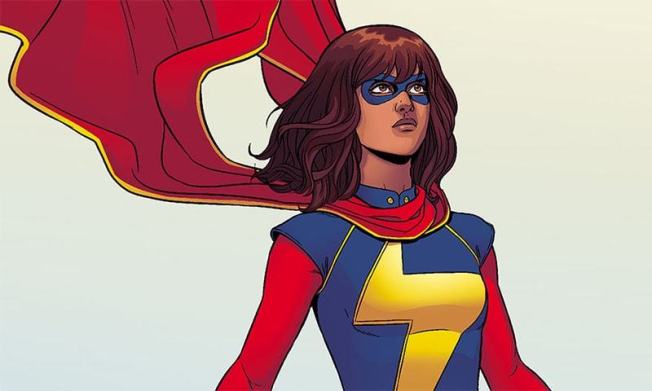
Kamala Khan is a high school student in Jersey City, New Jersey.  She has a Muslim friend, Nakia, who wears hijab, and non Muslim friends of both genders that seem to support her faith and culture, almost more than she does.  The story opens with her sniffing bacon and her friends humoring her oddness.  Having grown up with the same group of friends around her, they understand her quirks and nerdiness and she seems to fit in.  As with most teens though, she feels on the “outside” and Kamala right away tries to seem cool with the more popular crowd.  She  is struggling to find herself within her Pakistani culture, her American life, her Islamic beliefs and teenage friends, information all presented in the first few pages while at the local convenience store hangout.  A lot for Kamala to balance and she hasn’t even discovered her “powers” yet.

Kamala’s parents initially seem more “cultural” than religious as her father chastises Kamala’s brother Aamir for being too religious, yet is constantly on Kamala, presumably because she is a girl.  In a fit of defiance against her parents strict curfew, Kamala sneaks out of the house to attend a party, accidentally drinks alcohol (she spits it out) and gets caught in some “fog” that gives her morphing, stretching, embiggening, and quick healing powers.

As Kamala tests how her powers work, and what they mean, there are a few funny asides that appeal to Muslim readers: she attempts to use her Burkini as a base for her super hero disguise, and her mother threatens to send her to the Sheikh if she gets caught sneaking out again.  Her parents start to grow on you though, the mom is a very stereotypical immigrant mother who cares for her daughter in a worrying nagging way, the dad actually tries to communicate with Kamala and comes across a little more genuine toward the end of the first collection.  Her brother seems to be level headed, but a minor influence.  He sticks up for her and tries to help, but it doesn’t seem like they are that close.   The final scene in No Normal left a little bit of a bitter taste in my mouth and I was glad that I already had Generation Why to dive right into and not let the conclusion of the first one fester in my head.  Kamala shows up to a wedding late, complete in Shalwar Kameez (Pakistani clothing) and gets in an argument with her mom.  Kamala says, “You and Baba want me to be a perfect little Muslim Girl–straight A’s, med school, no boys, no booze, then some hand picked rich husband from Karachi and a billion babies.”  The mom says, “Your father and I want the best for our only daughter our expectations are high so that your successes will be many.”  It goes back and fourth then the mom says she is grounded and the book ends with Kamala retorting, “wanna bet…?”  While I’m sure most every Muslim American teen has felt this way, I don’t think I’d want my 9 year-old-daughter thinking that is how narrow success is defined, or that being the best you can be is a punishment. It’s probably a realistic gripe, but to have it be the last impression, naturally brought out my defensive instincts.

A lot of the awkwardness and stage setting in No Normal is resolved by Generation Why and I found I enjoyed it a lot more than I thought I would.  I might even be anxiously waiting to see what happens next.  Kamala is sent to the Sheikh and while she is intentionally vague about telling him what is going on with her, she does suffice it to say she is trying to help people and he responds by telling her to do it with as much honor and skill as she can. I love that he wasn’t putting her down, but rather trying to mentor her spiritually to find her self and do so honorably.  Really the only other religious/cultural scene is when Lockjaw a giant dog with transporting abilities shows up to help Kamala and her parents say he can stay, but outside because he isn’t clean.  I don’t know if non-Muslims will fully understand why, but it made me chuckle.  It also made me like her family a bit more.  They are strict, but not unreasonable.  They didn’t say, “no” they found a compromise.

Generation Why contains more action than back story.  I’m not entirely sure why Wolverine shows up, I have no idea who the lady in charge of stuff is with Captain America, and I’m not sure why no one finds it odd that the Inventor is a bird man, but hey it is fun.  And it definitely had me cheering on Ms. Marvel as she empowers her generation and learns that being American Muslim might be the easiest of her identity issues when she learns she is inhuman.  It gets a little cheesy, but the foundation of comic books being good against evil, lends itself to that right?

Overall, I think I would recommend both collections are read together, as it gives a better picture of what Ms. Marvel is and can be.  I think thus far the author has done a good job of showing that she is Muslim and that her faith adds depth to the character.  Her tenacity, persistence, determination, compassion for animals, her humor, her nerdiness, all make her very like-able and admirable.  I probably wouldn’t do it as a Book Club selection, because our school only goes to 8th grade and being an Islamic School I don’t know that most of the students feel the identity crisis until possibly much later if at all.  But I think the books would work well for discussion with older kids.  Topics of what youth can do, their role in preserving the planet, discovering your sense of self and purposes are all there in comic book, super hero, action packed form!
Kamala Khan


Bismillah Soup by Asmaa Hussein illustrated by Amina Khan

Standard
Bismillah Soup by Asmaa Hussein illustrated by Amina Khan

Bismillah Soup

It is always a cause of giddiness to find a good book, but to have one recommended by a mutual friend of the author, makes it all the better. Bismillah Soup is a spin-off of the Stone Soup folktale, but without the “trickery” of the classic.  Hasan, wants to surprise his mom with a feast, but money is tight and when Hasan is sent to ask the local Imam for some rice, a plan: Bismillah Soup, forms that brings the entire community together.  The story takes place in Somalia and the cultural words that are peppered in to the story add detail and talking points to have with the kids.  As each community member shares something small, the enormous feast that is created is a wonderful example of what can be achieved when we each give our best to help others.  The book is 40 pages with a glossary at the back and is definitely one that can be read over and over to kids of all ages.  Even the littlest ones are able to grasp the beauty of coming together through the colorful and playful pictures.

soup-gallery-img1 (1)The real treat of the book however, is how it all comes together: the words, pictures, sentence structure, font, size, and diction all compliment each other on the same level.  I read a lot of books aloud as a children’s librarian, and while the rhyming ones are great for the littlest listeners, there is often a void of read-out-loud stories for the kindergarten and first grade levels.  And I am talking about all books, not just Islamic ones.  Most picture books in my experience are written on a third grade level, with longer blocks of texts, smaller fonts, a wider range of vocabulary and longer sentences.  These books are often beautiful and very tempting, however when I read them during story time I end up “summarizing” them, and telling the story rather than reading it.  Similarly, early readers often find them frustrating and too difficult to read independently. Bismillah Soup strikes a wonderful balance, mashaAllah.
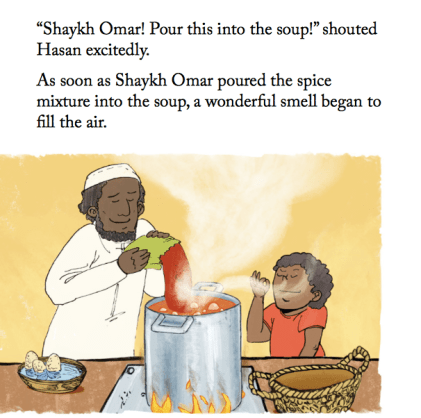
I read the story to my own children who enjoyed it and have found my first grader reading it independently twice this week.  Each time beaming with excitement to tell me something new he has gained from the book.  When I read it aloud to them, my kids marveled at how having a good intention and being so generous could benefit everyone. The first time my son read it independently he was in deep thought about how grateful Hasan was even though they didn’t have much food and how he was a determined problem solver.  The second time I found him reading it, he was so very impressed at the kindness of Shaykh Omar.  He really started to understand the subtle beauty of the character not just in helping Hasan’s family with food, but also supporting and working with the young boy to make the feast happen, alhumdulillah.  Screen-Shot-2015-08-29-at-12.06.00-AM

I highly recommend the book and I can’t wait to read it to my students at school next week, inshaAllah.  For more about the book, the author, and her other work you can go to the author’s website  http://www.ruqayasbookshelf.com

Amira’s Totally Chocolate World by J. Samia Mair

Standard
Amira’s Totally Chocolate World by J. Samia Mair

Amira' totally chocolate wold

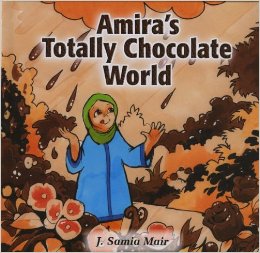
Amira’s Totally Chocolate World is a sweet story based on the idea of a young girl’s wish for the world to turn into chocolate.  As she imagines all the wonderful things that would be made better by being chocolate: flowers, grass, rain, the ocean, etc., she asks Allah swt to make a totally chocolate world.  The night before Eid ul-Fitr her mom promises to make Amira a chocolate cake with chocolate icing in celebration of Amira fasting for a part of each day in Ramadan.  When Amira wakes up the whole world is chocolate, and Amira runs out to enjoy all the chocolate around her.  Soon enough she misses the colors of the world, and the different smells, and misses the texture of grass too.  Amira remembers an Ayat of the Quran about the many colors of creation and asks Allah to turn the world back to the way he created it.  Naturally her alarm clock then wakes her up and she is now wiser, more appreciative and happy to eat her chocolate cake on the kitchen table.

Overall, the story touches on ideas of Ramadan, Eid, asking Allah swt for everything and anything, being appreciative and being thankful.  However, when read aloud I have found that the students have to be made aware of these topics to grasp them.  The text is a bit wordy and the author’s message seems to get lost in the chocolate-ness of everything.  I feel like there is just too much going on in the 23 pages of the story for a child younger than 1st grade to get much out of independently.  On the surface however, it is a fun story with adequate illustrations that kids, especially those that love chocolate, will enjoy.

(NOTE: the book is written in British English, and American children are quick to notice the difference in spelling the word color/colour.)

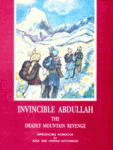
Invincible Abdullah: The Deadly Mountain Revenge by Haji Uthman Hutchinson

Standard
Invincible Abdullah: The Deadly Mountain Revenge by Haji Uthman Hutchinson

invincible-abdullah-the-deadly-mountain-revenge-workbook-aziza-and-uthman-hutchinson-2

I’m pretty sure I’ve seen and handled this book hundreds of times in my involvement in four Islamic Schools, as a teacher, a librarian, and host of book fairs.  So, it is a little embarrassing to admit that this is the first time I actually cracked open the cover and read the book.  Written in 1992 with a less than attention grabbing cover, I had minimal expectations, but with a newborn and down time, I thought I needed to give it a chance, and I’m glad I did.  The book is definitely geared to boys (there isn’t even a female character in it), and is pretty action packed and quick paced.  You know the boys will get out of the predicament at hand, he is “Invincible” after all, and there are three more books in the series, but you don’t feel bad reading it anyway, because it is sufficiently entertaining.  The book isn’t amazing, but it holds its own largely because it doesn’t talk down to the reader.  The characters are independent and thoughtful and yes they are teenagers battling drug carriers in the tribal areas of Pakistan, and yes they are wielding guns and hiking over glaciers, but mind you they never miss their salat or fail to thank Allah (swt) for their success which kind of makes the book that much more fun.  The book is 218 pages with a glossary at the back.  It is not an AR book, but I probably will make it into one at about a fourth grade fifth month level (4.5).  I also am considering doing it for book club, but might wait and read the rest of the series to see which one will have a wider appeal.

SUMMARY:

Abdullah travels to Pakistan from England to visit his cousin Hasan.  At the airport Abdullah’s bag gets switched with someone else’s and the boys find themselves getting accosted by the rightful owners who have a half a million dollars in their suitcase.  The boys talk to the police and learn that the money is part of a heroin operation going on in the tribal areas and that the inadvertent switch messed up the police’s sting to catch the criminals.  The boys run in to the drug runners again in the bazaar, and after an all out brawl decide when an opportunity to go into the tribal areas presents itself, that they should take it and do what they can, to put a stop to the criminal’s drug ring.

WHY I LIKE IT:

There is drugs, violence, and guns, but it is all done for the right reasons, in an action filled manner.  The “good” guys are all religious, and while the “bad” guys have religious sounding names, clearly are not, which lends it self to a decent discussion about what makes a good person and what makes one religious, clearly not just their name or culture.  It also lends itself to a realistic conversation about drugs, their effects on the users, and on drug culture as well.  The guns, well the guns are there to make threats, and to hurt people, at best it gives you a seg-way to discuss your views on guns with your children, but in the book, it is what it is, not a moral or religious issue as the drugs are made out to be.  The boys, the heroes of the book, are all very devout mashaAllah, and their actions, manners, and thoughts reflect this.  I like that this is consistent with their character.  They are respectful to their families, to each other and are ever mindful of themselves as Muslims in all facets of their adventures.

FLAGS:

Just the content of drugs, violence, and death. Mild compared to most TV shows or movies, but present, none-the-less, nothing a third grade and up can’t handle. (Spoiler, only one person dies and it isn’t directly at the hands of anyone, nature steps in to save the day).

TOOLS FOR LEADING THE DISCUSSION:

There is a workbook that apparently can be purchased to accompany and teach the book: http://www.islamicbookstore.com/b9648.html

The author gives pause as the characters have to decide what to do next and to weigh the pros and cons and possible repercussions of their decisions.  These moments would lend themselves well to a book club discussion to find out what the students would do, what they would be willing to risk, and at what cost.

Burning Boats by Zaynab Dawood

Standard
Burning Boats by Zaynab Dawood

burning boats

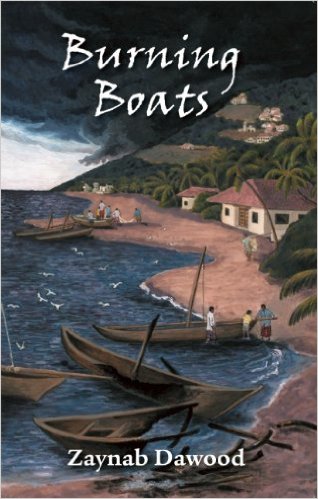
This book came highly recommended from a friend that read it aloud to her Kindergartener and I ordered a class set based on her raving review.  After trying to get into the book on three separate occasions I concluded that yet again I should have waited and read the book myself before ordering it.  So I handed it over to my avid reading eight-year-old who read it in a day and said it was pretty good, asked a few questions, and continued on her way confused as to why I couldn’t finish it.  So, I started it again determined to get through it and with Ramadan quickly approaching I thought I could motivate myself to do so.  However, I could not, and it sat on the shelf for the entire month with a book mark only a few chapters in.  At the prodding of my guilty conscious to return the book to my friend, I continued reading from where I left off, rather than starting over, again, and found that by dismissing completely who any of the characters are and how they are related, the story does get off the ground and I was able to finish it.  That being said, I think the story might have appeal if read aloud one chapter at a time. To read it in one setting did not help the story that can’t seem to decide it if wants to be character driven or action driven.  The sheer number of characters is completely over the top, there are at least 20 characters mentioned by name and the book is only 137 pages.  And honestly I never bonded with any of them.  There is action in the book, but the details seem misplaced.  The author details characters all saying salam and walaikumasalam to one another and giving moral reproaches based on Quran and Sunah, but I never felt I understood why the main characters were leaving, why the villain was so bad, or how (spoiler alert) a pivotal character in the book died. I guess by never connecting to the characters or feeling an emotional tie, positive or reproachful, the book didn’t live up to it’s potential.  The book is recommended for ages 12 and up, but I think younger children could read it and even younger could listen to it being read to them without any major concerns.  With guidance the book is by no means a waste of time, but if you recommend it to a child and they struggle to get into it, you might just have to let them find something else to read.

SUMMARY:

A small fishing village is being harassed by a corrupt businessman’s attempts to take over the entire industry in Tobay.  The principal of the school and a few close friends are trying to stop him, but have decide they cannot and thus are planning to move elsewhere.  The children are forbidden to go to the harbor as boats are being burned and crimes committed to persuade the local fisherman to abandon their solo endeavors.  With few places to play, the loss of the harbor affects the children greatly as well.  A tropical storm complicates matters as it tears through the village destroying the poor inhabitants meager dwellings as well as the damaging the school and the mosque.  With friends taking in homeless neighbors and the main family planning to leave the children plan one last game that turns dangerous when all the boats in the harbor are set a blaze.

WHY I LIKE IT:

There are some definite good qualities in the book, despite the holes.  It opened up a good discussion between my daughter and I about preparing a body for ghusl and Janaza.  It does show that people can change and that when people are sincerely apologetic and are striving to correct their behaviors, those around them should offer forgiveness in not just their words, but in their actions as well.  It also shows that good kids can make bad choices, and that the consequences can also be very real.  Similarly it shows that adults also don’t always know what to do, and that they can be forced to reconsider as well.

FLAGS:

There is violence in the book and death.  Nothing too graphic, but one might have to explain to younger, more sheltered reader,  that just because someone has a Muslim name doesn’t mean they are practicing Islam and are good people.

TOOLS FOR LEADING THE DISCUSSION:

There aren’t any online tools, but I would suggest having the readers keep a character journal.  Every time a new name appears, write down who they are, (and who they are related to), so later they can look back on it if they become confused.

Because of the “holes” in the story I would probably ask the students to give their thoughts as to what happened or why the characters decided to do what they did and then turn it back on them and ask them what they would do.

Why was Ibrahim leaving? Would you have left? What made Nasser change? Would you have forgiven him? How do you think Ayesha died? Etc.

A Party in Ramadan By Asma Mobin-Uddin Illustrated by Laura Jacobsen

Standard

BMP_8604_JT.indd

This is a great book that works on a variety of levels.  Leena is fasting the whole day for the first time, but is also invited to a friends party.  Her mom gives her the choice to fast or not as it is not yet mandatory at her age, and she decides to fast AND go to the party.  The story takes you through the activities of the party and how some parts are easy and some harder for the fasting Leena.  The end has a wonderful surprise for both Leena and the reader as the author gives us all reason to hope that respect among friends exists, and that in fact one can stay true to their beliefs and have support from their friends.

This book is  great conversation starter for older kids who maybe have tried to fast and felt the temptations of day-to-day life in a non -Islamic environment.  With an AR level of 4.2 and 34 pages the story is strong enough to hold a fourth graders attention and get them to analyze what they would do in a similar situation.  Although the book is about Ramadan and some facets about how fasting is done, what it means, and why Muslims do it, are sprinkled in, the story isn’t overly religious in nature.  The characters are simply Muslim, they pray, they thank Allah, they wear hijab, they make duaas and they also go to friend’s parties. I think non-Muslims would benefit from this book and see the beauty of diversity as Leena and her friends support one another.  The pictures also do a wonderful job of depicting the story: the characters are warm and happy, some cover some do not, they eat chocolate pudding and Baklava and the reader sees how a Muslim family is just like any other family.

The added beauty of this book is that it also works for story time. The younger ones may or may not understand the potential stress of being the only Muslim at a party, let alone being the only one fasting, but they do understand that Leena wanted to eat and drink and she remembered that when her little sister wanted her dessert.  They also understand how sometimes it is hard to do what is right, but inshaAllah the reward is sweet indeed.

Magid Fasts for Ramadan by Mary Matthews illustrated by E. B. Lewis

Standard
Magid Fasts for Ramadan by Mary Matthews illustrated by E. B. Lewis

Magid Fasts for Ramadan

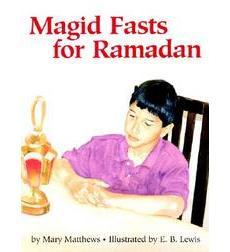
The intent of this 48 page chapter book is good, however, a few things rubbed me the wrong way about how Ramadan and Islam are presented.

Nearly eight-year-old Magid wants to fast on the first day of Ramadan, but everyone says he is much to young.  He decides to deceive everyone and fast anyway.  I’m actually okay with this main story line, as I could genuinely see a child wanting to do it so much they would lie about it.  The author even has the family sit down after the truth comes out and discuss how honesty is important and this is not how Ramadan should be celebrated.  Lesson learned for Magid and the reader, right? Nope, the author kind of blows it and takes it to the other extreme.

Magid’s sister Aisha is twelve and is “forced” to fast so she isn’t the only girl not fasting at her all girl’s school in Egypt.  What a sad reason to fast, The whole reason Magid wants to fast is to be a “truly obedient Muslim” which sounds great on the surface, but it get’s repeated so often that Magid at one point is judging a classmate who isn’t fasting and isn’t always at Jummah (Friday) prayers.  The parents decide at the end to let Aisha fast until school is out, hence shortening the day for appearance purposes, and Magid can fast til lunch.   He is told he can fast full days when the days are shorter.  Again a really odd reason to wait when fasting has been prescribed for us, to make it an issue of convenience.

So aside from the very negative view of Ramadan and the kids rejoicing at the end that they don’t “have” to fast, the lying, the disobeying your mother, and the judgmental laden diction of being truly obedient, the book does cover a lot of ground well.  The book shows the characters doing wudu and praying, it shows them trying to be kind to one another, it talks about how the Quran was revealed in the month of Ramadan and it does have a plot.

The water color illustrations are nice, and I also like how it showed a bit of Egyptian culture with the lanterns, singing, and food.  Interestingly the author says it is harder for Muslim’s in America to fast, but elsewhere says that Aisha has to watch the girls at school not fasting, eat lunch.

I really wouldn’t recommend this book, for the intended audience of 3rd through fifth graders I think it would do more harm than good in promoting Islamic values in Muslim children and in showing non-Muslims what Ramadan means to Muslims.

Does My Head Look Big in This? By Randa Abdel-Fattah

Standard
Does My Head Look Big in This? By Randa Abdel-Fattah

Image

I think I have purchased this book at least twice before and have never gotten around to reading before loaning it off to someone, that is until we were snowed in a few days ago.  Similarly bizarre, whenever I’ve asked someone who has read it what they thought of it, I’d nearly always get a a smirk, a shrug a nod of the head, and a vague response.  So when the book came in the mail and the snow hit the roads, I decided to put an end to all this none sense.  Needless to say I’m very tempted to make a video of me shrugging, smirking, and shaking my head instead of writing a synopsis, ya, it’s got a lot going on.

According to Accelerated Reader it is a 4.9, so fourth grade ninth month reading level, however, I wouldn’t encourage anyone that young to read it, you would need to be at least a junior or senior in high school for content.  It has 360 pages that fly by and is one of those books that if you put it down you could pick it up a month later and not miss anything, or you could read it in one sitting and not find it to be a daunting task.  I akin it to empty calories, a half hour sitcom, or books like Janet Evanovich’s Plum novels or Sophie Kinsella’s Shopoholic books; entertaining, light, and with a happy ending.

SYNOPSIS:

Australian born Amal Mohamaed Narullag Abdel-Hakim is considering wearing hijab and as she makes the decision, she is forced to handle obstacles in every relationship her sixteen-year-old life contains.  The only child of her Palestinian born parents, her mother is a dentist, her father a doctor, Amal seems to have it all: a few close Muslim friends from her days in an Islamic School, a few close friends at her current prep school, an amazing relationship with her parents, brains, looks, opportunity.  There is really no climax as she navigates all this other than the fact that she is a teenager and doesn’t often know what she wants.  Additionally she is Muslim and as various terrorist plots occur she is challenged with coping at school, deciding if she can achieve her goals and cover her head, if she can have male friends and go to parties, and if she can win over her critical elderly neighbor.  This book honestly has it all: Islam vs. culture, boy girl issues, gender roles, immigrant and assimilation, extremism vs liberal, weight and self esteem issues, Ramadan, cousins and family members who make things difficult, female circumcision, terrorism, drug and alcohol use, smoking, racism and bigotry,  and even at times a poignant moment or two.

But, to cram all that in to a YA book is really just too much that it gets lost and ultimately doesn’t leave a memorable place in the reader’s head or heart.

Never really getting into Amal’s head about why she wants to cover, the book stays superficial with her infatuation with Adam and her poor choices regarding her relationship with him.  A constant struggle she has is wondering if she can ever get a job and be taken serious as a professional while wearing a hijab, which seems really silly since her mom is a successful dentist who covers, but that never even is addressed.  Amal fights with her Principal, fights with classmates and at times even her parents regarding her decision to cover, and while yes you cheer for her, it seems to almost contradict how flighty she is in other capacities of her life.  The other main story line is with Amal’s Muslim friend Leila who’s parents are “cultural” and not very religious and thus oppressive in letting Leila practice Islam.  A worthwhile story line, however it almost makes Amal’s family in contrast seem “too perfect” which after a while just seems unrealistic.  The character fasts and prays and does many of the prescribed aspects of faith, but Amal seems in many regards to lack spirituality or enthusiasm or even a deeper connection for Islam.  She is a character who is Muslim, but not necessarily defined internally by her love of Allah, she just wears it on her head.

WHY I LIKE IT:

Many reviews of the book remark that it is a book that “needed to be written and needs to be read,” and I think yes, if you are an avid reader that is looking for a quick entertaining read about a Muslim, by a Muslim, go for it.  I don’t foresee me using this as a book club selection, but i think in a few years there are some students that I would recommend picking it up and reading it.  To some non-Muslims I think it would show that Muslim’s have the same everyday problems that everyone has, and in fact we are not all extremists.

FLAGS:

There is a little cursing in the book, girl/boy issues of dating, kissing,  mentioning of porn and prostitution, there is alcohol, drug use by a minor character, smoking, and lying to parents as a norm.

TOOLS FOR LEADING THE DISCUSSION:

Click to access RA-DMHLBITNotes.pdf

A little about the author and why she wrote the book:

http://www.randaabdelfattah.com/index.asp


Golden Domes and Silver Lanterns By Hena Khan

Standard
Golden Domes and Silver Lanterns By Hena Khan

Image

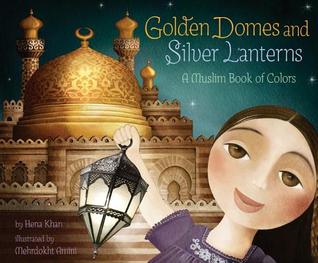
As a librarian I do a few story time sessions a week, so I will include the Islamic themed books that the students and I particularly love. Golden Domes and Silver Lanterns: A Muslim Book of Colors by Hena Khan, is currently at the top of the list.  The pictures are beautiful and engaging, the text is simple and poetic, and the fact that the students first saw the book at the Scholastic Book Fair, made it all the more appealing.  For such youngsters to see themselves, their religion, their culture, so simply and beautifully presented elicits smiles from even the youngest story time listener.  Recently the intermediate Language Arts teacher even borrowed it to review adjectives, and the students loved it.  From orange henna, to black ink writing Allah, the book presents, eid, hijab, prayer rugs, mosques, and love.  An absolute must on any book shelf, you won’t regret it.

To see some pages from the book online:

http://www.books4yourkids.com/2012/09/golden-domes-and-silver-lanterns-muslim.html