Category Archives: mature

Balti Kings by Sudha Bhuchar and Shaheen Khan

Standard
Balti Kings by Sudha Bhuchar and Shaheen Khan

I don’t recall ever reviewing the script of a proper adult play before, and probably last read a play in college, needless to say it has been a while, and this 112 page script of a play performed 25 years ago, has me itching to dive back in to regularly attending live theater. Literary wise I love seeing the characters and plot develop with dialogue alone, and the power that every word on the page has. The play takes place in one day, in a Pakistani restaurant in Birmingham, England, and the stresses of an event happening that night is the catalyst that brings together the characters own lives, the chaos of the kitchen, the stresses of the times, and an inside view on immigrant life.

Set on Jummah, everyone seems to be religious when bosses come looking for their employees, but duas, and boundaries, and justifications also stem from Islamic practices. The owners of Balti Kings are trying to compete with Karachi Karahi in the neighborhood, their father has had a heart attack and the brothers are trying to relaunch the business with a Bollywood star studded Curryoke night and the start of their cheaper buffet. The attitudes and social hierarchy of immigrants is highlighted with the contrasting kitchen crew downstairs. A mix of ages and genders and skills, legal and soon to be illegal desi workers along with a Bosnian brother sister team, show racism and stereotypes in action.

Their personal lives spill in to the kitchen as the young Mariam finds herself expecting and coworker Nadeem denying it is his, while she is left warding off advances from her boss. The head cook is again threatening to leave for Karachi Karahi, the biriyani is burned, the stars are imposters, and the brothers have to accept the outcome of their choices.

I found myself smiling, getting irritated at characters, and appreciating the found family that the restaurant provides. I love the Foreword and Authors’ note that set the place in a time not that long ago, and show how perhaps very little has changed. The end features pictures of the play performances, as well as a glossary.

A Tariq Twins Mystery: Murder for Two by Niyla Farook

Standard
A Tariq Twins Mystery: Murder for Two by Niyla Farook

I don’t know what I was expecting, but woah once the actual crimes started piling up and the sleuthing began, I was invested in Riri and Ani working out their differences, solving the case, and freeing their accused dad.  At 336 pages, a full on murder, attempted murder, arson, thieving, and arrests all taking place, the book is definitely for older middle grade readers. The premise and dual points of view of 11 year old twins being reunited after 3 years apart by their divorced parents, getting to know how their OCD, ADHD, and autism factor in to their personalities, learning about TUSC, the town of Castlewick, and the side characters that will turn suspects, result in it taking the story a while to get going.  But if you can get through it, and can suspend belief, the book is a fun mystery that takes on heavy topics, and crime, but somehow keeps it light and consumable by the intended audience. The twins are Muslim, one wears hijab, and there are Islamic references, but once the identity is established, it really doesn’t play a role, or shape the characters’ view of the world or approach to dealing with their grief, anxiety, and obstacles they face.  There is mention of halal marshmallows and hijab, but they never say a quick dua or pray, and by the end is not really even shown to be a big part of their daily lives.  I have no idea if the neurodivergent rep is accurate, but the tone and approach is very positive and normalizing.  Parents may want to know that the book starts on the last day of school and the teacher is non binary, referred to as Mx Henderson with they/them/theirs pronouns. The character is mentioned a lot in the first nine pages, and then never again.  Pronouns for other characters are listed on their profile cards.  There is teasing of a girl having a crush on a boy, a few couples dating, a character being born out of wedlock, and a male character being in a relationship with someone named Toby that is mentioned a few times, but only on the final mention in the last few pages of the book, does it clarify that it is a boyfriend.  The book seems to be intentionally diverse in ethnicities, religions, identity, and orientation, but the story is a murder mystery, and a family reconnecting, and the mentions in passing are not detailed, or overly explored.  I mention all this for adults to determine what is best for their children.

SYNOPSIS:

Supersleuth Imani Tariq aka Ani lives in Castlewick with her father, Abderrazzak and spends time at Cafe Vivlio with Mrs. Kostas.  The small town is Ani’s stomping grounds for sleuthing and carrying out the cases her TUSC (Tariq Ultrasecret Supersleuth Centre) organization takes on.  She knows everyone, and everyone knows her, and she is not looking forward to spending the summer with her “evil twin” visiting from California.  Riri short for Noori, lives with her mom and is heading to the UK so her mom can set up a new office for her company, and the twins can reconnect after being apart for three years.  There is a lot of animosity in the former family of four, but the girls slowly start to rely on each other when they find Mrs. Kostas’ dead body in the secret garden, alibis not checking out, relationships coming to light and their dad being arrested for the murder.

WHY I LIKE IT:

I naively thought it would be a murder of a distant side character that the girls tried to solve, or maybe a trick and it looked like a murder, but ended up not being one, so I was really kind of shocked that in fact a murder occurred, that the girls found the body, and that the story of lies, deceit, art theft, secret identities, relationships, and webs of coincidences and manipulation was just getting started. The girls’ voices are distinct, but as they pop around doing what they do, the reader is often just expected to go along with it an not over analyze. I kind of liked that the ending spelled it all out, like a good villain in cartoons the culprit gets their moment to detail and confess what they did, how they did it and why.  In full disclosure though, with about 30 pages left in the book, I was genuinely still curious who the guilty person would be.

The book balances very real mirroring threads with absolutely bonkers ones.  The girls get counseling for grief, talk about their OCD and ADHD.  They also run circles around the police, unravel the plot through research, interviews, crime scene analysis and get the murderer to confess to only them.

The Islamic rep at the start really got me excited, but it stopped rather abruptly and there was no longer even any Assalamualaikums or walakumsalams after about the first 40 pages or so. The characters are of Pakistani decent, but I have never heard “hudafiz” as a farewell before, Allah hafiz and KhudaHafiz, yes, but never with an H.  It appears a few times in the book, and even the internet, for whatever it is worth, says it is probably a mistake.

FLAGS: (Things parents might want to know the book contains):

Murder, attempted murder, assault, framing, deceit, lying, arson, teasing, close boy/girl friendships (Muslim characters), hetero and lgbtq+ relationships, romantic interests, child out of wedlock, jealousy, revenge, name calling, parents are divorced, therapy/counseling, ADHD, anxiety, grief, abandonment, loss, OCD, autism, unemployment.

Odd Girl Out by Tasneem Abdur-Rashid

Standard
Odd Girl Out by Tasneem Abdur-Rashid

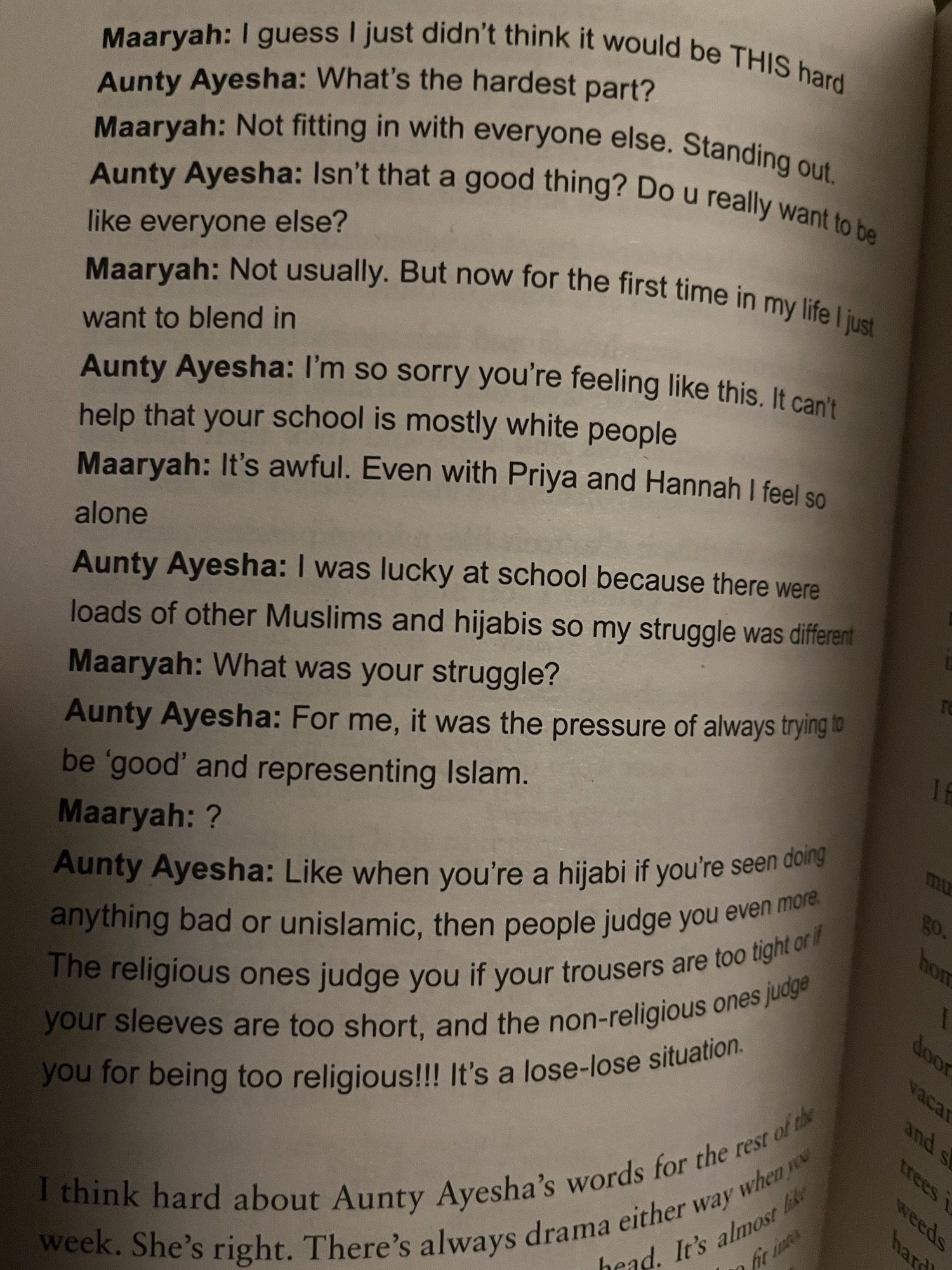
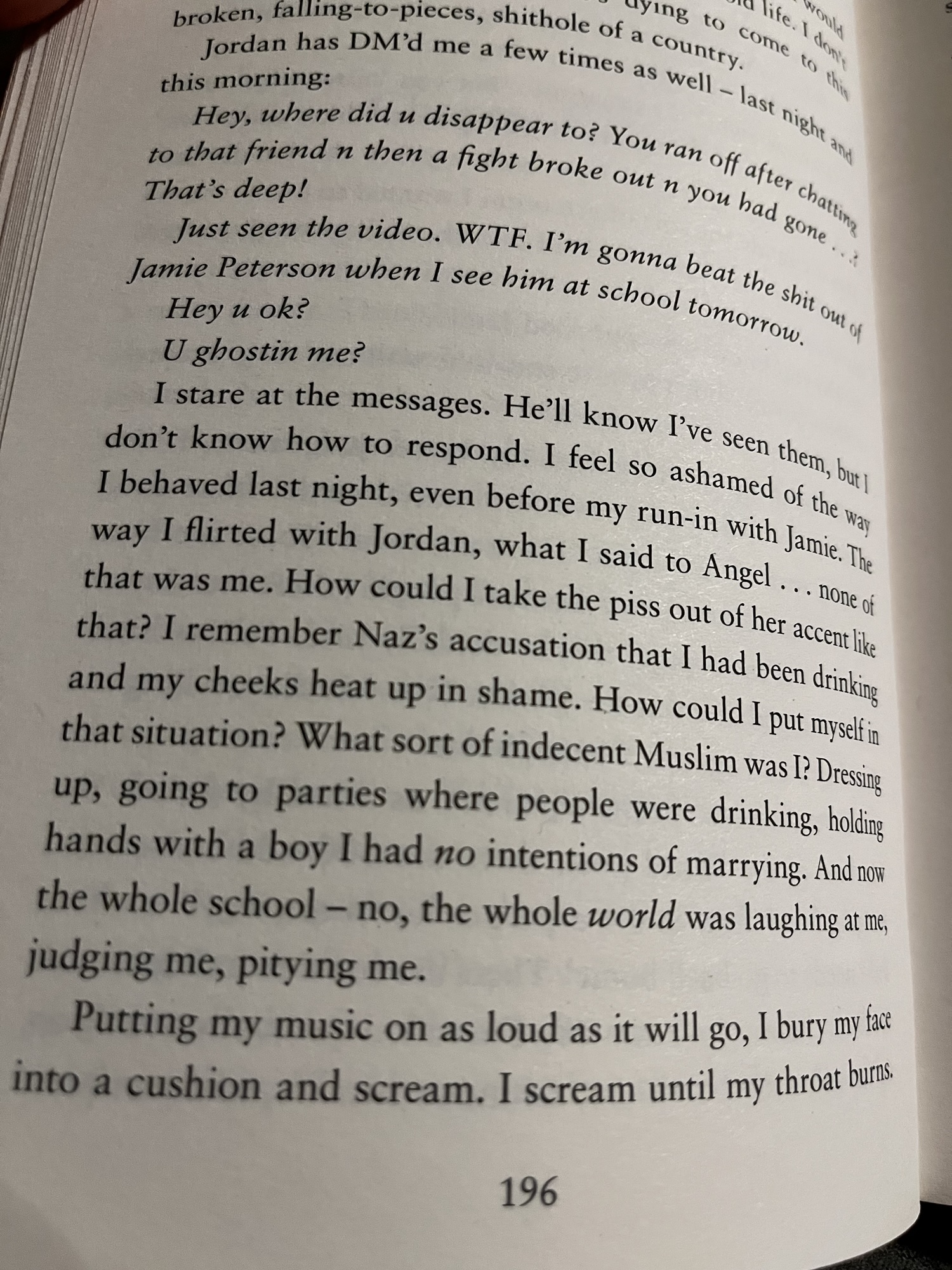
At 368 pages this identity centered mature YA book really hooked me and had me invested, which is impressive because Islamophobia stereotypes and being the new kid in a new place tropes are pretty frequently done, and often after a while, feel repetitive.  For me the charm of this book is actually not Maaryah and her peers/friends/bullies storylines, but the protagonist’s relationship with her parents and what caused her mom and dad to divorce.  Obviously as a mom of teens, I’m not in the target audience, but I feel like I benefited from the Muslim authored, Islam centered book, and think older teens, perhaps 17 and up, will also find the book enjoyable and reflective of views they have, challenges they face, and boundaries they have to establish.  I don’t want to spoil it, but SPOILER, had my dear friends that have read the book clued me in that the book will toe and slightly cross the haram lines, but ultimately show Maaryah deciding to re-establish her boundaries after being tempted not to, i.e. making a poor choice to attend a party with boys and alcohol present, and dressed in a way not typical to her hijabi style, I wouldn’t have read the last hundred and twenty pages or so with my jaw clenched in fear. The book shows a lot of Islam in practice, salat, duas, discussions about hijab, but not everyone will agree with decisions Maaryah makes or the rationale behind them as they vacillate between culture, religion, and family expectations.  I love that Maaryah is fallible and never abandons her faith, and that who we are is more than a singular mistake or instance of poor judgement. The book is not preachy, most will just take it as a girl finding her place in her new family dynamic in a new country, who happens to Muslim.  I think, an assumption really, based on what the author has said about her previous adult books, something along the lines that they are not meant to be Islamic fiction, but are stories with Muslim characters, and I think this book should probably be viewed the same.  There is swearing, hand holding, a side hug, normalized boy girl friendships, lying, running away, deceit, cheating, alcohol, mention of hookups, dating, vaping, music, flirting, hijab questioning, bullying, physical assault.  My biggest concern about the book is that it brings up Palestine, but doesn’t discuss Palestine. A side character is a non practicing Jew that visits Tel Aviv and Maaryah wants to discuss the occupation with her, but hesitates and the moment passes.  It is never revisited which I really wish it would have.  It could have modeled a bit how to have those conversations, I know it isn’t that type of book, but Maaryah mentions repurposing kaffiyehs in her designs and so it hints that it matters to her, but never pulls on that thread.  At one point it also mentions another character posted something pro Isr@*l during the genocide, which I can only assume the author thought that by the time of publication would have ended.  SubhanAllah ya Raab.
SYNOPSIS:
The tag line on the cover “From Dubai Girl to London Nobody…” very succinctly summarizes the plot.  Maaryah had an idyllic life in Dubai with her parents and close friends, spending her holidays with her mom’s family in London, and securing an internship with a famous designer.  All is going well until her parents get divorced, her mom moves her to the UK, not near her extended family, and the lack of Muslims, let alone hijabis, at her high school has her bullied with no friends to have her back.  With her mom in survival mode, their once close relationship is non-existent, and the 15 year old is left to sort through it all on her own.

WHY I LIKE IT:

There is a little pulling of punches so to speak of asserting that the boundaries are Islamic, but for the most part I think Muslim readers will see that Maaryah does view a lot of what she experiences through an Islamic lens which I appreciate. I also like that the protagonist’s connection to salat and faith is hers, it isn’t forced on her and I think for this demographic that is good micro messaging and framing.

I was very grateful that the book answered the questions about Maaryah’s family dynamic, so often parental problems are pushed to the void and let to be resolved or understood off the page. And while in the first half it was teased a little as we aren’t having that conversation right now, I did ultimately by the end feel like it was sufficiently resolved.  I also felt the mom was blaringly absent at weird times and I get that it was a plot device to get her out of the way, but if you are dragging at the 100 page mark, I do encourage you to keep reading, it does pick up.

This book isn’t meant to be didactic, and I recognize I’m putting that on it a bit, but I do think the Gaza framing missed an opportunity to show readers how to navigate that very real scenario through the power of fictional characters.

FLAGS:

Copied from above: There is swearing, hand holding, a side hug, normalized boy girl friendships, lying, running away, deceit, cheating, alcohol, mention of hookups, dating, vaping, music, flirting, hijab questioning, bullying, physical assault.

TOOLS FOR LEADING THE DISCUSSION:

I would shelve this in an upper high school classroom, I think that decision to be at the party is clearly shown to be a mistake, to put herself in that situation is something she regrets, and I think showing that she comes out from it offers a lot to be discussed.

The Djinn Waits A Hundred Years by Shubnum Khan

Standard
The Djinn Waits A Hundred Years by Shubnum Khan

img_8259-1

I didn’t realize how many characters this 308 page adult book has until I sat down to write this review.  The slow peeling back of layers into their backstories, motivations, perspectives, and insecurities, makes you get to know them in a way that feels real and deep, but in no way can be succinctly explained in a review.  First off to clarify, I feel the title is a bit of click bait, the djinn is there, but not a big part of the book, there is also a ghost, who is a more impactful character, so the vibe is more haunting than Islamic lens.  In fact, a few characters are Muslim, but that is about it.  The writing though, oh the writing is quite lovely and immersive.  The culture of desi characters in South Africa, the slivers of colonization and caste that get commentary, and the heartache of all those who have called, and do call Akbar Manzil home, will linger even if the details fade over time.  I listened to the audio book, so it is possible that triggers or flags might have been missed, for the most part the book is relatively clean, death, murder, attempted murder, and supernatural beings being the most obvious.

SYNOPSIS:

The main character is very much the grand estate of Akbar Manzil, a palatial home off the coast of South Africa that shaped lives and futures and hid horrors and loss.  In modern times it has been subdivided into apartments where lives and futures are still shaped and horrors and loss are also hid, and hid from.  When Sana and her father arrive to take up residence, the past and the present begin to unite, a djinn that has never left the house is stirred, and the more Sana pokes and prods, and the more she understands about the original inhabitants of the home, the more the house pushes back.

I don’t know how much to tell, as spoilers aren’t so easily defined in this book.  The family in the past is a man from India, Akbar, who falls in love with the area, builds a house despite his wife hating it all and desperate to leave, opens a sugar factory, his mother comes to live with them, they have two children, servants, friends, he stocks the gardens with monkeys, giraffes, a lion, and then one day he is enamored by a Hindu worker, Meena, at the factory and takes her as his second wife.  The jealously and family drama reaches a crescendo when she is pregnant and has a little boy.  Beyond the family storyline is a djinn also enamored by Meena, who takes up residence in the house to be close to her.

In present times, the other tenants in the house have their own baggage, loss, regret, and fears that cause daily squabbles and plottings.  Sana deals with the loss of her mother who hated her, and a dead sister who haunts her.  There is also Pinky in love with Shah Rukh Khan, Zuleikha a former famous pianist who has lost her edge, the Doctor who owns the home, a mother waiting for her son to visit, a parrot named Mr. Patel, Fancy, Razia Bibi, and so on. The house is occupied, but hollow, not full, and the the lingering djinn seems to always lurk just beyond the surface, in the corners and shadows that haunt them all.

WHY I LIKE IT:
I like that the writing keeps you hooked, even at times when there is no rising action, or conflict, you are genuinely drawn in and invested in just learning about the characters and how their lives, both those in the past and the present, intersect.  I didn’t like the fact that there is a djinn and a ghost, I feel like the ghost negates the realness that djinn.  It is possible that the ghost was a metaphor, or symbolism, but it was a little off to me, to have both as I understood it.  I don’t know how I feel about the vagueness of the final climax, yes I’m trying not to give anything away, but SPOILER: who set the fire?

FLAGS:

Loss, death, ghosts, djinn, murder, attempted murder, lying plotting, manipulation, music.

TOOLS FOR LEADING THE DISCUSSION:

I don’t know that this would work for an Islamic school book club, that doesn’t mean it wouldn’t work, but rather I need someone to discuss with me, so that I feel like I understood some of the lingering threads that are unresolved.  Basically, I would need to have someone explain parts to me, before I could help 15-16 year olds and up make sense of it all.

The Thread that Connects Us by Ayaan Mohamud

Standard
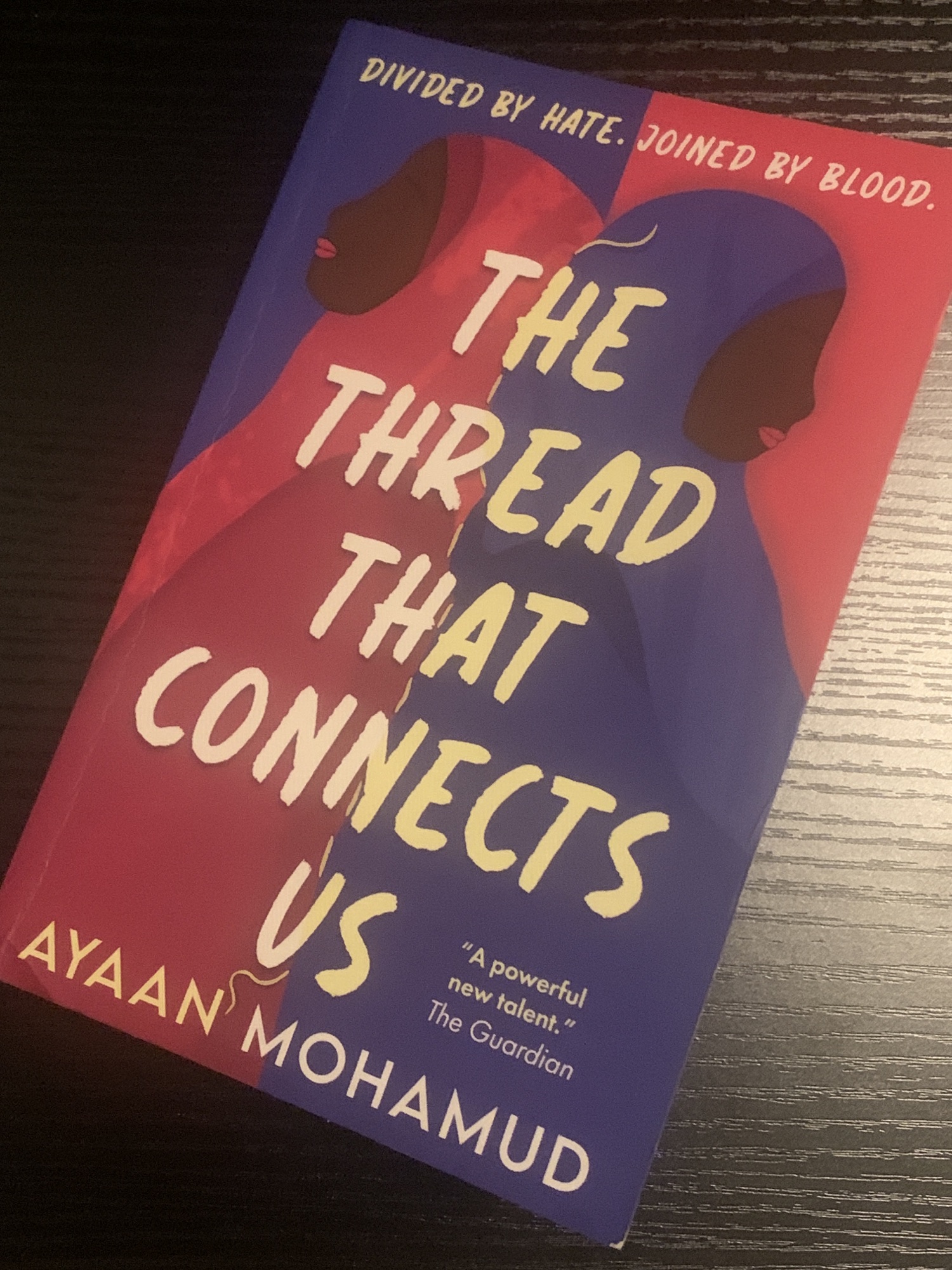
The Thread that Connects Us by Ayaan Mohamud


At just over 400 pages this book expertly blends the stresses of school, bullies, and friends in the UK with the twists and secrets of broken families, shattered hearts, and a past that needs to be reckoned with.  Told in dual perspectives from girls thrown together by the actions of their parents, Safiya and Halima maintain distinct voices that are rich with Somali culture, Islam, vulnerability, and ultimately love and hope.  The book is YA, but the premise is a bit mature and is better suited to older teens in my opinion, I think a high school book club would be wise to consider this book, as once you start reading, it is difficult to put the book down. 

SYNOPSIS:

Safiya is mature beyond her years.  Since her father abandoned her and her mother five years prior, she has managed the bills, the upkeep of the home, and for the most part her grades. Hooyo checked out and is rarely more than a silent being curled up unable to care for herself, much less her daughter.  With the the help from the community, particularly her best friends and neighbors Muna and Yusuf, Safiya has a found family that helps her weather the tough times.  When her dad moves back to London with his new family from Somalia, Safiya is forced to deal with not only all the painful memories of her past, but also the very real presence of her family living in her neighborhood, showing up to Eid prayers, and taking over the safe haven that school has often served as when home life has been so cold and lonely.

Halima’s father died when she was young, and life with her Hooyo in Mogadishu was good until her mother remarried, Safiya’s dad.  Her two younger half brothers that came further added to the rift between her and her mother, and now that they are moving to England with the husband, despite her protests, has her plotting a way to return to her home.  The language, the culture, the weather, are all added stresses to finding her way, and are compounded when she gets paired up to have Safiya show her around and help translate for her in school.  

The two girls hate each other, at least they have that in common, but their inability to avoid each other forces them to interact more than either wish to do.  As questions, and secrets are voiced, the two girls realize that they might have to work together to get what they want, and figure out their past.

WHY I LIKE IT:
I really enjoyed the owning of the characters’ language and culture and faith and how easy it was to be invested in their world.  Nothing pulls you out of the story, it is rich and lush and the reader can figure out why even though there is a crush, nothing is going to happen, and why they are wearing hijabs, and waking up to pray fajr, the balance is both inviting and educating, without the reader even realize it is happening, because hello, we are to busy trying to figure out what these two girls’ parents have done. 

The story has layers, and the emotional attachment I feel to both these girls, made me glad the story was over, they deserve some peace, but also desperate to know that they are going to be ok in the future too.  I can’t say too much without the risk of spoiling, but the writing is strong, the plot solid, the details intentional and relatable, and the characters very real.

FLAGS:

Lying, bullying, fighting, assault, crush, drug use, arrest, accusation, gossip, abandonment, relationships, edibles, affairs.

TOOLS FOR LEADING THE DISCUSSION:
This would be such a great upper high school read, the way the story unfolds will keep readers hooked from the first page and motivate those that start, to finish.  Students will see themselves in the characters, and be sleuths themselves trying to uncover what secrets are true and how do the pieces of the puzzle fit together.


The Last Man in Paradise by Syed M. Masood

Standard
The Last Man in Paradise by Syed M. Masood

paradise

I’ll be honest, if I would have read the blurb (see below) about this book from another author, I probably would not have read the book.  From the description alone, I could assume that it will undoubtedly be uncomfortable, it is an adult read, it is going to be irreverent, and I will disagree with probably whatever messaging the impossible situation the characters are placed in, come out with. But, having read his two YA books, and really liking More than Just a Pretty Face, despite the raised eyebrows I get from Muslim book fans when I say that, I felt pretty confident that Islam would not be othered or villainized, and that the writing quality would make the cringey situations worth getting through to hear the commentary that would be forth coming.  I’ve felt with the author’s other work that the Muslim characters, own their flaws as individuals, not as representatives of their faith, so, I was willing to give this book a read.

The first quarter of the book was a little stilted, but by the midpoint, I could not put the book down, as the writing did not disappoint.  Would I recommend this book? No, not to the majority of followers of my platform, much like the satire of Zarqa Nawa’s Jameela Green Ruins Everything, I know that this style of ridiculous situations to reveal humanity, consideration, and introspection, while being entertained by very Islamic concepts, is not for everyone. Did the make-out scenes in the masjid parking lot, child abuse, sleeping around, drinking alcohol, talk of pubic hair and board games, grandpa on masjid grounds watching porn, hate crimes, involuntary manslaughter, and impersonating an imam giving khutbahs and performing ghusl, cross lines? Probably, but it is fiction, it is raising the stakes to show extremes, and let the reader opine on their perspective when faced with it. And no, I won’t write my typical review about Islamic rep, because reviewers like me got called out for that too, about policing representation and confining Muslim experience to looking like one thing.  The author went really meta and called himself out for the ending of his other adult book (that I haven’t read, but probably should), The Bad Muslim Discount, so clearly no one was out of the line of fire.

Suffice it to say, this book literary wise is an easy read, the craft is on point, it flows and is compelling (except for the end, SPOILER, who was going to look after Baba, that thread just dropped), for Muslims though it will be very uncomfortable. For non Muslims, or Muslims that don’t read to see themselves represented with the fervor that I do, I think Islam is not painted in a negative light or insulted by the text.  The characters are messed up, their flaws their own, but because they are Muslim, religion is part of their understanding and view of their existence.  I do wish there was at least one Muslim character that had it together, that might hint that as a whole we are not all one extreme or another.  I don’t like labels of “liberal” or “extreme” and the book provides commentary and nuance to those flawed dichotomies as well. The book is not heavily moral, (SPOILER) the protagonist does not come back to Islam (might not have been an identity to even come back to), but identifies as Muslim, there is no YA or MG revelation or singular take away. The book centers Islam, but somehow is not Islamic rep, it simply has Muslims dealing with the messiness of life, expectation, family, relationships, and honesty.

————————————————

Blurb copied from Goodreads:
A decade ago, Azaan, a rebellious teenager with dreams of becoming an actor, was exiled from Redding, California to a religious academy in Egypt by his imam father. His crime? Getting caught kissing Madison, the girlfriend he isn’t supposed to have.

But while letting his family believe he is studying to become a preacher, Azaan ditched school and embarked on an acting career. Given that he has minimal contact and nonexistent plans to return home, he figured no one would ever know. Now, however, Azaan’s grandfather has a dying he wants to see his grandson one last time. In order to maintain the story he’s told his family for years, Azaan decides to become a fake imam. Playing at being a religious leader, he finds a community in Redding on the brink of a scandal involving his family. It’ll be the most challenging role of his life.

Navigating his new identity and old relationships, Azaan reunites with Madison, connects with old friends, and uncovers a shocking truth about his family history that threatens to expose his father as a fraud. It turns out, Azaan isn’t the only one pretending to be something he isn’t.

Before he can finish weighing the consequences of exposing his father or protecting him, an untimely death shakes Azaan’s priorities. He is forced to grapple with his religion, future, and family in a way that is sure to break hearts, but might heal a few along the way.

This Book Won’t Burn by Samira Ahmed

Standard
This Book Won’t Burn by Samira Ahmed

burn

It is clear that this 384 page contemporary YA book is about the hot topic of burn banning in America, and I would imagine most are aware that the overwhelming number of books that have been recently banned or pulled because of objection, are by BIPOC and queer authors featuring BIPOC and queer themes and representation.  So I read it not so much to see the author’s perspective, but more to see how the Muslim author had the Muslim identifying characters in the book approach the topic.  The book is very black and white: book banning is wrong, Republican right wing MAGA members are fascist, and liberal freedom of speech supporters are LGBTQ+ identifying and allies and upholder of first amendment rights.  Islam and the character’s Indian heritage is ingrained in the characters’ being, and a label they are comfortable with, unfortunately, it has no impact on how they act, think, or the lens in which they view their world. Every 50 pages or so some vague mention of Ramadan, or a tasbeeh, or mosque appears, only to disappear just as abruptly. The Muslim protagonist, Noor, likes two different boys, is often alone with one or the other, nearly kisses both, and with the support of her family attends prom. Her younger sister, Amal, is unsure if she wants a boyfriend or a girlfriend, it is not a major part of the story and is just mentioned in passing.  A major side character is lesbian, and starts a bit of a relationship with another girl, they hold hands, and there are a few kisses on cheeks, nothing overly detailed.  There is profanity in the book, arson, threats, racism, and stereotypes.

SYNOPSIS:
Noor and her family move to a small town from Chicago when her dad abruptly abandons the family.  It is the end of Noor’s senior year, and with the grief, stress, and emotional upheaval of her family, Noor just wants to get to graduation.  Quick friendships with Faiz and Juniper, and realizing that she is the daughter of her activist parents though, thrusts her into making enemies her first week in the conservative town by questioning the school’s book banning policies. Add in her strained relationship with her mom, her conflicting feelings for Andrew and Faiz, and her sisterly concern for Amal, and Noor has a lot on her plate as she shakes up a small town.

WHY I LIKE IT:
The first chapter is incredibly written, no doubt.  I hated the dad, actually more than that, I was so disappointed in him, and so concerned for Noor, Amal and their mom.  To feel such strong emotions for characters just introduced is a testament the author’s abilities.  Sadly, insight into why their dad left never came, and  perhaps no answers is something the characters had to grapple with, but as the reader, I felt it wasn’t really explored, or articulated, it just was unresolved, and I really wanted some closure.  In terms of literary quality, the book went down hill pretty quick for me.  The middle was slow and repetitive with the heavy handed views on book banning.  Some shades of gray, or some discourse would have prodded the readers to maybe think about the implications of banning books, but the narrative never allowed for that.  It is right vs wrong, us vs them from the start.  There really is no growth of the protagonist, she doesn’t have much of a character arc, and the supporting cast is not fleshed out.  I wanted to see more of Noor and her Mom, not just be told repetitively how absent she is, I wanted to see Faiz as a full person, not just the only other brown Muslim at the school and who likes to cook. Where are his parents, do they support his activism, that he is going to prom? Truly, there is no Islam in practice it is just a label that gets dropped when it furthers the notion of raging against an established bias system.  I’m not saying they need to be praying and reading Quran on every page, but I don’t know that the story would be much different if the family was not Muslim Indian American. Really the catalyst is that they are a new family, and a visible minority.

FLAGS:

Straight and LGBTQ+ relationships, arson, threats, stereotypes, racism, bullying, cursing.

Six Truths and a Lie by Ream Shukairy

Standard
Six Truths and a Lie by Ream Shukairy

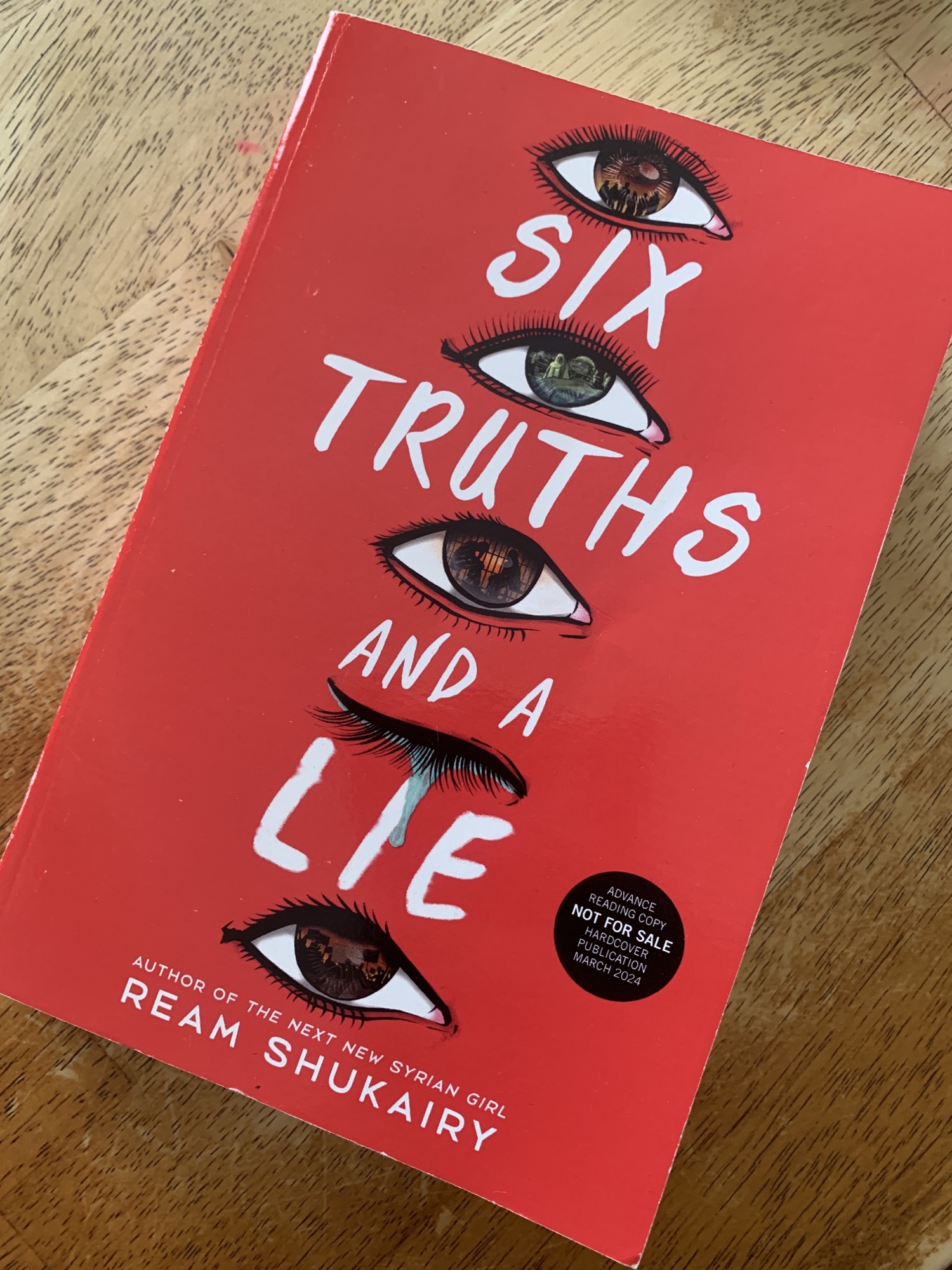
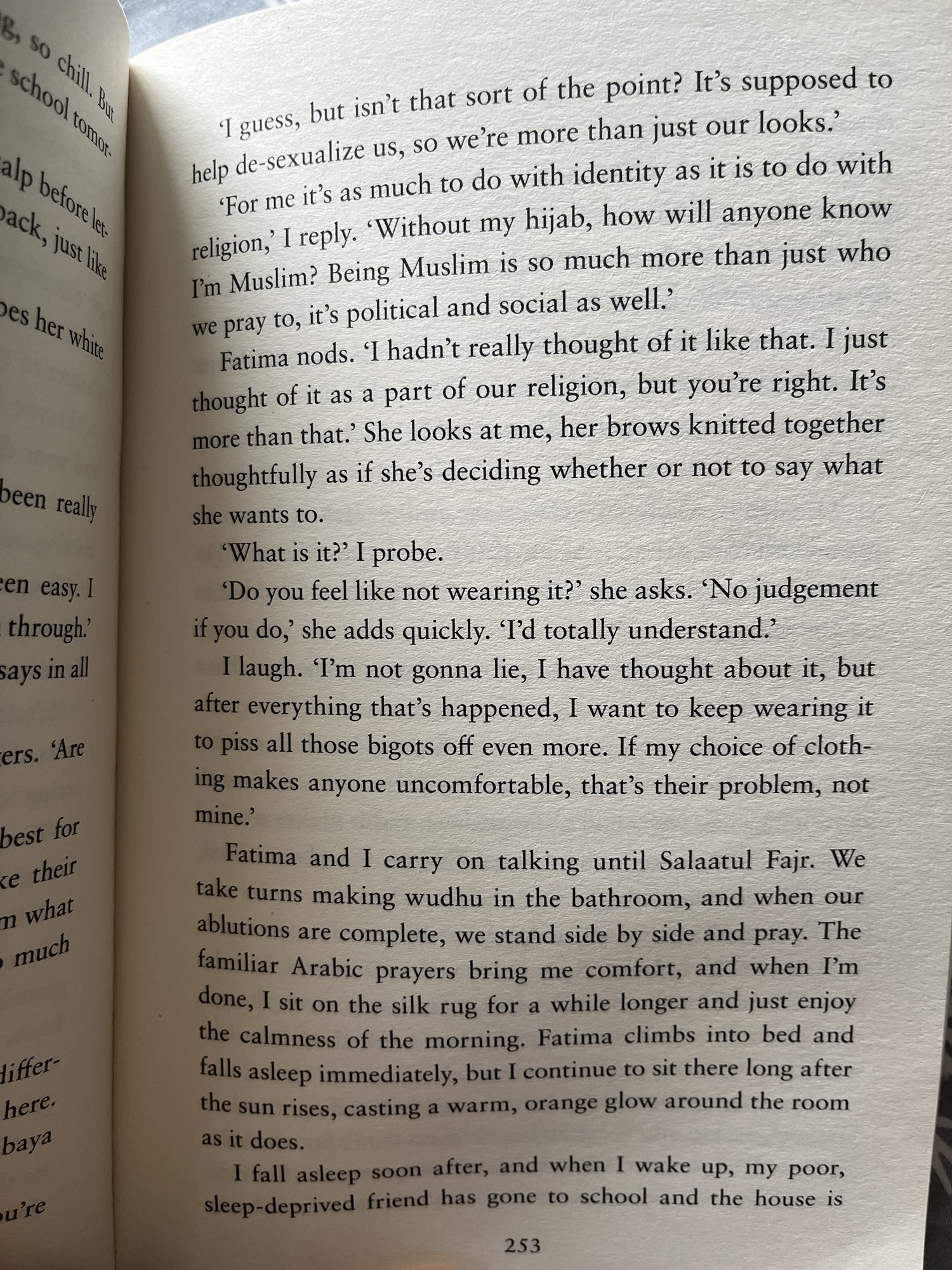
Woah baby, that was a wildly fantastic ride of a read.  The very first page grabs you and makes you sit up and pay attention.  I have never been so happy to sit in a waiting room so that I could read in peace.  This 387 page book is mature YA, I was gifted the knowledge prior to reading that there is a line that is toed, possibly stepped on, but not carelessly crossed, so I will gift that knowledge on to you, so that you might enjoy the story without that anxiety. Told from numerous perspectives, a group of Muslim teens find themselves arrested for an act of terror.  Strangers from different schools, different backgrounds, and different dreams for their future, are fiction, but their stories, their secrets, the broken system that they find themselves in, all feels very real.  The plausibility and commentary from an OWN Muslim author is incredible, I do wish their was more spiritual centering, Islamic framing, or even a more Muslim conscience present. Some of the characters do discuss hijab and one does find solace in prayer, but none of them really pour their heart out to Allah swt in the isolation of their cells, and in the predicament they are placed in, and it seems like they would.  Ultimately though the writing is remarkable, it has been a long time since I was truly tempted to skip ahead and read the last few pages because my heart was racing.  There is just one storyline thread that is so overly emphasized that comes close to a haram line, that I wish was a little down played so that I, as an Islamic school librarian, could encourage younger teens to pick up the book and dive in.

SYNOPSIS:
It is the fourth of July, and the MSA kids from the local different high schools are gathering at the beach for bonfires, fireworks, and socializing.  Everyone present will witness a crime, six teens though will be accused of committing it.  Qays, the Palestinian golden soccer boy who can charm everyone and anyone.  Nasreen, the outcast from a private Catholic school there to meet someone.  Samia the hijab wearing social media star. Muzhda the Afghan refugee with undocumented parents.  Zamzam the girl with a singular dream to be a doctor, and Abdullahi, the quiet EMT in training.  Six strangers whose histories and alibies link them to the outside world, but leave them skeptical of one another as they face charges in a world not concerned with the truth.

WHY I LIKE IT:

I love that the characters are Muslim and feel so real and developed. The characters are not tropes or their families stereotypical.  They know what Islamophobia faces them from others, they know what internalized issues they are dealing with, and they are not having a religious identity crises amidst everything else they are experiencing.  The writing allows each voice to be unique and clear, which is quite impressive as there are a lot of perspectives that move the plot along.  It is really hard to write a review that doesn’t spoil the book, so yes I’m being vague, and you are welcome.

FLAGS:

There are a lot of profanities not just when the stakes are high, but normalized as well throughout.  There are close relationships between boys and girls.  They take about dating.  There is weed, and the legalities of using, being in possession, and being high.  There is lying, death, incarceration, Islamophobia, some physical abuse mentioned.  There is a story line of a girl that doesn’t know if she is attracted to girls, she doesn’t act on it, but it is something that has tangled up her alibi and she choses not to explore it, but it keeps coming back up.

TOOLS FOR LEADING THE DISCUSSION:

This would be an awesome mature YA book club, just like some of the characters are being held in juvie and some being tried as adults, I think for Muslim readers a little older will benefit and be able to process, discuss, and see themselves in the book.  The book mentions that it could happen to anyone, and for a Muslim audience, to recognize and discuss that concept would be beneficial and engaging.

The Grimoire of Grave Fates by Hanna Alkaf and Margaret Owen

Standard
The Grimoire of Grave Fates by Hanna Alkaf and Margaret Owen

I keep saying I won’t read anymore anthologies or collections, but this 464 page YA fantasy mystery intrigued me because each chapter is written by a different author, presenting a different character to unravel a whodunit.  In total there are 18 character perspectives, 18 authors, and one murder that needs to be solved.  With two Muslim authors included and it created by a Muslim writer, I hoped there would be some Islamic representation.  The list of authors is quite diverse, and I think every character presents some minority label to normalize a specific culture or identity.  The Muslim characters both wear hijab, but nothing more about their religion is mentioned and no other faith is included.  There are Black, Asian, Hispanic characters, and every letter of LGBTQ+ is highlighted and seemingly the focus of the book.  At times it is just attempted normalizing that a character is queer or gay, but other times it is central to the plot such as when two girls spending the night together provides an alibi, and a few times it really takes away from the story, for example at one point two boys (one magical, one neutral) kissing and falling in love.  There are gender fluid, non binary, pronoun preferences, trans male-to-female, female-to-male characters as well. I kept reading to get to Hafsah Faizal and Karuna Riazi’s chapters, which were 10 and 12 and by then I was so close to the conclusion, I just finished.  Some chapters are stronger than others, but the resolution was really anticlimactic and didn’t do the buildup justice.  I share this review not just to comment on the story, but to also give a heads-up to the content so that you can decide if the book is suitable for you and your children.  I would not shelve this book in our Islamic school library, which is unfortunate, because I think even with the weak ending, I like the theoretical storytelling concept.

SYNOPSIS:
In moving school for magical students, a murder has been committed, and the students who all feel like they are the “chosen one” are determined to solve the case.  The characters share what they know and add to the “solving” of the case for the reader with their different magical abilities.  Some of the students are werewolves, some necromancers, there are those whose dancing is magical, others whose embroidery is, a few are the same, many are unique.  They don’t compete with one another so much as they are in their own world trying to prove their worth and right to belong.  When a homophobic, racist teacher “dies” secrets are uncovered and dirty administrators are called to account.

WHY I LIKE IT:

I like seeing a glimpse of the action from a character and then not really seeing that character again, it made it seem more puzzle-like in the coming together of the clues.  I also liked it because if I didn’t particularly like a character or writing style, it didn’t last the duration of the book.  I wish it didn’t feel so token representation though.  If the goal was to be inclusive, the mirroring uniqueness was lost when each character seemed to have to tick a box.  It made it read formulaic.
The conclusion just unraveled, and I know mysteries and horror stories tend to fall in to this trap, but I was hoping it would go out with a bang.  The buildup was strong, but then it became a lot more just telling, then sleuthing, and I don’t know if it was a reflection of the individual authors, or the overall arc of the book.  Either way, I felt like it could have concluded with a bigger punch and wrapping up of some of the loose ends.  Hanna Alkaf didn’t have a chapter, presumably she wove it all together and made it flow cohesively with the internal memos and emails and notes.

I wish the two “Muslim chapters” would have had some more representations about Islam or the girls’ cultures influencing their magical style or goals, but with token rep it is often just a label, an identifier, and then nothing more.  The two connect over fear of Islamophobes blaming them for the death of their teacher.

FLAGS:

The focus of the book is largely on relationships, mostly LGBTQ+ but some hetero crushes as well.  Trans, non binary, gender fluid, bullying, racism, prejudice, murder, magic, lying, sneaking. The Muslim characters do not have crushes or romantic relationships mentioned, but one has a close male identifying gay friend that she does have physical contact with, a reassuring hug- so the book does have Muslim girls with close male friends. Fear of Islamophobia, stereotypes.

TOOLS FOR LEADING THE DISCUSSION:

I would not be able to teach this book or shelve it in an Islamic school.