Tag Archives: violence

Love, Hate & Other Filters by Samira Ahmed

Standard
Love, Hate & Other Filters by Samira Ahmed

love hate and other.jpg

I seriously wish I could get back the few hours I spent reading this 281 page AR 4.8 book.  The blurbs talks about a girl being torn between the world around her and the world her Muslim-Indian-American parents want for her, unfortunately the protagonist is rather unlikeable and her worlds are actual not that different.  Islam is not represented at all, it is just mentioned as a checkpoint almost for the main character to continually justify her identity as “other” and try and illicit sympathy.  It seems to be a part of the story so that the story line of Islamaphobia can be addressed, but the book is cultural at best, and even that is rather lacking.

SYNOPSIS:

Maya Aziz is 17 and missing a dance her senior year to attend a wedding because she is not allowed to go to such events as the daughter of conservative Indian Muslim (dentist) immigrants living in Illinois.  But, immediately the hypocrisy shows itself as at the wedding, a boy, Kareem, deemed suitable by her parents is presented to try and woo Maya and possibly marry her, and the two of them wander off together, and consider meeting up at an after party.  As the reader gets to know Maya and her circle of characters, we meet her “cool” Aunt who lives alone and wants Maya to have a life of boys and partying and going to school in New York.  Her parents are never really defined except to maintain the stereotype of being controlling, focused on food and appearances, and not understanding their only daughter.  At school Maya has a best friend Violet who loves to flirt and remains loyal to Maya throughout, a cute boy Phil, who she has been crushing on for years, and some side figures that stir up some trouble.  

The premise of the book is that Maya loves film and wants to go to NYU to attend film school, her parents, want her to live at home and go to the University of Chicago.  The idea is that because they are immigrants, and culture and religion dictate all, that she get educated and married.  This conflict is intensified by Kareem, her sudden relationship with Phil, and a terrorist act that is first blamed on Muslims occurring hundreds of miles away in Chicago and giving someone at Maya’s school a reason to take out his anger on her and her family.

WHY I LIKE IT:

I don’t like it.  The book is presented as an own voice minority representation piece, but it isn’t.  I get that Islam is personal and that people identify with it and choose different paths, but this isn’t a case of her looking at Islam and saying it isn’t for me, this is a book that is billed as Islamic fiction, yet the character does nothing Islamic, seems to know nothing of Islam and has no moral conscious for anything about the faith.  She says she doesn’t pray or go to the mosque, the parents lament after hate crimes materialize against them, that maybe they should have gone to the mosque at some point.  She wears shorts, and tank tops and a bikini and doesn’t feel a tinge or reflection.  Even if she were to remark that this is an act of rebellion the reader would know, oh because she was perhaps raised with modesty, but no, she wears whatever.  She constantly mentions that she can’t have a boyfriend because she is Muslim, but then makes out with Kareem on like their second meeting, kisses him in her parents living room before deciding she doesn’t like him, repeatedly kisses Phil, practically spends a night with him, and then in the epilogue is kissing a Hindu guy she kind of just met.  Yes, there are Muslims that do this, I’m not judging, but how exactly is being Muslim then stopping you from doing that you want to be doing?  At one point when out with Kareem, he is drinking wine, Maya remarks she has had it before, and that at least it isn’t eating pork.  Misguided and off the mark, yes  some Muslims do drink, but with all build up that she can’t do things like that, only to find out she has, and it isn’t a big deal, and she doesn’t even see it as a deal breaker or worth mentioning to her parents who have set her up on this whole path to semi arranged marriage, seems so off.

Anyone hoping to pick up a pice of Islamic fiction to identify with, are going to be so completely let down.  The book seems to be written for non Muslims to feel good about having read a book with a minority character.  It’s like a coming of age story, except there is no self reflection or understanding of the world, no lessons learned, or wisdom gained, unfortunately.

I kept reading hoping that if even the Islam was poorly done that the love story would be sweet, or the presentation of hate and Islamaphobia would be on point, but it also was shallow.  Really only one kid had it out for Muslims, and yes he got violent with Maya and threw a brick through her parent’s dental practice, but it could have been used to show light on misguided hate and it didn’t, I don’t really even know what it was used to show.  Maya’s parents got scared and wanted to keep her close, thus forbidding her from going to NYU, but they were already on the fence about it.  Yes, maybe it added to the catalyst of her running away from home an in to the arms of Phil, but even that ended up seeming lame, as she left for NYU and was in someone else’s arms by the end of the book.  So, not sure really, what religion at all had to do with anything, and why the author and publishing team would want to advertise the book with such a strong religious angle, or even cultural one for that matter.  The parents are both successful dentists, who let their daughter do whatever, yes they have an opinion on her future, but Maya reads like a brat, I wish I could like her, and take her side against her tyrant parents, but they don’t actually seem written that bad, and Maya doesn’t make any effort, so she really comes across as whiney, privileged, and entitled.  

FLAGS:

Alcohol, lying, hate crime, terrorism, physical altercation, kissing, hand holding, talk of condoms, sneaking out.  I would not let a 4th grader read this or even a 7th grader, based on content.  Quality, I’d encourage most kids to skip it altogether.

TOOLS FOR LEADING THE DISCUSSION:

I wouldn’t consider this as a book club, I considered not even reviewing it, with the fear that people wouldn’t read the whole review and would just assume I was throwing my support behind it.  I am a bit disappointed that the book is available through Scholastic as its back flap reads very different than the text within.  
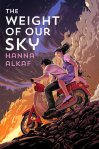


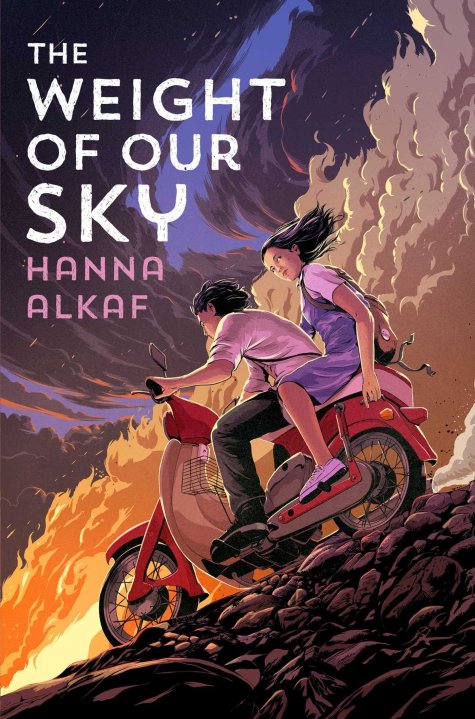
The Weight of Our Sky by Hanna Alkaf

Standard
The Weight of Our Sky by Hanna Alkaf

sky.jpg

This brand new middle school read is like a quick picture of a young girl’s life.  You get to know her as she is, you briefly meet those around her, you see a week or so of her life and then the book ends and you aren’t the same.  You wonder about her, you worry about her, and you find yourself wanting to reach out to those that maybe remind you of her.  Truly a wonderful book of 277 hard-to-put-down-pages that give insight into Malaysia in 1969, OCD, and the beauty of people willing to show their humanity in dire circumstances. My only concern is that I don’t know that there is anything relevant to the typical target audience western reader that would compel them to pick up the book and see it through.  All the reviews online that praise it seem to be from people older than the YA demographic.  Yes, I really enjoyed the book, but I know who the Beatles are, who Paul Newman is, I am a Muslim, I recently went to Kuala Lumpur, Malaysia and saw the diversity of religions and culture, I know people struggling with mental illness to the point of disability and the exhaustion that ensues; yet I don’t know if I could convince my 12 year old daughter to read it.  If I forced her, I don’t know that she would find the book as beautiful and powerful as I do.  I think a lot of it, she simply wouldn’t get, and even less of it she would relate to.  I probably will force her to read it at some point, and I’ll happily revise this review and swallow my assumption about what the youth these days can handle and identify with, but until then, please let me know if you are in the YA demographic and what you thought of the book. Thanks.

SYNOPSIS:

Melati is a 16 year old Malay girl in 1969, living with her mother, a nurse.  Her father, a police officer, has recently died, and with his loss, she has become crippled by OCD and the fear that her mother too, will die.  Counting numbers move from consoling her and keeping the horrific thoughts at bay, to becoming almost like an incantation that must be performed nearly constantly to keep her mother safe.  As race riots between the Chinese and ethnic Malays engulf the city one fateful afternoon when Melati and her best friend Safiyah are at the movie theater after class, watching the latest Paul Newman movie, the reader is shown how even in calm situations, keeping the OCD from consuming her is a full time job.  With no knowledge of treating and even diagnosing mental health, Melati tries to hide her visions and ticks from those around her as it has alienated extended family, and worries her mother.  The conclusion instead is that she is being haunted by a djinn and thus her mother takes her to different imams and healers, to no avail, and knowing that the common treatment at the time is to have those suffering carted off to an asylum and experimented on, something Melati’s mom, Salmah vows never to let happen, Melati suffers alone.

Once the movie ends, gangs enter the theater and Saf and Melati are separated.  Melati is saved by a stranger, a Chinese lady named Auntie Bee, and Saf is left at the hands of a Chinese gang.  Violence erupts, lasting for days, and curfews prevent Melati from searching for her mother.  While Auntie Bee and her family care for her and take in other neighbors, it is made clear that tensions between the two ethnic groups are high and have been for some time, but that good people exist on both sides too.  People who see people as people not just their culture. 

It is a YA book, so there is a little suspension of reality to reunite a number of the characters and give them the happiest ending such a gritty book can muster, but the author does warn the reader before the story begins that this book has violence and anxiety triggers, and death, she actually urges those that will be inversely affect by such things, to not read her book.  And it makes sense, it is graphic at times, and characters also die, and the tone is powerful, and the OCD is intense.

WHY I LIKE IT:

I love that the book embraces all its themes wholeheartedly, there is no happy ending, or magic cure for Melati’s illness, within one family there is racial tension and beautiful examples of selflessness, that two people can save each other but not like each other, and that families can be really disappointing.  At times the presence of the djinn is so annoying that the reader feels how crippling it must be to Melati, as it cripples the story as well, the balance is perfect though, it doesn’t drag the book to the point of wanting to put it down, if anything it makes you cheer harder when her little victories take place.  

I like that there isn’t a huge sappy reunion, because the danger is still going on and the characters presence of mind to the tasks still at hand is actually a subtle, yet powerful nod to the hope that Melati and her mom will be ok.  Can you tell I’m trying not to spoil too much, just suffice it to say, the women in this book are strong and determined and inspiring.

I like that Islam is present and that Melati has to grapple at times with her faith to find where it lies and how she accepts some of the events that have taken place, and the djinn fighting to consumer her. In many teens it is a right of passage, but for her it is amplified by the horrors she has lived through and seen and her own mental state.  Clearly the author is Malay and Muslim as she sprinkles words and phrases and traditions seamlessly into  the narrative that makes it flow with authenticity and vibrance.

I wish at times we knew more about the history of what lead up to the violence, or maybe even more about some of the characters, but alas I think this is Melati’s story and those that have turned their back on her and her mom really don’t deserve the ink needed to share their roles.  Some details about the resolution of the riots or how the country came back together might be nice, but a quick Google search can quell any curiosities.  I appreciate that the writing is smooth and intentional and well crafted and not a distraction to the internal turmoil and story being conveyed.

FLAGS:

Violence, racial tension, graphic death, anxiety triggers.  Melati and Vincent hold hands, it is a bit fuzzy if it is out of reassurance or something more.  There isn’t explicit sexual violence, but Melati does see a soldier pressing his body against a school girl who is of a similar age to her.  

TOOLS FOR LEADING THE DISCUSSION:

I want to do this as a book club, but I don’t know that the students will read it voluntarily.  I may have to bribe them and get permission from the school counselor.  I think they would benefit immensely from the insight in to mental illness and feel comfortable talking about their understanding of it, being it is presented in a fictional format.  I think the violence, because it is rooted in history can be understood and be discussed.  

Interview with the author: http://richincolor.com/2019/02/interview-with-hanna-alkaf-the-weight-of-our-sky/

Author’s website: https://hannaalkaf.com/the-weight-of-our-sky-2/


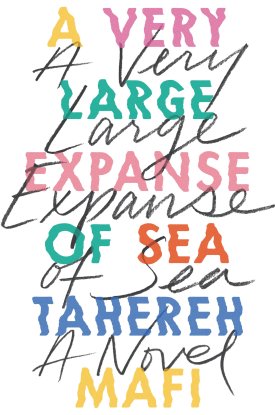
A Very Large Expanse of Sea by Tahereh Mafi

Standard
A Very Large Expanse of Sea by Tahereh Mafi

avleos

The book is often marketed as a Muslim coming of age story in a post 9/11 world.  The contemporary work is semi-autobiographical, but really I think the positioning is a bit misleading.  It’s a love story, and the main character is Muslim, and her environment is awful and she is angry. Its an engaging read, I read all 310 pages in one sitting, but I don’t know that the take-away will enlighten anyone about Islam, or really what it was like to be Muslim in the years after 9/11, I think people will remember how sweet the couple is and wonder how much of it mirrors the author and her husband, author Ransom Riggs (Miss Peregrine’s Peculiar Children), but not suddenly become knowledgable about more than what the main character experiences and endures.   I appreciate that the book challenges the stereotypes of Muslim women, there is authenticity as it comes from a writer who lives it, and I do think it shows evolution of attitudes that teens can benefit from.  The book is not yet in the AR database as it just came out, but I would imagine high school and up.  

SYNOPSIS:

Shirin’s Persian-American family moves a lot.  Her and her older brother are incredibly close as their parents are rather aloof to the day-to-day experiences the kids endure.  That isn’t too say her parents aren’t around, they eat two meals a day together and the parent’s are warm, but Shirin’s brother Navid is a much more present.  The story starts with 16-year-old Shirin starting her 12th new school.  Conditioned to not make eye contact, remember faces, or get affected by the trivialities around her, the reader sees how angry she is as she curses at a teacher that assumes she needs ESL not Honors.  Knowing how fleeting her time in any location can be, as her parents are constantly trying to find better jobs, Shirin doesn’t feel compelled to make friends or get attached to anyone or anything.  This intimidating vibe similarly keeps offers at bay, for the most part.  When she gets paired up with Ocean to dissect a cat, he tries to talk to her, and this throws her off her game.  Most every interaction she experiences at school are people making racist comments and being very one dimensional and bigoted.  Ocean tries to be nice, an attitude so foreign to Shirin that it begins to force her to change.  Simultaneously, Navid, who is charismatic and has no problem finding friends wherever they go, decides to put his and his sister’s dream into action and they start a break dancing club at school.  Three other kids join, and start becoming, not just Navid’s friends, but Shirin’s as well.  

Shirin and Ocean fall in love, despite Shirin fearing what the backlash will be for ocean.  She doesn’t really know anything about him, but feels strongly that all the racial slurs thrown at her on a daily bases will effect him and ultimately make them wish they didn’t pursue a relationship. She draws line after line in the sand, and crosses them all.  Only then does she learn how blind she has been, he is in two of her classes, not just one, he is a year older than her, and he is the golden star of the high school basketball team.  Being that the story is told from Shirin’s perspective, this is surprising to the reader as well.  The town turns on the pair and things get really ugly for Ocean who is willing to risk it all for Shirin.  Threats by the basketball coach, pictures of Shirin without her hijab being taken, accusations of terrorist ties and sympathies all challenge the couple and shape Shirin.

WHY I LIKE IT:

I really like the twist of having the relationship be difficult for the non Muslim, rather than going with the assumed Muslim girl having to sneak around.  Not saying that I support it, but interestingly she never mentions that what she is doing is going against anything religious.  She mentions twice that her parents wouldn’t like her with any guy, and that they view her as a child still, but she doesn’t explore Islamically any boundaries regarding their relationship.  She hides talking on the phone to Ocean, because her parents are adamant she gets enough sleep at night.  That is about it.  Shirin discusses that she wears hijab like an armor that she gets to pick who she shows her hair too.  I love the strength in that, but wish there was a bit of doctrine to back it up too.  At one point a Muslim, non hijabi, at school calls her out for wearing hijab and having a boyfriend, but she essential tells her it is none of her business, which it isn’t and who is to say that one sin is worse than another, but still it befuddles what exactly Shirin believes and why.  The book just paints her as a Persian Muslim, but never explores what that means other than the superficial outward appearance.  They do fast in Ramadan, no explanation about why is given, just that they not eat or drink during daylight hours, and right near the end, Shirin remarks how her mom asks her and her brother every morning if they have prayed and they lie and say yes, their mother sighs and tells them to make sure they pray the afternoon one, to which they lie and agree, only to have their mother sigh again.  AstagfirAllah, that is awful lying, and lying about Salat, but it is so real, I audibly chuckled.  

I like that the parents aren’t harsh, they just seem disinterested.  I didn’t want to read another book about the parent’s being the gatekeepers and bad guys, so that was really refreshing.  They mention they don’t celebrate Christmas, but they have an open door policy on Thanksgiving for any friends wanting to come.  I did hope for a bit more about them, why they don’t talk to the kids about moving, what makes them tick, because really they seem to have a solid relationship with the kids, they are just clueless to their social experiences and school environment stresses.

I love the growth and self reflection of Shirin, she holds a mirror to herself and she and readers are better for it.  She has to realize that she is doing so much of what she is accusing others of doing.  I love the support and genuine concern of the breakdancers and her brother.  It resonated to me as a girl with an older brother and the relationship feels very genuine. I just wanted to know more about Navid. 

FLAGS:

There is a lot of cursing. kissing, hand holding, romance, lying, and ditching school.  There is a brief mention of graffiti being sprayed.  There is racial slurs, threats of violence, violent physical outbursts by people of authority.  When a student throws a cinnamon roll at Shirin, Navid and his friends beat the kid up severely, it isn’t detailed, but it is mentioned.  Ocean  also gets suspended for a few games for a fight he engages in, and there is some detail of Shirin getting jumped in a previous city for wearing hijab.

TOOLS FOR LEADING THE DISCUSSION:

I don’t think I could in good conscience present this to a group of Muslim students.  I wouldn’t want them to think I was endorsing the violence and language and romance.  Like so many books of the genre though, if someone found it and read it on their own, I’d love to chat with them about it, as it is well written.

Youtube video about the book by the author: https://www.hypable.com/tahereh-mafi-a-very-large-expanse-of-sea-tour/

Escape from Syria by Samya Kullab, Jackie Roche, and Mike Freiheit

Standard
Escape from Syria by Samya Kullab, Jackie Roche, and Mike Freiheit

9781770859821.jpg

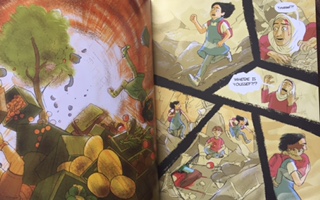
I have read a fair amount of fictionalized accounts of the war in Syria, the journey of refugees, and their resettling in various countries, but this was the first graphic novel on the subject that I have seen, and I was excited to wait my turn behind my kids to read it.  My 7th and 4th graders read it in about 20 minutes and said they really liked it, knowing that it was a quick read, I wanted to take it in slowly and examine each picture to grasp the full message that the author, a Lebanese journalist, was conveying.  Definitely meant, for ages 5th grade and up because of the content, I appreciated the book more than I loved it.  It seemed rather choppy and the fictionalized parts come across just as a front to convey facts.  The book definitely is a great introduction to the conflict, and the format will appeal to a broad range of individuals.  

SYNOPSIS:

Told from the voice of Amina, a bright young girl who rushes home to show off her latest A grade paper to her family, is met instead by a bomb striking the beautiful peaceful neighborhood.  The images on the first page are destroyed as her younger brother Youssef must be located in the rubble and debris.  Now in Canada, Amina tells the story of their journey from Aleppo.  The bouncing around of time, provides some context to how life became under the rule of Bashar al-Assad, how checkpoints and emergency rule changed everything about Amina’s life.  As war creeps in it isn’t just inconveniences and fear, but also death, as further shown through Amina’s uncle who has joined the rebel army.  The family decides they need to flee to Lebanon and truly believe it will be just for a little while. 

IMG_2082

They rent an apartment for a year, but when they cannot afford rent they relocate to a refugee camp, where they stay for two years.  Amina’s father is determined that Amina stays in school but as work remains scarce and Youssef’s health continues to deteriorate.  Amina is forced to take a break from school to try and find work.  Eventually her father arranges to go by raft to Europe to try and start a new life and bring his family there once he is settled.  The terms of the loan to pay the smugglers is steep and when the raft doesn’t make it too far before tossing its passengers, Amina’s father Walid is forced to return to Lebanon unsuccessful. 

It isn’t until Amina’s family considers, like many other families in the camp, to get her married to keep her safe.  That Amina upon picking up some aid at a UN reception center, spills everything to a worker there, and a week later the UNHCR contacts the family to help move them to Canada.  The readers at this point I would assume are relieved the family will be safe, and are surprised when the family isn’t sure if they want to leave.  Syria is there home, and before the mom will agree to anything, she wants to go back to Syria to see her newborn niece.  Once in Syria, she sees that her home is no more as she remembered it, and agrees to be resettled anywhere.  Through the same flashbacks and flash-forwards in time, we also see that life in Canada is not easy.  The family is welcomed and helped and grateful, but it isn’t yet home, and the ghosts of Syria are still present.

WHY I LIKE IT:

I kind of like how choppy it is upon further reflection.  At first it annoyed me, but as I thought about it more and more, I have decided I like that it isn’t easy and smooth and fleshed out, the tone of the unknown comes through by not over narrating the emotions and circumstances.  I also like that everything that happens to Amina and her family is anchored in reality and the footnotes, references, and facts are all in the Endnotes.  Having said that, I wish their was a little more character development, it reads like a bunch of facts strung together and connected by this fictional family.  There isn’t anything wrong with it, but a little more warmth for the characters would have added a beautiful level and would not have been hard to come by at all.  There are so many stories from this conflict out there, and the reason they resonate with so many isn’t from all the facts and numbers, but often from the individuals that make the numbers real and haunting.  I felt like this book fell short on the human element unfortunately.  The only character I really felt had some heart, was the dad, he was awesome, and his love for his family and determination for his daughter’s education was definitely felt.

The book does drop some acronyms and political alliances to add context but not overwhelm the reader.  It definitely hints that there are a lot of groups vying for power, and control: Assad, Russia, ISIS, US, rebels.

IMG_2084

I love that the flashbacks to pre-war Syria are so relatable.  Kids need to really understand that we are all so much more alike than different.  Not just in our hopes and dreams, but even in our daily lives.  The characters in the book are the same as us, their lives look great,  maybe even better.  They have friends, and families and jobs, and cell phones, they also unfortunately, have war.

There were a few surprises for me, for example that buses between Lebanon and ISIS held Syria took/take people back and forth.  Similarly,  I was surprised to see that the punishment of smuggling cigarettes was being beheaded, but maybe more surprised that the book included it.

IMG_2083

It is reassuring for readers to know that the family survives, but the harrowing journey of seeing body bags, cutting costs to survive, risking it all to trust smugglers with fake life jackets, paint pictures of a journey that will stay with the reader.  The book doesn’t talk down to anyone, if something seems too simplistic, it almost encourages the reader to go research more about it.  

There isn’t any mention of Islam or religion, the females wear hijab, that is the only indication along with their names that they are a Muslim family.

FLAGS:

The violence, is pretty haunting and while the images and text aren’t graphic, the splatter of blood and guns and death are very present.  There is also mention of cigarettes.  While not explicit and possibly over the heads of some readers, the book does show that the loan sharks would be willing to take Amina, “Something nice and sweet…like you,” to help pay off the family’s debts.  A former classmate of Amina also invites the family to her wedding.  At 13 Amina’s family is also considering getting her married as a way to help keep her safe.  

IMG_2085

TOOLS FOR LEADING THE DISCUSSION:

This book would be better in Social Studies class more than in a Language Arts one. It would be a great supplement to share even, when discussing current events.  Its a quick read, a factual account and a powerful one at that.  

Book Trailer: https://www.youtube.com/watch?v=AsZZwxM7YyQ

Publisher’s Synopsis: https://www.fireflybooks.com/index.php/catalogue/product/11566-escape-from-syria

Amal Unbound by Aisha Saeed

Standard
Amal Unbound by Aisha Saeed

amal unbound.jpg

This book was suggested to me and I was thrilled to find it at the public library so quickly after its May 8, 2018 release date.  I love that it is an AR 4.2 and 226 pages about a girl standing up for her self, determined to be educated, and facing whatever society, and culture, and circumstance throw at her.  The protagonist is 12, but I think most middle school readers will find the story a bit too idyllic, perhaps even too simplistic and neat.  I really think the AR level of 4.2 is spot on in terms of writing level, interest, and story telling: 3rd through 5th graders will benefit the most from this inspiring, memorable and informative tale.

SYNOPSIS:

Amal lives in a small Pakistani village.   The book opens with her begrudgingly having to take time off from school, as the oldest, to help her mother who is about to deliver her fifth daughter.  The stage is quickly set to show a supportive father, but the cultural stress involved in educating a girl is incredibly strong.  The priority is to care for the home when push comes to shove and this fight is simplified in the book, but not completely belittled.  Right away we also see some class divisions with servants and landowners and the various positions in between.  It is easy to judge those with money as being evil, but the author does show some nuances in character aside from wealth and position.  As Amal’s mom struggles with recovering after the baby, it is decided that Amal will miss more school.  This devastates Amal who dreams of being a teacher.  Burdened by keeping up the house and carrying for everyone’s meals, laundry, and watching her younger sisters constantly, frustration mounts and she snaps when an arrogant man tries to take her pomegranate in the market.  Her simply saying no, is the catalyst that changes her life as the man she stands up to, Jawad Sahib, is the wealthy land owner everyone in town is indebted to.  Saved by his mother, Nasreen Baji, who is in need of a personal servant, Amal is now forced to pay off an impossible debt to a cruel powerful family. 

In  many ways the story doesn’t really get good, until Amal enters the Khan family’s world, about 50 pages in to it, but obviously the character building and detail is necessary, so if you find your kid is getting a bit bored, encourage them to keep going.  

Once, she arrives at the Khan compound, she begins to make friends, and enemies, and similarly see just how ruthless Jawad Sahib is, and can be.  As she finds her own voice and realizes her own role in determining how others treat her, what her future holds, and what power she does have, she is forced to wrestles with the choices in front of her. Ultimately, the reader will cheer for her to take a stand and be bold in doing what is right, no matter the cost.  And while one can guess, because of the target demographic, that it has a happy ending, I won’t spoil the climax, the resolution, or outcome of the young heroine.

WHY I LIKE IT:

I love that despite the themes, the story isn’t depressing, in many ways it is informative and inspiring. I think the fact that things are not left to ponder but clearly articulated, has its merits in a book for elementary children who might be overwhelmed by the cultural aspects to think critically on their own.  At the beginning, with the birth of yet another daughter, the biggest concern is that the mom is depressed because she hasn’t had a boy.  The mom even apologizes to the dad about this.  The neighbors, friends, everyone seems so upset about it, but Amal doesn’t understand why the women particularly seem disappointed, when they themselves were little girls once, and this simplistic point of view on such a complex and real issue, is so spot on and obvious, I loved it.  The mom and dad point out that it is God’s doing and they clarify that they are not sad the baby is a girl, and to me it seems obvious the mom is suffering from postpartum depression, but the book only describes it, it doesn’t identify it.  I also love that there is perspective on how while Amal is in forced servitude and thus not free, either is her female boss, who is unable to go visit her family, or to garden.  This helps amplify that even the wealthiest woman, is still limited to be truly free in the context of the character’s world.  

I like that the book is culturally authentic and not judgemental.  There are strong females, supportive male friends, and plenty of details to show that the author is writing about what she knows, and that she loves her culture.  Islam is mentioned only a few times with regards to prayer time, but nothing more.  There is nothing about praying for anything specific, or covering, or religious beliefs, practices, or traditions.   The book like the author’s first book Written in the Stars, almost oddly leaves religion out, and stresses culture.  Because this book is for a younger audience, it isn’t as obvious, and if I didn’t write reviews about books I probably wouldn’t notice.  

The presentation of culture, the idea of indentured servitude, and females being educated is balanced and explained pretty well.  At most many of the readers will know little of Pakistan, but may have heard of Malala, and the author talks about her in the Author Note.  I like that this book shows a fictional strong female in a similar vein as Malala, but also shows that it isn’t an outside force, the Taliban, preventing her from an education, but in some ways a whole societal view.  I think this expansion of paradigm is really the most powerful thing about this book.  It is important to understand that people may want their daughters educated, and opportunities may be available, but sometimes more is needed.   A lot more to change tradition, on a lot of different fronts.

The book also does a good job of showing some of the paradoxes that exist in developing countries as well: Amal rides in a car for the first time, but also is handed a cell phone from her mom, she knows all about email but has never used a computer.  For readers to see that somethings are very similar to their own lives, and some things are foreign, will make Amal and what she stands for have staying power and relevance, long after the end of the book.

FLAGS:

There is talk of physical violence when people are murdered, crops burned, and Amal is slapped.  There is some lying, but the truth comes out. Overall: clean.


TOOLS FOR LEADING THE DISCUSSION:

I would absolutely present this book as an Elementary Book Club selection and I would encourage teachers to use it as a novel study.  There is a lot of perspective to be had from this book, and its clean simple style will keep the keep points in focus.

Author’s website: http://aishasaeed.com/amalunbound/

Q & A with the Author: https://www.publishersweekly.com/pw/by-topic/childrens/childrens-authors/article/76814-q-a-with-aisha-saeed.html

Discussion Guide: http://www.penguin.com/wp-content/uploads/2018/05/AmalUnbound_Brochure.pdf

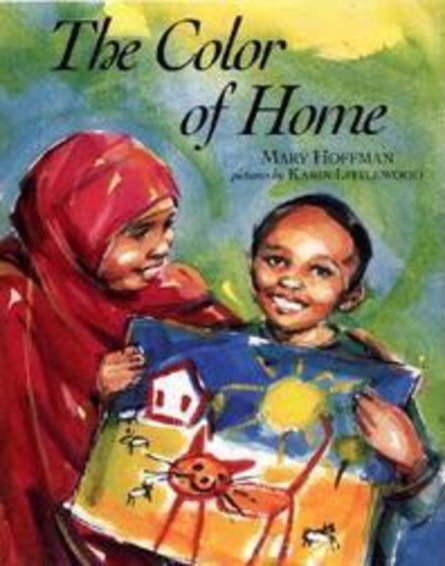
The Color of Home by Mary Hoffman illustrated by Karin Littlewood

Standard
The Color of Home by Mary Hoffman illustrated by Karin Littlewood

color of home

This powerful book about Hassan’s first day at school is a bit graphic, and incredibly important.  While it is a picture book, it is definitely not meant for small children.  The rich water color illustrations and the impactful text match the AR level 3.6 and would really appeal to thoughtful 2nd through 4th grade students.

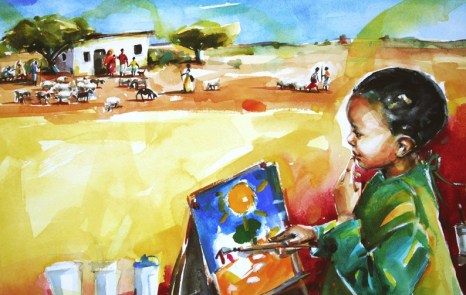
A refugee from Somalia, Hassan finds it “tiring remembering even a few English words.”  He misses the color of Somalia, his cat, the warmth of the sun, and the freedom of learning out doors.  He doesn’t miss the violence though.

colour3(1)

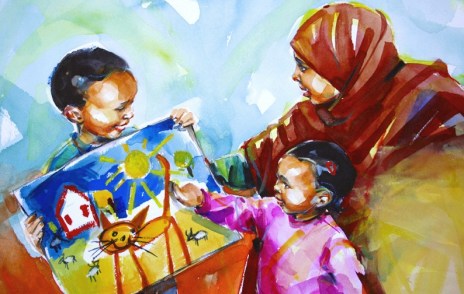
When it is time to paint, Hassan paints his home and his family, all 9 of them, and his pets, in bright happy hews, much to the delight of his teacher.  But then, Hassan, engulfs his house with the red paint of flames, smudges out his Uncle Ahmed when the black bullets that take him down, and Hassan communicates his sadness to his teacher.

Hassan doesn’t take his picture home, he knows it will upset his mom and little sister, Naima.  The next day, a translator comes to help Hassan.  Fela is Somali and wears a black hijab, like Hassan’s mom, but western clothes, a new concept to the young boy.

color

Through Fela, Hassan opens up to his teacher and explains what it was like when the soldiers came and he had to hide under the bed.  How they had to leave without any of their stuff, including his beloved pet cat Musa.  All they could take was his father’s prayer rug and the Quran, as they set off on foot in the night.  He tells about leaving his grandparents and cousins behind and being scared on the plane.

Being able to share his fears, seems to help as he paints a new picture to share with his mom.  This one filled with his animals, and not with fire and bullets.  There is hope for Hassan as he looks forward to adding color to his new life and reminds himself to learn the english word for “home.”

colour2(1)

The book  is great for seeing the experience through Hassan’s eyes, and taking the reader through some of his adult like fears, and childish stresses.  Older kids should appreciate that what he has lived through is horrific, but his understanding as a child is slightly limited.  It should increase empathy, compassion, and kindness.

While the illustrations are rich and detailed they are very realistic.  This adds to the somberness of the book, and keeps this work of fiction a very real reminder of the world and what trials so many go through.

The characters are visibly Muslim, but there is no mention of religious doctrine, and readers may not know what a prayer rug is or a Quran.  They will be able to use context clues to figure out hijab, but there is not a glossary in the back.