Tag Archives: Thriller

The Matchmaker by Aisha Saeed

Standard
The Matchmaker by Aisha Saeed

There is no Islam, save being told a wedding took place in a mosque, in this 320 page adult book by a Muslim author.  The thriller, mystery, romance, is fairly clean, save some drugs, killings, kissing, and normalized dating, yet I would probably be fine with mature teens reading it, if so inclined.  By the end, I enjoyed the book, but it took me three attempts to get past the 30% mark as the opening was painful with its numerous characters being name dropped, the setting being established, and getting the characters into position.  But then slowly the exposition gave way to story telling and intrigue, and the second half was a decent read.  Honestly, my biggest problem with the book is that I just didn’t like the main character, or any of the characters really, and I don’t know why.  They didn’t have some clear flaw or annoying habits, they just felt distant and bland, which resulted in the plot carrying the book, and me not really caring if the protagonist was killed or harmed, I know- harsh.  I cannot deny though, that what kept me reading was to see who was behind it all and I did figure it out, but continued on just the same to be sure, and that is a testament to the author’s writing skill, even if it took a minute for the pacing, plot, twists and climax to pull me in.

SYNOPSIS:
Nura Khan runs an elite matchmaking service in Atlanta, from hands on to a dating app, her and her team match people of all backgrounds and faiths.  She herself has a long time friend who acts as a fiancé for image purposes, and a recently retired aunt who’s bad days have meant family dynamics have changed.  As a third generation matchmaker, Nura is in charge and knows what she is doing, until suddenly her image, her reputation, and her matches start faltering.  Not confined to just heartbreak, there is also stalking, threatening notes, kidnappings, and attempted murder, which suddenly thrust Nura into a world she is ill prepared for, and one that seems to put her in the crosshairs of someone determined to see her demise.

WHY I LIKE IT:

It wasn’t a heavy thriller or heavy romance, it was an easy read that didn’t “other” desi culture and I found that refreshing. That being said, I always wish her books had Islam in them.  I also liked that the climax and second half honestly didn’t feel overly forced, I’m not a writer so take it with a grain of salt that I complain that the beginning was dry and too much telling, but then the second half flew by and loose ends were more or less tied up in a satisfactory way. I’m aware that the second half was a result of what was a established in the first part, but none-the-less I hope future books will make the two halves less cumbersome and inconsistent. I also really hope future books will have more character appeal.  There was a lot of potential to care deeply about the main characters, from the aunt, to the best friend, to Nura herself, but they lacked spark, and sadly just felt like vehicles for a plot that wasn’t dependent on them, their experiences, their flaws, and their personalities.

FLAGS:

Dating and relationships of all faiths, persuasions and labels, kissing, attempted murder, killing, plotting, lying, scheming, kidnapping, drugging, physical abuse, assault, deception.

TOOLS FOR LEADING THE DISCUSSION:

With no Islam I wouldn’t do this as a high school book club, but amongst friends it would be a fun group read.

The Hysterical Girls of St. Bernadette’s by Hanna Alkaf

Standard
The Hysterical Girls of St. Bernadette’s by Hanna Alkaf

This 352 page young adult mystery, thriller could possibly be classified as magical realism, or speculative fiction, I’m not really sure, but I do know, that my expectations were really low, and I was so pleasantly surprised by how the story pulled me in and kept me engaged.  Told primarily by dual points of view, Khadijah and Rachel, the book offers commentary on sexual assault and believing victims.  The book starts with a trigger warning of “ghosts and monsters, some of whom hide beneath human faces. It includes discussions and descriptions of sexual assault, trauma, and PTSD,” before diving in to a prestigious Malaysian girls school full of secrets, hysteria, and a past that seems to be repeating itself.  There are no religious identity crisis or issues, the student body is diverse and it is a non-issue, Khadijah recites Ayat ul Kursi, makes time to pray, and wears hijab as she tries to figure out what is making the students at St. Bernadette’s scream, what happened to those that have gone missing, and how to overcome the trauma that has made her stop speaking.  The symbolism is solid, the book starts out with the screams, but builds on it by adding backstory to the main characters, mystery with the disappearance, and numerous red herrings to keep the reader guessing.  I told myself to get to the midpoint before calling it quits, but once I was there, I read the second half of the book in one sitting. I appreciated that the book was unique, there was no relationship side stories, the cultural authenticity heightened the reading experience, and that I understood the haunting magical elements.

SYNOPSIS:

St. Bernadette’s is an old prestigious all-girls school, but one day a chain reaction of girls screaming starts and the hysteria doesn’t seem to be stopping any time soon.  When Khadijah, who is dealing with her own trauma of being sexually assaulted by her step-father, starts to look into the causes, more questions than answers arise.  In efforts to protect her younger sister, Khadijah discovers not only has this happened as their school before, but it doesn’t stop with the screaming, and the shadows, last time a girl went missing.

Rachel’s life is controlled by her single mother, who is determined that Rachel is successful and a reflection of how perfect and successful they are, despite, Rachel’s father abandoning them.  When in an act of rebellion Rachel signs up for monologue competition, she plans to get into character, not to become the character.  As Rachel starts to lose her self to the girl with pink lipstick and white ribbons in her hair, she starts to notice sights and sounds around the school, but when she falls victim to the screaming hysteria herself, will anyone care enough to save her?

WHY I LIKE IT:

So often with magical realism, I honestly don’t get it, so I’m not sure if my excitement of having it all be clear means the book was a bit simplistic, if I’m getting better the more of the genre I read, or if the writing was just good.  If I’m being honest, it is probably a little bit of all of it.  Often with the author’s book, the story is really good, until it is not, and I honestly feel like this is her best book yet, with the threads coming through, the ending feeling satisfying, the pacing being consistent, and the plot not getting lost on tangents and over explanation.

I loved the symbolism of screaming and it being largely brushed aside as society’s collective apathy to victims of sexual assault.  No one at the school has answers, no one likes questions being asked, everyone just wants to carry on as if nothing is happening, and the juxtaposition of the silence and the hysteria for me was powerful. A few plot holes were the result of telling over showing such as the case of the Khadijah and her sisters relationship, but that Khadijah stayed largely silent throughout the book, did not mean she was unable to communicate or not present, and I thought it was shown in a meaningful way.

I liked that the overbearing mom, with high expectations, and lacking emotional maturity was not from the Muslim parent, at least in Western literature, that is a common trope.  But it is worth noting that presumably the rapists mentioned in the story are Muslim.  Their faith is not a factor, but I noticed, and so I do feel that should be shared.

FLAGS:

Sexual assault, ptsd, rape, kidnapping, trauma, hysteria, lying, ghosts, monsters, magic, fear

TOOLS FOR LEADING THE DISCUSSION:
I think this would be a great high school book club read.  The conversation about sexual assault, both in the story and in real life would be important to have in a safe space.  The triggers would require some evaluation if the book is a good fit, but I think the elements that unfold and the commentary on expectation, honesty, trauma, monsters, etc. would create incredible discussion.

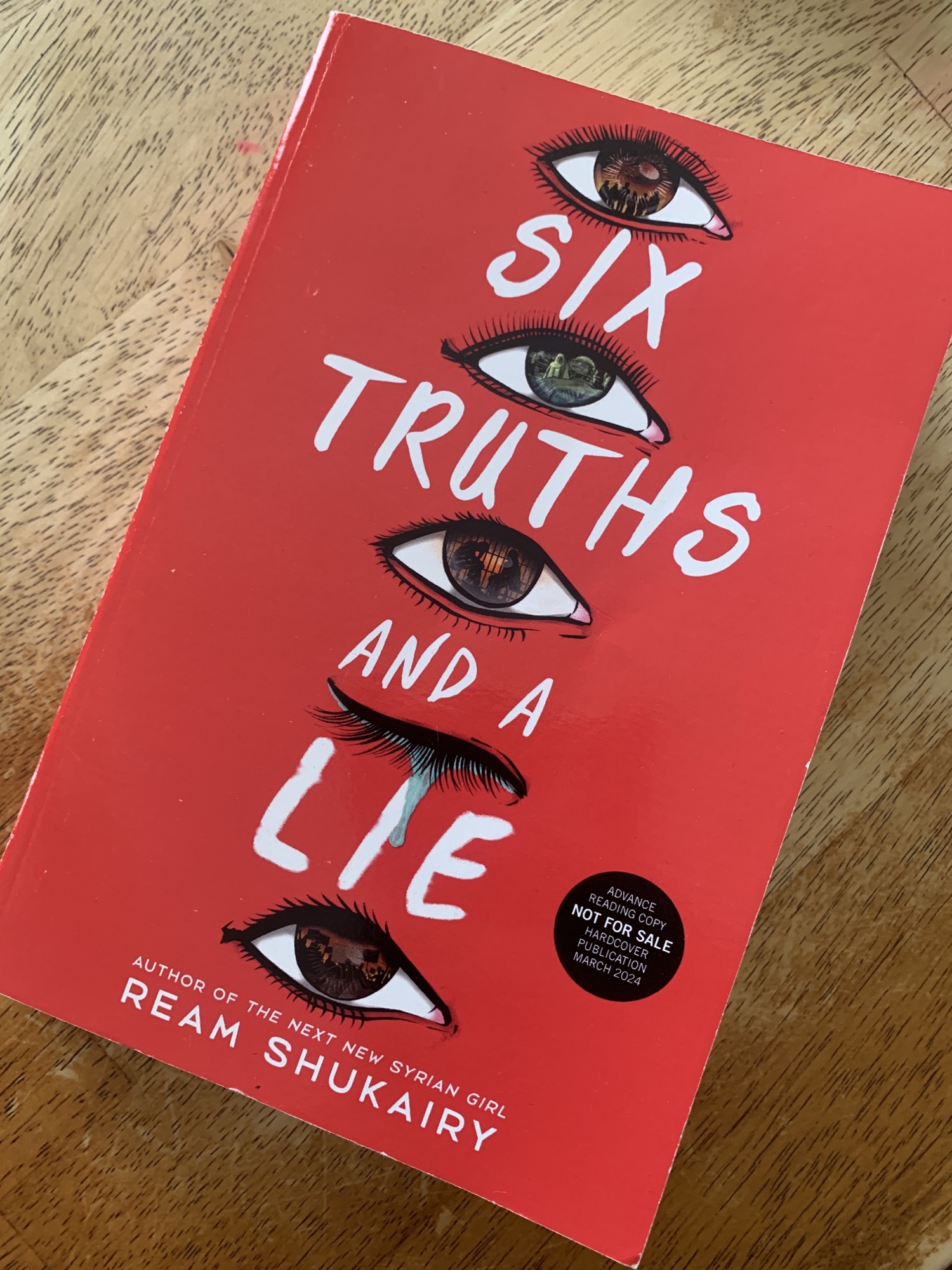
Six Truths and a Lie by Ream Shukairy

Standard
Six Truths and a Lie by Ream Shukairy

Woah baby, that was a wildly fantastic ride of a read.  The very first page grabs you and makes you sit up and pay attention.  I have never been so happy to sit in a waiting room so that I could read in peace.  This 387 page book is mature YA, I was gifted the knowledge prior to reading that there is a line that is toed, possibly stepped on, but not carelessly crossed, so I will gift that knowledge on to you, so that you might enjoy the story without that anxiety. Told from numerous perspectives, a group of Muslim teens find themselves arrested for an act of terror.  Strangers from different schools, different backgrounds, and different dreams for their future, are fiction, but their stories, their secrets, the broken system that they find themselves in, all feels very real.  The plausibility and commentary from an OWN Muslim author is incredible, I do wish their was more spiritual centering, Islamic framing, or even a more Muslim conscience present. Some of the characters do discuss hijab and one does find solace in prayer, but none of them really pour their heart out to Allah swt in the isolation of their cells, and in the predicament they are placed in, and it seems like they would.  Ultimately though the writing is remarkable, it has been a long time since I was truly tempted to skip ahead and read the last few pages because my heart was racing.  There is just one storyline thread that is so overly emphasized that comes close to a haram line, that I wish was a little down played so that I, as an Islamic school librarian, could encourage younger teens to pick up the book and dive in.

SYNOPSIS:
It is the fourth of July, and the MSA kids from the local different high schools are gathering at the beach for bonfires, fireworks, and socializing.  Everyone present will witness a crime, six teens though will be accused of committing it.  Qays, the Palestinian golden soccer boy who can charm everyone and anyone.  Nasreen, the outcast from a private Catholic school there to meet someone.  Samia the hijab wearing social media star. Muzhda the Afghan refugee with undocumented parents.  Zamzam the girl with a singular dream to be a doctor, and Abdullahi, the quiet EMT in training.  Six strangers whose histories and alibies link them to the outside world, but leave them skeptical of one another as they face charges in a world not concerned with the truth.

WHY I LIKE IT:

I love that the characters are Muslim and feel so real and developed. The characters are not tropes or their families stereotypical.  They know what Islamophobia faces them from others, they know what internalized issues they are dealing with, and they are not having a religious identity crises amidst everything else they are experiencing.  The writing allows each voice to be unique and clear, which is quite impressive as there are a lot of perspectives that move the plot along.  It is really hard to write a review that doesn’t spoil the book, so yes I’m being vague, and you are welcome.

FLAGS:

There are a lot of profanities not just when the stakes are high, but normalized as well throughout.  There are close relationships between boys and girls.  They take about dating.  There is weed, and the legalities of using, being in possession, and being high.  There is lying, death, incarceration, Islamophobia, some physical abuse mentioned.  There is a story line of a girl that doesn’t know if she is attracted to girls, she doesn’t act on it, but it is something that has tangled up her alibi and she choses not to explore it, but it keeps coming back up.

TOOLS FOR LEADING THE DISCUSSION:

This would be an awesome mature YA book club, just like some of the characters are being held in juvie and some being tried as adults, I think for Muslim readers a little older will benefit and be able to process, discuss, and see themselves in the book.  The book mentions that it could happen to anyone, and for a Muslim audience, to recognize and discuss that concept would be beneficial and engaging.

Hollow Fires by Samira Ahmed

Standard
Hollow Fires by Samira Ahmed

hollow fires

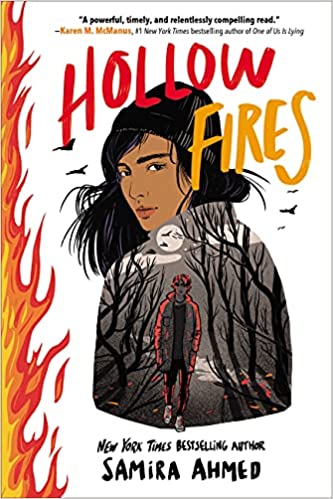
Every YA Samira Ahmed review I have written I remark at how amazing the premise is, how flat the characters are, and how forced the romance feels.  I am so happy that I did not dismiss this book, and when I return this copy to the library, I will be eagerly awaiting the purchased one to arrive so as to be placed on my book shelf.  There is connection to the protagonist, she is even likeable, the brief flirty romance is natural and not heavy handed, and the only thing better than the premise is the contemporary commentary.  The multiple writing styles, lyrical voices, and thriller/mystery elements make this 404 page teen book hard to put down.  Islam is present in different forms in different characters. There are very gentle elements of faith that really contrast the chaos of the plot and radiate peace: fajr salat, wanting a janazah, identifying as Muslim.  And while the book says 7th grade and up, I think it is more suited for high school readers.  There are strong themes of islamophobia, media, and privilege, there is killing, murder, a gay Muslim, a ghost, assault, language, planning to go to a school dance, racism, vandalism, misogyny, Halloween, relationships, hate crimes, and abuse of power, to name a few reasons that I think older readers (and adults) will appreciate and understand more deeply than most middle schoolers, how remarkable this book truly is.

SYNOPSIS:

Safiya is in her senior year at her elite private school, she’s a scholarship kid, and her passion is journalism.  As the editor of the paper she is unafraid to challenge the principal and spur others to action.  When a fellow Muslim kid, Jawad, at a nearby local school gets arrested for bringing a makerspace jetpack to school, it bothers her.  When Jawad goes missing, and events at school and in the community start putting Muslims and other minorities on edge, Safiya finds herself collecting bread crumbs and getting closer to the truth.  Throw in vandalism to her parents Desi store, smoke bombs in the bathrooms, swastikas graffitied at school, and a dead boy whispering to her and you have yourself an action packed thriller that hits close to home.  When the circumstances of how Jawad’s body are found and the clues start to fall in place, Safiya and readers will find themselves rushing against the clock.  Her to safety, and readers to see if their suspensions are correct.

WHY I LIKE IT:

I love, love, love how each chapter starts with a fact, or a lie, or an alternate fact, or truth, I keep rereading them. They are so clever, and thought provoking as the short lines stare at you in black and white and get under your skin.

I don’t think the book explains if a ghost in Islamic doctrine would be possible, but I do like that the book on more than one occasions tries to explore it.  I think for me acknowledging that it doesn’t fit, but that jinn exist and that maybe it just is what it is allowed me to overlook it and read the story for what it is.  I appreciate that the author gave the characters presence of mind to try and view it through an Islamic perspective and see answers that way, even if it did come up short.

I love the parents in the book, all of them. There is no oppression or force or lack of understanding, from the parents which was a nice break from the normal YA Muslim family dynamic presentation.  As a result perhaps, Safiya has never gone to a school dance, but when asked to Winter Formal she doesn’t have any religious or cultural hesitation in agreeing to go.  Part of me wishes it would have crossed her mind, but I think the other part wins out- that for her it is a non issue and that her view and practice of Islam is just different than mine and that is ok.  I think part of the reason I am ok with it is because there is no overly forced make-out sessions or drawn out angsty scenes.  There is a kiss on the cheek and one on the forehead, a tiny bit of snuggling, and maybe a handhold.  Suffice it to say it isn’t overboard and extreme, it never says that Safiya prays, she notes her parents do, but it seems she goes to the mosque, she identifies as Muslim and she is unapologetic, so by moving the choice to her to go or not go to a dance allows Islam to stay Islam and her actions to stay her actions.  A subtle difference I’m sure for most, but for me a very powerful one in a book that is about more than Islam’s view of premarital relationships.  I think it is also promising in that it shows how far literature has come that these nuances can exist without being overly explained or made into black and white issues.

In a similar vein is how the three Muslim characters are presented.  At one point it says they all go to different mosques because of geography or ethnicity, but to them they are just Muslim.  This includes Usman a kufi wearing Shia Hazara from Afghanistan who is always crushing on his tennis partner, or some other guy.  There is nothing more said about it, and the book carries on.

The style of the writing between the alternating voices of Safiya and Jawad are nice, but I particularly liked the inclusion of the interviews, articles, excerpts, and court transcripts.  The change of pace made it feel like it was more than a fictionalized story about the characters at hand, and a societal trend that is impactful to us all.  Which of course is a theme of the book, and was a nice way to show and convey that sentiment without having to say it over and over again to be heard.

FLAGS:

Copy and pasted from above:  There are strong themes of islamophobia, media, and privilege, there is killing, murder, attempted murder, a gay Muslim, a ghost, assault, language, planning to go to a school dance, racism, vandalism, misogyny, Halloween, relationships, hate crimes, and abuse of power. The hand of Fatima symbol is apparent in the marketing of the book, it isn’t a huge part of the story itself.  It is a key chain that was given to a character and then passed on with a message that it will keep you safe.  Clearly it doesn’t keep you safe and the irony and the passing of it from one character to another (I’m really trying not to spoil anything, can you tell) is the only significance it has on the story.

TOOLS FOR LEADING THE DISCUSSION:

I have already told my daughter she needs to read the book this summer after finals (she is 15), and while I would love to do this as a high school book club book, I don’t know that the ease of going to a dance, the normative presentation of a gay Muslim, and the ghost as a main character would be widely accepted at an Islamic school.  I think I will suggest it to high schoolers that I know, and would do so confidently as the writing, overall messaging, and critique on the media and privilege are so well executed in a compelling story, but I think the flags might keep me from “teaching” the book or shelving it in the school library.

Ace of Spades by Faridah Àbíké-Íyímídé

Standard
Ace of Spades by Faridah Àbíké-Íyímídé

spades

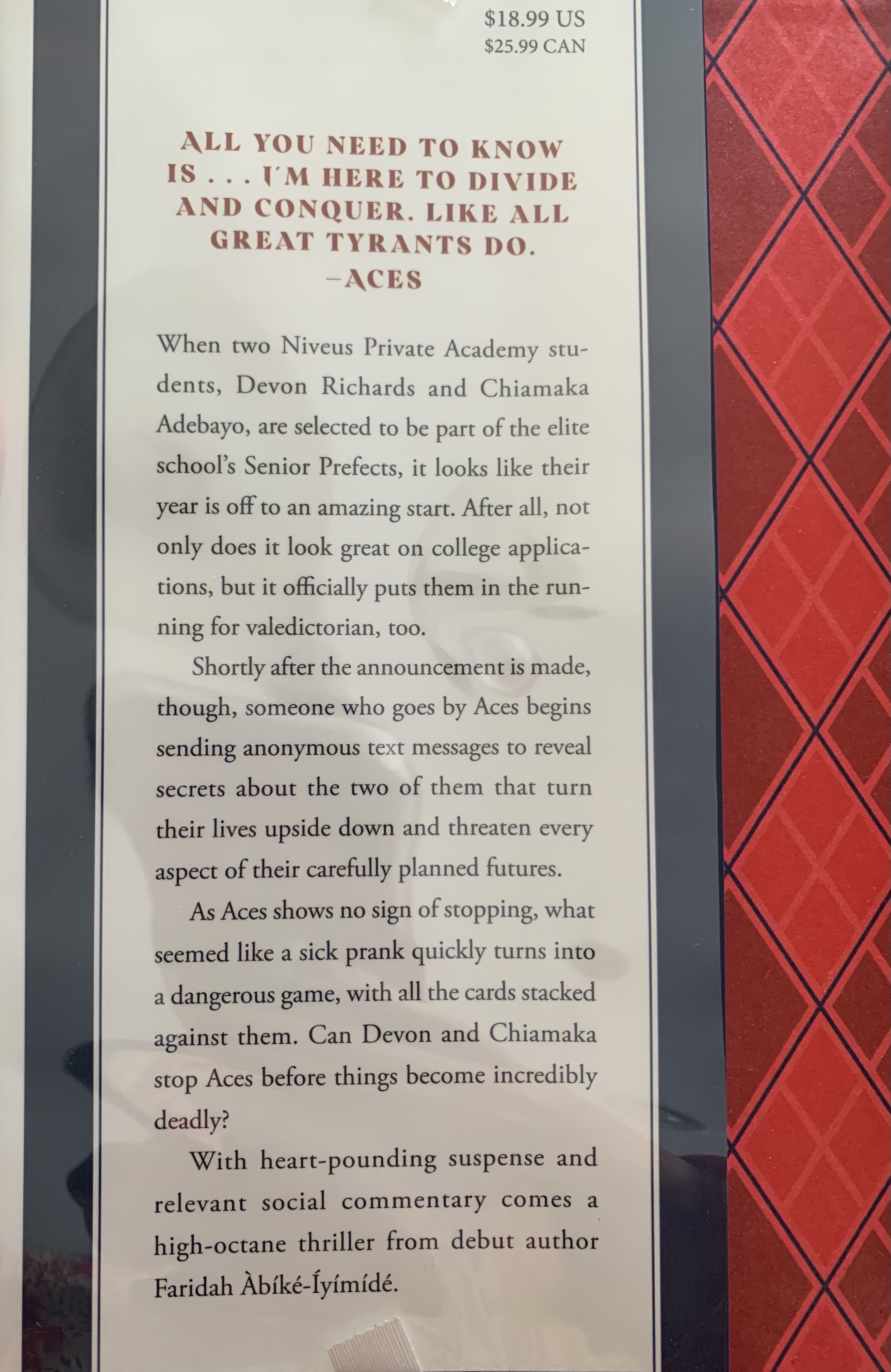
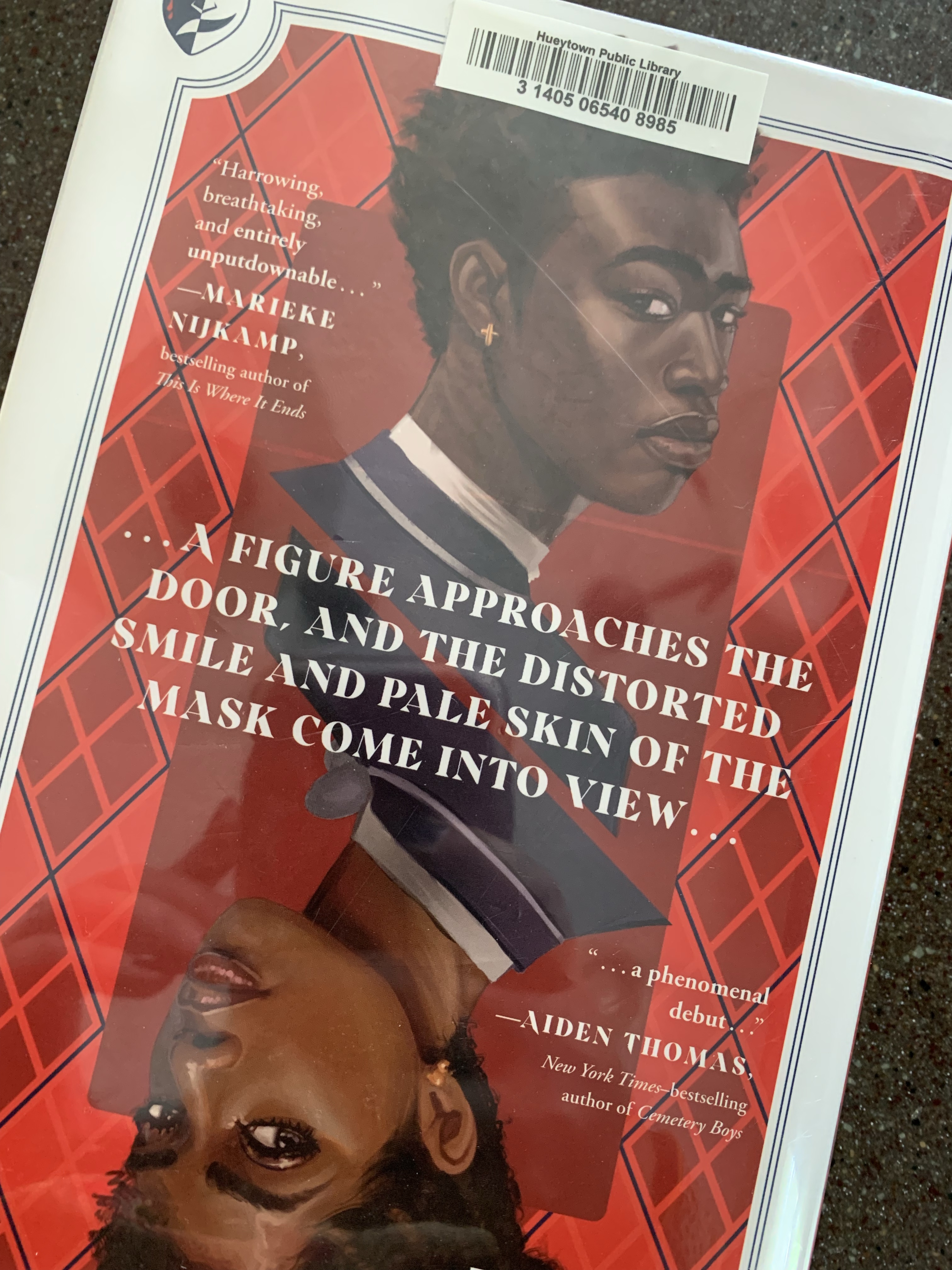
I had heard about this 420 page YA thriller and how it was written by a Muslim student at University and the seven figure book deal that she earned. It is constantly described as a combination of Gossip Girl and Get Out, having never seen either of those, I relied on the back of the book and the inside flap to see if it was something I would like to read and suggest my young teenage daughter, (and followers to read). Based on the suspense teasing and plot involving racism, I figured a contemporary YA book set in high school would have some relationship, sexuality, language and drugs, so at the last minute I decided to read it first. Alhumdulillah, I’m glad I did. The book has sex and relationships and sensual encounters between gay, queer, lesbian, bisexual, and heterosexual characters on EVERY SINGLE PAGE. I considered stopping, it was a over the top, forced, and honestly a little hard to read at times, but I continued because the commentary on racism and suspense storyline was well done that I was genuinely curious to see the climax and resolution. I write this review as a heads-up and to opine on the lack of mention of the amount of romance and sex in the book and in its blurbs. As a reader and someone who recommends books to people a lot, knowing what the majority of the book is about is helpful. To completely not mention something that is such a huge part of the book is frustrating, and so I’m writing this up more as an FYI, than a thorough and in-depth review. There are no Muslim characters, and the only mention of religion is a side character reading the Bible. Coming from an Islamic School Librarian standpoint, without exception this book would be considered inappropriate.

SYNOPSIS:

The book is told in two alternating personalities, Devon and Chiamaka. Two senior black students at a prestigious private high school. The only two black students. Chiamaka is the top of the school hierarchy, head prefect, planning on Yale for pre-med and the girl everyone wants to be. Devon is a scholarship student who plays music and dreams of Julliard. He flies under the radar and has one friend. When the book opens both are named Senior Prefects at the opening assembly of the school year, and no one is more surprised than Devon. The glory of such an honor is short lived however, as anonymous texts start popping up exposing secrets about the two. The two characters have skeletons they would rather not have exposed, and even though they barely know each other, they eventually resolve they must work together to figure out who is out to destroy them.

WHY I LIKE IT:

I like that the whodunit aspect really had me on my toes. I honestly, however, didn’t like either of the characters at all. The book has a lot going on, aside from the texts and secrets being exposed, that I wish would have gotten more page time. The two characters have very different, but very impactful home lives. Devon’s father is absent and it is learned he was executed on death row, his mom works three jobs, he has younger brothers and they struggle financial so that he has a chance at education. He lives in a tough neighborhood and runs drugs to help out with money. He hooks up with multiple guys in the book, and tries to keep it a secret so that he doesn’t get further harassed by the neighborhood guys, but it seems everyone knows he is gay even before the texts start coming. Chiamaka is Nigerian from her mom and Italian from her father. Her father’s family doesn’t accept her and her mom because of their skin color, so they no longer go to Italy to visit. Both parents are physicians and are never around. Chiamaka has no friends, picks boyfriends to further her power agenda, and spent her entire junior year having sex with her best friend, Jamie, with the hopes that he likes her too. She eventually realizes she likes a girl and hooks up with her. By-and-large for both main characters, only their sexual relationships are really explored, and most of them are brief. Thus it kind of limits the relatability to the characters in other facets of their lives. Not that people and characters have to be like-able, but they have a lot of layers, and it would have been nice to get to know them better as people, not just as shell minority representatives in a system built for them to fail.

Only a few side characters are developed, presumably just enough to make them suspect, but to drop information like one of them getting incarcerated and not explored, one diagnosed with diabetes and told without prompting and then dismissed, makes it feel like a lot is crammed in for no real purpose. As a debut novel by a young author, the writing is obviously amazing. I just didn’t connect to the characters, and the parts of the book I did like were overpowered by parts that I felt were overly forced. I will definitely read anything she writes in the future, although I will definitely research the books more thoroughly know what I’m getting in to.

FLAGS:

There is violence, sex (hetero, gay, and lesbian), cursing, drinking, drug use, drug selling, romance, kissing, hit-and-run, conspiracy, making out, drug dealing, physical beatings, passing out drunk, drunk driving, lying, cheating, racism, bigotry, hate speech, gaslighting, privilege, death, gun violence, destruction, murder, attempted murder, crude language, assault, blackmail, misogyny, homophobia, voyeurism, institutionalized racism, and probably more. Mature content.

TOOLS FOR LEADING THE DISCUSSION:

There is no way I would suggest, recommend, or encourage this book to Islamic School high schoolers.

The Tyrant’s Daughter by J.C. Carleson

Standard

the tyrant's daughterI was intrigued to see this book offered by Scholastic in the teen Reading Club Catalog as it sounded both action packed and cultural.  The jacket cover summary was vague in describing the characters as being from an “unnamed Middle Eastern country,” but with the slightly veiled girl on front, I figured they probably are Muslim, and I should at the very least how they/we are being portrayed.  The book is 295 pages long and that includes the story, the Author’s Note, and a  Truth in Fiction section.  The author is a former undercover CIA officer and the intense action, intertwined with cultural  understandings, leave the reader second guessing and on the edge until the end.  The AR level is 5.1, but with the profanity, sexual situations, and violence I would recommend the book to those in high school and up (15+).

SYNOPSIS:

Fifteen-year-old Laila flees her homeland, when her father, the head of the county, is killed.  Trying to fit in, in Washington, D.C. is not easy for a girl raised like a princess.  She has to navigate not only the social norms and high school drama that most kids her age do, but she also has to examine what type of ruler her father was and what price her privilege came at.   There are a lot of plot twists, and her mother’s efforts to broker deals with rebel fractions and CIA operatives, keep the plot moving forward.  The interpersonal relationships in the background give the characters some depth and memorable traits by contrasting the intensity of a country on edge with the daily dramas of daily life.  Surprisingly with so much going on, I thought the book was well written, my only major critique being,  I wish i knew more about Laila, the main character telling the story.

WHY I LIKE IT:

It’s a fun story, simple as that. The plausible political plot, the young adult characters with their own heightened sense of self worth, is well crafted by-in-large and the book was engaging.  I read it quickly because I wanted to see how it unraveled and it kept my interest.  Will I remember it a month from now? Probably not, but often books like this as YA or adult fiction are delicious empty calories and nothing more-or-less than that.

FLAGS:

The “royal” family is “Muslim.” Yes, the quotes are intentional, because they don’t identify as Muslim, yet those in America identify them as such.  A teacher asks her if she is ok with dissecting a fetal pig and she seems confused as to why that would be a problem.  A boyfriend is nervous to make a move, and again she seems taken aback that there would be a religious reason not to, as she sees it as a cultural one only.  Even at the end when she is discussing going back to her country her mother remarks that she hates wearing a veil and Leila says she never really minded it.  Laila’s mom drinks alcohol and always has, as many heads-of-states of Muslim countries are assumed to do. There is violence, some crude language, and some relationship situations.  Again I would not recommend it for younger teens.

One aspect that is worth noting is how the “bad guy,” Laila’s uncle, is painted as being “religious.”   I would hope that readers would realize that he is an extremist, an exception to the mainstream followers of Islam.  But I don’t know if they would.  He is harshly critical of how Laila and her mom dress calling them “whores,”  he uses religion as a means of power to oppress and condemn others and is just generally awful.  I think the author by largely leaving religion and the name of the country out of the book, isn’t making a judgement on the faith or region, as much as providing plausible pieces to craft an interesting story.  That is just my opinion though, and it could probably be changed.

TOOLS FOR LEADING THE DISCUSSION:

I wouldn’t teach this book, or use it for Book Club, but the supplemental information in the back of the book is definitely interesting, and I think among friends, good discussions about the story’s origins would be fruitful, speculative and engaging.

In a high school setting you could definitely connect it to a Social Studies unit or the Arab Spring.