Tag Archives: running away

Odd Girl Out by Tasneem Abdur-Rashid

Standard
Odd Girl Out by Tasneem Abdur-Rashid

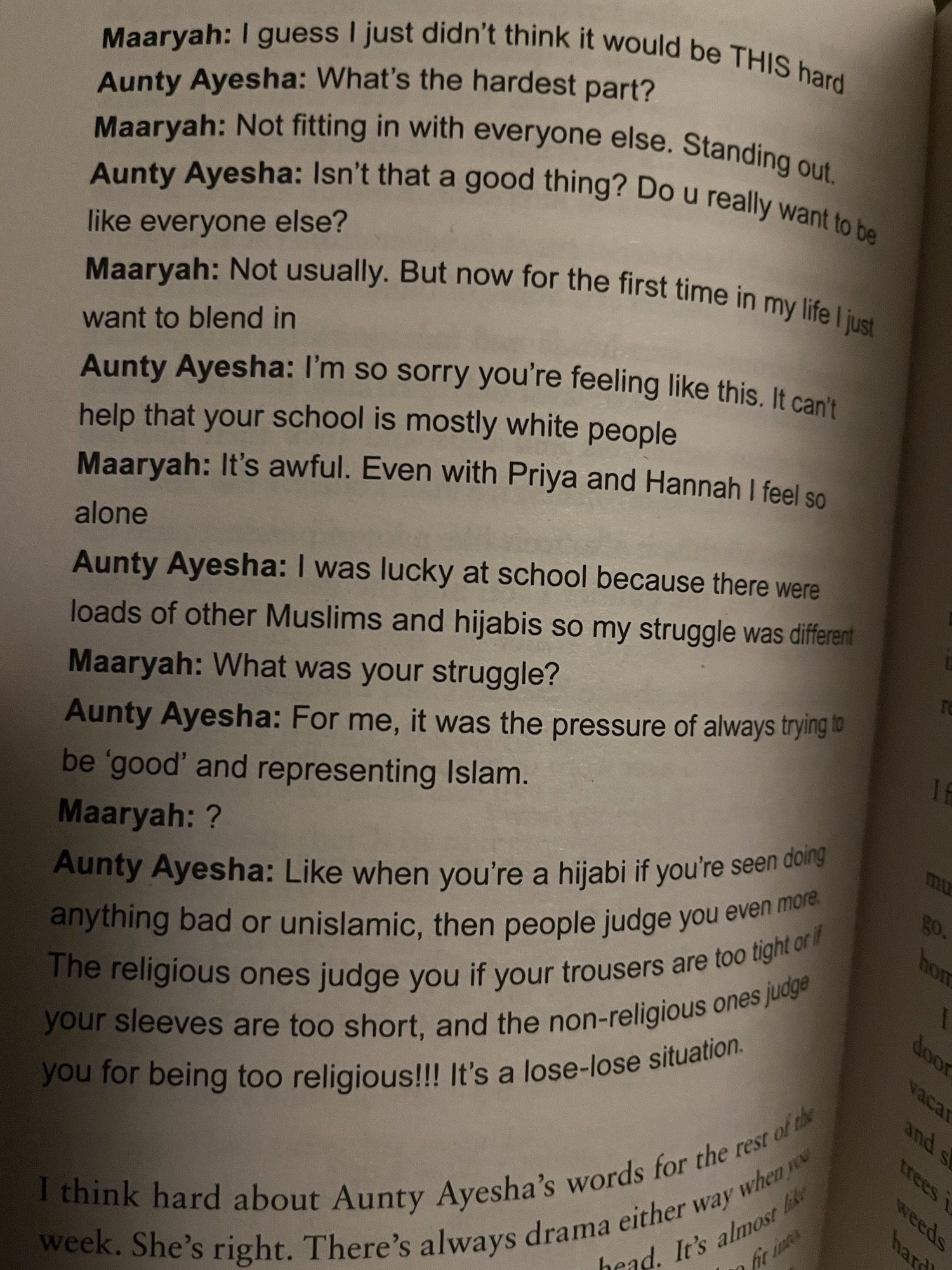
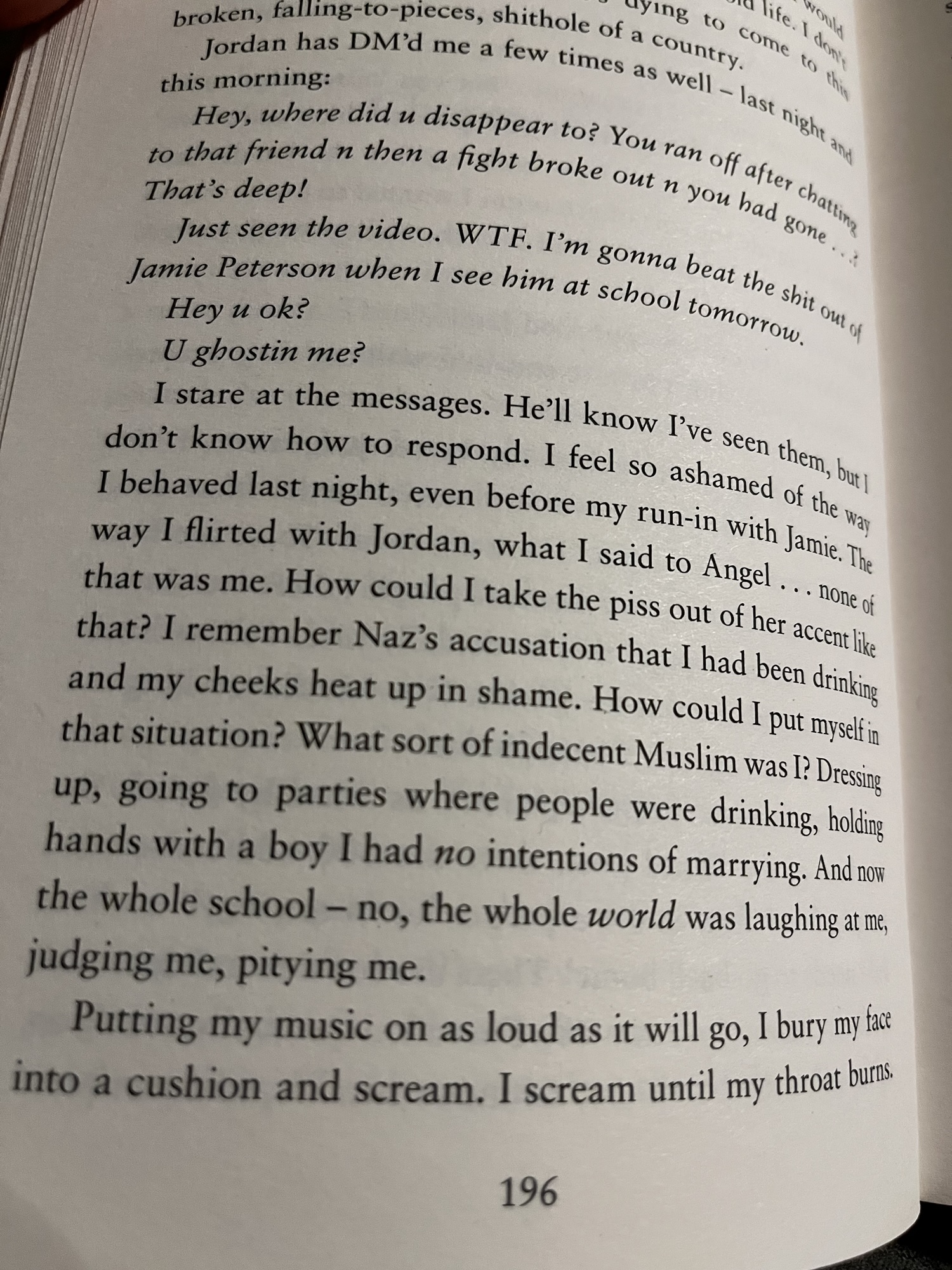
At 368 pages this identity centered mature YA book really hooked me and had me invested, which is impressive because Islamophobia stereotypes and being the new kid in a new place tropes are pretty frequently done, and often after a while, feel repetitive.  For me the charm of this book is actually not Maaryah and her peers/friends/bullies storylines, but the protagonist’s relationship with her parents and what caused her mom and dad to divorce.  Obviously as a mom of teens, I’m not in the target audience, but I feel like I benefited from the Muslim authored, Islam centered book, and think older teens, perhaps 17 and up, will also find the book enjoyable and reflective of views they have, challenges they face, and boundaries they have to establish.  I don’t want to spoil it, but SPOILER, had my dear friends that have read the book clued me in that the book will toe and slightly cross the haram lines, but ultimately show Maaryah deciding to re-establish her boundaries after being tempted not to, i.e. making a poor choice to attend a party with boys and alcohol present, and dressed in a way not typical to her hijabi style, I wouldn’t have read the last hundred and twenty pages or so with my jaw clenched in fear. The book shows a lot of Islam in practice, salat, duas, discussions about hijab, but not everyone will agree with decisions Maaryah makes or the rationale behind them as they vacillate between culture, religion, and family expectations.  I love that Maaryah is fallible and never abandons her faith, and that who we are is more than a singular mistake or instance of poor judgement. The book is not preachy, most will just take it as a girl finding her place in her new family dynamic in a new country, who happens to Muslim.  I think, an assumption really, based on what the author has said about her previous adult books, something along the lines that they are not meant to be Islamic fiction, but are stories with Muslim characters, and I think this book should probably be viewed the same.  There is swearing, hand holding, a side hug, normalized boy girl friendships, lying, running away, deceit, cheating, alcohol, mention of hookups, dating, vaping, music, flirting, hijab questioning, bullying, physical assault.  My biggest concern about the book is that it brings up Palestine, but doesn’t discuss Palestine. A side character is a non practicing Jew that visits Tel Aviv and Maaryah wants to discuss the occupation with her, but hesitates and the moment passes.  It is never revisited which I really wish it would have.  It could have modeled a bit how to have those conversations, I know it isn’t that type of book, but Maaryah mentions repurposing kaffiyehs in her designs and so it hints that it matters to her, but never pulls on that thread.  At one point it also mentions another character posted something pro Isr@*l during the genocide, which I can only assume the author thought that by the time of publication would have ended.  SubhanAllah ya Raab.

SYNOPSIS:
The tag line on the cover “From Dubai Girl to London Nobody…” very succinctly summarizes the plot.  Maaryah had an idyllic life in Dubai with her parents and close friends, spending her holidays with her mom’s family in London, and securing an internship with a famous designer.  All is going well until her parents get divorced, her mom moves her to the UK, not near her extended family, and the lack of Muslims, let alone hijabis, at her high school has her bullied with no friends to have her back.  With her mom in survival mode, their once close relationship is non-existent, and the 15 year old is left to sort through it all on her own.

WHY I LIKE IT:

There is a little pulling of punches so to speak of asserting that the boundaries are Islamic, but for the most part I think Muslim readers will see that Maaryah does view a lot of what she experiences through an Islamic lens which I appreciate. I also like that the protagonist’s connection to salat and faith is hers, it isn’t forced on her and I think for this demographic that is good micro messaging and framing.

I was very grateful that the book answered the questions about Maaryah’s family dynamic, so often parental problems are pushed to the void and let to be resolved or understood off the page. And while in the first half it was teased a little as we aren’t having that conversation right now, I did ultimately by the end feel like it was sufficiently resolved.  I also felt the mom was blaringly absent at weird times and I get that it was a plot device to get her out of the way, but if you are dragging at the 100 page mark, I do encourage you to keep reading, it does pick up.

This book isn’t meant to be didactic, and I recognize I’m putting that on it a bit, but I do think the Gaza framing missed an opportunity to show readers how to navigate that very real scenario through the power of fictional characters.
FLAGS:

Copied from above: There is swearing, hand holding, a side hug, normalized boy girl friendships, lying, running away, deceit, cheating, alcohol, mention of hookups, dating, vaping, music, flirting, hijab questioning, bullying, physical assault.

TOOLS FOR LEADING THE DISCUSSION:

I would shelve this in an upper high school classroom, I think that decision to be at the party is clearly shown to be a mistake, to put herself in that situation is something she regrets, and I think showing that she comes out from it offers a lot to be discussed.

My Perfect Family by Khadijah VanBrakle

Standard
My Perfect Family by Khadijah VanBrakle

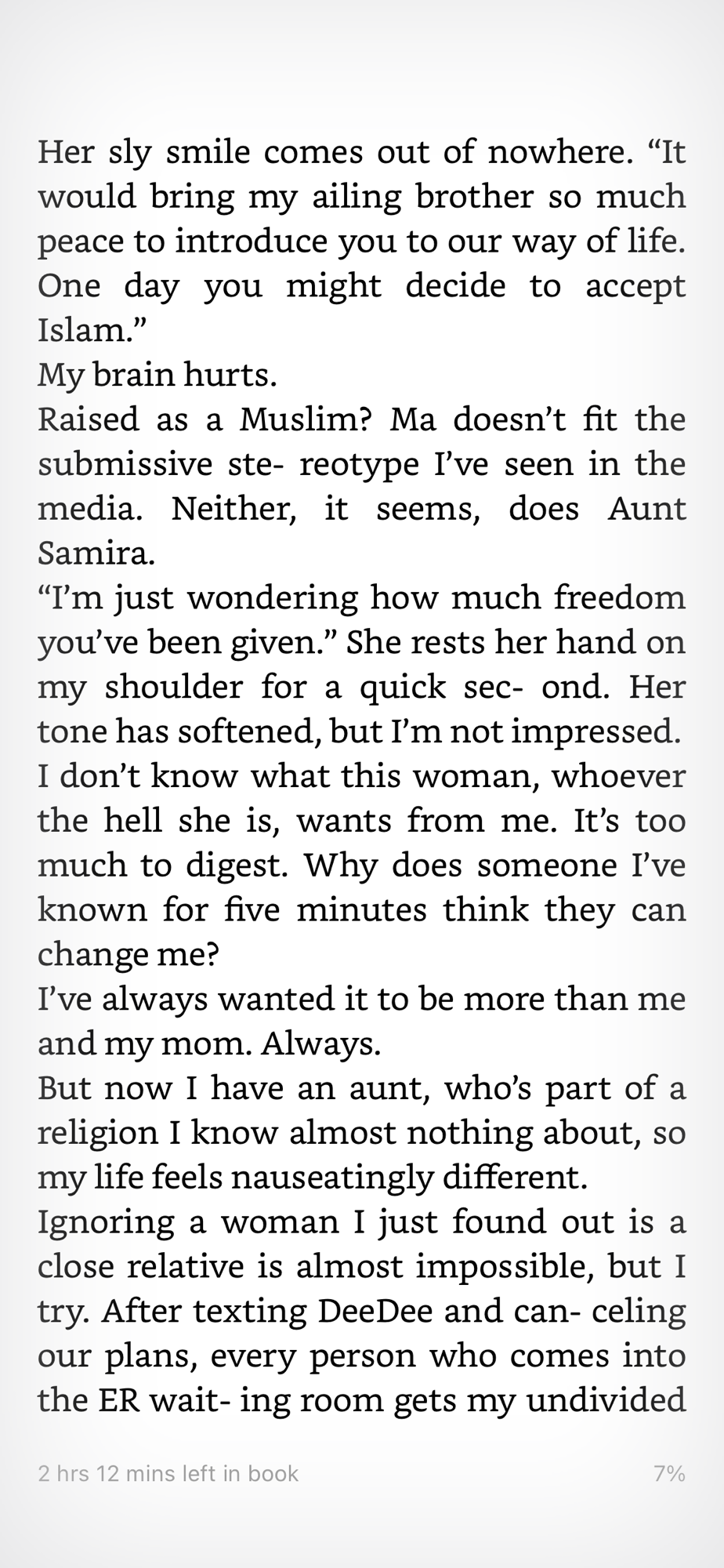
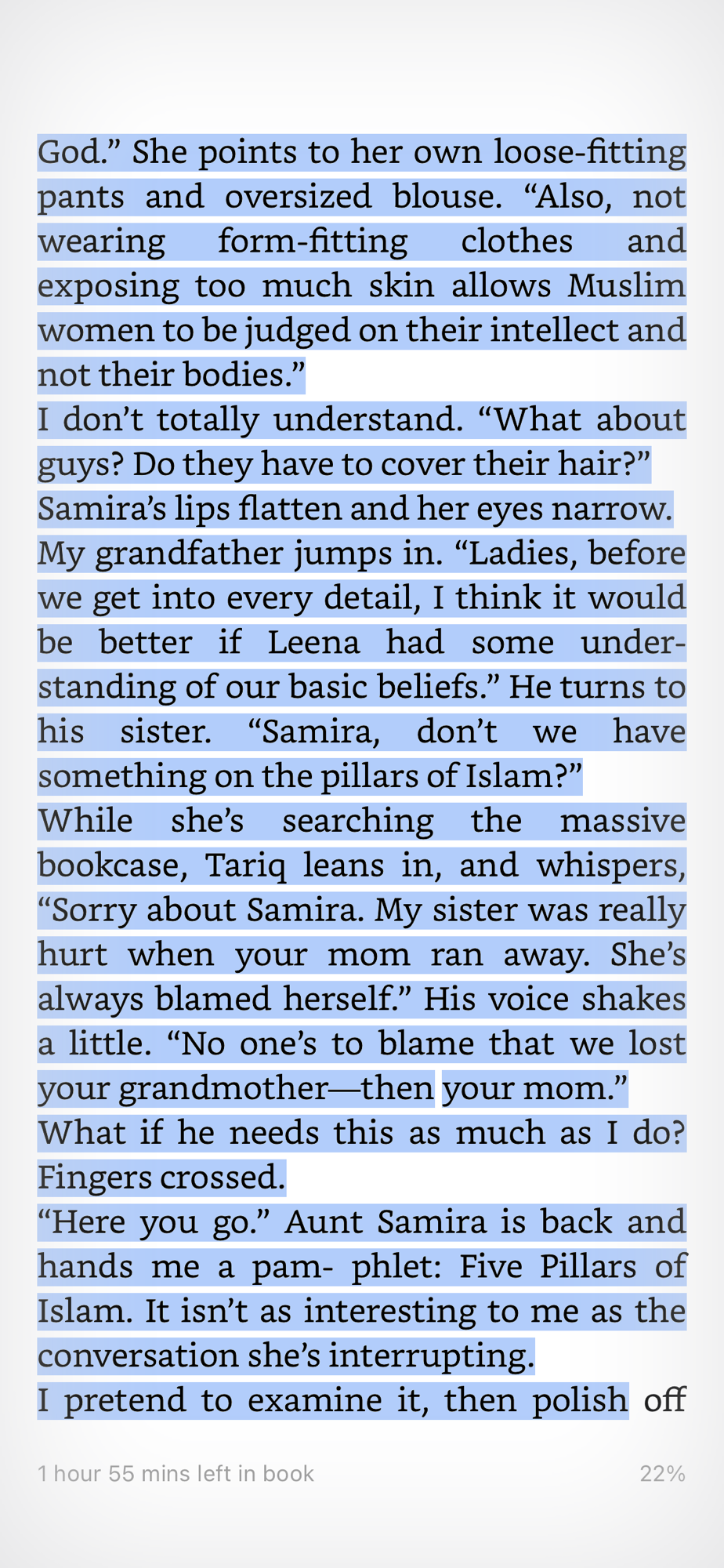
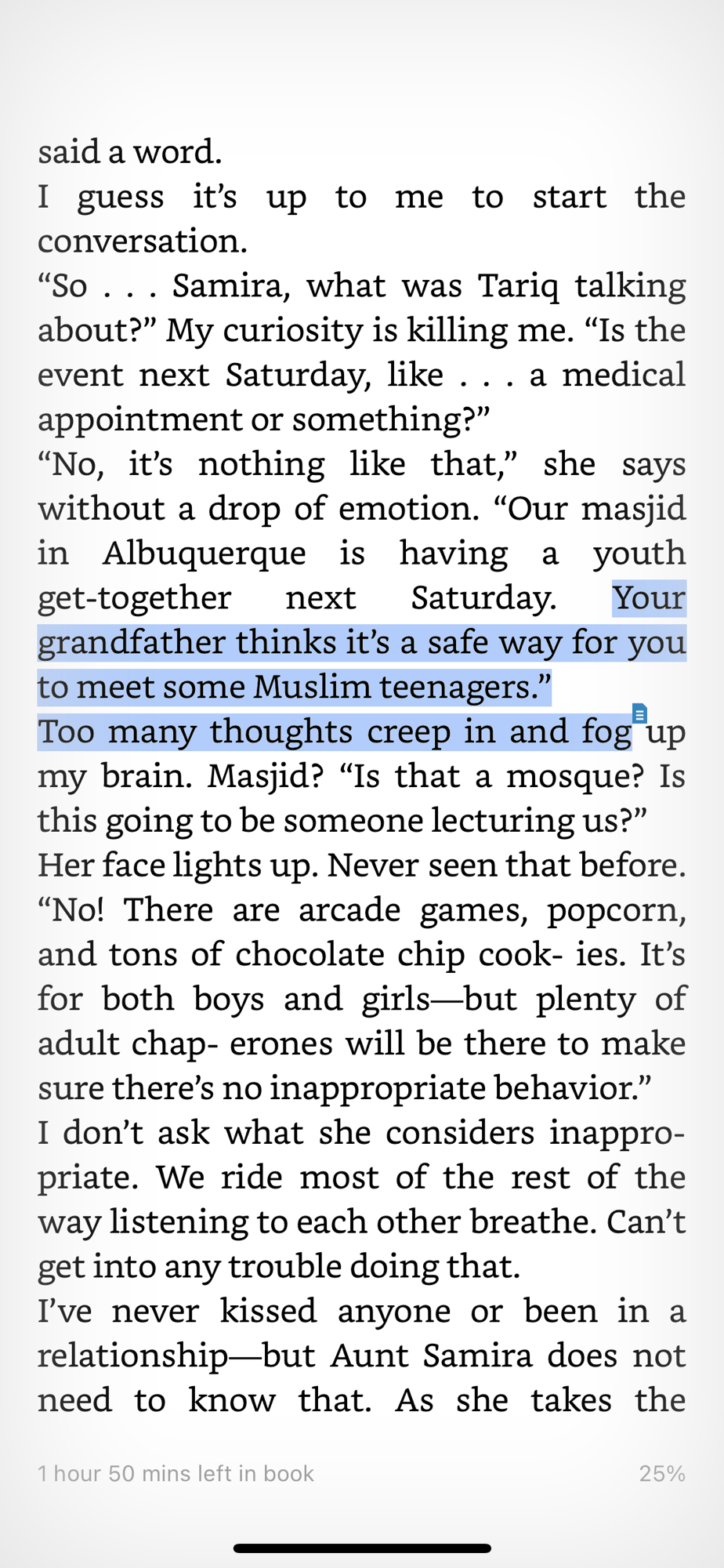
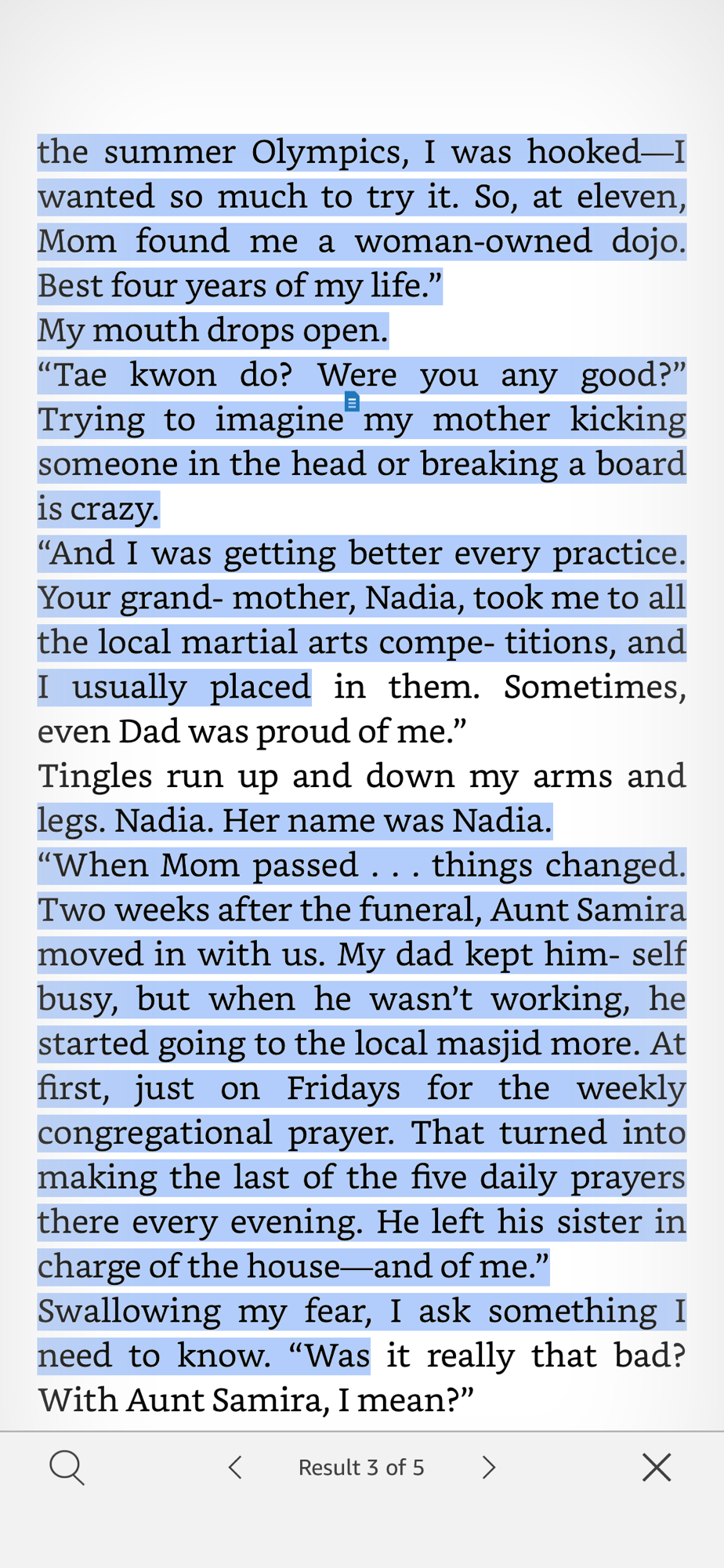
Oh Dear. The very premise alone of this book requires the author to expertly thread the needle of numerous pitfalls, which in my opinion did not occur.  A girl, Leena, learns about family members at age 16, who are Muslim, and the practice of Islam being the “reason” her mother ran away from her family when she herself was 16, means that for Muslim readers the representation needs to be clear that the family’s interpretation is to blame and not the religion itself.  It also means that as Leena learns the reader learns, and non Muslims (or honestly even Muslims) are not going to want a heavy handed preachy 256 page YA book. The Islam “taught” to Leena has to align with the readers interpretation or show why the characters believe as they do, and the conclusion regarding religion and identity needs to make sense for the character aside from what reader wants to have happen.  Unfortunately the copy I read contained numerous errors, repetitive paragraphs, a weak resolution, dropped plot threads, and had me cringing at how harsh Islam was being presented through the great aunt character, that honestly if Islam was just presented as no dating and dressing modestly, or else you will get married off, I can see why one would run away.  The book contains a lot of cursing, and features dating, having a child out of wedlock, death, and gambling by non Muslim characters.

SYNOPSIS:
Leena has always wanted a big family, but her and her single mom, Asiyah tackle life together.  Leena and her best friend Deidre are employed by Asiyah’s in home daycare and are as close as sisters, but she wants more.  When Asiyah finds out her father has had a heart attack, Leena learns she has a grandfather and great aunt that live an hour away, in Santa Fe.  From the moment Leena sets foot in the hospital, under the gaze of her Aunt Samira, the judgmental overtones begin regarding clothing, education, food choices, and dating.  As a result Asiyah is reassured that she made the right decision all those years ago to leave Islam and her family.  Leena however, has had her entire world changed, and is willing to endure the abrasive Samira to get to know her grandfather Tariq.

WHY I LIKE IT:
I like that family drama and secrets were teased, even if I didn’t think that they were presented and resolved well. I wish they took more of the focus and that Islam being a reason for the animosity was downplayed.  I think religion could and should have been one of many factors, having it be the ONLY factor put a lot of pressure on the presentation, which fell short.  It also means that the resolution needed to resolve the Islam hanging in the air, SPOILER,  it didn’t.  The conclusion has Asiyah realizing her father never stopped loving her, but how did that resolve the relationship with her and Samira? And suddenly Samira just backed off her singular Islamic identity? A bit of whiplash with it all happening off the page, left me unsatisfied.  Speaking of pages, the book spends a lot of page space having characters drive the one hour one way to have conversations that are less than 15 minutes and could have been done over the phone or even texted.  Nothing exciting or revealing comes from these drives, they just make the story drag. Tariq should have ridden along, so we could see why he was “such a great man,” see why Leena kept enduring the harshness of her Aunt to get to know him, and have the family she always dreamed of.

Islam is presented through the harshest of harsh characters, a few side characters are brought in that make Islam more realistic in practice and fleshed out, but it really feels like it is too little too late.  I think a non Muslim would feel Islam is just modest dress, no interacting with boys, marrying early, and rigid rules.  Leena is harassed from the first moment she meets her family, no easing in to it, she is even handed brochures on her first visit to her grandfather’s home.  Yet, Leena never shows any interest in learning about Islam, she could Google it if she was curious, even when at the masjid, she doesn’t go and watch them pray, no connection to Allah is ever discussed, it is just dos and do nots.  Consistently throughout it feels like Islam is weaponized and perhaps that is the author’s experience or intent, but it is odd coming from a Muslim writer in a fictional setting.  We get enough of that stereotyping from the non Muslim real world.

The emphasis on Islam being the only thing that matters for these characters means that whether they are religious or not, the characters are painted very one dimensional. Leena is a terrible friend, she counts on Deidre to drive her around, she never follows up on asking about her dates or reciprocating the effort for her other than feeding her.  Asiyah has an ex-boyfriend show up, and then goes out with a friend, but there is no context for their abrupt arrivals and then departures from the story, they do not serve as a foil to reveal any pertinent information or connection. A plot device used quite often in the book, and one I am not a fan of, is when things can be solved by characters simply having a conversation.  It is never the right time, they will talk later, even the fruition that started the family fracturing could have been eased by, you guessed it, the characters talking, not even agreeing, just talking.  While I’m running through my top gripes, might I add, that I have spent a few too many minutes on the cover as well.  Presumably Leena is in the middle, her young single mom Asiyah on the right, but who is the young hijabi? Her aunt does not read young at all, and she would not have her neck showing, that would go against her core characterization. So before you come at me that I have no right to my opinions and that I’m too mean, please solve the mystery of who is on the cover, thank you.

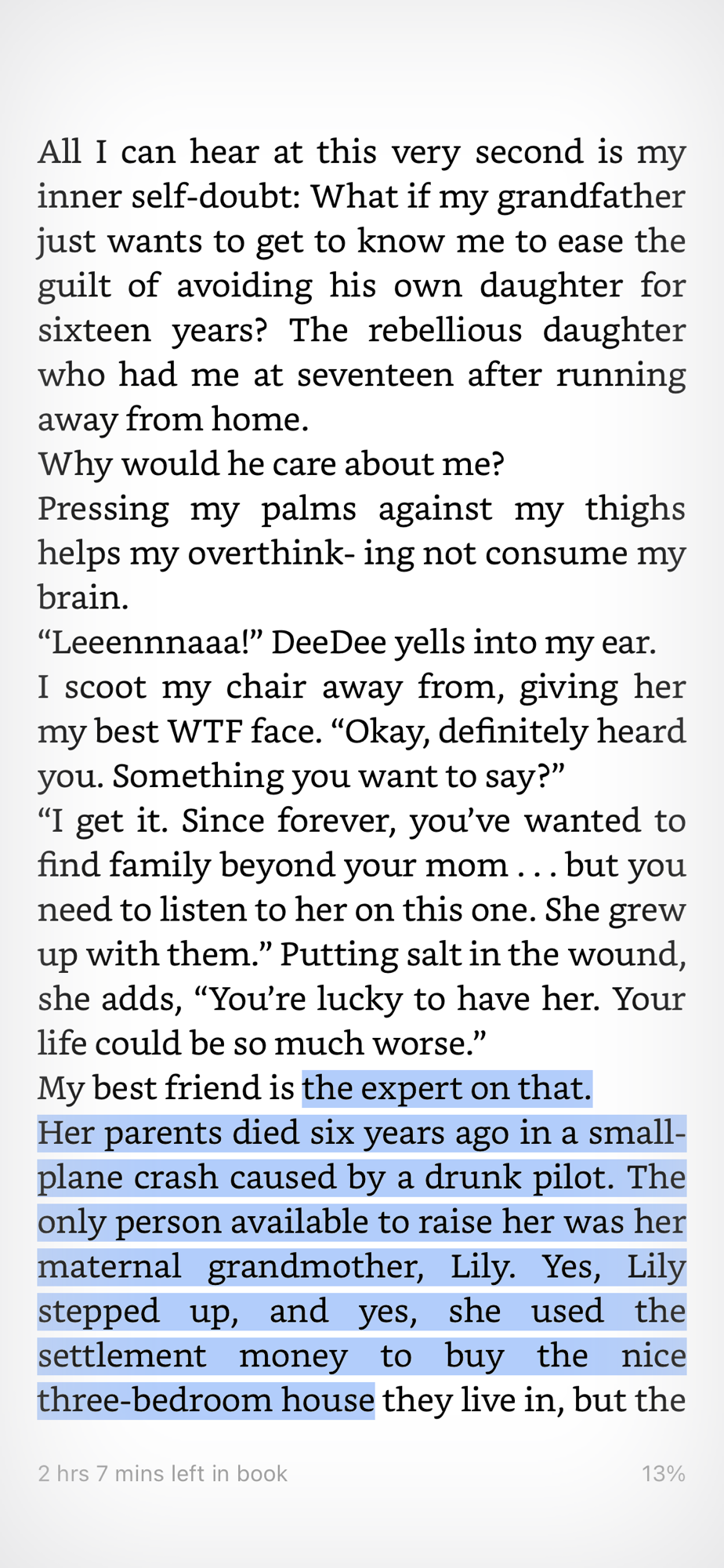
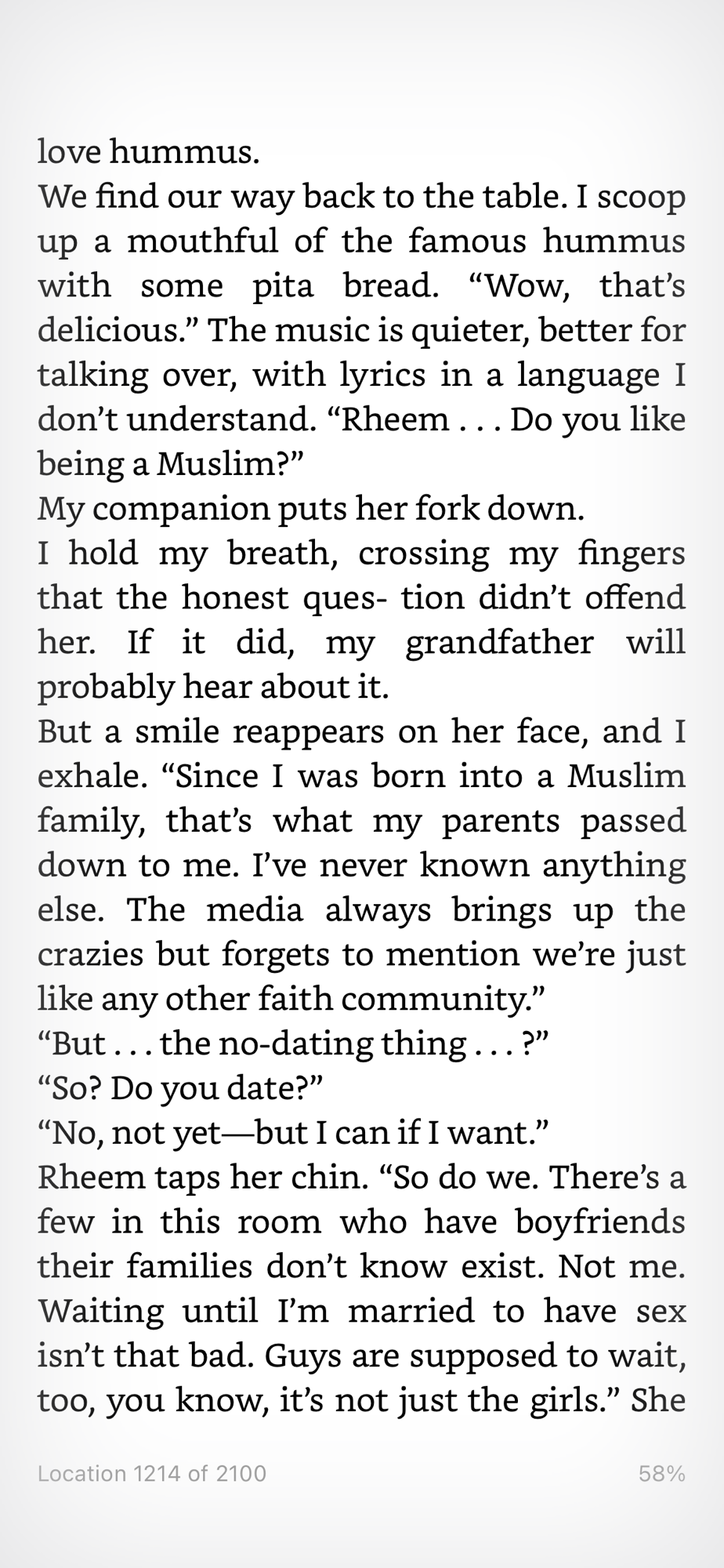
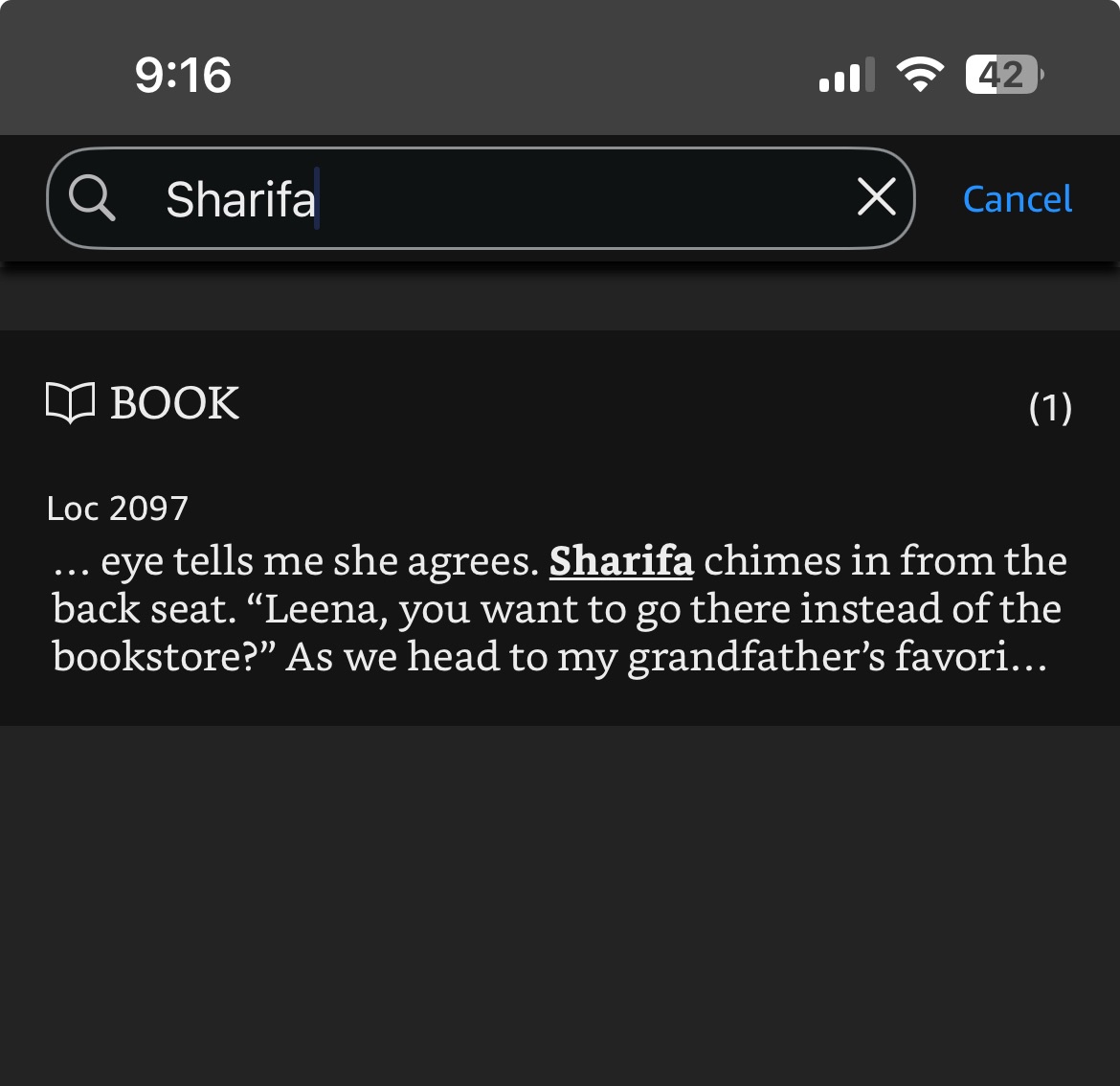
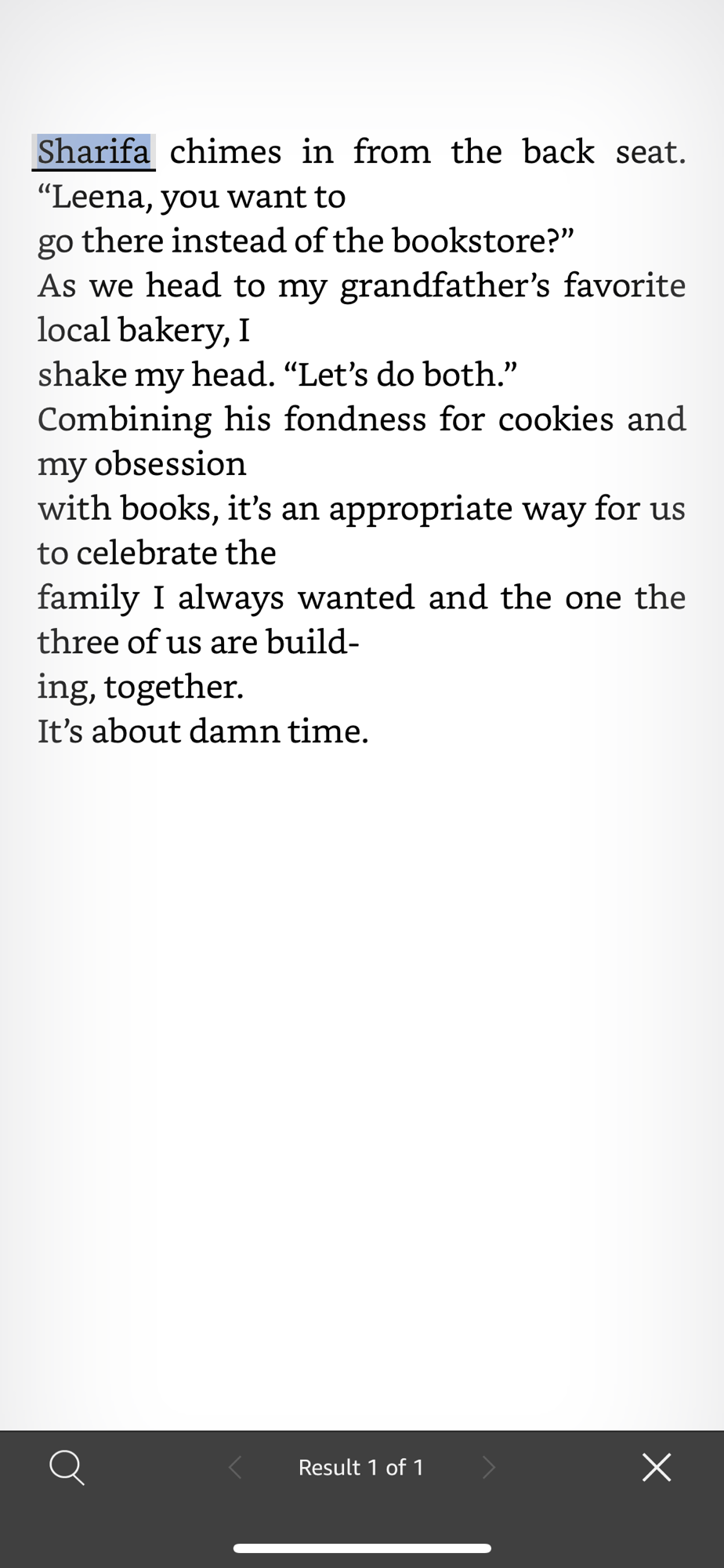
I read an ARC so I am aware that changes could have occurred, I’ve requested the book from my library and it is on order, and I will come back and correct this paragraph if needed.  The story of tae kwon do is repeated in two different spots almost word for word as if the information that Asiyah was good at tae kwon do both times is news to Leena.  Clearly it is in error.  It also has Deidre’s grandmother getting their house with the insurance money from Deidre’s parents dying and then a few lines later saying how the grandma doesn’t let Diedre forget that the spare room was changed to a bedroom for Diedre when she moved in.  A friend, Rheem, is brought in guide Leena academically, and is described as being homeschooled and changing to an online program for her senior year to also take dual enrollment classes, a few chapters later they are going to her Islamic High School for a party.  Side note, the sign on the high school says, “ALHIDAAYAH ISLAMIC SCHOOL: Grades sixth through twelfth.  We want our children learning it’s okay to be both American and Muslim.” The last page of the book also has a “Sharifa” in the back seat, and there is no Sharifa previously mentioned in the book.

FLAGS:
Cursing, judgement, dating, running away from home, anger, death, loss, lying, flirting, gambling, child out of wedlock, cutting family ties, clothing shaming, music, othering.

TOOLS FOR LEADING THE DISCUSSION:
I wouldn’t shelve or use this book for a book club read.  I think Muslim kids would be annoyed by the way Islam is presented.  I think they would be ok that Leena SPOILER didn’t take an interest in Islam, but I think they would be bothered by the flat, angry portrayal that it has in the book.

When a Brown Girl Flees By Aamna Qureshi

Standard
When a Brown Girl Flees By Aamna Qureshi

when a brown girl flees

I was both nervous and excited to read this contemporary book having loved the author’s fantasy, but unsure how a Brown Muslim Pakistani American girl running away from home would be presented.  Alhumdulillah, the author approached the story from a place of love.  There is no internalized Islamophobia, self othering, or in broad strokes even an identity crisis. The protagonist has made decisions, drastic ones, and is trying to piece her life back together on her own terms, but the love of culture, family and faith, is always upheld.  It reads like Islamic fiction, with very didactic passages and moral positioning, I’m still quite surprised that it is traditionally published.  The version I read had grammar errors, so I’m hoping that they will be corrected when the book releases in a few weeks.  The story is engaging, but the writing a bit monotone.  Much of the story is telling, not showing, and because of the surface level spoon feeding of so much of the plot, when the catalyst or rationale is not provided, the book seems underdeveloped, or lacking, unfortunately.  I would not recommend this book for the target audience of YA readers (12/13 and up) it contains sex, slut shaming, self harm, depression, suicidal thoughts, physical and emotional abuse, profanity, and mentions drug use.  I do think though, early college age readers will enjoy and benefit from reading the book.  At a time in the reader’s life when they are defining themselves on their own terms, owning up to their own mistakes and laying out a future path, this book will provide relatability amplified by religious and cultural touchstones.  The heart of the story is the connection of a girl with Allah swt after she has sinned, the guilt and regret she feels, and how she finds herself, and returns to try and fix things with her family.  The characters are flawed and the overall messaging beautiful, hopeful and uplifting.  Unfortunately, it just reads like an early draft and I wish it had a bit more refinement.  Keeping that in mind though, it does have a place, and I’m glad to see our “new adults”  can find reflections of  themselves in a piece of literature that amplifies their Islamic identity instead of criticizing or questioning it.

SYNOPSIS:

The book starts with Zahra deciding to run away from home.  She parks her car, leaves her phone and catches a flight to New York from California.  The reader doesn’t exactly know why she is running, only that a few days after high school graduation she is escaping a toxic home life, an impending wedding, and misery.  As the story peels back layers we start to see some of the nuance of what she is running from as characters from her past find her and physical space allows her some perspective to see her own role in her “old” life.  When she arrives in New York, it isn’t the city life that she seeks, but rather the nature and pace of Long Island that offers her a fresh start.  She heads to the masjid, makes a friend, and starts to put her life together without parental obligation, outside interference, and self loathing.  She cannot run forever though and she cannot escape herself.  She must confront her past, own her mistakes, be honest with her new friends, and find peace with her family, not because she has to as a Brown daughter of immigrants, but because she trusts Allah, loves her family, and wants to “fix” things.

WHY I LIKE IT:

I’m a sucker for books that show redemption through the love and mercy of Allah (swt).  Yeah her new friends were idyllic in their family life, relationships and worship, but we all want friends that make us better Muslims, so I let it slide. Islam is centered, she wears hijab, she reconnects with salat, it is her identity even when she is just going through the motions. The author at times conflated culture and faith, but it never issues blanket statements or falls into universal stereotypes for Desi culture or Muslims.  She does a good job of keeping the negatives to the people and the critiques to the failure to push back on dangerous expectations. My issues weren’t the character flaws either, I’m onboard with the messiness of being human and the ability to seek and receive forgiveness from our creator.  I just wanted to feel things more.  So much was just told when it should have been shown.  I wanted to see the stress and anguish of her family life, not simply told it was depressing.  I wanted to see her cutting life long friends out and being isolated, not told she had lost her friends.  The book focuses on her running, and why she ran, but a big plot point for why she ran, having sex, needed more fleshing out.  Why was she driven to such an act? I know that she was depressed, I’m not belittling that, but what pushed her to such a strong stance, when she was already allowed on the school trip, she hadn’t yet been given the ultimatum and over and over the book says “I miss my family,”” I miss my home,” “I miss my mom.”  I didn’t feel the connection or understand what she was feeling, thinking, and it seemed like a huge hole in the book.  For all the themes of mental illness, faith, generational trauma, misogyny, abuse, expectation, depression, lying, culture, life choices, higher education, family dynamics, self harm. the book never quite felt rich with emotion or deeper than the surface level story.  At the beginning the author says she first wrote the book when she was a senior in high school, and while that may have made the main character’s perspective and voice ring true, as a successful author now, I wish she would have added the nuance, the insight, the subtlety that would have drawn the reader in and allowed them to get inside Zahra’s head and heart to see her and perhaps even themselves.

FLAGS:

The author and book identify triggers in the book “please be mindful of TWs: depression, anxiety, emotional abuse, physical abuse, self-harm, suicidal ideation, slut-shaming, PTS.”

There is also music, boys and girls alone in cars together, lying, cursing, generational trauma, misogyny, abuse, expectation, depression, anxiety, guilt, life choices, higher education, family dynamics, cutting, a brother who is often high or smells like weed/pot, it mentions partying, a sexual event, deceit, physically assaulted by a parent.  Nothing haram is glorified, but it is there and it is detailed, and not everything is resolved.

TOOLS FOR LEADING THE DISCUSSION:

I would not be able to shelve or teach this book in an Islamic school library, but in a college MSA book club or a youth group of a similar age this book would be incredible to read and discuss.

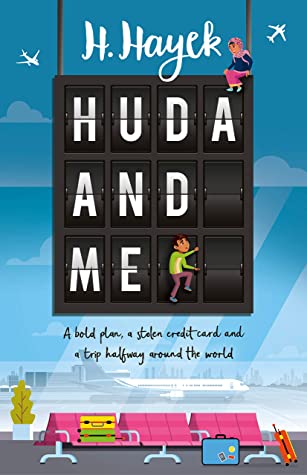
Huda and Me by H. Hayek

Standard
Huda and Me by H. Hayek

huda

At 194 pages, this book just became required reading for all my children save the two year old.  Meant for middle graders, I absolutely loved this book.  Sure literary siblings often run away and have adventures, think Claudia and Jamie Kincaid from Mixed Up Files, or the sisters in Ticket to India, but this Australian Muslim duo adore each other and are doing it to reach their parents and save their other five siblings from an evil Aunty babysitter.  In some ways the book couldn’t and hopefully wouldn’t really happen, it is plausible however, and the way it is written bouncing back and forth in time until the resolution, and the absolute authenticity of the characters make the book hard to put down and had me laughing out loud.  The book is for everyone, Muslim kids specifically though, will feel an incredible kinship to the Muslim family and relate to the anxiety of making wudu in a public restroom, the shock of having the athan clock tossed in the freezer, the nervous looks between siblings hoping someone else will speak up about what Muslims can’t eat, mistaking a nun for a hijabi, amongst so many other little sprinkled in examples.  The power of OWN voice writing is exemplified and celebrated, and provides a mirror that a large swath of Muslims children, not just Lebanese Australians will benefit from and enjoy.

SYNOPSIS:

There are seven children in the family and when Mum and Dad announce that they have to make an emergency trip to Lebanon, the kids don’t understand why they need Mum’s friend Aunt Amel to stay with them in Australia.  They don’t really even like Aunt Amel, but they don’t really know her either and as their parents leave, they have no choice but to endure until their parents return.  When Aunt Amel assigns them all duties: 17 year old Omar is the 24/7 chauffeur, Kholoud becomes her personal stylist, twins Suha and Layla must keep her supplied with baked goods and tea, Akeal is the butler, Huda is the maid and little Raheed will be glued to her, some of the kids think it could be fun until they realize they are being used to provide Aunt Amel with a holiday in exchange for her staying with them. The kids are required to be up by five in the morning, are not allowed to talk to their parents, and some are even kept from school to provide the services Aunt Amel demands.  The kids grudgingly try to endure, but spunky Huda is pushing back, and with the help of the retired Polish Sleep Doctor next door, a plan is hatched, tickets are booked, and Akeal and Huda are making a run for Beirut. Along the way they will be met with an Islamaphobic teen pulling off Huda’s scarf, a variety of minders keeping track of the unaccompanied minors through airports and plane rides, and baited breath as they have obstacles at every step to find their parents in a country they have never even been to before.

WHY I LIKE IT:

The book is incredibly well written, I sometimes stumble a bit with Australian authored books, but this one was easy and universal in most of the dialogue and vocabulary. I enjoyed what was sprinkled in, and as a privileged American didn’t get lost at any point.  The shifts in the timeline to keep the story fast paced and moving also made the stress of “if they could pull off the escape” a little bit subdued allowing the experience and dialogue and connections along the way to really be enjoyed.  I think it was a smart move to not have it be full steam ahead, gritting your teeth, but more in the moment seeing why they had to do what they did, and how it was panning out for them.

I absolutely love that the family is unapologetically Muslim living in a western environment.  They don’t celebrate birthdays, but they seem ok with make-up, they pray, the mom wears hijab I believe, but I don’t think the sisters do, it really is such a relatable family with their own quirks and tests and they are active and doing their best.  It could be my family or most families I know, well lately my kids bicker a lot, that’s why it is required reading for them, but that is off track.  Back to the book, I was so proud of Akeal sticking up for his little sister wearing a scarf to be dressed up and not backing down from confronting her harasser.  I love the spunkiness but maturity of Huda.  From page one you are cheering them on, and it doesn’t let up.

FLAGS:

Kids scheming and lying and running away, all for good cause mind you.

TOOLS FOR LEADING THE DISCUSSION:

This would be super fun to read aloud to a 3rd or 4th grade class, but I don’t think it would work for a middle school book club, it is just too quick of a read.