Tag Archives: Picture book

Ruler of the Courtyard by Rukhsana Khan illustrated by R. Gregory Christie

Standard

RulerOfTheCourtyard

Set in Pakistan, Saba has to cross the courtyard to get to the bathhouse.  Fearful of the chickens that seem to have it in for her, she braves the distance in a dashing sprint and slams the door to relish in the safety of a chicken free patch of space.  However, today as she searches for courage to face the chickens after her shower she spots a snake near the door.  She is afraid, and wants to scream for her grandma, her Nani, but worries that the snake will bite anyone that comes through the door.  Realizing she must face this fear and solve the problem on her own, not only empowers her, but puts the chickens in to perspective.

This 32 page picture book written on an AR 2.6 level is a good book when discussing overcoming fear.  It reads aloud well, as the short sentences from Saba’s perspective convey her trembling fear, her determined resolve, and her elation and freedom after she faces the snake.  The illustrations on first glance, and even after the first reading seemed off.  They didn’t seem to compliment the story smoothly, however, after revisiting this book, I think I have grown to appreciate the exaggerated features of the girls face, and the simplistic blurred images of her surroundings.  I think it shows her focus and skewed view when faced with such a fear.

The Author’s website & teaching guide

Saladin: Noble Prince of Islam by Diane Stanley

Standard

saladin

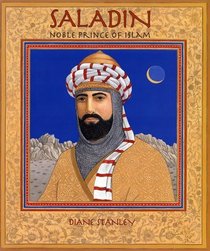
This is a beautiful historical biography of Salah al-Din, known in the west as Saladin, that I felt worth sharing despite it not being fiction.  Written on an AR Level of 7.0 the 48 pages are highly wordy, and cover a lot of historical ground.  There is a post script, a glossary and bibliography at the end.  The pictures are detailed and bright and inviting, but even for a 7th grader, I think the book would be a challenge.  If one has an interest in the time, or has studied it and knows some of the supporting characters, the book in fantastically interesting, and insightful for the format.  To an average middle school or even high school student, they might thumb through it and keep it on the shelf as a reference tool, but that might be about it.

Saladin inside page

With any historical account, particularly those trying to simplify and appeal to children, the author gets to pick in what historical light to present the events.  The book starts with an Author’s Note detailing the fight for Jerusalem up until the first crusade. It then begins with the story of Saladin’s life.  Born in 1138, he was named Yusuf ibn Ayyub, and then tells a bit about his upbringing and the basic tenants of Islam.  It explains how he came to power and how the truce with the Franks was broken by Reginald.  It then details the battles, the follies and plans of both sides.  It shows the honor that Saladin had for his enemies and even the respect he had from Richard the Lionheart.  It shows the politicking in Europe and the toll of the Crusades on the people there and in the Middle East.  The book also tries to show Saladin outside of his battle armor as a family man who was devoted to his wife Ismat.  “When she (Ismat) died, Saladin was lying in his tent, seriously ill.  His advisors kept the news from him for three months, until he was fully recovered, for fear the shock might kill him.”

Saladin died in 1193 and  knowing that he was dying he passed on advice to his son oh how to be king.  “Win the hearts of your people and watch over their prosperity; for it is to secure their happiness that you are appointed by God and by me. . . I have become as great as I am because I have won men’s heart’s by gentleness and kindness.”  The book states that he was so generous and unconcerned with money and luxury that when he died he didn’t even have money to pay for his simple burial.  

Admittedly I know very little about the historical accuracies or slant of the author.  I do know that it does inspire pride for Muslims and hope that people of different faiths can one day again co-exist in Palestine and the world, inshaAllah.


Colours of Islam by Dawud Wharnsby

Standard

Colours of Islam

This beautiful book is a compilation of the lyrics from Dawud Wharnsby’s well known collection of songs found on the Colours of Islam CD released nearly 20 years ago.  The book states for ages 5+ and is a large and very colorful 35 pages.  The hardback binding, the inclusion of the CD, and the knowledge that royalties go to a trust fund supporting educational initiatives for children, make it a great gift item.  It looks lovely on the shelf and the children will eagerly thumb through it, once.  After that, I’m not entirely sure what to do with the book.  colours of islam2

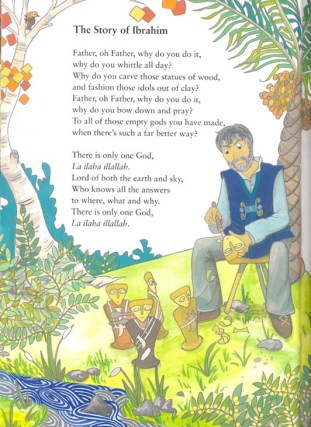
The pictures are very busy for the most part, and very detailed.  The text on the page is pretty intimidating in its line length and volume.  The songs are lovely, I’ve knows them by heart since I was a child, but I don’t know that they lend themselves directly to poetry for children.  If a child knows the songs, or is following along with the CD then yes, older children will benefit from the book.  A five-year-old or possibly a 7-year-old will not.  I can see the poems/songs supplementing a language arts lesson in a classroom, and in a library the book looks wonderful displayed.  But, as hard as it is for me to not gushingly praise a Dawud Wharnsby product, I don’t know that the book would really ever be read cover to cover and/or more than once.

colours of islam1colours of islam


Lailah’s Lunchbox: A Ramadan Story by Reem Faruqi illustrated by Lea Lyon

Standard

Lailah's Lunchbox

Another standout in a crowded field of Ramadan picture books, mashaAllah, Lailah’s Lunchbox works well even outside of Ramadan for Muslim and Muslim children alike.  In 32 pages, the reader gets to know Lailah and understand how hard it has been for her to move to America from Abu Dhabi, make new friends, how nerovus she is to be identified as different, as well as how excited she is that her mother has finally agreed to let her fast this Ramadan.

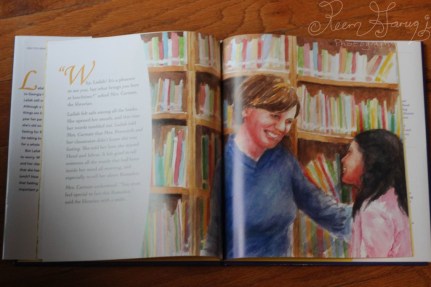
Lailah is excited to wake up and have sehri with her family before heading to her new school, fasting for the first time.  Her mother has written a note for her teacher, but on the bus, Lailah reads the note and suddenly worries if her teacher will even know what Ramadan is ,and decides not to give it to her teacher.  Lunchtime arrives, and when the teacher asks Lailah if she forgot her lunch, her voice fails her, and her classmates offer to share their lunch with her.  Lailah decides to leave the cafeteria and finds herself in the library spilling all her worries and stresses and fears to a kind librarian.  (Yes the librarian is the hero, and really no one should be surprised, right!?) With the librarian’s urging and Lailah’s determination, she writes a note to the teacher explaining that she is Muslim, and fasting, and even includes a poem.  She leaves the note on her teacher’s desk at the end of the day.  The following day, the teacher has written her back and the reader, along with Lailah, know that having courage and staying true to one’s self can often be scary, but also wonderful too.

lilah inside

While the story is billed a Ramadan Story, it really just is the back drop for a lot of really good messages.  I think 2nd and 3rd graders to early middle schoolers could really benefit from the book.  It is semi autobiographical and I think the authenticity of the emotion woven in, makes the book very relatable and powerful.  I plan to discuss it with my daughter going in to 5th grade, who is also a bit shy on occasion: the way Lailah worked out the problem, the way she found someone to trust and talk to that was patient with her, to point out to her that the kids in her class were very kind and that most of her fear and anxiety was with herself, not them.  I also really like the message that she was so excited to fast, and how her nerves took that excitement away, but having the courage to face her fear, brought back her happiness and enthusiasm.

The end of the book has an Author’s note, telling how the story came about and a bit more about Ramadan. It also tells the definition of Sehri and Iftar, the only two “foreign” words in the book.  I found it interesting that the word Sehri, an Urdu word, was used instead of Suhoor, if they are coming from Abu Dhabi, but perhaps the author is of subcontinent heritage.  The illustrations are colorful and realistic, complementing the story and tying in the range of emotions and events Lailah is experiencing.

I was pleasantly surprised at the book, and even more excited to see that it is available in the public library system.  Here is the link to the author’s blog I hope she plans to write more, as her style and message resonate with Muslim American kids, and their parents, alhumdulillah.


It’s Ramadan Curious George by Hena Khan illustrated by Mary O’Keefe Young

Standard

It' Ramadan Curious George

This highly anticipated book came with a lot of expectations and hope for many of us born and raised in America.  Alhumdulillah, Hena Khan did a great job and everyone’s favorite monkey learns and enjoys Ramadan and Eid.

The 14 page rhyming board book is festive and inviting as the tabbed ends head different aspects of Ramadan and Eid  The first tab is George helping his friend Kareem and his family get ready for Ramadan while explaining to the reader how Kareem is going to try and fast all day.  The pictures show Kareem’s mom in hijab and dad helping in the kitchen.  A banner they are hanging says Ramadan Mubarak, but there is no mention of religion or Muslims or Islam.

Curious GeorgeThe next tab has George helping Kareem get up for a predawn meal, keeping his mind off food and keeping him busy.  Not the normal mischievous George in this book, but rather a very helpful one.
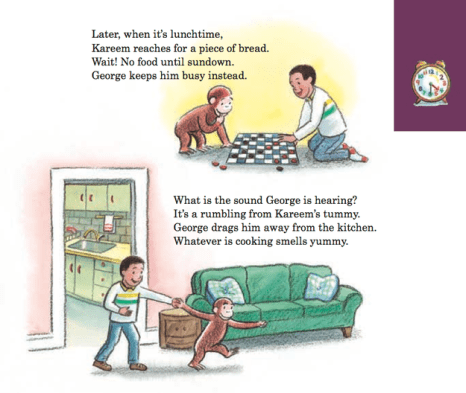
 curious george 3

The next tab talks about dates and breaking the fast and the sounds of prayer, but  again no specific mention of religion or belief.  The pictures show men and women of different skin colors, veiled and un veiled, visiting together.  The next tab is all about food, in all of its diverse glory.  The next tab has Kareem inviting George to the mosque to make food baskets for those in need.  George gets a little silly, and inspires the imam to add a clothing drive next year.  The final tabs are spotting the moon and celebrating Eid.  Gifts are given to George and the man in the yellow hat. Kareem and George are sad the month is over, but George enjoyed celebrating his first Ramadan with his friend.

curious george 1

Overall the book is great for Muslim kids, non Muslim kids, and also notably for non Muslim kids with Muslim friends.  The book does not label and discuss belief or even spirituality, but rather shows how Muslims celebrate Ramadan and Eid in its most basic way, and shows that it is a part of American culture.  For as excited as my family (and myself) were to see Curious George enjoying Ramadan and doing things we do, I can see many of my neighbors and kid’s friends also identifying that they know what George is doing too because of their Muslim friends, and getting excited.  The book works for all ages, to be read independently or aloud.

MashaAllah, don’t judge it by its size, it accomplishes a lot in just a few pages, a lot like a curious little monkey!

Ilyas & Duck and the Fantastic Festival of Eid-al-Fitr by Omar S. Khawaja illustrated by Leo Antolini

Standard
Ilyas & Duck and the Fantastic Festival of Eid-al-Fitr by Omar S. Khawaja illustrated by Leo Antolini

Ilyas & Duck and the Fantastic Festival of Eid-al-Fitr


In the world of Islamic fiction, there are a lot of Eid books out there for children, but this one is definitely more fun than most, especially for the younger crowd.  The presentation of a big, bright, hardback book is aimed at 3 to 6 year olds, and reads well out loud, however, the book is very, very inviting, and older kids with happily pick it up and thumb through the 32 pages of rhyming lines as well.

The book starts with Ilyas watching the sky to see if Ramadan is over and if Eid is here.  Duck in all his silliness doesn’t know what Eid is and rushes out to get decorations to celebrate.  he returns with a Christmas tree and ornaments.  Ilyas non judgmentally explains that those are for our Chrisitian neighbors for their holiday.  Duck then runs out again and returns with a menorah and dreidel and once again Ilyas explains that those are for our Jewish friends celebrating Hanukkah.  Ilyas and Duck then fly away in their hot air balloon to the Masjid to learn about Eid.

Ilyas and Duck2Ilayas and duck

The book works for Muslim children to understand what others celebrate and works for non Muslims to see what we celebrate.  It is all done in a matter of fact way of celebration, not of doctrine.  It is built on the idea that, “There is an Eid for every nation ant his is our Eid.”ilyas and duck eid

Much like the first Ilyas and Duck book, this one is great to have around and read again and again!

The Elephant from Baghdad by Mary Tavener Holmes and John Harris illustrated by Jon Cannell

Standard

the elephant from baghdad cover

This fun and informative picture book written on a 4th grade 8th month AR level retells a historical event through a fictionalized narrator.  A great retelling of a West meets East event with an albino elephant thrown in, makes for a story that is hard to believe is true.

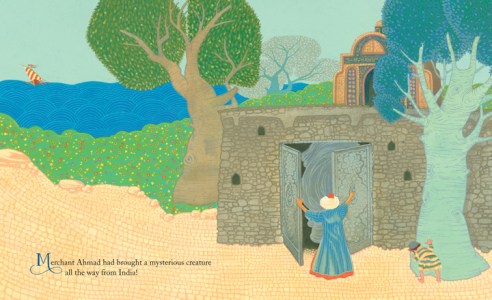
Charlemagne, the medieval ruler of most of Europe, sent ambassadors to meet the Caliph of Baghdad, Harun al-Rashid.  Charlemagne was curious to learn more about the amazing ruler he had heard so much about.  When the Europeans arrived they were astounded at the buildings, libraries, organization and cleanliness of the city.  For months, Harun “introduced the men to artists, musicians, scholars, mathematicians, architects and poets” and taught them about “science, medicine, engineering, and art.”  Harun al-Rashid’s generosity however did not stop there.  “He loaded a caravan with presents fit for a fellow emperor.”  He sent a saber and scabbard, a precious water jug, and a magnificent clock that he had commissioned his artisans to create.  A mechanical water clock, that unfortunately, has been lost in history, but was detailed in the 807 CE Annles regain Francium, a journal that chronicled the daily life in Charlemagne’s court as well as in a book written 400 years after Harun by Al-Jazazi in Istanbul, Turkey.  Even this, however, was not enough for the great emperor of the West, and Harun gave Charlemagne the rarest treasure of his court, an albino Elephant named Abu.the elephant from baghdad

Abu even had his own keeper, a Jewish man named Isaac, and when they returned back to Europe both were invited to live in the palace.  “Once or twice a day Charlemagne would visit his immense guest.” Abu’s image was preserved in portraits and began to appear on coins and tapestries in the empire.  Even in Charlemagne’s tomb is a silk cloth woven with elephants.  Abu was taken into battle against the Danes and when he got old, Charlemagne had a house built for him and Isaac near a river.  In 810 Abu died and when Charlemagne learned of his death, “he wept.”

The story shows the amazing respect the two leaders had for one another, for animals, and the tolerance of people of different faiths.   At 40 pages it works for story time and for older students learning about the Middle Ages.  Obviously they would take away drastically  different points from the story, but both groups would enjoy it.  I learned a lot, so I recommend it to adults as well.  The pictures are beautiful water colors and pencil, supplemented with actual photos of artifacts, that all combine to make the story and book a wonderful addition to your library to be read and enjoyed again and again. elephant from baghdad 2


The White Nights of Ramadan by Maha Addasi illustrated by Ned Gannon

Standard

the white nights of ramadan

I love learning about people’s Ramadan traditions, and am slightly embarrassed to admit that I never knew about this Gulf tradition of Girgian.  My kids and I enjoyed reading this book during the middle of Ramadan, when the moon is full and bright, and thus known as the white nights of Ramadan.  Written on an AR 3.6 level the story does a good job of blending the concepts of Ramadan, Girgian, Islam in a 32 page fiction story format for Muslim and non-Muslim children alike.  There is an Author’s note and Glossary in the back as well.

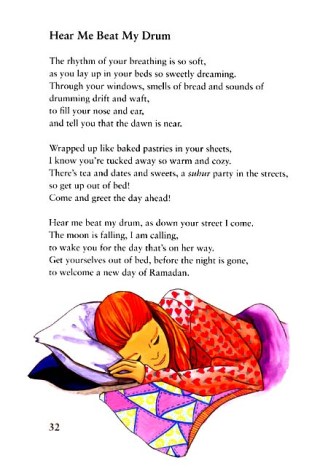
A young girl, Noor, excitedly waits and prepares for Girgian.  She explains the activites to her two younger brothers, Sam and Dan, how they will walk the streets with lanterns (fanouses) and get treats from neighbors for three nights.  But before night falls, they first have a lot to do to prepare, and with the help of their parents and grandparents, the children make and wrap the candy, decorate bags to keep the candy in, and get dressed in fancy traditional clothes.  In the process the book also explains Ramadan, and shows Noor praying and reading Quran.  Arabic and islamic words are tossed in and well explained: iftar, fanous, suhoor, dishdashas, musaher, etc.. Noor in all the excitement shares a tender moment with her grandma where they discuss how fun Ramadan is, but that the “true meaning of Ramadan is spending time with family and sharing with those less fortunate.” A religious scholar may add more to what Ramadan is, but for a children’s book, the message is beautiful and perfect.  The story concludes with Noor and her grandfather taking a basket of food to the mosque to give to the poor.

The book has a slow melancholy type feel to it and the pictures definitely help set that tone.  They are detailed and well done, but maybe not overly inviting to younger readers.

IMG_9586

white nights of ramadan

The book made me want to learn more about the tradition, and talk to people that may have celebrated it to see how it has evolved over time.  My kids liked the idea of having a musaher, a drummer walking the streets waking people up for suhoor.  As a mom of four, I can see why something fun in the middle of the month, especially when the days are so long, is a great way to re-energize the children about the fun and blessings of Ramadan.

Yasmine’s Belly Button by Asmaa Hussein illustrated by Charity Russell

Standard

Yasmine's Belly Button

This book is fun, fun, fun.  The mere mention of the word belly button to little kids gets them giggling, and the words and pictures in the book kept them engaged and happy through out.

The story is a simple dialogue between 4 year-old Yasmine and her mother about belly buttons as she heads off for her first day of school full of butterflies.  We learn that everyone has a belly button, even cats! And the students have a fun time following along with Yasmine’s confusion of why it is called a button, to her understanding that it allowed her to receive food while in her mother’s tummy.  yasmine2The illustrations are bright and colorful and have a lot going on.  The expressions on the character’s faces compliment and complete the text seamlessly to tell a well thought out story.  They keep the audience’s attention even after the text is read, with the kids telling me to “wait” so that they could soak it all in before I turned each page.  The mom and teacher’s expressions on the last page amused the daycare through Kindergarten students and made them feel like they were in on the silliness.

A lot is conveyed even with just a few words on its 28 pages.  The reader sees what she thinks, they see the mom without hijab at home and with hijab when she goes out, they see a diverse classroom, a patient mom, and a way to deal with being nervous in a new situation.

I read this book to many students at school and to my own children at home, and can tell it will be an often requested book in both settings, mashaAllah, I highly recommend it.


Bismillah Soup by Asmaa Hussein illustrated by Amina Khan

Standard
Bismillah Soup by Asmaa Hussein illustrated by Amina Khan

Bismillah Soup

It is always a cause of giddiness to find a good book, but to have one recommended by a mutual friend of the author, makes it all the better. Bismillah Soup is a spin-off of the Stone Soup folktale, but without the “trickery” of the classic.  Hasan, wants to surprise his mom with a feast, but money is tight and when Hasan is sent to ask the local Imam for some rice, a plan: Bismillah Soup, forms that brings the entire community together.  The story takes place in Somalia and the cultural words that are peppered in to the story add detail and talking points to have with the kids.  As each community member shares something small, the enormous feast that is created is a wonderful example of what can be achieved when we each give our best to help others.  The book is 40 pages with a glossary at the back and is definitely one that can be read over and over to kids of all ages.  Even the littlest ones are able to grasp the beauty of coming together through the colorful and playful pictures.

soup-gallery-img1 (1)The real treat of the book however, is how it all comes together: the words, pictures, sentence structure, font, size, and diction all compliment each other on the same level.  I read a lot of books aloud as a children’s librarian, and while the rhyming ones are great for the littlest listeners, there is often a void of read-out-loud stories for the kindergarten and first grade levels.  And I am talking about all books, not just Islamic ones.  Most picture books in my experience are written on a third grade level, with longer blocks of texts, smaller fonts, a wider range of vocabulary and longer sentences.  These books are often beautiful and very tempting, however when I read them during story time I end up “summarizing” them, and telling the story rather than reading it.  Similarly, early readers often find them frustrating and too difficult to read independently. Bismillah Soup strikes a wonderful balance, mashaAllah.

I read the story to my own children who enjoyed it and have found my first grader reading it independently twice this week.  Each time beaming with excitement to tell me something new he has gained from the book.  When I read it aloud to them, my kids marveled at how having a good intention and being so generous could benefit everyone. The first time my son read it independently he was in deep thought about how grateful Hasan was even though they didn’t have much food and how he was a determined problem solver.  The second time I found him reading it, he was so very impressed at the kindness of Shaykh Omar.  He really started to understand the subtle beauty of the character not just in helping Hasan’s family with food, but also supporting and working with the young boy to make the feast happen, alhumdulillah.  Screen-Shot-2015-08-29-at-12.06.00-AM

I highly recommend the book and I can’t wait to read it to my students at school next week, inshaAllah.  For more about the book, the author, and her other work you can go to the author’s website  http://www.ruqayasbookshelf.com