Tag Archives: party

Odd Girl Out by Tasneem Abdur-Rashid

Standard
Odd Girl Out by Tasneem Abdur-Rashid

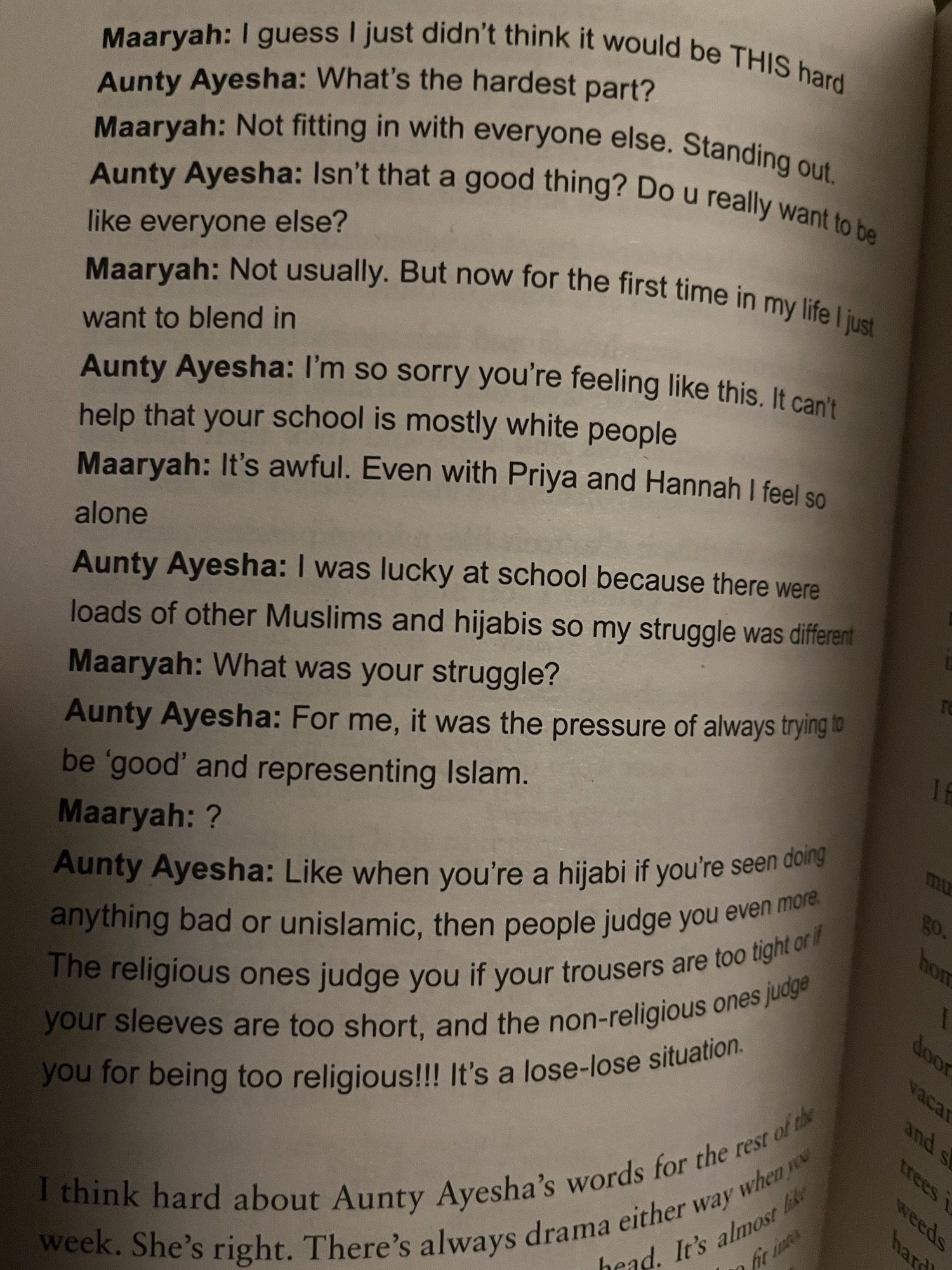
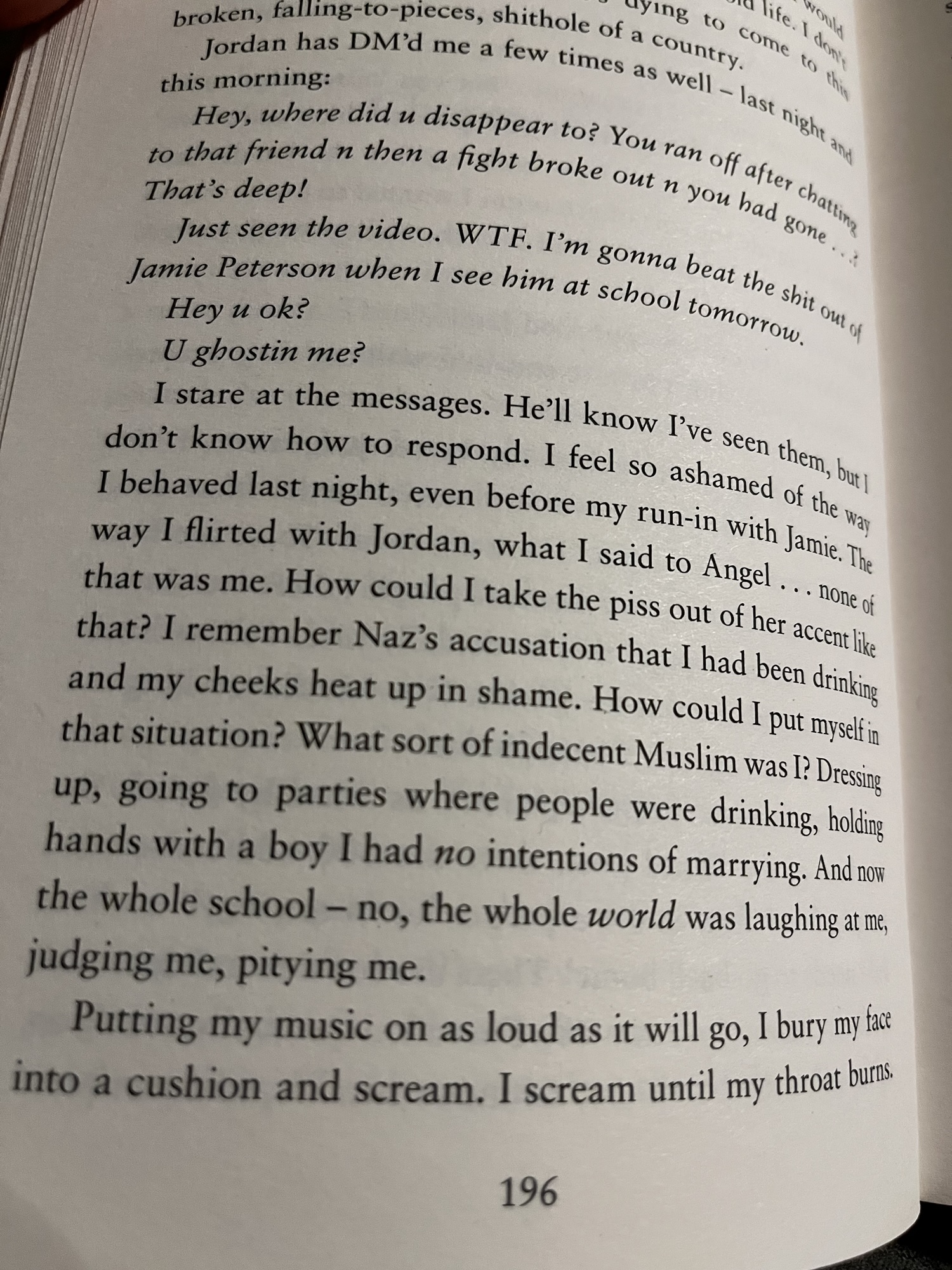
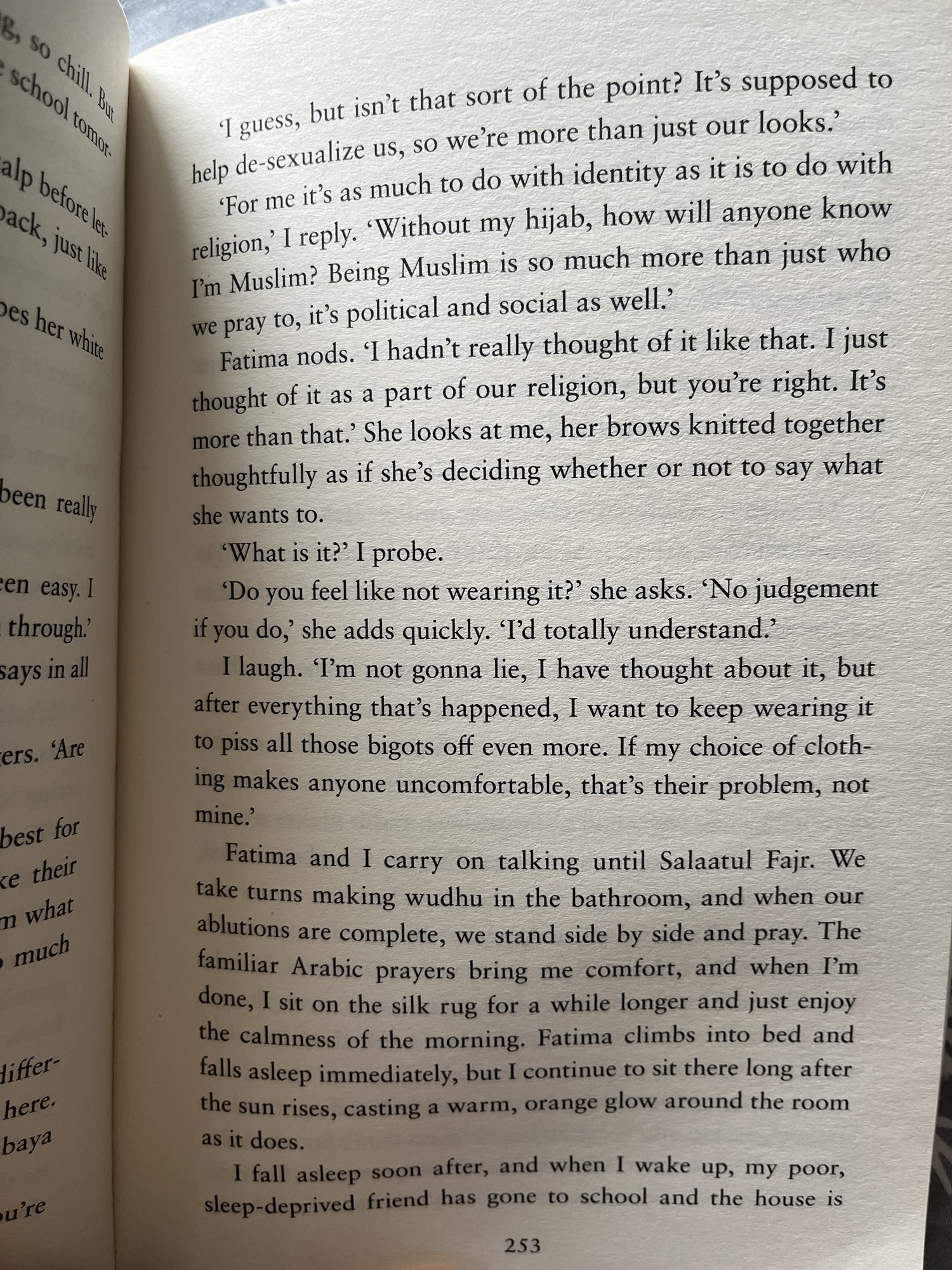
At 368 pages this identity centered mature YA book really hooked me and had me invested, which is impressive because Islamophobia stereotypes and being the new kid in a new place tropes are pretty frequently done, and often after a while, feel repetitive.  For me the charm of this book is actually not Maaryah and her peers/friends/bullies storylines, but the protagonist’s relationship with her parents and what caused her mom and dad to divorce.  Obviously as a mom of teens, I’m not in the target audience, but I feel like I benefited from the Muslim authored, Islam centered book, and think older teens, perhaps 17 and up, will also find the book enjoyable and reflective of views they have, challenges they face, and boundaries they have to establish.  I don’t want to spoil it, but SPOILER, had my dear friends that have read the book clued me in that the book will toe and slightly cross the haram lines, but ultimately show Maaryah deciding to re-establish her boundaries after being tempted not to, i.e. making a poor choice to attend a party with boys and alcohol present, and dressed in a way not typical to her hijabi style, I wouldn’t have read the last hundred and twenty pages or so with my jaw clenched in fear. The book shows a lot of Islam in practice, salat, duas, discussions about hijab, but not everyone will agree with decisions Maaryah makes or the rationale behind them as they vacillate between culture, religion, and family expectations.  I love that Maaryah is fallible and never abandons her faith, and that who we are is more than a singular mistake or instance of poor judgement. The book is not preachy, most will just take it as a girl finding her place in her new family dynamic in a new country, who happens to Muslim.  I think, an assumption really, based on what the author has said about her previous adult books, something along the lines that they are not meant to be Islamic fiction, but are stories with Muslim characters, and I think this book should probably be viewed the same.  There is swearing, hand holding, a side hug, normalized boy girl friendships, lying, running away, deceit, cheating, alcohol, mention of hookups, dating, vaping, music, flirting, hijab questioning, bullying, physical assault.  My biggest concern about the book is that it brings up Palestine, but doesn’t discuss Palestine. A side character is a non practicing Jew that visits Tel Aviv and Maaryah wants to discuss the occupation with her, but hesitates and the moment passes.  It is never revisited which I really wish it would have.  It could have modeled a bit how to have those conversations, I know it isn’t that type of book, but Maaryah mentions repurposing kaffiyehs in her designs and so it hints that it matters to her, but never pulls on that thread.  At one point it also mentions another character posted something pro Isr@*l during the genocide, which I can only assume the author thought that by the time of publication would have ended.  SubhanAllah ya Raab.

SYNOPSIS:
The tag line on the cover “From Dubai Girl to London Nobody…” very succinctly summarizes the plot.  Maaryah had an idyllic life in Dubai with her parents and close friends, spending her holidays with her mom’s family in London, and securing an internship with a famous designer.  All is going well until her parents get divorced, her mom moves her to the UK, not near her extended family, and the lack of Muslims, let alone hijabis, at her high school has her bullied with no friends to have her back.  With her mom in survival mode, their once close relationship is non-existent, and the 15 year old is left to sort through it all on her own.

WHY I LIKE IT:

There is a little pulling of punches so to speak of asserting that the boundaries are Islamic, but for the most part I think Muslim readers will see that Maaryah does view a lot of what she experiences through an Islamic lens which I appreciate. I also like that the protagonist’s connection to salat and faith is hers, it isn’t forced on her and I think for this demographic that is good micro messaging and framing.

I was very grateful that the book answered the questions about Maaryah’s family dynamic, so often parental problems are pushed to the void and let to be resolved or understood off the page. And while in the first half it was teased a little as we aren’t having that conversation right now, I did ultimately by the end feel like it was sufficiently resolved.  I also felt the mom was blaringly absent at weird times and I get that it was a plot device to get her out of the way, but if you are dragging at the 100 page mark, I do encourage you to keep reading, it does pick up.

This book isn’t meant to be didactic, and I recognize I’m putting that on it a bit, but I do think the Gaza framing missed an opportunity to show readers how to navigate that very real scenario through the power of fictional characters.
FLAGS:

Copied from above: There is swearing, hand holding, a side hug, normalized boy girl friendships, lying, running away, deceit, cheating, alcohol, mention of hookups, dating, vaping, music, flirting, hijab questioning, bullying, physical assault.

TOOLS FOR LEADING THE DISCUSSION:

I would shelve this in an upper high school classroom, I think that decision to be at the party is clearly shown to be a mistake, to put herself in that situation is something she regrets, and I think showing that she comes out from it offers a lot to be discussed.

Yusuf and Yusra’s Spooky Dilemma by A. Dawood illustrated by Fatimah Farooqi

Standard
Yusuf and Yusra’s Spooky Dilemma by A. Dawood illustrated by Fatimah Farooqi

This 54 page early chapter book about a Muslim kid being tempted by Halloween somehow didn’t really center Islam much, it didn’t explain the origins of Halloween, and it meant well, but I didn’t get the messaging, it actually felt othering.  Young Yusra lies to her parents, gets a costume, attends a school Halloween party, and then once caught goes out to lunch and taken to a museum with her brother and friend Fatima. At the museum the vibrant room is the “From Around the World” exhibit, and the depressing room is “The World Around Me.” the dichotomy is stereotypical and presumptuous without sufficient insight.  The book’s concluding lesson being, don’t give in to peer pressure and feel like you have to celebrate something that isn’t right, “think of all the millions of Muslims in the world not celebrating.”  Wait? What? That is the exact same thing- do or not do something because other people are doing or not doing it! Literary wise there were numerous paragraphs and pages I had to reread to know who was talking, the side characters were underdeveloped as they would get mad and storm off and then be chatting shortly after, and at the end, Umar completely ceased to exist.  Having already reviewed the other title in the series Merry Dilemma, I’m going to allow myself a little forgiveness in comparing the two books, as I would imagine many consumers will buy both, and I found the messaging and presentation in the Christmas book, a lot stronger in facilitating conversation and reflecting Muslim kids’ stresses, than this Halloween book was able to do.  The discussion of Isa (A.S.) and the messaging of what Christmas means and why it is problematic for Muslims was more clear and allowed me to overlook some of the literary inconsistencies and weaknesses; I’m glad I read it first.  If you read this with your kids plan to supplement and discuss because the book does not leave you feeling like you really know why Yusra, or Muslims, don’t celebrate Halloween.

SYNOPSIS:

Halloween is here and Cedarcrest Elementary is throwing a huge party.  Yusuf isn’t going, he knows Halloween isn’t for him as a Muslim.  Family friends, Fatima and Umar, aren’t going either.  But Yusra’s best friend Amanda is really excited, and Yusra thinks she can just help Amanda celebrate, it is just for fun any way right? It isn’t like she is celebrating, she will just be there.  She tells her parents she can’t miss school, her dad buys her a costume, not for Halloween, just for dress-up, and now she is at the school party with glitter and candy and a whole lot of guilt.

WHY I LIKE IT:

I like that the parents try and meet the kids where they are.  I think a lot of Muslim parents buy candy and costumes on clearance the day after Halloween so their kids can still have treats without partaking in trick or treating and enjoy imaginative play after the holiday.  The book having the costume being purchased before the holiday, thus is a relatable occurrence.  Yusra wanting to go is also believable.  But, the parent’s letting it play out to their fourth grade daughter actually lying about a quiz and going to school is a bit of a stretch.

I struggled with the lack of explaining why Muslims don’t celebrate Halloween and what the origins of Halloween are.  It said I don’t do it because I’m Muslim, I don’t celebrate because my parents told me not to, and thank you for explaining it aunty- but in fact, there was no explanation.

The writing wasn’t great.  At one point it says, “Let’s go to the frozen food section we need milk and cereal.”  There were multiple places I didn’t know if Yusra or Yusuf were talking, they sound the same age and I don’t think they are twins, but maybe they are, they are family friends with a brother sister: Umar and Fatima at their school, but Fatima is not in Yusra’s class either, the school vibes feel more junior high than elementary. Back to Fatima though, she gets mad when Yusra doesn’t take a firm “Muslim’s don’t celebrate Halloween position” with Amanda and she walks off being labeled a party pooper, but after school everything seems fine. The plan is all four Muslim kids will hang out instead of going to school for the party, but Umar is not with Yusuf and Fatima when they bust Yusra, or at the museum, so where did he go?

The messaging hinges on Yusra’s guilt.  I don’t know that the book explores it enough, doesn’t have her struggling with it a lot, so it comes across that it is more the getting caught that caused the realization.  She remembers Allah swt when caught, she apologizes to her mom, which is good, but not celebrating Halloween then seems more a family expectation not a religious no-no.  Ultimately the book felt a bit like a missed opportunity to explain the origins of Halloween and let the child decide what to do based on their understanding of Islam and the holiday.

FLAGS:

Lying, going to a Halloween party.

TOOLS FOR LEADING THE DISCUSSION:

I have a few teenagers and a 3rd grader and a toddler, I don’t think this book will do much to foster communication and deepen their understanding about Muslims and Halloween.  For my oldest three when they were in early elementary, we would listen to a NoorArt CD Qu’an for Little Muslims it had a track about Halloween that seemed to work when they were young: you can listen to it here.

If you think this book will work for your needsthough, you can order it here.

Mark My Words: The Truth is There in Black and White by Muhammad Khan

Standard
Mark My Words: The Truth is There in Black and White by Muhammad Khan

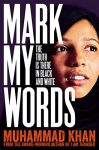
This 304 page YA/Teen book was surprisingly well written, gripping, relevant, and engaging.  I say “surprisingly” because the cover and title don’t scream pick-me-up-and-read-me, at all.  If I’m being completely honest, it looks like a self published book from the 90s, not one about to be released on June 1, 2022.  Appearances aside, it reads real and raw and even though it is very British and I didn’t understand a lot of the slang or the framing, I still was very invested.  The main character is Muslim and while part of the plot is focused on her identity, it isn’t her doubting herself, it is her in all her facets taking on stresses in her life, sticking up for what’s right, and going to bat against some very heavy hitters in the community.  The book has drugs, parties, racism, islamophobia, lying, crushes, cross dressers, gay and straight characters and relationships, privilege, assault, theft, robbery, language, hate crimes, talk of condoms, rape, sexual assault- it is raw, but the Muslim characters know who they are and engage in the environment around them as informed practicing Muslims.  The main character wears hijab and when she goes undercover she wears a wig and that conversation with herself if it is ok or not takes place, as she starts to have feelings for a boy and she tries to justify if it is ok for her, that conversation in her mind also is written out, many of her friends are of different sexual orientation and there is no judging or preaching, she accepts and celebrates them and they do the same for her. The drug use is never glorified and racism and misogyny are called out. The author is a teacher and it states in the backmatter the role his classroom and the students have in his writing and I think it shows.  The book says ages 12 and up, but I think for the content, critique on systemic racism, details about drug and drug use, gentrification, and media bias, the book is better suited for 16 year old readers and up.

SYNOPSIS:

Fifteen year old Dua’s school is under renovations which means her whole grade is being integrated with students at Minerva College, an elite private school on the other side of town.  It is an exam year, and what should be a dream for hard working Dua to get a foot in the door at her ideal school, quickly becomes anything but.  The kids from Bodley are made the scapegoats for a growing drug problem and the journalist in Dua is not standing for it.  When she doesn’t make the Minerva paper, she decides to start her own, and the dirt her and her news crew start uncovering isn’t mere gossip, it is outright illegal.  While journalism starts taking over her school life, Dua’s home life is quickly crumbling.  Her mother is falling apart mentally, failing to get to work, and struggling to keep her own demons at bay.  When Dua’s slightly estranged father tries to step in to help, Dua has to reconcile her past relationship with him and find a way to move forward.  In between all the drama at school and home is Dua’s time on the basketball court, and star Minerva Rugby player, Hugo, has taken an interest in her Kobe sneakers, and her.  The two spend some flirty time on the court leaving Dua with some decisions to make, and her questioning who to trust as everything starts to blow up.

WHY I LIKE IT:

I love how fierce and strong Dua is.  Yes, she over does it at times, but just as fiercely as she pushes for what is right in her mind, she acknowledges her errors and works to correct them.  She is Muslim because she is Muslim it is never a label she wears for attention or for someone else, it is who she is.  I love that there are also Muslim side characters including the principal.  Dua and Huda, another girl at school are always getting mistaken for one another, which is a great OWN voice (even though the author is male) inclusion.  Additionally Huda has a boyfriend, and when in the midst of a conversation she refers to him as her fiancé, Dua freezes, and Huda explains that they are getting married as soon as they turn 16 since dating is Haram and their parents all know.  I love that there is no explaining or judging at 16 year olds getting married, it just is what it is. Most of the book is written in that tone, that there are girls wearing hijab, and yes it gets pulled off at some point, there are guys writing make-up columns, there are gay guys explaining sub groups within the minority, but it all comes across as judgement free.  When racist, or homophobic, or Islamophobic, or misogynistic, or classist comments are made, other characters call them out, not to debate or preach, but to just emphasize the live and let live tone the book seems to advocate.

I was thrilled to see Dua’s best friend Liam wears hearing aids and that is very much a part of him, it isn’t a label stuck on and forgotten.  It is joked about, it is a daily presence and the author notes it in the backmatter as well.

There were some side storylines that felt a little under devolved, I would have liked a stronger emotional arc in Dua’s mom’s mental health deterioration, as well as what drove her parents to divorce.  The book is fast paced, so I wouldn’t want a lot more back story, but a little more to connect with would have been nice.

Honestly it took a few attempts to get in to the story, just because I’m American and the book is British.  I finally just read through the first twenty pages and kept going and then I was fine.  I know that is my own bias, but it is worth noting since the title, and cover aren’t attractive and then once you start it isn’t immediately clear what is going on, that some determination might be required before the book becomes difficult to put down.

FLAGS:

Drugs, drug use, sexual assault, physical assault, corrupt police, racial profiling, gentrification, systemic racism, media bias, partying, deception, bribery, expulsion, mental health, bullying, cross dressing, relationships, attraction, misogyny, hate crimes, threats, corruption, property damage, theft, stealing, cursing, language, alcohol consumption, dealing, to name a few, it is a contemporary high school setting with students taking on racist elitists.

TOOLS FOR LEADING THE DISCUSSION:

I know the flag list seems long, but I think there is a lot of sleuthing, action, character and story building and investment that give the book a lot of heart.  I think it could be shared in an Islamic high school and would result with some amazing discussions.  If you want to grab a copy, you can go through this link that will benefit me, I think Amazon gives me 2.2% back, lol, but when you pay for your own books, truly every little bit helps! Happy Reading!

The Most Pleasant Festival of Sacrifice: Little Barul’s Eid Celebration by Munise Ulker Illustrated by Beyza Soylu

Standard
The Most Pleasant Festival of Sacrifice: Little Barul’s Eid Celebration by Munise Ulker Illustrated by Beyza Soylu

batul.jpg

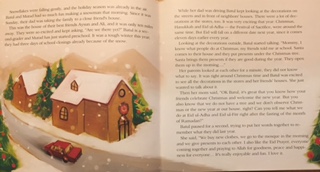
This book is beautiful, it feels great in your hands, the raised glitter embellishments in the illustrations, the price point, everything except the text.  The gist of the story is even fine, the execution is just off.  It reads very much like it has been translated from another language in to English, and yes my privilege might be showing, but the phrasing, the passive voice, the orphanage, all make the book with its massive text passages hard to convince kids younger than 7 to sit through.

batul9

The story starts off with parents and two kids , Murad and Batul, driving to a friend’s house for dinner, commenting on the Christmas decorations that they see.  The parents ask what the kids know about Eid al-Adha that is coming up and the kids remember how much fun they had in Turkey.  Except it is really awkward to get this bit of information out.  They discuss Eid last year, and then remind each other that they were in Turkey, and how it was much more fun.  Noting that international travel is expensive and they won’t be able to go again, the Mom over dinner discusses how they can make Eid fun for the kids with her friend.

batul2

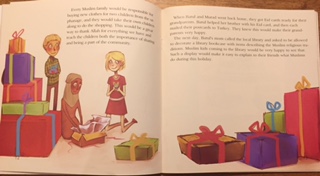
It is decided that the Muslim and non Muslims will celebrate together and include a local orphanage.  “Each Muslim family would be responsible for buying new clothes for two children from the orphanage, and they would take their own children along to do the shopping.” This would teach the kids to thank Allah and learn about community and sharing.  A great lesson overall, again just a concept presented in a really wordy, round about, awkwardly forced manner.

The Mom contacts the library and gets permission to decorate an information table, the kids make Eid cards for their grandfather in Turkey, at Sunday school they make gifts for friends.  They learn about Zakat and sacrificing an animal like Allah commanded Abraham to do, they even send cards to their neighbors.  Oddly though remarking how fun it is to get candy outside of Halloween.  After the first two pages explaining Christmas and telling that Muslims don’t celebrate it, I found it odd that they would, 15 pages later, be referencing Halloween. 

bat

Some of the sentences also don’t made sense.  About half way through I didn’t understand what the author meant by the boys “celebrating each other’s Eid” after they put their new clothes on and went to Eid prayer.

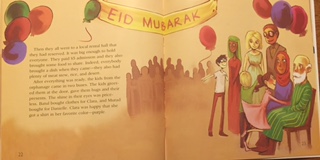
Once at the party, they give specific details of how much they charged everyone, yet no details about the food they all brought.  The kids enjoy a pinata and everyone including the orphans get Eid gifts.  Despite everyone’s fun the party has to end, and the orphans return to the orphanage and Murad and Batul declare they “will always remember this Eid.”

batul3

The illustrations are great, it is really yet another example of a book just needing a good editor.  From the very beginning, even the title isn’t really right, the book isn’t even mainly about Batul, to the random details shared, the book is just too long and too unpolished.  It is really unfortunate, because it has so much going for it on its 32 pages.  The main points however, I feel are lost about Eid and the reason it is so dear to Muslims everywhere.