Tag Archives: Noor Alshalabi

Birthday Kunafa by Rifk Ebeid illustrated by Noor Alshalabi

Standard
Birthday Kunafa by Rifk Ebeid illustrated by Noor Alshalabi

img_4902-1

This 50 page wordless picture book allows readers to make up their own words to describe the progression of what is shown in the illustrations. With no right or wrong, the backmatter helps give context and points out key images that allow the story to resonate on multiple levels.  On the surface it is a birthday girl who is upset she cannot have kunafa, but when you truly look at the pictures, and see what is preventing her from moving from Jerusalem to Nablus, the reader is shown, she is not just a child wanting something she can’t have, but that she is being denied basic rights by an occupying force.  I love that the little girl represents so much more than just herself, and that her determination to cross checkpoints, is not just about acquiring dessert.  The book starts with a little girl on her birthday that could represent a little girl with her friends and family anywhere, but as the pages are turned you witness how beautiful Palestinian joy is, how much we take for granted the freedom to move, and how desperately we need to stand up for a free Palestine.  With no words, Islamic representation is limited to two hijabis in the illustrations.  The author and illustrator are Muslim. The book centers a birthday, there is dancing dabkah and an oud shown leaning up against a wall.

So often when thinking about Palestine, not just since October, we all find ourselves speechless.  There are no words, only tears when watching the news, reading headlines, or scrolling, and I find it incredibly timely for a wordless picture book about Palestine to be published.  There are a few labels so to speak throughout the book that I didn’t particularly find necessary, but they do not distract from the story, so they didn’t bother me.  I like that the book showed restraint in terms of the oppression that could have been shown.  It allows for the story of the little girl and her family to maintain the narrative.

The story that I understood the images to be telling is that it is a little girl’s birthday, the family is having a party, they have a birthday cake, but she wants kunafa, she tries to get some and along the way sees joy everywhere, until the checkpoints turn the images gray, and prevent her from moving forward.  So mama and her problem solve, they try and make their own, but it is not the same, so they devise a plan, and they try again.  They do not give up. There is no giving up.

The backmatter provides a recipe for kunafa, a two page spread about “Why Wordless Picture Books,” another spread about “Context Matters” giving information about Zionism and Palestinian resistance.  It is then followed by four pages entitled “Did You See?” where symbols are shown that appear in the pages and described.  Warning there are numerous sweet and savory foods shown, and it will make you very hungry.

The book is available here from Crescent Moon or here from Amazon.

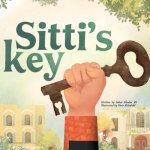
Sitti’s Key by Sahar Khader Ali illustrated by Noor Alshalabi

Standard
Sitti’s Key by Sahar Khader Ali illustrated by Noor Alshalabi

sitti key

I try and buy, read, and review every children’s book about Palestine that is published, it is the least I can do.  I also try not to compare them to each other as they present different aspects of oppression, perspectives of strength, examples of joy, and messages of hope, even among many similar themes of food, keys, traditions, and culture.  I really appreciate that this book though is incredibly blunt.  It isn’t lyrical, it isn’t poetic, and as Israel is bombing Jenin as I write this I’m glad it doesn’t mince words about the Nakba. I do think caregivers though, should probably read it first as it might be a little triggering for sensitive children.  The story is OWN voice and probably best suited for middle elementary aged children.  It is perhaps also worth noting that the book could be seen as making Jews synonymous with Zionists.  The characters are Muslim, Islamic phrases and Arabic terms are sprinkled throughout, and even despite the pain the family has endured, the book stays hopeful and proud.

Sitti is coming and Amal is excited, it has been two years since she last saw her.  She loves how excited her mom and grandma are to unpack gifts of olive oil, dates, and zataar from friends.  Amal isn’t sure what to do with the “old lady thoub” she has been gifted, but she smiles in appreciation none-the-less.  When Sitti pulls out an old key, Amal starts to ask her about it, but her mother shuffles her off to bed.

The next day at school, Amal has to work on a presentation about “culture,” but there are no Palestinian books in her school library, so she just watches the other kids.  At home they eat and listen to Sitti’s stories of long ago in Haifa, and Amal asks her why she left Palestine.  Despite her mother trying to redirect, Sitti says it is time she knew about the Nakba.

Sitti tells about living on the land for generations and how the Jews believed the land belonged to them.  In 1948 the British decided Palestine would be the homeland for the Jews.  Armed men came and arrested anyone who tried to stay in their homes. Sitti’s brother was handcuffed and never seen again.  The family grabbed what they could including the key to their home as they made their way to a refugee camp in Lebanon.  They stayed for three years, before making their way to America.

When Sitti concludes her story she hands the key to Amal and her hope that she will return to their home inshaAllah.  Feeling the pride and warmth of home, Amal has a determination to reclaim her heritage and share her “culture” with her classmates.

The illustrations are sweet, the mom and Sitti wear hijab even in the home, and the inshaAllahs and salams come naturally. The book does not stop to define zataar or marimya, which helps the flow. I also like how it shows that there aren’t books about Palestine in the school library, it is strong and important detail.  I don’t understand where Sitti is coming from though, it would seem Palestine as she is bringing gifts from friends, but in the story it says after Lebanon they made their way to America, so I’m not sure where Sitti lives, and how the logistics of the family work to be honest.  I also kind of wish there was a  recipe for zataar in the book and lyrics with translation for the song the family sings.

Book is available on Kindle or can be ordered from www.littlehibba.com

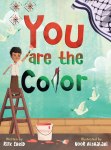
You are the Color by Rifk Ebeid illustrated by Noor Alshalabi

Standard
You are the Color by Rifk Ebeid illustrated by Noor Alshalabi

you are the color

Books like this are hard for me to review, and I have gone back and forth on whether I should post anything or not.  On the one hand, we need books that are unapologetically Palestinian written by Palestinians.  They need to be celebrated and elevated and I want to offer my support to the stories, to the voices, to the authors, illustrators, everyone involved.  On the other hand, if I didn’t love it, why should I shy away from saying so, when I have purchased the book (pre-ordered and changed the shipping address even, to have it delivered to me on vacation because I didn’t want to wait to read it).  The book is emotional, but the last six pages unraveled the whole book for me, and in a picture book particularly of this nature, when you finish- if you don’t have a cathartic pull, you start to find holes in the story as you feel deflated.  The book, I would go out on a limb to say, needs to be discussed and given context even if you are Palestinian.  As someone who is not, I recognize my arrogance in such a statement and am happy to be corrected, but from a literary reviewer standpoint the book needs discussion and additional context.  The Nakba is only articulated in one paragraph in the author’s note.  In the story itself there is no indication that what happened to Thaer happened to so many Palestinians in 1948.  The use of color and how it is depicted in the illustrations is tangible and powerful, but as odd as it is to say, the words got in the way of the story.

img_0713

The book starts with Thaer trudging to school in dull sepia filled pages to begrudgingly sit at a desk and begin an art lesson.  He is glad the spitballs are just spitballs and not real explosions, but the tone is still melancholy.  When he sees boys playing soccer he recalls the last time he played soccer, and the memory comes alive in color.  He was in Yafa, it was the day before the Zionists came and took his family’s home.

img_0714

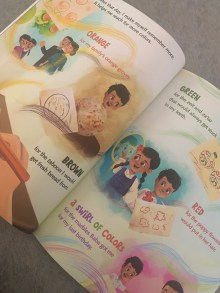
The teacher, back in muted tones, asks him to draw what has made him smile, and Thaer gives it a try.  Blue for the color of the sea, green for zeit and za’tar, brown for taboon to get fresh bread, etc..  When he takes the drawings home to his mother, she is not impressed.  Drawings are silly and colors aren’t going to bring Baba and Susu back.

img_0716

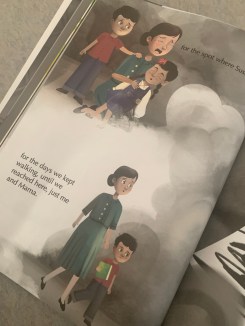
Defeated, the next day in class, Thaer recalls the men pounding down the door and Baba being shoved in a truck and Susu falling.  The next day at school they hang up some of their pictures and Thaer talks about his sister.  (SPOILER) On the way home Thaer paints the alleyway and brings color to his and his mom’s world.  His mama says that he is the color, and when the following day’s prompt is to draw what you want to be when you grow up it shows Thaer (presumably) on the beach as an adult painting.

img_0715

The disconnect for me occurred with the painting of the alleyway.  I was incredibly invested in the story, my heartstrings were being tugged, I was breaking for this character and his experiences, and it all came to a screeching halt because I couldn’t understand where the paint and the alleyway and the mama’s change of heart all manifested from.  As for the ending, I think I know what the author was going for, but it didn’t connect with any of my kids aged 2-15 nor my mother, a 40+ year early elementary veteran teacher.  I wish I could have taken a picture of their faces as she read the book to them.  The frozen expressions of huh and confusion at the end, until my 11 year old to broke the awkward silence to ask if the boy wants to be a painter or a father or an adult?  Those facets coupled with the often advanced vocabulary, makes the book an important one, but one that needs a lot of outside commentary to connect with the readers and to further the conversation about Zionism, al-Nakba, the occupation, and the continued oppression of Palestine.

There are flags of loss, kidnapping, sorrow, violence, etc., that parents will have to gauge if their children can handle. I’m not sure what age group is the best fit, the murder of a young girl, the forced displacement from one’s home, the removal of the father are all heavy themes.  I appreciate that it isn’t “watered down” for a western gaze so to speak, but I wish there was more about what happened to the dad, is there hope he is alive? I wish there was something about this not being an isolated reality for the protagonist and his family.  I wish there was some conversation or connection between the mother and son, because the loss of continuity really derailed the story.

As for the idea of the story, and the use of the illustrations to physically show two worlds I think is a great idea, it just sadly fell apart for me at the end: the faltering conclusion and the loss of emotional buildup that the first two thirds of the story worked so hard to create.