Tag Archives: life

The Lines We Cross by Randa Abel-Fattah

Standard

LinesWeCross.jpg

It is kind of remarkable now that I look back on the book, that before reading it, I knew exactly what was going to happen based on the jacket flap synopsis, yet somehow the book held my interest and I finished it easily.  There were no surprises, no plot twists, not even any amazingly poignant passages, yet, I kept reading, so there is some merit, perhaps in ideas, even if the story line wasn’t meticulously crafted.  At 390 pages, this 4.8 level AR book is not for elementary or even middle school readers, it is a high school and up for content understanding and appropriateness.

SYNOPSIS:

The dual storylines are told from the intertwined perspectives of Mina, a Muslim refugee to Australia who fled Afghanistan in a boat, and Michael, an Australian upper middle class high school student whose parents run an anti-immigration group and oppose the arrival of refugees.  The two see each other on opposite sides at a protest, and reunite when Mina earns a scholarship to a prestige posh school, and the family moves so that she can attend.  Naturally the two clash, then fall in love.  Along the way there are slight changes as the characters grow, some side stories about friends and family members, and like the title suggests, crossing of lines, so to speak.

WHY I LIKE IT:

I like that the book in terms of its political plot is actually pretty nuanced.  You could say it is framed as a good vs. bad, but it isn’t that simple, and I think the characters shed light on the gray area in between.  In many ways Michael changes and grows and challenges himself to go out of his comfort zone created by his family.  He forces himself to see where immigrants live, he steps foot in a mosque, he researches the detention centers and what not, to learn that he doesn’t agree with his parents.  I wish, however, that all of these scenarios would have been slightly more memorable, maybe an interaction at the mosque, or follow-up by talking to Mina about it.  The lack of reflection made his journey seem like he was changing his views for a girl, and not because of a deeper understanding.  At the end his mom even asks him about it, and I kind of had to side with her in wondering about his motives.  Mina’s personal growth is more in that she learns to trust new people, and let them in.  Her growth is not as obvious as Michael’s and I think some would put her on the “good” side and see her as a stagnant character.  She is greatly shaped by the death of her father and brother, by the escape and journey to Australia, and then having to move again for school, but in the course of the books timeline, she really doesn’t change much.  Her Islam is really culture, she doesn’t pray, or mention anything about her belief or faith.  Halal is not explained, but is just seen as a political tool to protest and argue about.  Mina never goes to the mosque, and even for religious reasons never questions if she should have a boyfriend, but worries what her mother will say and thus does keep it secret.  For all realistic purposes, she is portrayed as a Muslim as a political identifier that illicits stereotypes and assumptions by others, not as a description of what she believes, behaves, or thinks.  Michael’s parents are where the real meat of the story for me was.  Understanding how they see themselves as “not racists” ordering ethnic foods from all over, but actively working to keep non-assimilating foreigners out.  Their organization claims to promote the idea of upholding Australian values, not of disliking other countries values, and I think this is really what so much of the world is facing right now. The ethnocentric idea of being so great and understanding in words, but not in behavior and policy making.  Michael’s dad goes overseas and feels sad, but doesn’t feel compelled to help, rather than to keep those people from changing, “his” world.  As the book mentions a lot, his parents in other ways are kind, good people.  It really isn’t good against evil in all facets of life.

I think my favorite part in the book are the female relationships.  I love Mina’s friend Paula, who quotes Oscar Wilde and while on the outside has it all together, lets Mina see the real her.  She is smart and feisty and seems to stay genuine throughout.  I like that Mina’s friends from the “old neighborhood” are still in her life and I even like how close she and her mom are.  It’s nice to see females helping each other, there is power in that, that fiction helps remind readers about.

FLAGS:

There is mention of sex, nothing explicit, but side characters hook up, are accused of being sluts, and it is definitely there.  The main characters kiss regularly.  There is some swearing and lots and lots of lying.  Mina can’t go out after library hours because that is where she says she is, when she is elsewhere.  There is fighting, alcohol, clubbing, and smoking mentioned throughout.  None of the aforementioned flags are glorified or even praised, but all are there.

TOOLS FOR LEADING THE DISCUSSION:

I wouldn’t do this as a student book club, but I think it could be done as an adult book club.  The politics need some background and understanding, that I think some discussion would be enlightening in a community or larger society setting.  Sometimes even in the real world, meeting people different than ourselves does wonders for changing preconceived notions and stereotypes.

The Muslims by Zanib Mian

Standard
The Muslims by Zanib Mian

the muslims.png

After reading this book, I really, really want to meet (and be friends with) the author, she writes from the point of view of Omar, a nine year old boy, and his perspective and voice are so authentic and relevant that while the book targets 3rd through 5th grade, I am certain kids and adults, Muslims and non-muslims, boys and girls, and everyone else, will all thoroughly enjoy this laugh-out-loud 164 page book.  

muslims mum.png

SYNOPSIS:

Omar is starting at a new school, we don’t know why, and while he is nervous, he has a good attitude about it.  His parents are supportive scientists and he has an older sister, Maryam who can be a bit mean in a big sister way, and a little brother Esa, who he secretly loves.  All are practicing muslims who remind me a lot of the people I know.  We say our duaas, we pray, we laugh at the funny stereotypes and just try and be good neighbors and people.  Omar’s neighbor is hilarious, Mrs. Rogers, doesn’t like Omar’s family, or “the Muslims” as she calls them, but they just keep being themselves and when she falls and gets hurt, she starts to realize they are good people who care about her.  She even starts showing up for iftar every night in Ramadan and counts down like a space ship launch until it is time to eat. 

Using his Islamic upbringing, and seeing how is family handles problems, gives Omar a lot of tools for starting at a new school.  But Omar is the protagonist, the hero, so he also has a super imagination that involves H2O, his dragon, that shows up to help him out when things get rough.  And unfortunately, a bully by the name of Daniel makes things rough for Omar.  He tells Omar that all Muslims and all Asians are going to be kicked out of the country, and this really sticks with Omar.  He verifies it with a cousin, and learns it could be a possibility.  So, the underlying anxiety is there, but most of the book that focuses on the bullying aspects involve the day-to-day comments, physical pushing, and efforts of Omar to avoid Daniel.  When they do meet up, however, the result is often comical, as Omar and H20 confidently navigate the situation at hand.  Between visiting a different mosque in London each week, learning to read the Quran, celebrating Ramadan, and just being a kid with new friends and a fun family, Omar eventually does win Daniel over after the two of them get lost in the London Underground.  And all of us that came along for the ride are better for it, alhumdulillah.

FullSizeRender (46)

WHY I LIKE IT:

There is so much to love about this book.  Seriously.  The accuracy of family life depicted is spot on and the Islamic elements are so interwoven that non Muslims would truly learn about Islam through learning about Omar, but not in a preachy way, and Muslims will see themselves on every. single. page.  I love that Omar doesn’t ever seem embarrassed to be who he is.  He is a cool kid for his confidence alone, and being able to laugh at a bully and not have it shake your core belief and self image is so powerful.  The characters are well developed, from little Esa to Omar’s teacher, by viewing them through his eyes, you see enough of their personality to remember them, and appreciate them.  The only exception to this was Maryam, I really didn’t feel like I got much on her, but I have a feeling there will be more books, and she will develop too.  The book reads like a diary, until a tinge of foreshadowing of the changing relationship between Omar and Daniel pops up to setup the climax.  The chapters are short, the fonts and doodles endearing and engaging, and the size of the book, really makes it fun for elementary aged children.  The only possible gripe for American children, is that it is a British book, and you might have to google or ask what a few things are, yeah we are selfish like that, but its good for us to learn what pains au chocolate are, or crumpets, or nappies.  

FullSizeRender (47)

FLAGS:

The book is clean. 

TOOLS FOR LEADING THE DISCUSSION:

Oh this should be required reading for every kid.  I know I will be trying to implement this every where I go.  This would be awesome for a elementary book club, and especially great in Islamic schools for struggling readers.  In much the same way that teachers use humor to engage students, this book has heart and humor and a surprising amount of information, that I can see it being connected to a lot character building supplements in various curriculums, at least I hope it is, we need voices like this, both within our community and to serve as a representative of us to the larger society.

Book Trailer:  https://www.youtube.com/watch?v=AIKtoxt3InM

Author’s website: http://www.muslimchildrensbooks.co.uk/


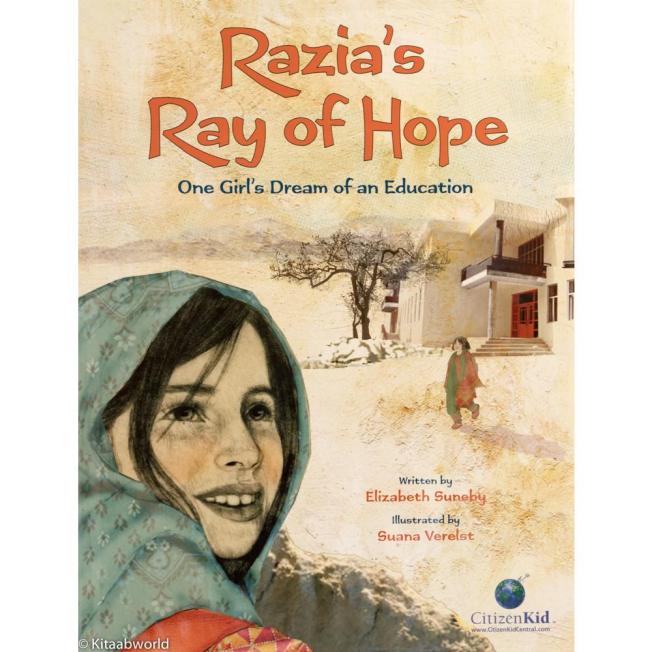
Razia’s Ray of Hope: One Girl’s dream of an Education by Elizabeth Suneby illustrated by Suana Verelst

Standard
Razia’s Ray of Hope: One Girl’s dream of an Education by Elizabeth Suneby illustrated by Suana Verelst

razia

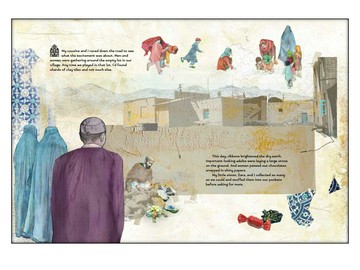
I usually love books about girls, and education and hope, but for some reason, I didn’t love this book.  I really like the pictures with their mixed media feel and textures, but I found small things annoying in the book, that based on other online reviews really put me in the tiny minority.  Most people seem to drool over this 32 page AR 4.1 picture book, I, however, think there are a lot of inspiring books about girls in Afghanistan dreaming of an education that one needs to do something different, and do it well to win me over.

So the basic premise, in this text heavy, tiny font, book, is that Razia learns they are building a new school close to her home in Afghanistan for girls, and wants to go.  Her grandfather also wants her to go, but one of her older brothers, Aziz, won’t allow it, so she isn’t allowed to go.  No historical lead up explaining why her grandfather talks about days when women were educated, and now it is a rarity.  No summation on the Taliban or the 17 years of war that the grandfather mentions.  So, unless the reader knows some background on Afghanistan, the story may not resonate with them or provide needed context for connection and appreciation.  Even the afterward, about the real founder of the school, offers very little context.  The brother’s decision is final until one day he falls ill and can’t read the medication directions, and Razia can, eventually he relents and she is allowed to go. The story hints that the rocks around the school are from the quarry he works at so he now feels confident she will be safe, and that his initial refusal was a concern for safety.  They hug and seem loving, and once school starts Razia has to learn as much as she can to be able to go home and teach Aziz and her mom.

razia1

I like that when she initially is told no, she doesn’t sit and assume a helpless manner, but rather goes to the school and meets the founder herself.  I find it odd, and irksome that the head of the school is also named Razia and it isn’t even noted. I get that is her real name, but why have the two main characters in a book have the same name and then not even acknowledge it? I didn’t get why the little girl couldn’t have a different name, seems distracting to me, and imply that every girl has the same name in Afghanistan.  I also didn’t get the hierarchy. The grandfather wants her to go, the father and uncles have legit concerns of where she is needed in helping the family farm and orchard, but why did the brother’s opinion trump them all? There is no mention of Islam, but they wear hijabs and burkas, so I think the stereotype is implied.  And that was another thing, they made it seem like she would be corrupted if she went out alone or without the burka on, but then Aziz shakes the headmistress’s hand, as if that isn’t against religious and custom norms. I felt that the kindness of the brother at the end was disjointed too, a bit too forced. The grandpa seemed kind, but the rest of the family seemed cold and rigid and not overtly concerned with Razia’s well being and growth.  Yes, they did have a jerga, to discuss and consider it, but I felt like Razia never had a voice, and while education is important, having a voice is too.  More has to change in society and in literature to give me real hope, and this book sadly fell short.

razia2

It Must Have Been You! by Zanib Mian illustrated by Fatima Mian

Standard
It Must Have Been You! by Zanib Mian illustrated by Fatima Mian

it must have been you.jpg

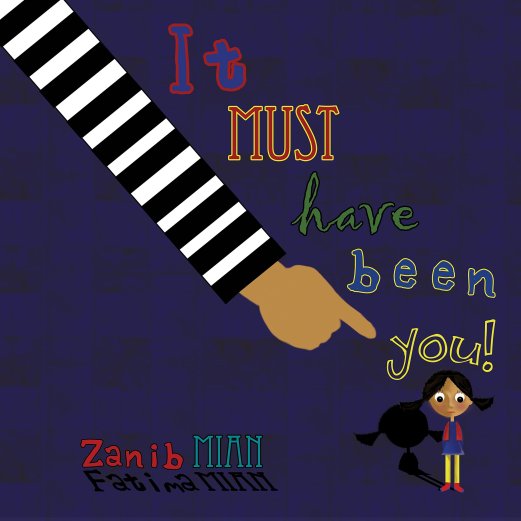
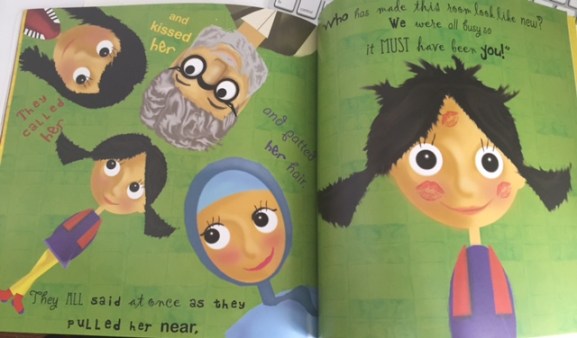
This rhyming 32 page book follows around a small girl, “about the same age as you,” who seems to make a mess every where she goes.  She never lies or even responds to the accusations of her unintentional messes, as she gets caught each time by someone in her family who points their finger and identifies the clues that led them to their answer. Luckily, she uses this pattern to her advantage as she cleans up and makes her family a card resulting in hugs, kisses, and love.

FullSizeRender (34)

Written for younger kids (4-6), the book is bright and colorful and very well done.  Even two and three year olds will enjoy the sing-song rhythm and chunky engaging illustrations.  The pages are thick and the binding solid, especially for a soft back book.  The 10 x 10 square size works well for story time and bedtime alike.  However, because the text is incorporated into the illustrations, if you are reading to a group, you will want to read it a few times before you present.  Looking at it straight on, the word order is much more clear and if you are reading it with emerging readers, I would recommend pointing to the words as you read, so as to help guide your listeners.  The fonts get a little crazy, which is part of the fun, but again may require some assistance to help the younger readers decipher the words.  Older independent readers (up to age 7 perhaps) might like the slight challenge of figuring out what word comes next, so that the story makes sense.

FullSizeRender (33)

The mom wears hijab and that is the only islamic reference or overt implication.  A fun book that thus far with multiple readings has yet to get monotonous and boring, yay!

FullSizeRender (32)

Wishtree by Katherine Applegate

Standard
Wishtree by Katherine Applegate

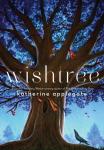
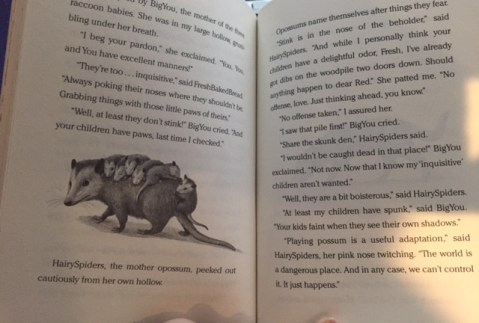
wishtreeI saw this book on Scholastic when I searched for “Muslim” on the website, a regular endeavor of mine, and was surprised to see it pop it since the synopsis on the back doesn’t mention Muslims or Islam.  So I researched it a bit, and sure enough the discrimination of a Muslim family in this tree’s neighborhood is the catalyst of this giant Oak Tree, sharing her story and enlightening the characters and readers with her wisdom.  At 215 pages, this slow and thoughtful book is a short read on an AR 4.2 level.  The pages are well spaced and the black and white drawings keep the reader engaged. And while I bought the beautiful hardback book, I didn’t read it, I listened to the two and a half hour audiobook version, and it was fabulous as well.

FullSizeRender (40)

SYNOPSIS:

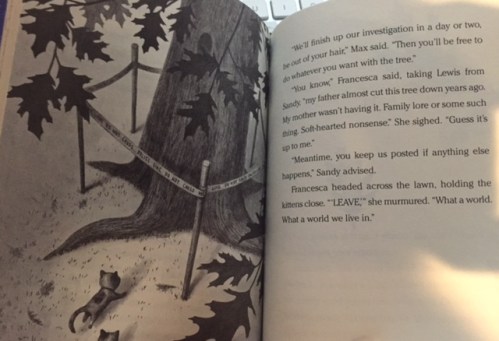
Aside from maybe Shel Silverstein’s The Giving Tree, I can’t recall too many books being narrated by a tree, but like The Giving Tree, the lessons and wisdom come through loud and clear and stay with you long after the story has ended. Red, is an old Oak Tree that has been around for over 200 years.  She has many stories that she shares with her inhabitants: the possums, the raccoons, the skunks, the birds, her best friend a Raven named Bongo, but never humans, for they must not hear her speak, that is kind of a rule.  But when 10-year-old Samar’s family moves in and people don’t respond well to the new Muslim neighbors, the tree considers getting involved.  Samar spends a lot of time near the tree, and the animals enjoy her presence, while most people tie wishes to the wishing tree on May 1st (Wishing Day), trees are good listeners and Samar tells Red that she wishes for a friend.  This coupled with the act of vandalism someone commits against Red by carving “LEAVE” into her trunk, pushes the tree to ponder what makes people friends and how can she help Samar.  When the owner of the home who’s land Red resides on decides to have her cut down, Red throws caution to the wind and speaks.  Hoping to bring two kids together that need one another, and by extension their families and the whole neighborhood, Red has her work cut out for her.  Luckily she isn’t alone, her animal friends are up for the challenge and the lucky reader gets to laugh with the funny animals, ponder roots, and inclusion, and friendship, and diversity through the loving gentle manner of a tree.  It may be written for fourth graders, but I think everyone can draw upon the lessons, the depth, and the compassion needed to help Samar, to save Red, and to learn to be better to one another.  

FullSizeRender (43)

WHY I LIKE IT:

It flows like prose, the deliberate manner in which the story is told, grabs hold of you and halts time.  I love the relevance of inclusion and differences, there isn’t a magic wand, that makes everyone like everyone at the end, but there is hope.  And sometimes that is more powerful.  I listened to the book with my daughter, a 6th grader, and it was nice to chat about it with her after.  What makes people friends? How do people become friends? We move a lot, so she was really insightful about how sometimes friends are just friends because of proximity or because their parents are friends, she really had to think about what has kept certain people in her life, and I loved that this book gave us a starting point to have such a meaningful dialogue.  There isn’t much about Islam in the book other than that the Samar’s family is Muslim and that her mom wears hijab.  

FullSizeRender (42)

FLAGS:

None. It’s clean.

FullSizeRender (41)

TOOLS FOR LEADING THE DISCUSSION:

I would absolutely do this for a 3rd to 5th grade Book Club.  It has so many lessons presented in a non preachy way that the students would add themselves so naturally and effortlessly into the narrative and grow from it.  The book has won numerous awards, and the author is well known, so it also will encourage children to read other books of hers.

Author’s website: http://wishtreebook.com/

Teacher’s Guide: https://images.macmillan.com/folio-assets/teachers-guides/9781250043221TG.pdf


nine, ten: A September 11 Story by Nora Raleigh Baskin

Standard
nine, ten: A September 11 Story by Nora Raleigh Baskin

nine, ten.jpg

I still struggle with the fact that 9/11/2001 is taught as history, it seems so current and fresh in my mind, that I really struggle with how works of fiction (and non fiction too) try to tell me about the pulse and the mood and the impact of something that I lived through and recall so clearly.  I suppose this isn’t a unique predicament, but because of the magnitude, one that I still wrestle with.  The author of nine, ten glosses over the big picture and in a lot of ways, the events of 9/11, but instead tries to show the paradigm shift that occurred and the division drawn as life before and life after.  She attempts to do this on an AR 4.8 and in 197 pages.  No easy feat, but one that definitely has some hits, and for me at least,  a few misses too.

SYNOPSIS:

Told from four different perspectives that intersect at the opening and at the close, the reader meets the characters two days leading up to 9/11, spends some of September 11 with them, and then peeks in on them again a year later.  The characters all cross paths at Chicago’s O’Hare Airport.

The first character is Will.  A middle school boy struggling to come to terms with how his father died helping someone on the side of the road.  Often more responsible and mature for his age as he helps his mom with his younger siblings, he lives in Shanksville, Pennsylvania and finds healing with helping those affected by the plane that goes down there.

Next we meet Aimee, who has just moved to California and is starting a new school.  Her daily drama is more missing her mom who travels a lot to New York for business, but is relatable as she tries to make new friends, fit in, and find her place in a new environment.  Her mom is in New York during the duration of the book, and has a meeting in one of the Twin Towers on the 11th.

Sergio lives in Brooklyn, New York and is a math wiz who gets a special award and recognition for his achievements.  He lives with his loving grandma, but it is the stressful encounter with his deadbeat father that sets him on a fateful subway trip that introduces him to Gideon, a New York fire fighter.

Naheed is the fourth character, and is an Iranian American Muslim girl, who is struggling to handle friends, and new questions about the hijab she wears.  Her friend drama consumes her, until 9/11 happens and she has to now prove her love of America at every turn.

The characters each take chapters divided by dates and while short, they do form a connection in their snapshots.  You feel like you get to know the characters and you do feel a tinge of stress knowing how they are all related geographical to what will transpire on the 11th. But in the afterward, the author explains why she intentionally keeps the carnage at bay to show how connected we all are, especially children, at the forefront of her fictionally retelling, and to show how much we all were affected that day.

WHY I LIKE IT:

I like that breaking up of the story, it adds some dimension to the book.  I know some reviews feel it is over done, but I think it is deliberate, and highlights how we all are inter connected and for late elementary, early middle school readers, I think the choppiness it allows, keeps the book on their level.  I like that each character has their own struggles, it isn’t that life was rosy and then 9/11 ruined everything, these kids have their own issues and stresses and realistic personalities before and after.  I also like that the Muslim character is not from the Middle East, it further shows how groups get lumped together for different reasons giving the book a bit more for readers to consider.

There are however, some real issues in how they present Naheed, which seems odd, since the book is so politically correct, and given the topic, you’d think the author and editors would work overtime to get the islamic parts correct.  But alas at one point Naheed’s visiting Uncle wants to know why Naheed doesn’t pray the mid day prayer, thuhr, at school, to which the mom replies, “she makes up her prayers at third prayer.” What? Yes I laughed out loud, no one calls the prayers by their numbers! I have never used numbers to describe our prayers, they have names, and we use their timings to describe them to others, not numbers. At one point, Naheed is making wudu, ablution, and the author gets it wrong. “And lastly, feet.  Right foot with right hand. Left foot with left.  Toes to ankles.” Left hand for both feet.  I also take some issue with Naheed having to wear hijab at age nine.  Hijab becomes required at puberty, so yes it could have been when it became required of her, but it seems a little young for her, and it seemed a bit forced.

In terms of plot, I would have liked a day or two after 9/11 to juxtapose the differences in priorities and the lens of how we got to a year later, or two years later, or 15.  Also, how they all went to New York on the anniversary to tie the story together made for a nice ending, but why they all went was a bit of a stretch, ok a big stretch.

FLAGS:

For a book about 9/11 there is relatively no violence.  The only death is in talking about Will’s father and the only blood is when Sergio helps a man on the subway.  There is some hate speech at the end, but even that is minimal.  Will does kiss a girl he likes. And both Will and Sergio skip school.  Aimee worries if her mom is having an affair (implied) and if her parents are getting divorced, but it isn’t explicit.

TOOLS FOR LEADING THE DISCUSSION:

I think this would be a good book for a younger book club.  With its overt commitment to political correctness and breaking down stereotypes, it reinforces how similar we all are through strengthening bonds of humanity, rather than being divided by our skin color, or religion.  I think it would also lead so easily into faccilitating discussion of today’s kids putting themselves in the story.  What in their lives wouldn’t matter any more or what would matter more. There is a Reading Group Guide at the end of the book, along with an Author’s Note and Acknowledgement, that easily lend themselves to more discussion ideas.

Curriculum Guide: http://www.norabaskin.com/nine-ten-curriculum-guide/