Tag Archives: Indonesia

What Shape is Your Mosque? By Jenny Molendyk Divleli illustrated by Zeynep Begüm Şen, Ayşenur Kazan, Hümeyra Yograncı, Hatice Leyla Arslanbenzer, Gökhan Özdemir, Özlem Güneş, Rumeysa T. Karaca, Şüheda Başer Yılgör, Aybüke B. Aslanoğlu, M. Ahmet Demir, Fatma Betul Akbal

Standard
What Shape is Your Mosque? By Jenny Molendyk Divleli illustrated by Zeynep Begüm Şen, Ayşenur Kazan, Hümeyra Yograncı, Hatice Leyla Arslanbenzer, Gökhan Özdemir, Özlem Güneş, Rumeysa T. Karaca, Şüheda Başer Yılgör, Aybüke B. Aslanoğlu, M. Ahmet Demir, Fatma Betul Akbal

Framed the same as the author’s book entitled What Color is Your Mosque? The readers are taken all over the world to see masjids in a variety of shapes: conical, spiral, oblong, flower, boat shaped and more.  Each two page spread has a child introducing themselves, where they are from, the name of the mosque and some bits of information to engage the reader.  It isn’t a literary masterpiece, but I don’t think it attempts to be.  It is a fun informative book to show children the diversity of architecture, the universal practice of Islam, and be motivated by the prompt at the end to ponder how they might design their own masjid. I particularly like that the author points out that the first mosque she ever prayed in was a converted house.  This book is great in small groups and story times, where the pictures can be looked at, and lends itself to further research of looking up pictures of the mosque’s included, building mosques with blocks or legos, or paired with a similarly inspired craft.

The book starts with a note to parents, some hadith, a dedication, and then the author, Jenny introducing herself to the reader, and starting the journey.  The book shares mosques in Kuwait, Qatar, Indonesia, Germany, Pakistan, Saudi Arabia, Croatia, Kazakhstan, China. Each spread is illustrated by a different artist, but all are beautifully done.

I found the pages smile inducing, as I Googled to see real photographs of the mosques mentioned.  One of my favorites was the Rijeka Mosque in Croatia that was designed by a sculpture and changes shapes depending on the vantage point.  And I was shocked I had never seen or heard, or somehow noticed, the Kashti Wali Masjid in Karachi, Pakistan.  I masjid that is boat shaped and very near to my familys’ homes.  

I purchased my copy from Crescent Moon and if you use code ISL (my initials) at checkout you can save 10% on your entire order.

Aisha’s Colors by Nabila Adani

Standard
Aisha’s Colors by Nabila Adani

img_6445-1

On first glance it seems this 32 page picture book is going to focus on colors from the perspective of a little Muslim girl in Indonesia, but it isn’t a basic color book, in fact only three colors are even explored.  The book is also not religious, aside from the hijab wearing mother and grandmother in the illustrations. And the writing isn’t really noteworthy, but yet, the book is endearing, and I can’t wait for my physical copy to arrive so I can share it with my kids and some classes for story time. The book has a plot, a little girl wishing she was spending her summer vacation seeing and going fun place like her friends.  Instead she is going to her Grandma’s house, the same place they always go.  She throws a bit of a tantrum, and then cools off and gains some perspective.  It is sweet, it is realistic, it shows growth and life lessons of appreciating the beauty around you, and not worrying about other people, all without preaching or talking down to the reader in the simple text.  It is joyful and highlights bits of Indonesian culture with beautiful images by the author-illustrator, a solid addition on bookshelves for ages 3 and up.

The book starts with Aisha bemoaning that her friends are going to fun far away places over the holidays, and she is going where they always go, from their home in Jakarta, to their Grandma’s village.  She tells her parents about her friend Jennie going to see snow this year, and imagines the cold white crispness that she doesn’t know.  Her parents respond by taking her to get es campur.  

She then laments about Dimas floating in turquoise water looking up at a blue sky, to which her father encourages her to look out the window.  When their car breaks down, and Aisha is encouraged to go cool down after her tantrum, her mom works on fixing the car, and a sky of kites shakes Aisha’s melancholy mood.  By the time they arrive at Grandma’s Aisha is seeing her own vacation in a different way, surrounded by colors, love, and family.

The book warms your heart, Aisha is grumpy, but not annoying, and the yellow warmth of Grandma is palpable.  I wish a few more colors were included and more culture shown that way, and I stumbled repeatedly over a few awkward sentences, not that they were wrong, but they just didn’t seem to flow when read aloud.  Overall, a good book. Preorder today, it releases September 3, 2024. 

Ramadan Kareem by M.O. Yuksel illustrated by Hatem Aly

Standard
Ramadan Kareem by M.O. Yuksel illustrated by Hatem Aly

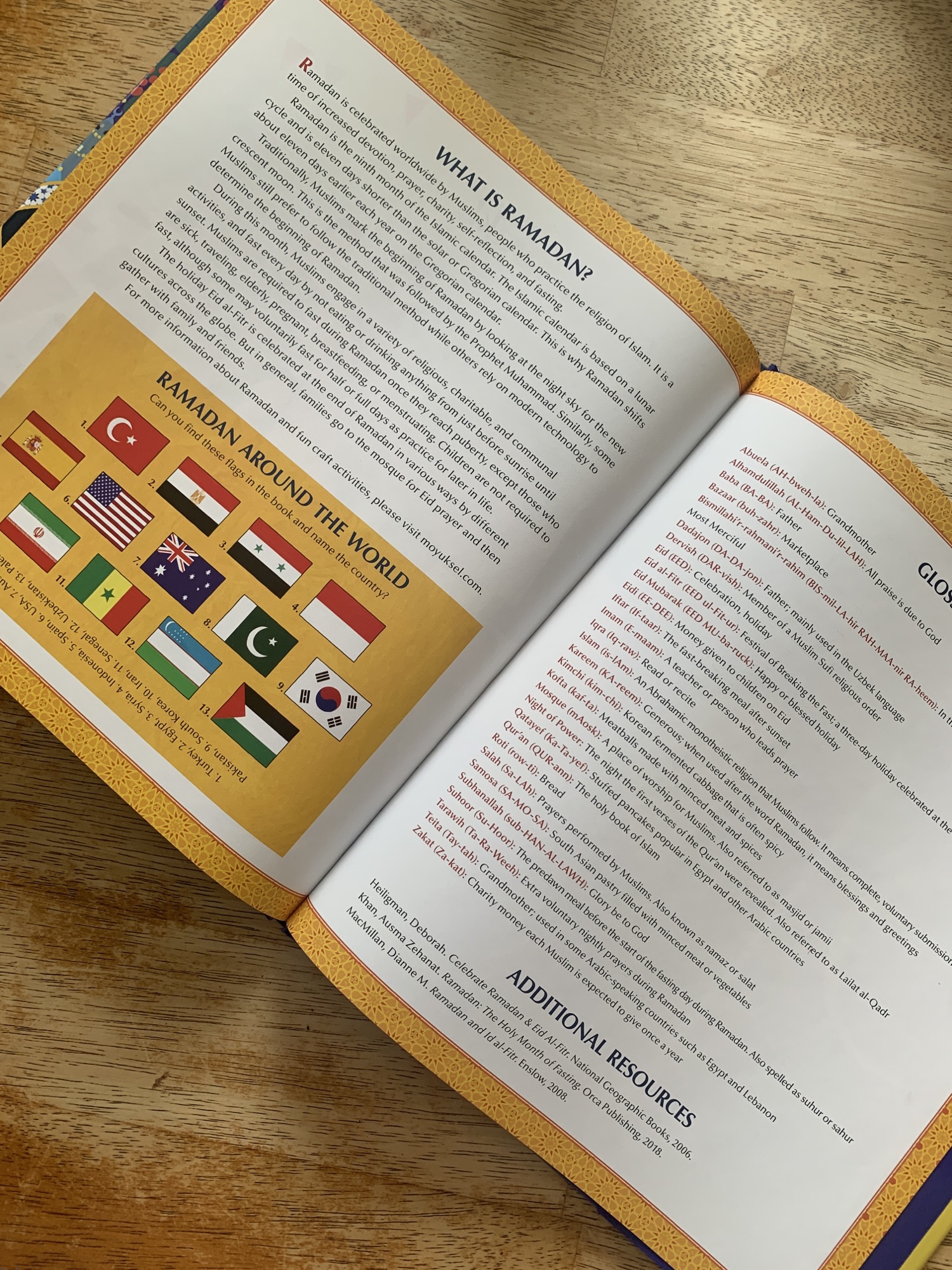
The lyrical text that shows joy, Muslim joy, all over the world during the most wonderful time of the year is felt, truly truly felt in this rich, beautiful book. The illustrations, the text, the sentiment, it all comes together so splendidly, that when you turn the last page you want to start over again. Hundreds of people are wondering what book to read to their children’s public schools this year, what book to start off masjid story times this Ramadan, what book to read every night leading up to the blessed month to get their children excited, what book to hand to your children to look through so they can have a few more minutes of sleep and alhumdulillah to all the above, I whole heartedly suggest, this one. Even with the errors.  The book states “the Night of Power is better than a thousand nights,” and should read, better than a thousand months.  The backmatter says “by not eating or drinking anything from just before sunrise until sunset.”  The story itself though has it correct and says “suhoor is a predawn meal” and notes the “sun is still sleeping.”

A universal story of celebrating Ramadan, with waking up for suhoor, greeting neighbors, having self control, praying, volunteering, iftar, community.  It is a singular story, but each two page spread showing a child in a new country continuing the narrative.  The worship uniting us all as Muslims even while our unique traditions add diversity and layers to the acts that we share.

It starts with gazing at the new moon in Turkey and mom saying that the narrator can fast. The drummer than beats her drum and it it time to wake up in Egypt. The call to prayer and remembering you are fasting reaches Syria, and donations are given in Indonesia. In Spain Qur’an is read in abuela’s lap and neighbors are visited in the United States.  Donations are packed in Australia,  friends and family are visited in Pakistan, and kimchi after dates for iftar in South Korea.  It is then off to Iran for prayers, Laylatul Qadr in Senegal, and getting ready for Eid in Uzbekistan.  Palestine is the final stop as Eid joy erupts for Muslims everywhere.

The book is widely available, you can order yours here at Crescent Moon or here on Amazon

Girls Rock: Indonesia by Claudia Bellante illustrated by Josefina Schargorodsky

Standard
Girls Rock: Indonesia by Claudia Bellante illustrated by Josefina Schargorodsky

img_8112

This book is part of a series that claims to want to bring the world closer to American children.  It is based on a true story, with noted liberties taken regarding the protagonists, and yet the Author’s Note says she went to Indonesia and was unable to meet with the characters whose lives the book is about.  I am not against non Muslims and non Indonesians per se writing a book about Muslims in Indonesia, nor am I naïve to the fact that music inspires many and radicalism is a real threat, but to conflate ideas without explanation, and not containing that OWN voice authenticity or biography feel, really leaves this book fighting against self made stereotypes and trying to seem woke and relevant while maintaining a very Western American paradigm of what it means to be happy and fulfilled.  The book (and series) may have had good intentions, but it just felt off to me, and with a publisher suggested reading age of 5-8, I think this book assumes too much about the readers prior understanding of hijab, Quran, Indonesia, music, heavy metal, radicalization, small village life, culture, Islam, Quran, imams, and prejudice and fails to assist in connecting the concepts, opting to use them interchangeably and ultimately making the 32 page book rather pointless.  I think if older children read it, it is one of those books that makes one feel like they are cultured and supportive of those breaking stereotypes, but I think Indonesian and Muslim readers will just be confused about why a book is supporting sneaking and lying and why music is ok, but loud metal is not, and why a Muslim teacher could have a band years before, but the current characters are receiving backlash now, amongst so many other things.

img_8105

The book starts with basic information about Indonesia: Java, Jakarta, religion, and the motto.  It also includes hijab as something some Muslims wear but does not detail why or what it entails.  It then introduces the reader to three girls that go to school and study Quran, as the pride of their parents and village. The girls feel something is missing and while they are “studying” they in reality are often secretly watch YouTube videos after learning about the heavy metal band Metallica from their teacher.

img_8106

The girls want to learn to play, but fear their parents will get mad, why they would get mad is not articulated, so they go to their teacher and whisper their passion for heavy metal “as if they are confessing a sin.” Their teacher, Pima, says she used to play in a metal band, and that they can use the instruments in her garage to learn and practice.

img_8107

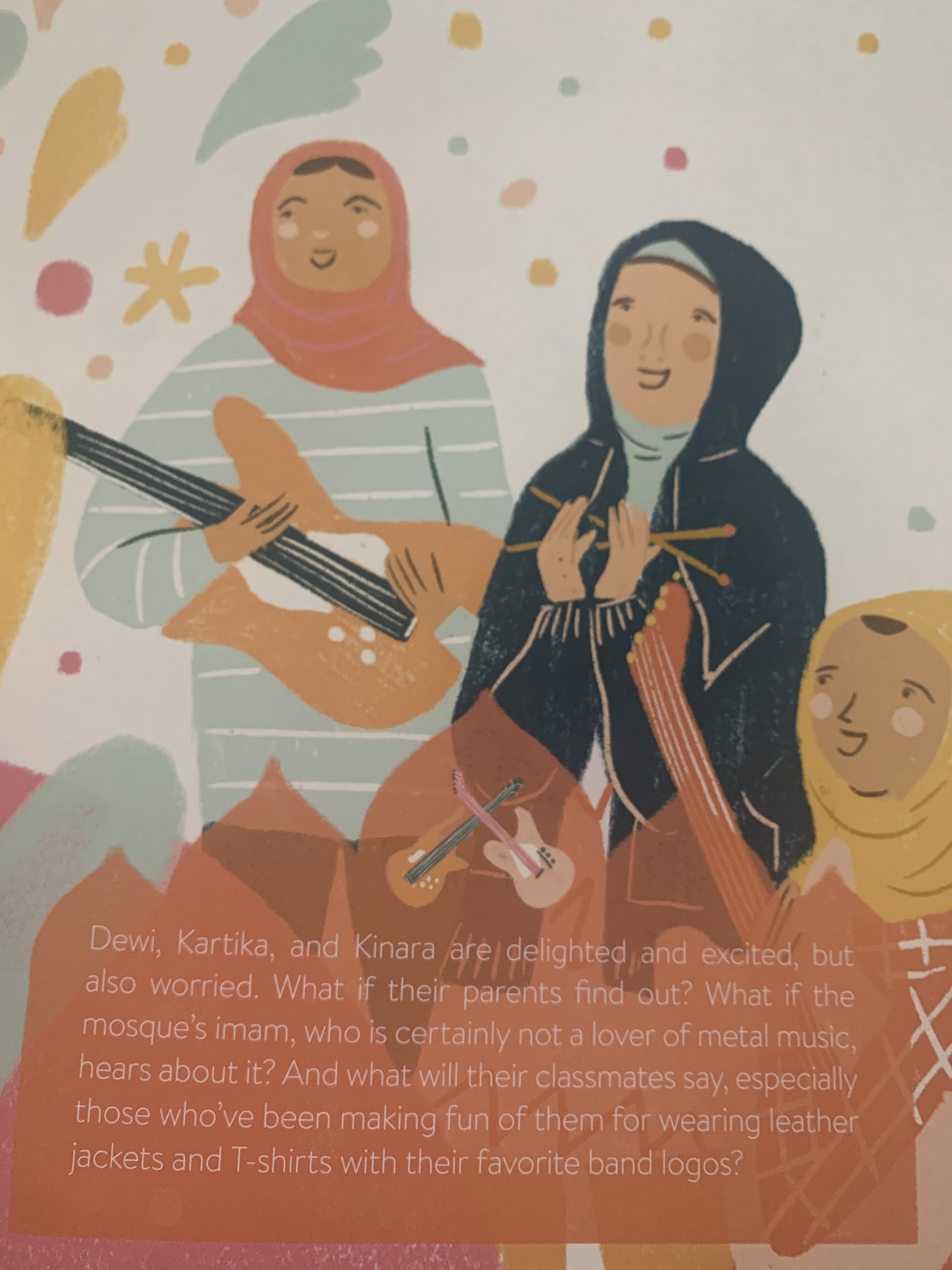
So while their parents think they are studying, they are playing music.  The book says music is not against their dreams, not against Islam, they choose to wear hijab, they start to write their own lyrics, and their teacher arranges for a producer to come listen to them. The girls worry the imam will get mad and so will their parents. When a local interview airs, the teacher asks negative folks, “who says a girl in a hijab can’t play loud music? Does the Quran forbid following your dreams?”

img_8109

Pima regrets letting the naysayers deter her from her music dreams, but earlier said her band broke up when the members moved or got married.  The parents seem fine when a festival in Jakarta is about to happen and presumably they live happily ever after.
img_8108

The backmatter then throws in radicalism and Muslim feminist groups, and I’m not sure what the takeaway would be for Muslim or non Muslim children reading this book.  I admittedly haven’t read the other books in the series, but I would be skeptical of their portrayal of cultures and religion after reading this one, it isn’t so much that it is wrong, but it just seems to water the reality down to make it more “palatable” and “acceptable” to American children which results in strong themes of “othering” and dismissal.