Tag Archives: Elementary Fiction

Adam in Lost and Found by Zanib Mian illustrated by Maria M. Goncalves

Standard
Adam in Lost and Found by Zanib Mian illustrated by Maria M. Goncalves

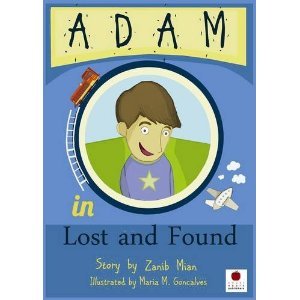
Adam in Lost and Found

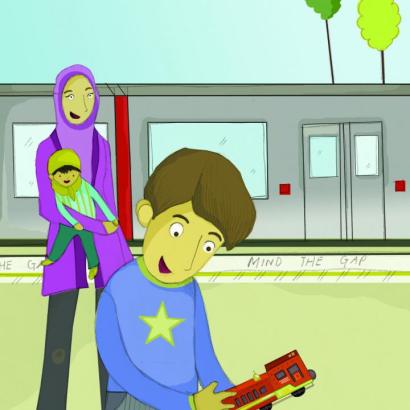
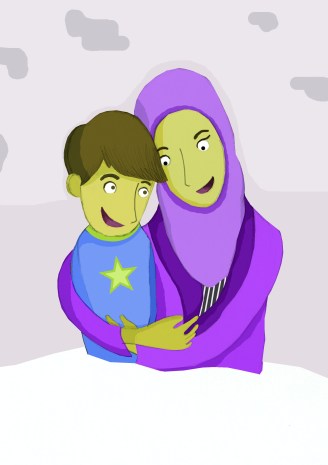
This book resembles kindergarten and 1st grade leveled readers in both appearance (shape and size) and appeal.  It very easily could have been a picture book, with its sparse words and simple linear story, but by making it a smaller size, with a variety of playful fonts, it really excites beginning readers who pick it up and are thrilled to see Muslim characters in an Islamic book on their level.  The book is 32 pages and has nice large age appropriate pictures that work very well, even when reading the book aloud to small groups.
adam 1

The  story explores the concept of “finders keepers losers weepers” in a fulfilling way.  Adam, a young boy on a train with his family, finds a toy train and desperately wants to keep it.  His father kindly explains to him the two options before him and lets him choose.  Adam, Alhumdulillah,  chooses to give the train to the lost and found man and earn Allah’s reward.  Later, Adam realizes after much searching and help from his family, that when he found the train, he left his toy airplane.  The moral is cemented in the readers, as they too hope, with Adam, that whomever found his plane, also did the right thing and gave it to the lost and found. By coming full circle the message is conveyed, and a happy ending is had by all.

The book takes place in Britain and is book two in the Adam series.adam 2


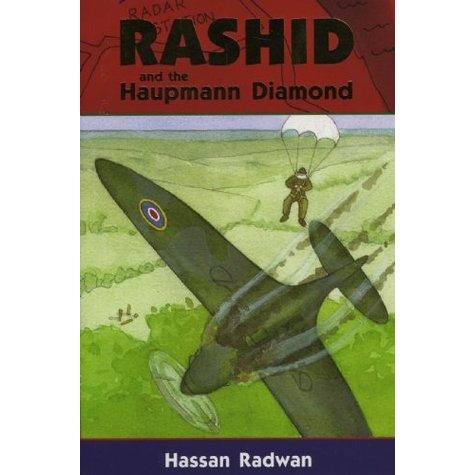
Rashid and the Haupmann Diamond by Hassan Radwan

Standard

haupmann diamond

This is the second and seemingly last book in the Rashid series, which is unfortunate, because like its predecessor Rashid and the Missing Bodythe book is a quick fun read aimed at 3rd through 5th graders with Muslim characters solving a mystery.  At just 110 pages the book reunites friends Rashid, Gary, and Chris, three boys of different religious backgrounds with plenty of respect and understanding to inspire readers of all ages.

SYNOPSIS:

Rashid and his friends hear screaming in the middle of the night and rush outside to see robbers in their neighbor’s house. Once the police come and no evidence of a break in can be found, the boys do their own investigating to see what is going on.  Pieces of information start to come together from the elderly neighbor and her stories of her father, mysterious contacts online, old WWII veterans at retirement homes, and good old fashioned library research, to lead the boys on an adventure to find a lost diamond.  Never a dull moment as the boys are chased by the burglars, family issues at home bring Rashid’s sister and baby into the story, some bullies at school and more.

WHY I LIKE IT:

The book is incredibly fast paced, it hops around from one story-line to the next.  While this format seemed more cohesive in the first book, it was a little jarring for me in this one.  I didn’t mind the side stories at school, or even the soccer matches, but the story of the sister, Huda and her marital problems with her husband Ahmed seemed a bit out of place.  I see what the author’s intent was, but in such a short book aimed at elementary aged boys, it seemed  a heavy story-line to interweave into an adventure story.  The deeper understanding of mixing cultures and expectations I am positive would be lost on all young adult readers.  Once again, the author however, does do a great job of telling a story where the character’s Islam adds to the character, and doesn’t distract from the adventure on hand.  Rashid uses islamic terms, the family prays together, they go to the masjid and laugh with the imam and congregation, they talk about proper ways to correct people and the value of intentions, overall, I’d say they convey a “normal” Muslim family.

FLAGS:

No flags, the book is clean and inspiring, alhumduillah

TOOLS FOR LEADING THE DISCUSSION:

There isn’t a lot out there about the book or the author, nor is the book in the Accelerated Reader database.  I think with its linear story, keeping track of the clues and throwing in some highlights of Islamic manners and morals, however, would make a discussion on the book easy and natural enough for all to enjoy.

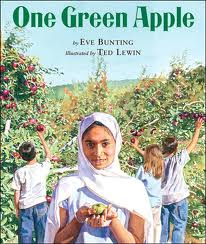
One Green Apple By Eve Bunting Illustrated by ted Lewin

Standard

one green apple

One Green Apple is a great story that really puts the reader in the shoes of a new immigrant that doesn’t speak English.  Farah, a young Muslim girl goes on a field trip to an apple orchard her second day of school and as they go for a hay ride and pick apples and make cider she and her classmates develop a connection that shows the reader how easy it is to reach out to someone new.

The sunny pictures and delicate words aptly describe Farah’s frustration in not being able to articulate her thoughts, and knowing where she belongs.  Similarly as she asserts her self and the others accept her you cheer her on and feel optimistic that she will find her place just fine.  

This story works well for new kids and for students with someone new in their class.  Being able to imagine what someone else is going through and discovering ways to help is a great lesson at any age.  The AR level is 2.6 and I read it to many of the classes the first week of school with new students, and even the older elementary grades were engaged and drawn to the message of the story and young Farah.  I don’t know that classes younger than Kindergarten would truly understand the story, maybe one-on-one, but I don’t think clothing and communication skills are a big deal with the younger ones.

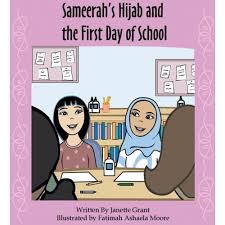
Sameerah’s Hijab and the First Day of School by Janette Grant Illustrated by Fatimah Ashaela Moore

Standard

sameerah's hijab

This book is perfect for 1st through 3rd grade girls, as it focuses on Sameerah’s first day of school in America and meeting new friends.  Sameerah and her family have just moved from Yemen and Sameerah is nervous about fitting in, however her love of wearing hijab and Islam radiate through her as her new classmates ask her questions.  Before long the students have found they have more in common than differences and Sameerah can’t wait to go back to school the next day, alhumdulillah.

This book works well for students to see how confidence, patience, and kindness can go a long way in understanding those around you.  Sameerah is articulate and confident and a great example in knowing your deen well enough to present it to others.  It is also a way to introduce Muslim children to how others may worship as Sameerah also learns about her classmates.


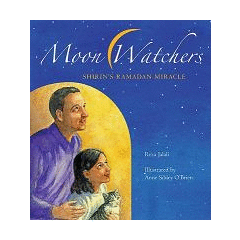
Moon Watchers Shirin’s Ramadan Miracle By Reza Jalali Illustrated by Anne Sibley O’Brien

Standard

moon watchers


This book is similar to Night of the Moon By Hena Khan as it focuses on a young girl experiencing the month of Ramadan and Eid, through the waxing and waning of the moon.  This is an AR book 3.5 and the text is driven by dialogue between nine-year-old Shirin and her Persian American family.

Too young to fast Shirin is feeling left out of the blessed month of Ramadan, her older brother Ali and her bicker until her Grandma encourages her to do “part-time fasts.”  Facts about Islam and Ramadan are slightly peppered in to the story, primarily through vocabulary, and the characters do discuss hijab and why Shirin’s mother doesn’t wear it.  It is important to note that the tale is told from a Shia perspective that is made clear as it explains how the family prays, touching the prayer stone, and kissing it three times.  The illustration here is more peculiar as it shows Shirin praying next to her dad and her brother, mom, and grandma in the row behind.

The pictures show a happy family that most readers or listeners would probably be able to identify with, along with the sibling bickering and excitement felt with the blessed month.  Persian culture is represented in the foods and sweets they prepare as a family and the henna Shirin gets on her hands.  The family prays together, spends time together and they discuss doing good deeds, not just fasting in Ramadan.

The book is beautifully done, but I think because of the brushing aside of hijab being a cultural practice, not a religious one and the presentation of prayer, I don’t know if I would give the book without discussion to a third grader in a Sunni school to read independently.  As for story time, I might simply omit those few sentences, but I’m not sure, it would depend on my audience.

If your children are aware of the differences between Sunni and Shia or you are Shia, this book is wonderful.  If your children would be greatly confused or get hung up on a few lines in a 32 page book, then it would be better to hold off.


Night of the Moon By Hena Khan Illustrated by Julie Paschkis

Standard

night of the moon

Night of the Moon is a beautiful book both visually and content wise.  The pictures are bright and inviting and consume the entire page, keeping even the youngest of listeners engaged.  The book has an AR level of 4.1 and has 32 pages, making it work great for story time and well for independent readers too.

The book tells of seven-year-old Yasmeen, a Pakistani-American girl experiencing Ramadan. The story is moved along by the ever changing phases of the moon. While this book is adequately called a Muslim Holiday Story, it is very cultural.  The characters go to the mosque, but the focus of the story is not why we fast, the revelation of the Qur’an to Prophet Muhammad (peace be upon him), or even manners.  The story focuses on going to iftar parties, having henna painted on your hands, presents, and the very Pakistani-tradition of celebrating chand-raat, the night of the moon.

I like that this book shows Yasmeen talking about Eid at school with classmates of other backgrounds, I even like that her grandma wears hijab and her mother does not.  I also like that they eat a variety of foods, from kebobs to cupcakes.  Thus far, so many of the Ramadan and Eid books I’ve read contain the same information in a fictionalized setting, this one is definitely different, instead of focusing on what Ramadan is, it shows how it is celebrated.  The book works well for Muslim and non Muslim children from all around the world.  If your audience lives in American and has ties to the Asian subcontinent they will see them selves in this book, and even if they don’t, they will probably want to join Yasmeen and her family is celebrating Ramadan and the Night of the Moon.

The Three Muslim Festivals By Aminah Ibrahim Ali Illustrated By Aldin Hadzic

Standard

Image

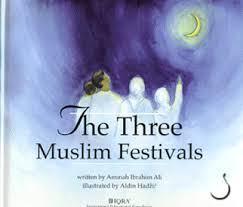
The Three Muslim Festivals is a very informative book about Ramadan, Id al-Fitr, and Id al-Adha, at over 60 pages however, it is a bit long for story time or smaller children.  Broken up into three parts, each told from a different character, the book would work well for second through fourth grade students.  It reads like a very basic chapter book, with information mixed in with a simple story.  The morals are clear, hadith, ayats and dua’as are shared and the illustrations help support the fictionalized portions.  The pictures aren’t engaging, but they do show a variety of ethnic groups and happy families.  The book is content, not character driven, but the families are supportive of the children, there are actively involved moms and dads, grandparents, and siblings.  The mom in one story is a physician and the dads help in the kitchen and around the house, showing some diversity. I like how it serves as both a review of basic Islamic principals while reinforcing elements that a child may not know or may have forgotten in a non condescending manner.  I would imagine the average seven year old could read it independently and comprehend it without being bored.  It isn’t the best written story out there, but it should be engaging enough to convey a lot of good information to an elementary aged reader.  Based on the style it is probably more intended for Muslim readers, but there is a three page glossary of terms in the back.

Nabeel’s New Pants: An Eid Tale Retold by Fawzia Gilani-Williams

Standard

Image


Nabeel’s New Pants: An Eid Tale retold by Fawzia Gilani-Williams and illustrated by Proiti Roy is a silly story about a shoemaker getting ready for Eid.  He goes to buy gifts for his wife, mother and daughter and gets a new pair of pants for himself.  The pants, however, are four fingers too long, and no one has time to hem them for him: Not the shop keeper, not his wife, not his mother, not his daughter, so he does it himself.  Nabeel then goes out to visit the poor and hand out charity and all the women in his life feel guilty andsneak over to hem his pants for him.  Luckily Nabeel has a sense of humor and there is just enough time to fix some seriously too short pants.

The book is 32 pages and an AR level 2.9.  It reads well out loud, with simple, yet colorful pictures for even the littlest ones to look at and enjoy.  The story is simple, and probably has a lot more relevance to a Muslim audience than a non Muslim one.  Eid is not described in any great detail, other than gifts are given, charity distributed, new clothes are worn, and lots of food is prepared, so it might put off those not familiar with the holiday.  Islam isn’t mentioned by name, but is obviously assumed.  Culturally the characters are Indian sub-continent based on the food’s being prepared.  Some of the women fully cover, some a little and some not at all.  And I particularly like that Nabeel can sew his pants himself.  The kids enjoy seeing themselves and their families in a silly story.  Even the three-year-olds get the punchline and all around it is just a fun book.  Alhumdulillah!

The Hundredth Name By Shulamith Levey Oppenheim

Standard

hundredth

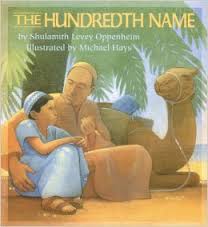
The Hundredth Name is a heartwarming story of a boy named Salah, his father, and his camel named Qadiim, Ancient One.  Salah is concerned that his best friend Qadiim is sad, and this in turn makes Salah said.  As Salah’s father gently and patiently teaches Salah about the power of prayer, the mercy of Allah and how we only know 99 names of Allah, the hundredth name is not known to us, Salah finds a way to make Qadiim happy.  Through beautiful pictures and prose like paragraphs, the reader is inspired to trust Allah with all matters, big and small.

The book has 32 pages and is an Accelerated Reader level 3.7.  I think Kindergarten would enjoy this book during story time, but the younger ones, Daycare through Pre-k,  may not truly understand the beauty and the message.

My Father’s Shop By Satomi Ichikawa

Standard

Image

What a surprisingly delightful book about a Moroccan boy named Mustafa in his father’s rug shop.  Helping his father, Mustafa finds a beautiful carpet with a hole in it and asks his father if he can have it.  His father agrees if in turn he promises to work on phrases in a variety of languages to help them sell carpets to tourists.  The boy agrees, but doesn’t put much effort in until in a moment of fun, he puts the carpet over his head, peeking through the hole, and runs out into the bazaar.  A rooster begins following him and as the tourists gather around, Mustafa, and the reader learn what a rooster says in five languages.  In Morocco:Kho Kho Hou Houuu!
In France: Co-co-ri-co! In Spain: Qui-qui-ri-qui! In England: Cock-a-doodle-doo! In Japan: Koke-ko-kooo!

The pictures really bring the story to life and connect the story to the reader.  I look forward to reading this book aloud during story time as I think the kids will see themselves in the Muslim characters in the bazaar, and see the different cultures all in one place just as they do in their classes.  At 32 pages the book is simple and memorable with large print and not too many words on the page.  It has an AR level of 2.2 and I think the kids will laugh and contribute to the sounds roosters make.  The story is completely clean, enjoyable, and memorable.