Tag Archives: Elementary Fiction

Nadia’s Hands by Karen English illustrated by Jonathon Weiner

Standard

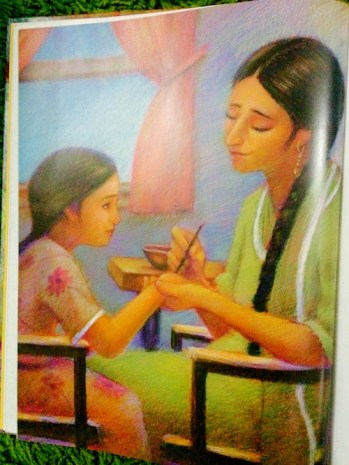
nadia's hands.jpegNadia’s aunt is getting married and she gets to be the flower girl in the Pakistani-American wedding.  She also will get mehndi put on her hands for the big event.  Her cousins warn her that she might mess up and even in the midst of her excitement she begins to worry what the kids at school will say when they see her hands on Monday.  As her aunt prepares the mehndi and the application process begins, various uncles peek in on her and her aunt gifts her a beautiful ring.  The mehndi has to sit on the skin for a while to set and as Nadia practices sabr, patience, I couldn’t help but think something seemed off in the story.  I’ve been at, in, and around a lot of Pakistani and Pakistani-American weddings, and this story didn’t seem to reflect the tone of such occasions.  The book doesn’t reflect the hustle and bustle and near chaos, it doesn’t sound like the tinkle of jewelry and laughter as the women sit around chatting and getting mehndi put on together, the pots on the stove are referenced but not described so that the reader can smell the sauces thickening and hear the pans crashing and taste the deep rich flavors.  It is lonely.  Nadia is lonely and filled with anxiety about Monday.  Durring the wedding she is walking down the aisle and suddenly freezes when she looks down and doesn’t recognize her hands.  Her cousins seem to show unsupportive “I-told-you-so” expressions as she searches for some comforting encouragement to continue on.  When she finishes her flower girl duties, her grandma asks if she understands why looking at her hands makes her feel like she is “looking at my past and future at the same time.” Nadia doesn’t understand and the author doesn’t explain.  At the end she is ready to embrace that her hands are in fact hers and that she will show her friends on Monday.  But the reader has no idea how it goes, or what exactly the significance of her painted hands are.  The book fails to give any insight or excitement for a culture bursting with tradition at a time of marriage.
 nadia's hands inside

There is a glossary at the beginning for the few Urdu words sprinkled in the book.  There is no further explanation however, of  mehndi, or weddings, of the brides clothes etc.  The illustrations are adequate, but because the text doesn’t offer much warmth or vibrance, they seem a little drab, and raise more questions about what some of the traditional items depicted are.  The book is a standard 32 page picture book and is written on an AR 3.8 level, which I think is a little high.  Granted my children are familiar with mehndi, but my first grader read it to me with little assistance.  There isn’t any mention of Islam and could probably be argued that the story reflects any wedding from the subcontinent background performed in the west.  The bride has a duputta on her head in the picture, but that is neither here nor there, and no one in the audience appears religiously covered.  I would assume they are Muslim because of the minor characters’ names: Omar, Saleha, Amina, Abdul Raheem.  Also, the word Sabr, an Arabic word, suggests that they are Muslim.  Plus they eat kabobs which the glossary defines as mincemeat, so probably not Hindu.  Overall the book is not, “bad” or “wrong,” I just wish there were more to it.
 

Snow in Jerusalem by Deborah da Costa illustrated by Cornelius Van Wright & Ying-Hwa Hu

Standard

Snow in Jerusalem

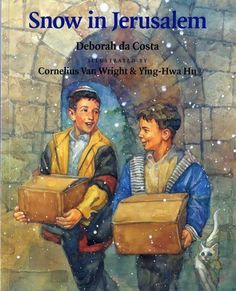
The world is always in need of kindness for animals and for one another, so when I saw this book written in 2001 about two boys who live in different quarters of Jerusalem coming together when they learn they are caring for the same stray cat, I was definitely excited to dive in.

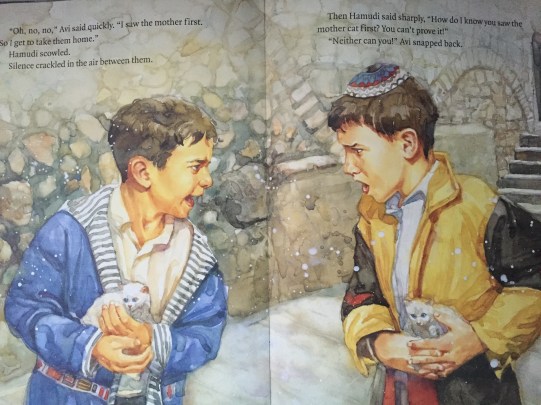
The book starts with a Jewish boy, Avi, caring for a fluffy white stray cat and his mom teasing him for caring for him.  He begins to wonder where the cat goes and resolves next time he comes around to follow him.  The reader then sees the cat journey through a market place and have the exact same interaction with Hamudi, a Muslim boy.  Both boys go days without seeing their beloved cat and when they begin to look for her, they find each other.  The boys fight over her as it begins to snow and the cat takes them to see where she has been, with her new kittens.

Again the boys fight and ultimately resolve to divide up the kittens to care for them and let the mama cat go back and forth to feed them.  Needless to say, I was a little let down by the book, I had hoped the boys would bond or see how similar they are. Instead they simply work out a solution for this one situation.  I can’t help but thinking the kitty family getting broken up and the poor mom having to go back in forth is rather selfish on the boys behalf.

IMG_0326

The book is 32 pages and written on an AR level 3.1.  Third grade and up can probably understand the similarities of the boys and how they come together to care for the cat and appreciate it with a simplistic understanding of Jerusalem’s complexities. Kindergarten and 1st graders could probably handle it as a story time selection, and understand working together to help a cat.  I’m sure fifth graders and up however, will be a little concerned for the mama cat and disappointed in the boys at a lost opportunity to provide hope in a troubled region.

There is an Author’s note and Glossary of Arabic and Hebrew words at the end, and a simple, yet valuable map of the Old City at the beginning.


The Lost Ring: An Eid Story by Fawzia Gilani-Williams illustrated by Kulthum Burgess

Standard

The Lost Ring.jpg

This is a good little story about Eid ul-Adha for 2nd through 4th graders.  It is not AR and at 29 pages it balances information about Islam and Eid with a simple little story that keeps the target demographic interested.  It isn’t great, but for a book that would probably be a level reader equivalent of a three, it suffices in being a bit of a mystery, a bit of a comedy, and bit of a lesson on why and how we celebrate Eid.

Rahma’s Grandma and cousin, Muslimah, are visiting for Eid. The girls start off the story trying on their beautiful dresses and feeling like princesses.  The girls and Grandma then get to work on making samosas for Eid.  Rahma sees her grandmother’s ring next to the bowl of dough and tries it on. The story moves fluidly and the girls take turns helping  with the folding of the samosas.  Some more adults come in and add tidbits to the story about giving gifts on Eid and getting ready for Salat and depicting a typical practicing family.

The story shifts to dad asking the kids what they remember about Eid-ul-Adha and what they know about Eid-ul-Fitr, the Festival of Sacrifice. On the day of Arafat the children fast, visit the hospital and take gifts to people in the community and the neighbors.  After Salat-ul-Maghrib dad reviews some of the sunnah acts for Eid as well.  It doesn’t get too preachy, or overly detailed, it is more highlights and brief summary revisions.

Eid day is fun and exciting, but when night falls and the family prepares for people to come over, Grandma can’t find her ring.  The kids want to be detectives, but Rahma suddenly realizes that the ring must be IN one of the samosas. So the children decide to eat them all to check. When the ring doesn’t turn up, Rahma and her cousins recite Ayat-ul Kursi, ask Allah for help and decide to tell Grandma the truth.  Just then Mum yells and the ring is found in her samosa, the truth is revealed and they all enjoy a good laugh and resolve to “always remember this as the Samosa Eid.”

The Lost Ring inside

There is a lot of text on the page, and a fair amount of “foreign” words that I think the book is probably meant for Muslim children, or those familiar with the basics of Eid.  There is a Glossary in the back, but it still might be a bit too much for non Muslim children to grasp without someone to answer their questions. The illustrations have the elder females with hijab and the girls uncovered when not praying.  The small pictures are detailed and complimentary, but the younger readers will wish they were a bit more engaging.  Overall, a good book to have in a classroom, and a great one to check out from the library to encourage young readers, or just to enjoy before Eid-ul-Adha.

Better Than a Thousand Months: An American Muslim Family Celebration by Hassaun Ali Jones-Bey

Standard
Better Than a Thousand Months: An American Muslim Family Celebration by Hassaun Ali Jones-Bey

Better Than a Thousand Months.jpg

To be honest, I didn’t get the book.  I mean I understand that it was derived from stories the author told his children, and I’m guessing it was written to show similarities between Muslims and Christians, but I don’t understand how the 168 pages with lots of photographs and text from the Qur’an got published as a book.  That is not to say it isn’t without merit, it just leaves a lot to be desired.  The teacher in me really, really, really, wanted to pull out a purple pen and start editing.  I checked twice to see if I had an advanced copy or uncorrected proof, I even Googled the book to see what I was missing.  It doesn’t work for me as a completed book.  To me, however, it is a wonderful outline that is desperately wanting to be fleshed out.

SYNOPSIS:

A man in San Fransisco is sitting on the train when there is an earth quake, thus delaying his trip home.  As he dozes off he imagines interactions with his children that share his knowledge of Islam with them, and thus the reader.  The first interaction is with him and his young daughter discussing Christmas, and how Muslims view Jesus and the power of Allah the creator of all.  They jump in the “time machine” truck and drive through the hills of San Francisco reflecting on the concept of patience.  As Ramadan comes and the narrator dreams we get bits of how Muslims in America celebrate Ramadan, and some of the tenants of faith.  When he is awake we get some story about his family, how he came to Islam and his Grandma passing away.  But nothing is explained or even connected.  I have no idea how many children he has, what the story is with the step children and the confusion from having two daughters with the same name.  The story goes back and forth with his dreams being more “real” then his awake time, and both kind of moving in the same direction of explaining how Islam is practiced as a family in America (praying together, waking up for suhoor), the questions that arise from the children (how to pray at school, why Ramadan decorations don’t decorate the city), and how we are all more alike than different (same Prophets, similar stories).  The final dream sequence is sweet with the father and daughter showing, not just talking, about giving and charity, that I really want to send the author back to finish writing the book.  There are so many tangents that would give it depth that are stated in a few sentence paragraph that could so easily be developed in to whole chapters.  Unfortunately, as is, the reader is just left disjointed and confused.

WHY I LIKE IT:

I really like the premise, I like the literary flip of telling the story in the dream.  The ideas are just not presented smoothly.  I don’t think that a tween would get it, and the choppiness of the ideas bouncing around from short paragraph to short paragraph would dissuade even the most seasoned middle school reader.  The book has some good tidbits, but they are lost in the short glimpses of story and long passages of meaning of the translations from the Quran.  The Arabic Calligraphy is nice, but it isn’t stop in your tracks beautiful, and the font of the English translations are difficult to read.

FLAGS:

None, the book is clean.

TOOLS FOR LEADING THE DISCUSSION:

I tried to get my daughter to read it, but she was so lost and even asked if it was a collection of stories or a chapter book, that I couldn’t force her to finish.  If you can get through it, one could discuss how to “fix” some of the struggles the book has, thus emphasizing what the reader liked and imagining the back story for all the questions that arise but are ultimately not answered.

Max Celebrates Ramadan by Adria F. Worsham illustrated b y Mernie Gallagher-Cole

Standard

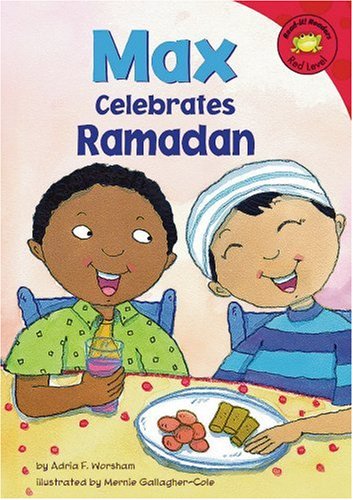
Max Celebrates Ramadan

Max is a character in a series of leveled readers that explores familiar topics to build reading confidence (Max Goes to the Doctor, Max Goes to School, etc.), and introduces new ideas as the reader’s skills build (Max Celebrates Cinco de Mayo, Max Learns Sign Language, etc.).  I love that Ramadan was included and this 24 page AR 2.0 book is spot on, in what a new reader can handle without getting frustrated or bored in terms of content, and ability.

max

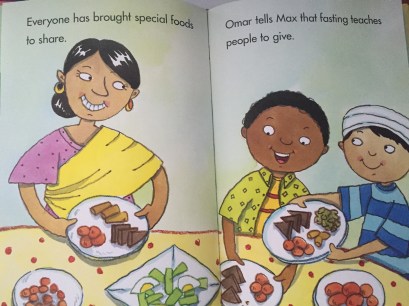
Max goes to his friend Omar’s house to celebrate Ramadan.  He learns a little about the month, what the Quran is and about Eid al Fitr too.  The foreign words are explained in the text and there is no explanation of belief or doctrine.  There are just simplified, age appropriate, descriptions of what a Muslim does and what you might see during Ramadan.  Very level appropriate for Muslim and non Muslim children.  Omar’s family is inviting and kind, and the illustrations show them to probably be of Indian decent as the mother and other females are wearing saris.  None of the women cover, but the males all wear kufis.max1

The book doesn’t stand out in any way, but most leveled readers, in my opinion, don’t.  If you have young readers check and see if your library has the book, the kids will enjoy it.  It works ok in small groups, but not for story time so well, as it is rather repetitive in a dry, not predictive way.  If you are a kindergarten through 3rd grade teacher, I think this book would be a great addition to your book shelf, as well as the others in the series as a way to learn about other people in an independent way.  My son going in to first grade read it by himself fluently and enjoyed the pictures.  Someone new to the concept of Ramadan, i think, would also be able to grasp the concepts without much outside help.


Lailah’s Lunchbox: A Ramadan Story by Reem Faruqi illustrated by Lea Lyon

Standard

Lailah's Lunchbox

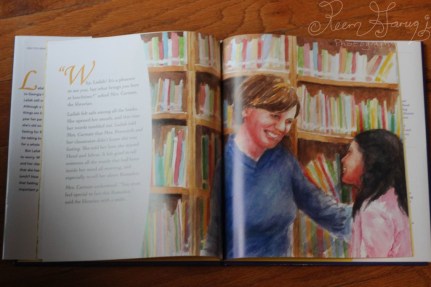
Another standout in a crowded field of Ramadan picture books, mashaAllah, Lailah’s Lunchbox works well even outside of Ramadan for Muslim and Muslim children alike.  In 32 pages, the reader gets to know Lailah and understand how hard it has been for her to move to America from Abu Dhabi, make new friends, how nerovus she is to be identified as different, as well as how excited she is that her mother has finally agreed to let her fast this Ramadan.

Lailah is excited to wake up and have sehri with her family before heading to her new school, fasting for the first time.  Her mother has written a note for her teacher, but on the bus, Lailah reads the note and suddenly worries if her teacher will even know what Ramadan is ,and decides not to give it to her teacher.  Lunchtime arrives, and when the teacher asks Lailah if she forgot her lunch, her voice fails her, and her classmates offer to share their lunch with her.  Lailah decides to leave the cafeteria and finds herself in the library spilling all her worries and stresses and fears to a kind librarian.  (Yes the librarian is the hero, and really no one should be surprised, right!?) With the librarian’s urging and Lailah’s determination, she writes a note to the teacher explaining that she is Muslim, and fasting, and even includes a poem.  She leaves the note on her teacher’s desk at the end of the day.  The following day, the teacher has written her back and the reader, along with Lailah, know that having courage and staying true to one’s self can often be scary, but also wonderful too.

lilah inside

While the story is billed a Ramadan Story, it really just is the back drop for a lot of really good messages.  I think 2nd and 3rd graders to early middle schoolers could really benefit from the book.  It is semi autobiographical and I think the authenticity of the emotion woven in, makes the book very relatable and powerful.  I plan to discuss it with my daughter going in to 5th grade, who is also a bit shy on occasion: the way Lailah worked out the problem, the way she found someone to trust and talk to that was patient with her, to point out to her that the kids in her class were very kind and that most of her fear and anxiety was with herself, not them.  I also really like the message that she was so excited to fast, and how her nerves took that excitement away, but having the courage to face her fear, brought back her happiness and enthusiasm.

The end of the book has an Author’s note, telling how the story came about and a bit more about Ramadan. It also tells the definition of Sehri and Iftar, the only two “foreign” words in the book.  I found it interesting that the word Sehri, an Urdu word, was used instead of Suhoor, if they are coming from Abu Dhabi, but perhaps the author is of subcontinent heritage.  The illustrations are colorful and realistic, complementing the story and tying in the range of emotions and events Lailah is experiencing.

I was pleasantly surprised at the book, and even more excited to see that it is available in the public library system.  Here is the link to the author’s blog I hope she plans to write more, as her style and message resonate with Muslim American kids, and their parents, alhumdulillah.


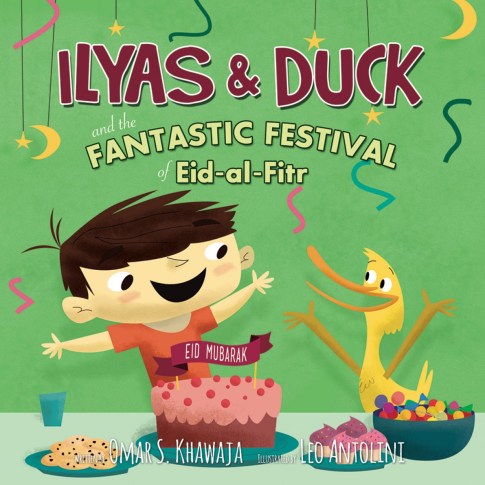
Ilyas & Duck and the Fantastic Festival of Eid-al-Fitr by Omar S. Khawaja illustrated by Leo Antolini

Standard
Ilyas & Duck and the Fantastic Festival of Eid-al-Fitr by Omar S. Khawaja illustrated by Leo Antolini

Ilyas & Duck and the Fantastic Festival of Eid-al-Fitr


In the world of Islamic fiction, there are a lot of Eid books out there for children, but this one is definitely more fun than most, especially for the younger crowd.  The presentation of a big, bright, hardback book is aimed at 3 to 6 year olds, and reads well out loud, however, the book is very, very inviting, and older kids with happily pick it up and thumb through the 32 pages of rhyming lines as well.

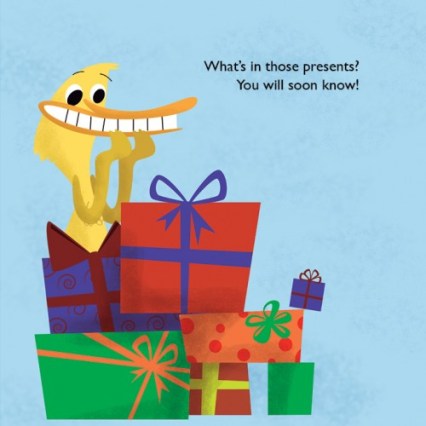
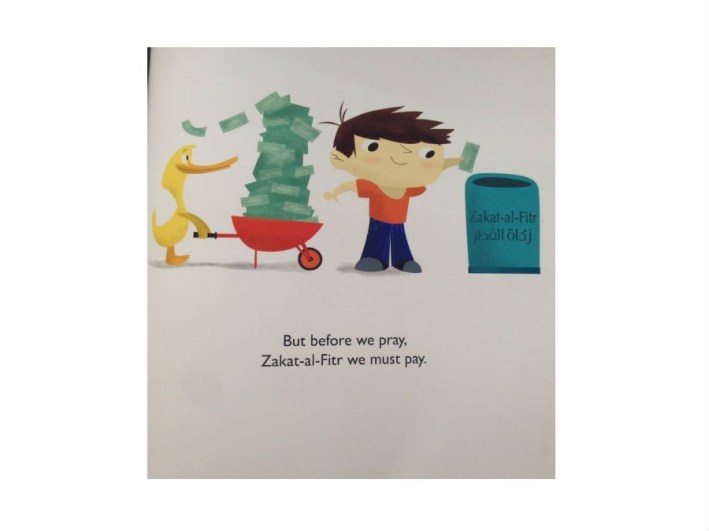
The book starts with Ilyas watching the sky to see if Ramadan is over and if Eid is here.  Duck in all his silliness doesn’t know what Eid is and rushes out to get decorations to celebrate.  he returns with a Christmas tree and ornaments.  Ilyas non judgmentally explains that those are for our Chrisitian neighbors for their holiday.  Duck then runs out again and returns with a menorah and dreidel and once again Ilyas explains that those are for our Jewish friends celebrating Hanukkah.  Ilyas and Duck then fly away in their hot air balloon to the Masjid to learn about Eid.

Ilyas and Duck2Ilayas and duck

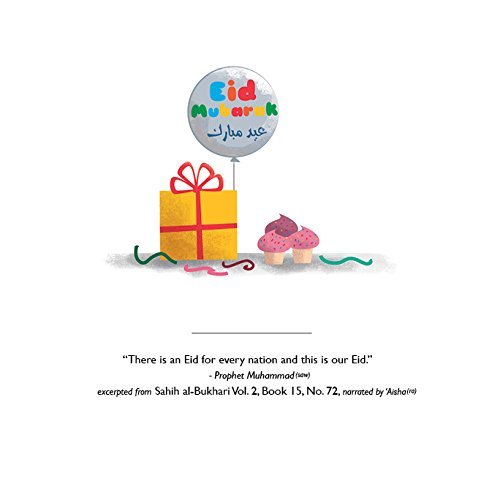
The book works for Muslim children to understand what others celebrate and works for non Muslims to see what we celebrate.  It is all done in a matter of fact way of celebration, not of doctrine.  It is built on the idea that, “There is an Eid for every nation ant his is our Eid.”ilyas and duck eid

Much like the first Ilyas and Duck book, this one is great to have around and read again and again!

Calabash Cat and His Amazing Journey by James Rumford

Standard
Calabash Cat and His Amazing Journey by James Rumford

calabsh cat

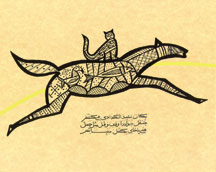
We stumbled on this book at the library and got excited when we saw that it is written in both English and Arabic.  It isn’t a book that has been translated, the author wrote it in both the Arabic dialect of Chad and English.  The Arabic script compliments the artistic style of designs burned on a calabash gourd. The simplistic contrasting color illustrations, force the reader/ listener to give life to the folktale style story.  I debated on whether to review it here on the blog being as it is not Islamic (or unIslamic) in any way, but opted to do so, because it would probably excite other children to see the Arabic just as it did mine.

calabsh cat 2A calabash cat in the middle of Africa wants to see where the world ends. When the road stops at the edge of the great desert he thinks it stops there. But a Camel corrects him and offers him a ride on his back to show him where the world ends.  When they get across the desert, the camel puts him down on the edge of the grassland and tells him this is where the world ends.  A horse corrects him, that in fact this is not where the world ends and offers to show him where it does.  He climbs up on the horse and the gallop through the grassland.  This continues through the jungle on a tiger, the ocean on a whale, then on the back of an eagle all the way home. Written on a 3.3 level, there are 32 pages with a author’s note about where the idea for the story came from.  The book works well for story time and  the repetition makes it good for bedtime too.
 calabsh whalecalabash


Hiss-s-s-s! by Eric Kimmel

Standard
Hiss-s-s-s! by Eric Kimmel

Hiss-s-s-s!

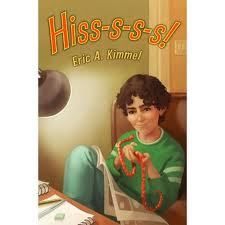
So um ya, its a book about a boy who wants a pet snake. Very linear, very simple, often more instructional than story, but somehow I really enjoyed it and read it in one sitting, as did my 9-year-old daughter and 7-year-old son. The book is 154 pages (including the author’s note) and is written on an AR 3.7 level.

SYNOPSIS:

Omar is an American Muslim who wants a snake.  His dad, Ahmed, supports the idea, but his mother, Hoda, is terrified of snakes, and begrudgingly gives her permission.  The rules are pretty simple, Omar will have to take care of the pet, and it is never to leave his room.  His mother basically doesn’t want to know that there is a snake under the same roof.  Little sister Zara is just excited.  The majority of the book is Omar learning about corn snakes, and everything involved in their care.  There are a lot of lists, and passages about him researching and taking notes. His friend Philip, nicknamed Samkatt-short for Samurai Cat, is the comical sidekick, who in this case also is the brains in the group, keeps the plot moving along. The author sprinkles in some anecdotes and history giving the characters depth.  We learn Ahmed’s dad is from Pakistan and while he grew up in the city he spent time in the country and with snakes.  He retells a fictional story about how snakes kept the rodent population down, and thus allowed the farmers in his family to have higher grain yields.  He also tells Omar tidbits about his time in college working in a biology lab with snakes.  Omar’s mom is an accomplished artist that often incorporates her Lebanese culture into her work and gallery shows.  The banter between her and Samkatt keep the story light and entertaining.  (SPOILER ALERT) At the climax, the snake gets loose, and Omar learns where his mother’s phobia comes from in her childhood.  During one of Lebanon’s many wars, a man with a snake tattoo beat her father extensively while she was forced to watch.  This somehow over time developed in to Ophidiophobia, the fear of snakes.  When the snake pops up, mayhem ensues, resulting in Hoda going to the hospital and Omar having to decide what to do with his snake, Arrow.

WHY I LIKE IT:

It is such a simple story, yet the warmth of the characters at the beginning and end really made it enjoyable.  I truly applaud the author for stretching a very simple idea into a full fledged YA novel.  The characters and family are Muslim, but it isn’t really discussed or made an issue.  There is nothing religious talked about or detailed.  In some ways, it would have been nice to throw a little more cultural or religious depth in to the story to connect with the characters, but being as the author is not Muslim it is kind of impressive that he presented them as just a regular American family.  Culturally there are only a few references outside of the anecdotes the parents share: Omar can’t come up with an example of when he was bullied, some of the foods served or eaten, the mother’s art work.

FLAGS:

None. Even if you don’t like snakes, the book should not make you squeamish.

TOOLS FOR TEACHING THE DISCUSSION:

There is not much to discuss with the book, and thus I wouldn’t choose it for a book club pick.  I think 2nd or 3rd graders, however,would do well with the book in small groups.  There is just a tinge of foreshadowing, symbolism, and interpretation that wouldn’t overwhelm the student, but would boost their confidence when they connect the dots so to speak.  Plus, some discussion could come from how he had to persuade his family, the responsibility he had to show, and the sequencing of events. The worksheets and questions would practically write themselves.

Author Eric Kimmel’s blog about the book http://ericakimmel.com/2012/02/h-i-s-s-s-s-s/

Muslim All-Stars Helping the Polonskys by Khaleel Muhammad

Standard

Muslim All Stars

A mishmash of young teen characters come together to form the Muslim All-Stars, the first book in a new series that will hopefully stick with the same set of characters doing good deeds in their community.    With only 67 pages and colorful illustrations of a variety of sizes scattered through out, the book is enticing, but not memorable.  I never bonded with any of the characters, and really couldn’t even list them all or identify them in the pictures.  Hopefully the series will continue and their individual personalities will take shape.   There are a few plot holes: how did Leila have a note from her parents if she just read the advert, how did none of the kids know each other or recognize each other if they all went to the same school, why would something done outside of school warrant recognition in school? And some random unresolved ideas: the Polonsky’s harbored a burglar or was it a rumor, why did Mr. Polonsky call Leila three times just to tell her to go?  Despite it all however, it is overall a fun book for both girls and boys in grades 2 through 4.

SYNOPSIS:

Mr. Polonsky’s wife is coming home after having surgery and their home is a mess. Overwhelmed by the prospect of cleaning it, he gets the brilliant idea of hiring kids to do it, for cheap.  A handful of kids, all Muslim, show up to do the work.  But even overcoming Mr. Polonsky’s rotten attitude, the mountains of rubbish, the menagerie of critters that have taken up residence in the home, and a crazy washing machine, is not enough to prove themselves in the face of Mrs. Polonsky’s anger when she gets home.

WHY I LIKE IT:

I love that within the Muslim group there are kids of different ethnic and cultural backgrounds and abilities; one kid is a convert, one is Pakistani, one is good with machines, one has Aspergers, one seems to get in trouble a lot.  They all answer the advert for different reasons, but after some convincing of sorts, they all agree to help the Polonskys because it is the right thing to do.  MashaAllah the girls wear hijab, they break for salat as a group, verify the food is halal, and generally just work well together.

FLAGS:

Clean alhumdulillah

TOOLS FOR LEADING THE DISCUSSION:

There is nothing online.  It is a book that if you recommend it to a child you simply would want to follow up with them by asking about what they thought about how the kids were treated, what they would do if Mr. Polonsky treated them that way, if they were surprised by the ending etc..

The book is written in British English and American kids shouldn’t have trouble understanding what is going on, but might need some help figuring out some of the words, such as rubbish, bin liners, skip, etc..