Tag Archives: culture

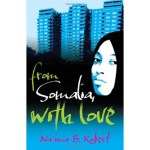
From Somalia With Love By Na’ima B. Robert

Standard
From Somalia With Love By Na’ima B. Robert

somalia

This book was a great glimpse into Somali Muslims in the UK, a world I admittedly know nothing about.  Whether accurate or not, I loved the incorporation of words, foods, culture, all of it.  And most of all I love that the main character Safia is a Muslima.  Yes, the point of the book is a coming of age story as she searches to find herself and define who she is, but in every sphere she is defining herself in, Islam is present.  Her home-life, her friendships, her poetry, all of it.  My only concern in recommending the book to my students. I think 7th and 8th graders, even in an Islamic School, can understand the temptation of going to the movies with someone of the opposite gender, of sneaking out, I think they can understand dealing with someone they love that is making bad decisions, in this case her brother experimenting with drugs and alcohol (the author doesn’t go into explicit detail).  But, truly one page (page 128) just goes too far for my students.  Had he tried to hold her hand, or kiss her even, I think the message would still come back to her conscience and her repentance, but the implied attempted rape pushes the issue over the line in my view, for my sheltered students.  High School students I think can handle it and I think lends itself well to a discussion on boundaries, respect, and sexual violence.  The AR level of the book is a 5.1 and it is a quick 159 page read.  There is a glossary of terms and phrases in the back and the font and book size make it very approachable and inviting to readers.

SUMMARY:

Safia Dirie is a 14 year-old-girl living in East London with her Mom, two brothers, and in close proximity to her large extended Somali family.  Safia is a good student, very close to her mother and very devout in her Islamic faith.  Like most teenagers she is defining who she is in a world that doesn’t seem to understand her.  Unlike most however, she has the added burden of being a religious and cultural minority.  In addition to handling friends, and temptation, she also learns that her father who has been missing in Somalia for the last 12 years has been found and is coming to live with them in London. The focus through the whole story is Safia and the reader is definitely drawn into her struggles of how to help her brother, who is rebelling, how to be a good daughter, and with her internal debates to drift closer to a less religious cousin who encourages her join in activities that Safia is hesitant to be a part of. Once her father arrives everything she has known is threatened and the issues and struggles intensify.  Despite efforts Safia can’t connect to her father and the changing dynamic of the family tests her in ways that while fiction and extreme, I think many can relate to and sympathize with.

WHY I LIKE IT:

The book does a good job of showing how people are not “good” or “bad” and how often mistakes, are just that, mistakes. It also provides hope that people can recover and improve.  The heart of this book is Safia’s and Safia’s heart is pure and has a strong connection to Allah (swt).  She sways and swerves, but never loses sight of who she is at her core, and i think for many young Muslim’s today that is an incredibly strong message.  That mistakes can be made, and Allah (swt) will forgive.  That intentions and repentance are real and valid, irregardless of where you are in life.  From friends Safia wrongs, to a brother who realizes what he is doing is wrong, to a cousin who is passed around without a permanent place to belong, to a mom trying to balance a returned husband, every character is fallible, yet not beyond hope.

FLAGS:

 The attempted sexual violence.  The implied drug abuse and lying of Ahmed, Safia’s brother.  The lying of Safia to her mom and parents about her whereabouts.

TOOLS FOR LEADING THE DISCUSSION:

The Author’s blog about the book: http://fromsomalia-withlove.blogspot.com/

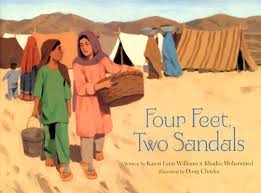
Four Feet Two Sandals by Karen Lynn Williams & Khadra Mohammed Illustrated by Doug Chayka

Standard

four feet

A beautiful hardback picture book I picked up at the Scholastic Warehouse sale, at 32 pages long and an AR level 3.2, Four Feet, Two Sandals, works well as both a story time selection to younger students and as independent reading for up to 5th grade.  The story is about two refugee girls that come to know each other when relief workers throw donated clothes for the people and Lina and Feroza each end up with one sandal each of a beautiful pair.  Rather than fighting or being ungrateful, the girls work out a plan so that they can both enjoy the sandals and in the process, become friends.  The girls share their stories with one another, and thus the reader, about how their families have been affected by war and how they came to be at this refugee camp in Peshawar, Pakistan.  The girls dream of school and their futures and show the readers a bit of their daily struggles getting water and doing chores.  When Lina’s name shows up on a list to go to America, and Feroza’s does not, the friends must part and decide who gets the sandals.

While it probably bothers some that America is seen as the saving grace to sweep Lina to a better life and pander to an American audience. I think it makes sense seeing as the book was co-authored by the executive director of the Pittsburgh Refugee Center and was inspired by a refugee girl who asked “why there were no books about children like her.”  Clearly refugees do get a chance at a new life when other countries open their borders and stories like this that give our children insight into the world they have left behind, with the hopes of fostering compassion, is something that I definitely want to share with my own children and students.

The author’s website and reading guide: http://www.karenlynnwilliams.com/files/sandals_guide.pdf

The Breadwinner By Deborah Ellis

Standard

breadwinner

The Breadwinner is the first book in Deborah Ellis’ four book series about 11 year-old-Parvana, her friends, and her family in Taliban controlled Afghanistan.  The remarkable thing about this book is that it is a compelling story, that has moments of intensity and reality, yet never falters from being on about a 4th grade reading and comprehension level.  The AR level is 4.5 and as a teacher I taught the book as a novel study to 4th graders, and now as a librarian I presented the book for my Jr. Book Club.  In both cases, after completion, the children are arguing and fighting for the next books in the series, Parvana’s Journey, and then Mud City, and finally My Name is Parvana.  It is not a tempting book on the shelf necessarily, but once you start, it is hard to put down.

SYNOPSIS:

The book gives readers a glimpse of how the Taliban changed the day-to-day lives of the Afghani people.  Young Parvana starts out helping her father, a  former History teacher, earn a meager living by reading and writing for the illiterate in the marketplace, and selling odds-and-ends that the family is willing to do without in order to survive.  As a young girl she is allowed to accompany her father into the marketplace, her older sister and mother, however, have not left their home in a year and a half.  When Parvana’s father is dragged off to prison, the family is in need of a provider, a breadwinner, and with some of her deceased brother’s clothes, a haircut and some courage, young Parvana becomes Kaseem.  She carries on her father’s work, digs up bones to earn more, and sells items from a tray to keep her family afloat.  In the process she meets an old classmate, Shauzia, who is also disguised as a boy, an old gym teacher, Mrs. Weera, determined to fight back through disseminating journals and magazines, and other characters that bring the horrors and hope of the Afghan people to life.

WHY I LIKE IT:

I like that it doesn’t get too political, which would bog down the story and turn off young readers, and while it presents unfair imprisonment, stadium style punishments, death and pain, it does so in a way that evokes empathy not fear.  It even at times finds a way to stay light-hearted and offer up hope as the reader sees the resilience and determination of these people.

“I’ve been thinking about starting up a little school here,” Mrs. Weera said to Parvana’s surprise.  “A secret school, for a small number of girls, a few hours a week.  you must attend.  Parvana will let you know when.””What about the Taliban?” “The Taliban will not be invited.”

FLAGS:

The book is intense at some moments, such as when the father is taken by the police, the girl’s nearly see prisoners having their hands chopped off, and the characters discuss landmines.  But it is on a child’s level, too much description is not offered and for most 3rd graders and up, I think the book is a great dialogue starter about what some people have to endure in the world.

TOOLS FOR LEADING THE DISCUSSION: (There are a lot of resources for this book)

Author’s website and study guide:   http://deborahellis.com/teacher-resources/

Unit study:  http://www.teacherspayteachers.com/Product/FREE-The-Breadwinner-Unit-Guide-for-Students-365169

Lesson plan:  http://coolkidlit-4-socialstudies.pbworks.com/w/page/27715927/The%20Breadwinner%20Lesson%20Plan

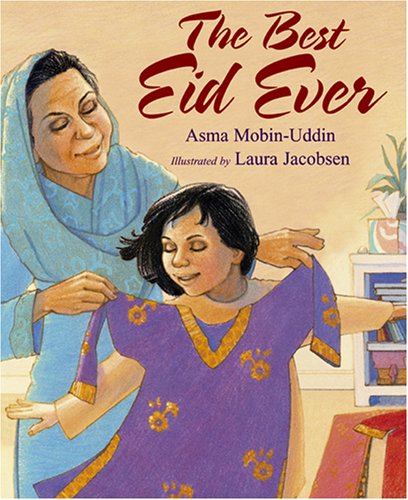
The Best Eid Ever by Asma Mobin-Uddin Illustrated by Laura Jacobsen

Standard

best eid ever

For some this book may have a lot going on it’s 32 pages: Eid ul Adha, parents at Hajj, refugees, charity, Pakistani culture, but if you are reading this book to Muslim children (or they are reading it independently, it has an AR level of 3.8) i think it is delightful.

Aneesa wakes up on Eid morning missing her parents who are in Saudi Arabia performing Hajj. Her grandma, Nonni, surprises her with three new outfits complete with bangles and shoes for each of the days of Eid and is preparing her favorite dinner, lamb korma, for them to eat after Eid prayers.  At Eid prayers Aneesa meets some refugee girls and wants to do something to make their Eid a little brighter.  Nonni and Aneesa come up with a plan and the result is “the best Eid ever!”

I love that it has morals and plot and sparks dialogue.  The message is so simple yet beautiful, that it stays with the reader, adult and child alike.  The illustrations are beautiful and warm providing a nice balance to the long passages.  There is an author’s note and Glossary in the back, but I think this book is really intended for a Muslim audience familiar with Hajj, Eid, and Paksitani culture.  It wouldn’t be lost on someone new to the vocabulary and customs, but definitely wouldn’t be as magical or memorable.

My 3rd grader loved the book and we were able to talk about it and reflect upon it long after the initial reading.  My younger boys enjoyed it, but didn’t get as much out of it.  I think this book works better in smaller groups rather than story time, or simply to have on the shelf to sweep the reader up and allow them to draw their own conclusions on what it means to do something for someone else.

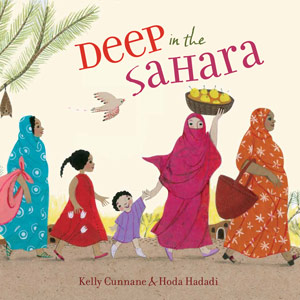
Deep in the Sahara By Kelly Cunnane Illustrated by Hoda Hadadi

Standard

deep-in-the-sahara

SubhanAllah, how absolutely wonderful to walk into your public library and find such a treasure of a book.  So simple and beautiful in appearance, in its poetic text, and in its message.  Set in Mauritania, West Africa and sprinkled with Hassaniya (an Arabic dialect), young Lalla wants to wear a malafa, a beautiful, colorful cloth that some Muslim women in Mauritania wear to cover their clothing and heads when they go out in public.  She wants to wear it to be beautiful like her mother, mysterious like her older sister, a fine lady like her cousin, and a long-ago queen like her grandmother but it isn’t until she understands what the malafa means and why the women wear it does she receive a beautiful blue one from her mother.

The illustrations and descriptions take you to a far a way land, with eager anticipation at what you will see, hear and experience.  Culture is shared, tidbits about Islam’s traditions are shared and a wonderfully simple, yet thought provoking story is conveyed.  With an AR reading level of 3.7 this book would be wonderful for story time listeners as well as independent readers.  Also because it is probably not a culture most are familiar with I think students up to 5th grade would enjoy the book and close the last of the 40 pages with a smile on their face and a light happy heart.  Alhumdulillah

Magid Fasts for Ramadan by Mary Matthews illustrated by E. B. Lewis

Standard
Magid Fasts for Ramadan by Mary Matthews illustrated by E. B. Lewis

Magid Fasts for Ramadan

The intent of this 48 page chapter book is good, however, a few things rubbed me the wrong way about how Ramadan and Islam are presented.

Nearly eight-year-old Magid wants to fast on the first day of Ramadan, but everyone says he is much to young.  He decides to deceive everyone and fast anyway.  I’m actually okay with this main story line, as I could genuinely see a child wanting to do it so much they would lie about it.  The author even has the family sit down after the truth comes out and discuss how honesty is important and this is not how Ramadan should be celebrated.  Lesson learned for Magid and the reader, right? Nope, the author kind of blows it and takes it to the other extreme.

Magid’s sister Aisha is twelve and is “forced” to fast so she isn’t the only girl not fasting at her all girl’s school in Egypt.  What a sad reason to fast, The whole reason Magid wants to fast is to be a “truly obedient Muslim” which sounds great on the surface, but it get’s repeated so often that Magid at one point is judging a classmate who isn’t fasting and isn’t always at Jummah (Friday) prayers.  The parents decide at the end to let Aisha fast until school is out, hence shortening the day for appearance purposes, and Magid can fast til lunch.   He is told he can fast full days when the days are shorter.  Again a really odd reason to wait when fasting has been prescribed for us, to make it an issue of convenience.

So aside from the very negative view of Ramadan and the kids rejoicing at the end that they don’t “have” to fast, the lying, the disobeying your mother, and the judgmental laden diction of being truly obedient, the book does cover a lot of ground well.  The book shows the characters doing wudu and praying, it shows them trying to be kind to one another, it talks about how the Quran was revealed in the month of Ramadan and it does have a plot.

The water color illustrations are nice, and I also like how it showed a bit of Egyptian culture with the lanterns, singing, and food.  Interestingly the author says it is harder for Muslim’s in America to fast, but elsewhere says that Aisha has to watch the girls at school not fasting, eat lunch.

I really wouldn’t recommend this book, for the intended audience of 3rd through fifth graders I think it would do more harm than good in promoting Islamic values in Muslim children and in showing non-Muslims what Ramadan means to Muslims.

Moon Watchers Shirin’s Ramadan Miracle By Reza Jalali Illustrated by Anne Sibley O’Brien

Standard

moon watchers


This book is similar to Night of the Moon By Hena Khan as it focuses on a young girl experiencing the month of Ramadan and Eid, through the waxing and waning of the moon.  This is an AR book 3.5 and the text is driven by dialogue between nine-year-old Shirin and her Persian American family.

Too young to fast Shirin is feeling left out of the blessed month of Ramadan, her older brother Ali and her bicker until her Grandma encourages her to do “part-time fasts.”  Facts about Islam and Ramadan are slightly peppered in to the story, primarily through vocabulary, and the characters do discuss hijab and why Shirin’s mother doesn’t wear it.  It is important to note that the tale is told from a Shia perspective that is made clear as it explains how the family prays, touching the prayer stone, and kissing it three times.  The illustration here is more peculiar as it shows Shirin praying next to her dad and her brother, mom, and grandma in the row behind.

The pictures show a happy family that most readers or listeners would probably be able to identify with, along with the sibling bickering and excitement felt with the blessed month.  Persian culture is represented in the foods and sweets they prepare as a family and the henna Shirin gets on her hands.  The family prays together, spends time together and they discuss doing good deeds, not just fasting in Ramadan.

The book is beautifully done, but I think because of the brushing aside of hijab being a cultural practice, not a religious one and the presentation of prayer, I don’t know if I would give the book without discussion to a third grader in a Sunni school to read independently.  As for story time, I might simply omit those few sentences, but I’m not sure, it would depend on my audience.

If your children are aware of the differences between Sunni and Shia or you are Shia, this book is wonderful.  If your children would be greatly confused or get hung up on a few lines in a 32 page book, then it would be better to hold off.


Night of the Moon By Hena Khan Illustrated by Julie Paschkis

Standard

night of the moon

Night of the Moon is a beautiful book both visually and content wise.  The pictures are bright and inviting and consume the entire page, keeping even the youngest of listeners engaged.  The book has an AR level of 4.1 and has 32 pages, making it work great for story time and well for independent readers too.

The book tells of seven-year-old Yasmeen, a Pakistani-American girl experiencing Ramadan. The story is moved along by the ever changing phases of the moon. While this book is adequately called a Muslim Holiday Story, it is very cultural.  The characters go to the mosque, but the focus of the story is not why we fast, the revelation of the Qur’an to Prophet Muhammad (peace be upon him), or even manners.  The story focuses on going to iftar parties, having henna painted on your hands, presents, and the very Pakistani-tradition of celebrating chand-raat, the night of the moon.

I like that this book shows Yasmeen talking about Eid at school with classmates of other backgrounds, I even like that her grandma wears hijab and her mother does not.  I also like that they eat a variety of foods, from kebobs to cupcakes.  Thus far, so many of the Ramadan and Eid books I’ve read contain the same information in a fictionalized setting, this one is definitely different, instead of focusing on what Ramadan is, it shows how it is celebrated.  The book works well for Muslim and non Muslim children from all around the world.  If your audience lives in American and has ties to the Asian subcontinent they will see them selves in this book, and even if they don’t, they will probably want to join Yasmeen and her family is celebrating Ramadan and the Night of the Moon.

The Sandwich Swap by Queen Rania Al Abdullah

Standard

Image

I stumbled upon this book at a used book shop and my own children loved it so much (ages 7,4,3) that I took it to school and read it to the Kindergarten Class.  The KG class loved it, the students eyes lit up when I read the words “hummus sandwich” and had to be settled down when they learned one of the characters is named Salma.  Even the youngest of our children, subhanAllah know what a treat it is to see a character they can relate to religiously and culturally in a beautifully illustrated book.

The Sandwich Swap by Her Majesty Queen Rania (the girls were excited just knowing a REAL queen wrote the book), is a sweet story of two best friends who are put off by each others “weird” lunches, peanut butter and jelly and hummus and pita.  The situation escalates until the whole school is pointing out differences between students and the foods they eat and climaxes in a food fight.  Salma and Lily realize how silly it all is, sample each others lunches and then work to bring the entire school back together.  

A good book to talk about differences, and similarities, friends and food.  The book appeals to students of all ages with an Accelerated Reader level of 2.9, I think most preschool to Third grade students would laugh, and smile throughout the entire story.

Rickshaw Girl by Mitali Perkins

Standard

Image

The book Rickshaw Girl by Mitali Perkins was recommended to me by the same person that suggested Overboard, (thanks Cheryl) as it is a rare book that appeals to the often difficult to find 2nd to 4th grade demographic.  The book is 91 pages, with large drawings and a fairly large font.  I read it in about 30 minutes and I’m sure most students, not slowed down by the names, could easily read it in a few hours.  It is that engaging and vivid that I think most students, boys included, would have a hard time putting it down.  The AR level is 4.3, but I think the gender issues would be relate-able in an Islamic School setting to advanced second graders.  I am considering obtaining a few more copies and letting the younger students that really want to be in the Book Club read this book and give it a try; or reading the book aloud to the students and then discussing it with them, will talk to some teachers and post back what I opt to do, inshaAllah.

SYNOPSIS:

Set in Bangladesh, Rickshaw Girl is a sweet story about 10-year-old Naima, who is smart and caring, and at that critical age where she can no longer play freely with her best friend, because he is a boy, she must start helping her mother in tending to the house, and because of financial restraints can no longer continue her school education.  Frustrated by the fact that as a girl and she cannot financially help her father, as a son would be able to do, she makes a poor decision that causes the situation to get worse (don’t want to spoil the book by disclosing what she does). Her personality and inner strength, however, push her on a path to correct her mistake and help her family, proving girls can definitely rise above restraint and succeed in following their dreams.

WHY I LIKE IT:

One could/would assume (dangerous I know) that the characters are Muslim, it is never stated, never implied, never brought up.  In the pictures the female characters have a scarf draped over their hair, but in that part of the world, most every woman would.  Same goes for the gender issues.  That being said, I think it would lend itself very easily to a discussion of what most Muslim girls experience in general terms of being slowly discouraged from playing with boys, encouraged to start helping in the kitchen, etc.  I love that the story is fast paced and that you truly cringe at Naima’s actions, and cheer for her to try and fix her error.  Her family situation is also very soothing.  Her parents are strong and loving and kind, and I think how most 10 year old children see their families.

Flags:  None, clean

TOOLS FOR LEADING THE DISCUSSION:

The author’s own page is helpful in getting the ball rolling, there is also information in the back of the book: glossary, author’s note about microfinance and how to wear a saree.

Click to access RickshawGirlDiscussionGuide.pdf