Tag Archives: Children’s Islamic Fiction

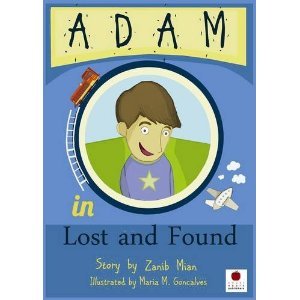
Adam in Lost and Found by Zanib Mian illustrated by Maria M. Goncalves

Standard
Adam in Lost and Found by Zanib Mian illustrated by Maria M. Goncalves

Adam in Lost and Found

This book resembles kindergarten and 1st grade leveled readers in both appearance (shape and size) and appeal.  It very easily could have been a picture book, with its sparse words and simple linear story, but by making it a smaller size, with a variety of playful fonts, it really excites beginning readers who pick it up and are thrilled to see Muslim characters in an Islamic book on their level.  The book is 32 pages and has nice large age appropriate pictures that work very well, even when reading the book aloud to small groups.

adam 1

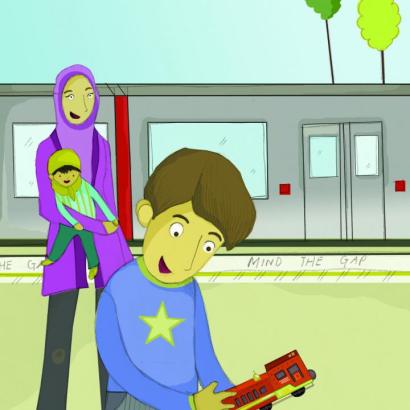
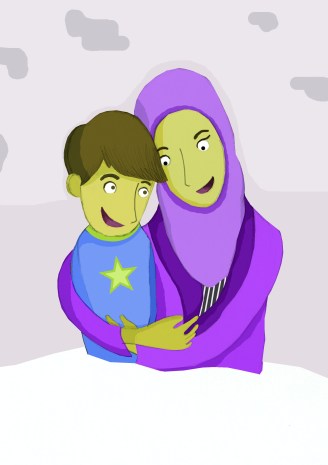
The  story explores the concept of “finders keepers losers weepers” in a fulfilling way.  Adam, a young boy on a train with his family, finds a toy train and desperately wants to keep it.  His father kindly explains to him the two options before him and lets him choose.  Adam, Alhumdulillah,  chooses to give the train to the lost and found man and earn Allah’s reward.  Later, Adam realizes after much searching and help from his family, that when he found the train, he left his toy airplane.  The moral is cemented in the readers, as they too hope, with Adam, that whomever found his plane, also did the right thing and gave it to the lost and found. By coming full circle the message is conveyed, and a happy ending is had by all.

The book takes place in Britain and is book two in the Adam series.adam 2


Zak and His Good Intentions by J. Samia Mair illustrated by Omar Burgess

Standard

Zak and his good intentions

Zak  and his sister Hana compete to do good deeds, but nothing goes as Zak intends.  Each time he sets off to help someone or do something kind, he is thwarted by something unexpected.  As frustration mounts with each failure, his mom steps in to reassure him that, “Prophet Muhammad (saw) said that whoever intends to do a good deed, but does not do it, still gets a good deed for his or her intention.” With his spirits restored Zak appreciates Allah’s mercy and accepts that even when we try and plan, it is Allah’s plan that ultimately prevails.

The beauty of the book is in its simple message that is reiterated four times and brought to life with simple straightforward text and detailed, but not overwhelming illustrations.  The book is written on about a second grade level and would appeal to ages 4 to about 8.  It has 32 pages and contains discussion points at the end.  The book is fun and funny and conveys a message and moral in a relevant non preachy way.  Young kids can definitely relate to the character’s desire to do good, disappointment when he fails, and comfort in knowing that Allah swt knows all and is the most just.

Overall a good book with a strong message that can be read more than once and referenced often in both the home and school setting.


Ilyas & Duck Search for Allah by Omar S. Khawaj illustrated by Leo Antolini

Standard

Ilyas and Duck  Search for Allah

I might have squealed in delight after reading this book.  Alhumdulillah, since starting this blog I have found that there are indeed a lot of good quality children’s books out there, but this one, well it just does it all.

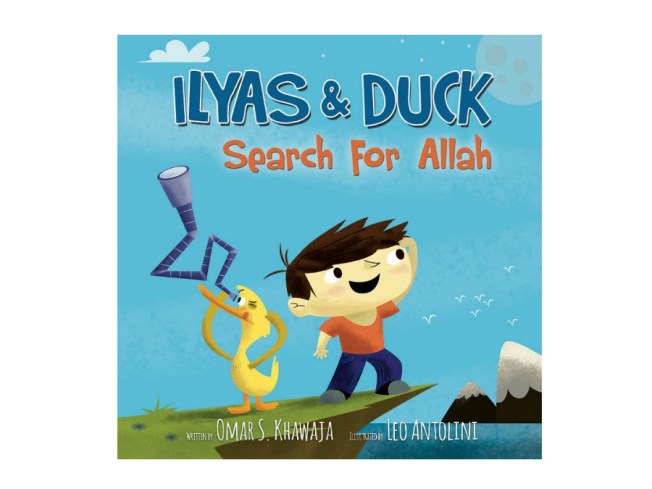
Ilyas & Duck Search for Allah is concise in words, but somehow successfully tackles the huge concept of understanding Allah (swt) through His creation in a powerful way.  And I think a big part of its power comes from its humor and silliness.  The book says it is for ages 3-6 on the inside cover, and I think that is spot on.  The dialogue between Ilyas and duck and the animals they meet on their adventure is written on a child’s level of understanding, and is silly, but not demeaning, and my favorite part is that Ilyas and Duck figure it out on their own.  There are no adults in the book telling them what Allah is or where Allah is, they ask the various animals they meet in the rain forest, underwater,  in the mountains, and come to their own understanding.  This progression makes the book pure gold at story time.  You can almost see the kids brains turning right along with the characters’ brains in the book and when they get it, forget asking them to wait to raise their hands to be called on and explain it, they are so gleefully excited they can’t contain their understanding.

The book starts with an ayah from the Quran and is not preachy or cultural.  There is a glossary of sorts at the end telling a little bit about the four animals they meet and each of the 39 pages are beautifully illustrated.  The dialogue and interactions remind me a lot of the show Justin Time, which is neither here nor there, but conveys my impression of the story’s tone.

ilyas and duck inside Whether you have students or children that are naturally curious and have asked where they can find Allah or not, this book is engaging and fun and one the kids want read to them over and over again, alhumdulillah.

Sana’s Startling Sneeze by Sumaiya Noori illustrated by Ridwaan Naik

Standard

Sana's Startling Sneeze

I got this book at the same time as Sajaad is Sick, and thought they would go together nicely.  They did, Alhumdulillah, but I was honestly a little underwhelmed by this book.

For the most part. the pictures are detailed and fun, but they have the appearance of being done with either crayon or colored pencils and don’t pop off the page and grab the reader’s attention.  If they were a little brighter and bolder, it would definitely help the overall story, especially since the illustrator is clearly talented.

The story itself is clever and funny, but kind of unresolved at the end.  Once the Pre-k 3 through KG students were done laughing, they wanted to know why her sneeze was tiny.  Was it because she put both hands over her mouth or because it was just a little sneeze? They got a little annoyed that I didn’t know the answer and that there was no moral, or lesson, or conclusion.  I think after so many sneezes and so much repetition they were a bit unsettled that she would again resume her out of control startling sneezes, with no more hope of containing them.

Something else that struck me as being odd about the book is that the main character and her family are visibly Muslim in a diverse environment, yet Sana never says “Alhumdulillah” and her family never says “yarhamukum Allah” following her sneezes.  I added it in when I read it aloud, since that is basic Islamic etiquette, but a few of the Kindergartner’s in the first row caught on that it was missing and wanted to know why.  Again I had no answer.

A layout criticism I have of the book is the inside margin. It is too small and when reading aloud to a group, I could not see the last word of the line without moving my head or the book, and thus blocking the students from seeing the illustrations.  The font and text and overall book size is adequate, but the first few readings, until I practically memorized the book, were a little cumbersome.


Sajaad is Sick by Mini Mu’min Du’a Series

Standard

sajaad is sick

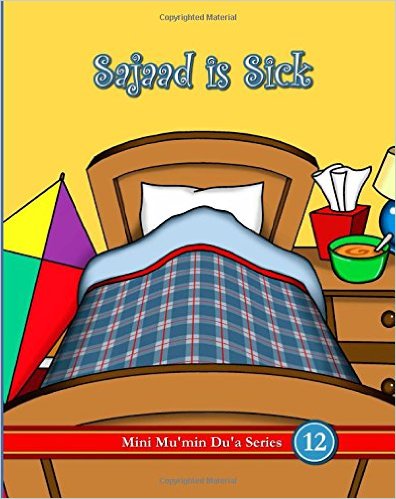
I picked this book up on a whim to go with my “being healthy” or “community helpers” story time themes.  I had never heard about it and the pictures, while colorful, aren’t very detailed or engaging.  I was hoping the rhyming couplets and familiar concept of going to the doctor would at least review some key concepts in an Islamic manner.  Alhumdulillah, the book not only met my expectations, but exceeded them.

The first fabulous surprise is that the Doctor is female, not that it should be an issue, but it is nice to find books that definitely don’t assume a familiar stereotype.  The second surprise is that at 28 pages, the rhymes never seem forced or awkward, it flows very nicely, mashaAllah. I read the book to 3,4, and 5 year old students and it managed to keep everyone’s attention.  The students got concerned when Sajaad worried if he would have a shot, they tried to remember the name for “stethoscope,” they enjoyed learning the dua for being sick and the dua to make for those that are sick, and they even liked that they often also get lollipops when they leave the doctor’s office.

Overall the book was a good review of what happens at the doctors office in an Islamic tone.  It would work well to reassure children that might be nervous about what they might experience.  It was interesting to watch the kids “read” the book after story time to each other imitating a teacher.  For most students it is a topic that they feel mastery over and you could see their confidence when they retold the story.

I’ll be keeping my eye out for other books in the Mini Mu’min Du’a Series to see if they are of similar quality and can serve in a similar capacity in the library.


Yasmine’s Belly Button by Asmaa Hussein illustrated by Charity Russell

Standard

Yasmine's Belly Button

This book is fun, fun, fun.  The mere mention of the word belly button to little kids gets them giggling, and the words and pictures in the book kept them engaged and happy through out.

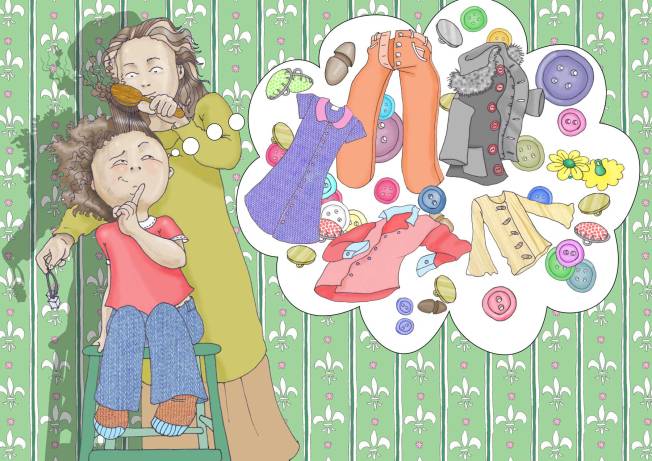
The story is a simple dialogue between 4 year-old Yasmine and her mother about belly buttons as she heads off for her first day of school full of butterflies.  We learn that everyone has a belly button, even cats! And the students have a fun time following along with Yasmine’s confusion of why it is called a button, to her understanding that it allowed her to receive food while in her mother’s tummy.  yasmine2The illustrations are bright and colorful and have a lot going on.  The expressions on the character’s faces compliment and complete the text seamlessly to tell a well thought out story.  They keep the audience’s attention even after the text is read, with the kids telling me to “wait” so that they could soak it all in before I turned each page.  The mom and teacher’s expressions on the last page amused the daycare through Kindergarten students and made them feel like they were in on the silliness.

A lot is conveyed even with just a few words on its 28 pages.  The reader sees what she thinks, they see the mom without hijab at home and with hijab when she goes out, they see a diverse classroom, a patient mom, and a way to deal with being nervous in a new situation.

I read this book to many students at school and to my own children at home, and can tell it will be an often requested book in both settings, mashaAllah, I highly recommend it.


Bismillah Soup by Asmaa Hussein illustrated by Amina Khan

Standard
Bismillah Soup by Asmaa Hussein illustrated by Amina Khan

Bismillah Soup

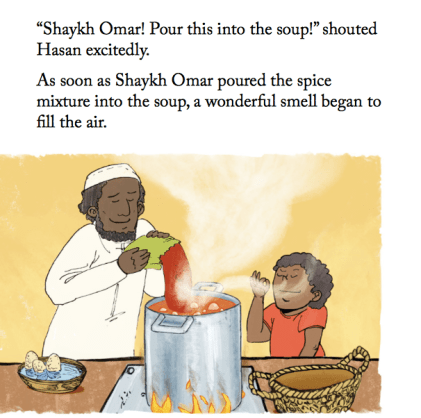
It is always a cause of giddiness to find a good book, but to have one recommended by a mutual friend of the author, makes it all the better. Bismillah Soup is a spin-off of the Stone Soup folktale, but without the “trickery” of the classic.  Hasan, wants to surprise his mom with a feast, but money is tight and when Hasan is sent to ask the local Imam for some rice, a plan: Bismillah Soup, forms that brings the entire community together.  The story takes place in Somalia and the cultural words that are peppered in to the story add detail and talking points to have with the kids.  As each community member shares something small, the enormous feast that is created is a wonderful example of what can be achieved when we each give our best to help others.  The book is 40 pages with a glossary at the back and is definitely one that can be read over and over to kids of all ages.  Even the littlest ones are able to grasp the beauty of coming together through the colorful and playful pictures.

soup-gallery-img1 (1)The real treat of the book however, is how it all comes together: the words, pictures, sentence structure, font, size, and diction all compliment each other on the same level.  I read a lot of books aloud as a children’s librarian, and while the rhyming ones are great for the littlest listeners, there is often a void of read-out-loud stories for the kindergarten and first grade levels.  And I am talking about all books, not just Islamic ones.  Most picture books in my experience are written on a third grade level, with longer blocks of texts, smaller fonts, a wider range of vocabulary and longer sentences.  These books are often beautiful and very tempting, however when I read them during story time I end up “summarizing” them, and telling the story rather than reading it.  Similarly, early readers often find them frustrating and too difficult to read independently. Bismillah Soup strikes a wonderful balance, mashaAllah.

I read the story to my own children who enjoyed it and have found my first grader reading it independently twice this week.  Each time beaming with excitement to tell me something new he has gained from the book.  When I read it aloud to them, my kids marveled at how having a good intention and being so generous could benefit everyone. The first time my son read it independently he was in deep thought about how grateful Hasan was even though they didn’t have much food and how he was a determined problem solver.  The second time I found him reading it, he was so very impressed at the kindness of Shaykh Omar.  He really started to understand the subtle beauty of the character not just in helping Hasan’s family with food, but also supporting and working with the young boy to make the feast happen, alhumdulillah.  Screen-Shot-2015-08-29-at-12.06.00-AM

I highly recommend the book and I can’t wait to read it to my students at school next week, inshaAllah.  For more about the book, the author, and her other work you can go to the author’s website  http://www.ruqayasbookshelf.com

Amira’s Totally Chocolate World by J. Samia Mair

Standard
Amira’s Totally Chocolate World by J. Samia Mair

Amira' totally chocolate wold

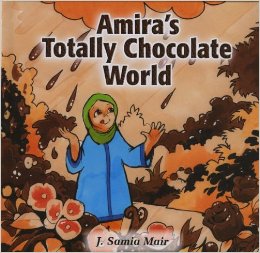
Amira’s Totally Chocolate World is a sweet story based on the idea of a young girl’s wish for the world to turn into chocolate.  As she imagines all the wonderful things that would be made better by being chocolate: flowers, grass, rain, the ocean, etc., she asks Allah swt to make a totally chocolate world.  The night before Eid ul-Fitr her mom promises to make Amira a chocolate cake with chocolate icing in celebration of Amira fasting for a part of each day in Ramadan.  When Amira wakes up the whole world is chocolate, and Amira runs out to enjoy all the chocolate around her.  Soon enough she misses the colors of the world, and the different smells, and misses the texture of grass too.  Amira remembers an Ayat of the Quran about the many colors of creation and asks Allah to turn the world back to the way he created it.  Naturally her alarm clock then wakes her up and she is now wiser, more appreciative and happy to eat her chocolate cake on the kitchen table.

Overall, the story touches on ideas of Ramadan, Eid, asking Allah swt for everything and anything, being appreciative and being thankful.  However, when read aloud I have found that the students have to be made aware of these topics to grasp them.  The text is a bit wordy and the author’s message seems to get lost in the chocolate-ness of everything.  I feel like there is just too much going on in the 23 pages of the story for a child younger than 1st grade to get much out of independently.  On the surface however, it is a fun story with adequate illustrations that kids, especially those that love chocolate, will enjoy.

(NOTE: the book is written in British English, and American children are quick to notice the difference in spelling the word color/colour.)

Layla Deen and the Case of the Ramadan Rogue by Yahiya Emerick

Standard

layla deen

I remember my 2nd graders reading this many years ago and strongly disliking it.  And I vaguely remember agreeing with them, but perhaps at the time, there weren’t a lot of Islamic fiction options for the age group, so I decided that the pros out weighed the cons and left the book on the classroom bookshelf.  Fast forward to today where mashaAllah there are more options, yet this book is still often a staple on most school and family book shelves.  That being said, I thought a revisit was in order, and yikes I agree with my 2nd graders of so long ago, and I have major issues with this book.  At 42 pages, the clipart illustrations and wide spaced font seems a bit dated, but with the short chapters and Islamic backdrop the book overall would still appeal to 2nd to 4th grade Muslim students. The story is sweet in merit and intention, however, some of the details make me hesitate to recommend this book.

Overall, I feel like the author tries too hard, he is trying unsuccessfully to relate on a students level, trying to sound cool, and ultimately in the process uses unnecessary language in my opinion.  The manner in which siblings Layla and Ahmed speak to one another is incredibly harsh, and while perhaps realistic for some families, there is no reprimand or apologizing.  The name calling and yelling at one another throughout makes their collaboration at the end seem unlikely.  Even how Layla talks to her mom about the homeless man at the store, saying he is dirty and gross and a “stinky bum”, seems jarring to a book that is trying to teach a moral lesson.  Layla’s mom gently reminds Layla that Prophet Muhammad (saw) was kind to those in need, but I feel like the mom doesn’t go far enough in correcting Layla, and Layla dismisses rather arrogantly what her mother has to say.

Later, some bullies taunt Ahmed, and while in her head Layla defends her brother which is nice, out loud she resorts to calling the bullies “idiots” and “freak squad” which seems to be a form of bullying as well, and at the very least don’t empower the students to know how better to deal with bullies.  She then remarks that they smell bad and smoke pot and hopes her brother will “kick their butts.”  If the author wanted to make a comment on the ill effects of recreational drug use ok, but for this reading level to mention it as an insult in passing does little to benefit the story and even less to help the reader grasp what pot is and that children using it (irregardless of how one feels about adults using it) is not a joking matter.  Later when something is stolen Layla assumes it is the bullies who have committed the crime and sets up a sting to catch them.  Needless to say it isn’t them, and I wish the author would have at least had her feel bad that she assumed someone to be guilty when in fact they were innocent. A premise that I feel needed some addressing or reflective growth to benefit the reader.

My next concern, would not have been a concern ten years ago, but with the current situation regarding how police are being treated in response to the actions of a few, I wouldn’t want to perpetuate a stereotype that widens the gap between police and the communities they work for.  In the book when a crime is committed Ahmed dismisses going to the police remarking that the police do little and just sit around eating donuts.

And finally the climax of finding out who stole the food and why is sweet, but I really felt could have been handled so much better.  (SPOILER) The homeless man stole the food to feed it to some kittens he found in a garbage bag.  On the surface that is sweet, but I don’t think that, that justifies theft.  Furthermore he didn’t want to take the cats to the shelter because they would be gassed. Again, like the pot reference, that is a bit heavy to just leave hanging out there without explanation or background for such a young reading audience.  Layla then offers to take the cats to her friends and assures the man they will have good homes.  To me a better option would be to purchase the cats from the man so he can have some income and also assure the cats a good home.  It seemed to me that she took them from him in a rather abrupt fashion as if because he was homeless he didn’t have a right to his property, and getting a meal in exchange didn’t cut it for me as the happy ending I was hoping for.

SUMMARY:

Layla and her family are preparing for Ramadan, which starts in a few days, Layla joins her mom for a trip to the grocery store to stock up and they see a homeless man begging for money.  Disgusted Layla not only can’t stand to be near the man, but it is appalled that her mother stops to talk to him.  When the food set out for the nightly iftaar goes missing from the kitchen window, Layla and her brother take advantage of a night when their parents are out to try and catch the thief or thieves.  They discover the homeless man, and in a change of heart, Layla arranges to meet him at the grocery store the next day with her mom so that they can invite him to dinner.

WHY I LIKE IT:

I appreciate what the book tried to do: blend a fictional story in an Islamic context for a younger elementary aged Muslim child.  I also like that it showed a Muslim family, praying, fasting, and going about their normal life so to speak.

FLAGS:

Pot drug reference, less than ideal handling of bullies, negative unsupported stereotypes.

See beginning of this review for detailed concerns.

 TOOLS FOR LEADING THE DISCUSSION:

For some reason, despite all my concerns with the book, I have been trying to find a way to still utilize it.  And I think the only way I could comfortably convey this story to kids would be to read it aloud and self edit it while reading.  I think there are too  many issues to let a second or third grader read it independently and then discuss, but I think if I were to edit out some of the random comments that have no bearing on the story, and then paused to discuss some of the bigger issues of bullies, assumptions, treatment of the less fortunate, and a better way to help others and animals the book might still be successful.  I think it could be read aloud in less then an hour and if today’s students are as perceptive as my students years ago, they not only will pick up with what is wrong in the story, but also devise ways to make it so much better.
Burning Boats by Zaynab Dawood

Standard
Burning Boats by Zaynab Dawood

burning boats

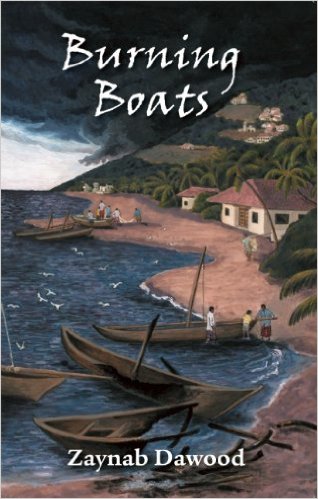
This book came highly recommended from a friend that read it aloud to her Kindergartener and I ordered a class set based on her raving review.  After trying to get into the book on three separate occasions I concluded that yet again I should have waited and read the book myself before ordering it.  So I handed it over to my avid reading eight-year-old who read it in a day and said it was pretty good, asked a few questions, and continued on her way confused as to why I couldn’t finish it.  So, I started it again determined to get through it and with Ramadan quickly approaching I thought I could motivate myself to do so.  However, I could not, and it sat on the shelf for the entire month with a book mark only a few chapters in.  At the prodding of my guilty conscious to return the book to my friend, I continued reading from where I left off, rather than starting over, again, and found that by dismissing completely who any of the characters are and how they are related, the story does get off the ground and I was able to finish it.  That being said, I think the story might have appeal if read aloud one chapter at a time. To read it in one setting did not help the story that can’t seem to decide it if wants to be character driven or action driven.  The sheer number of characters is completely over the top, there are at least 20 characters mentioned by name and the book is only 137 pages.  And honestly I never bonded with any of them.  There is action in the book, but the details seem misplaced.  The author details characters all saying salam and walaikumasalam to one another and giving moral reproaches based on Quran and Sunah, but I never felt I understood why the main characters were leaving, why the villain was so bad, or how (spoiler alert) a pivotal character in the book died. I guess by never connecting to the characters or feeling an emotional tie, positive or reproachful, the book didn’t live up to it’s potential.  The book is recommended for ages 12 and up, but I think younger children could read it and even younger could listen to it being read to them without any major concerns.  With guidance the book is by no means a waste of time, but if you recommend it to a child and they struggle to get into it, you might just have to let them find something else to read.

SUMMARY:

A small fishing village is being harassed by a corrupt businessman’s attempts to take over the entire industry in Tobay.  The principal of the school and a few close friends are trying to stop him, but have decide they cannot and thus are planning to move elsewhere.  The children are forbidden to go to the harbor as boats are being burned and crimes committed to persuade the local fisherman to abandon their solo endeavors.  With few places to play, the loss of the harbor affects the children greatly as well.  A tropical storm complicates matters as it tears through the village destroying the poor inhabitants meager dwellings as well as the damaging the school and the mosque.  With friends taking in homeless neighbors and the main family planning to leave the children plan one last game that turns dangerous when all the boats in the harbor are set a blaze.

WHY I LIKE IT:

There are some definite good qualities in the book, despite the holes.  It opened up a good discussion between my daughter and I about preparing a body for ghusl and Janaza.  It does show that people can change and that when people are sincerely apologetic and are striving to correct their behaviors, those around them should offer forgiveness in not just their words, but in their actions as well.  It also shows that good kids can make bad choices, and that the consequences can also be very real.  Similarly it shows that adults also don’t always know what to do, and that they can be forced to reconsider as well.

FLAGS:

There is violence in the book and death.  Nothing too graphic, but one might have to explain to younger, more sheltered reader,  that just because someone has a Muslim name doesn’t mean they are practicing Islam and are good people.

TOOLS FOR LEADING THE DISCUSSION:

There aren’t any online tools, but I would suggest having the readers keep a character journal.  Every time a new name appears, write down who they are, (and who they are related to), so later they can look back on it if they become confused.

Because of the “holes” in the story I would probably ask the students to give their thoughts as to what happened or why the characters decided to do what they did and then turn it back on them and ask them what they would do.

Why was Ibrahim leaving? Would you have left? What made Nasser change? Would you have forgiven him? How do you think Ayesha died? Etc.