Tag Archives: cheating

Odd Girl Out by Tasneem Abdur-Rashid

Standard
Odd Girl Out by Tasneem Abdur-Rashid

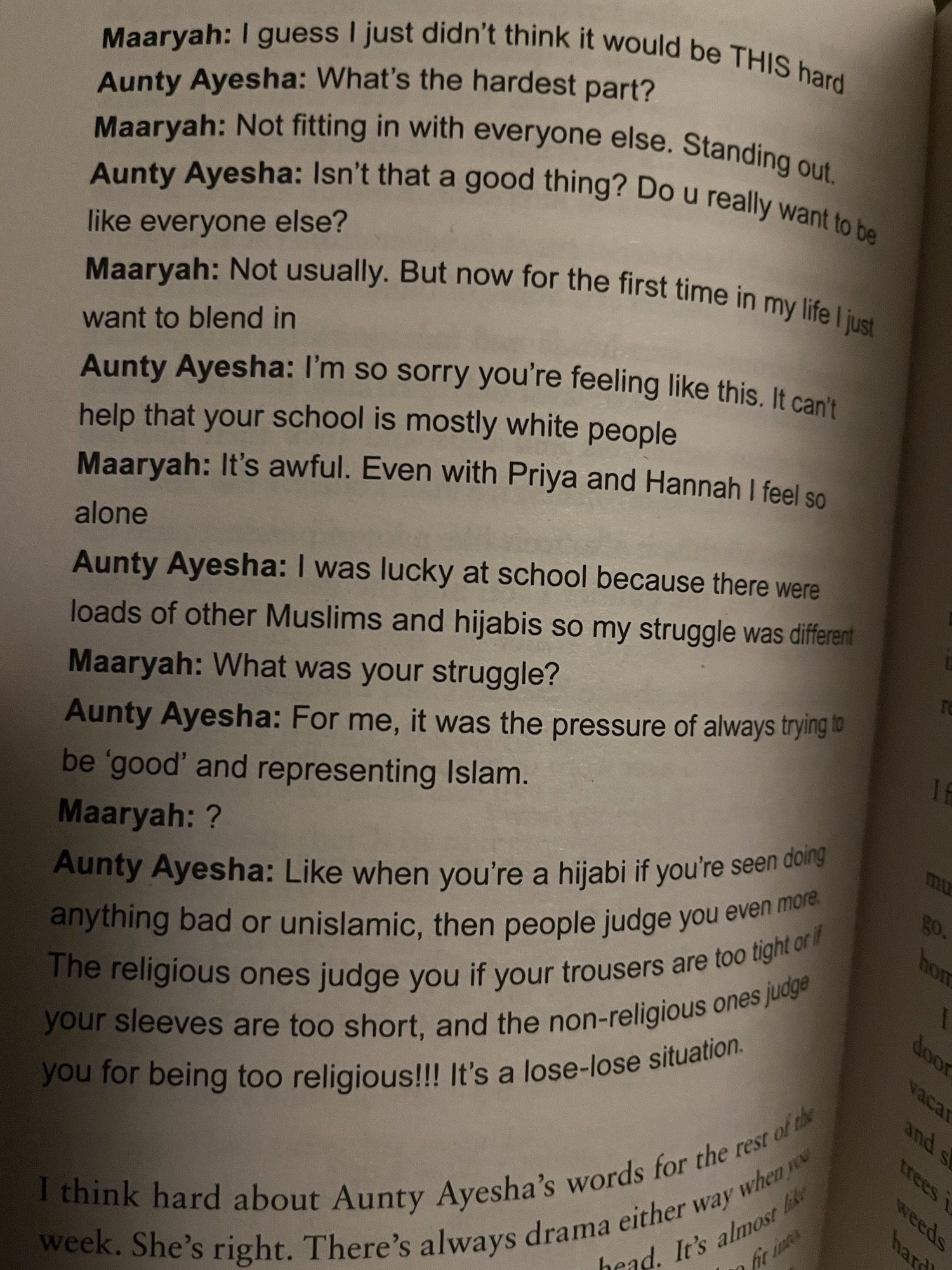
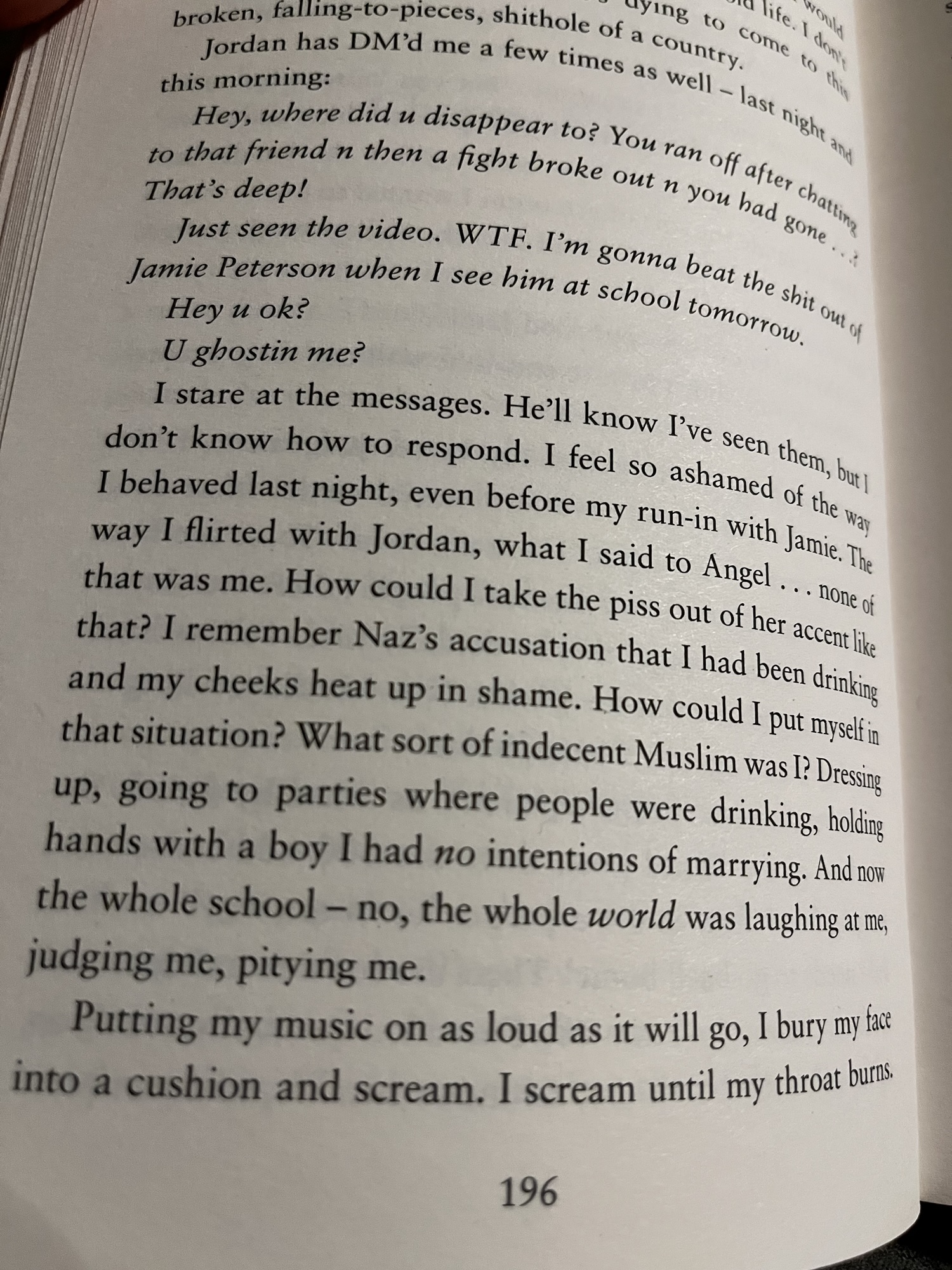
At 368 pages this identity centered mature YA book really hooked me and had me invested, which is impressive because Islamophobia stereotypes and being the new kid in a new place tropes are pretty frequently done, and often after a while, feel repetitive.  For me the charm of this book is actually not Maaryah and her peers/friends/bullies storylines, but the protagonist’s relationship with her parents and what caused her mom and dad to divorce.  Obviously as a mom of teens, I’m not in the target audience, but I feel like I benefited from the Muslim authored, Islam centered book, and think older teens, perhaps 17 and up, will also find the book enjoyable and reflective of views they have, challenges they face, and boundaries they have to establish.  I don’t want to spoil it, but SPOILER, had my dear friends that have read the book clued me in that the book will toe and slightly cross the haram lines, but ultimately show Maaryah deciding to re-establish her boundaries after being tempted not to, i.e. making a poor choice to attend a party with boys and alcohol present, and dressed in a way not typical to her hijabi style, I wouldn’t have read the last hundred and twenty pages or so with my jaw clenched in fear. The book shows a lot of Islam in practice, salat, duas, discussions about hijab, but not everyone will agree with decisions Maaryah makes or the rationale behind them as they vacillate between culture, religion, and family expectations.  I love that Maaryah is fallible and never abandons her faith, and that who we are is more than a singular mistake or instance of poor judgement. The book is not preachy, most will just take it as a girl finding her place in her new family dynamic in a new country, who happens to Muslim.  I think, an assumption really, based on what the author has said about her previous adult books, something along the lines that they are not meant to be Islamic fiction, but are stories with Muslim characters, and I think this book should probably be viewed the same.  There is swearing, hand holding, a side hug, normalized boy girl friendships, lying, running away, deceit, cheating, alcohol, mention of hookups, dating, vaping, music, flirting, hijab questioning, bullying, physical assault.  My biggest concern about the book is that it brings up Palestine, but doesn’t discuss Palestine. A side character is a non practicing Jew that visits Tel Aviv and Maaryah wants to discuss the occupation with her, but hesitates and the moment passes.  It is never revisited which I really wish it would have.  It could have modeled a bit how to have those conversations, I know it isn’t that type of book, but Maaryah mentions repurposing kaffiyehs in her designs and so it hints that it matters to her, but never pulls on that thread.  At one point it also mentions another character posted something pro Isr@*l during the genocide, which I can only assume the author thought that by the time of publication would have ended.  SubhanAllah ya Raab.

SYNOPSIS:
The tag line on the cover “From Dubai Girl to London Nobody…” very succinctly summarizes the plot.  Maaryah had an idyllic life in Dubai with her parents and close friends, spending her holidays with her mom’s family in London, and securing an internship with a famous designer.  All is going well until her parents get divorced, her mom moves her to the UK, not near her extended family, and the lack of Muslims, let alone hijabis, at her high school has her bullied with no friends to have her back.  With her mom in survival mode, their once close relationship is non-existent, and the 15 year old is left to sort through it all on her own.

WHY I LIKE IT:

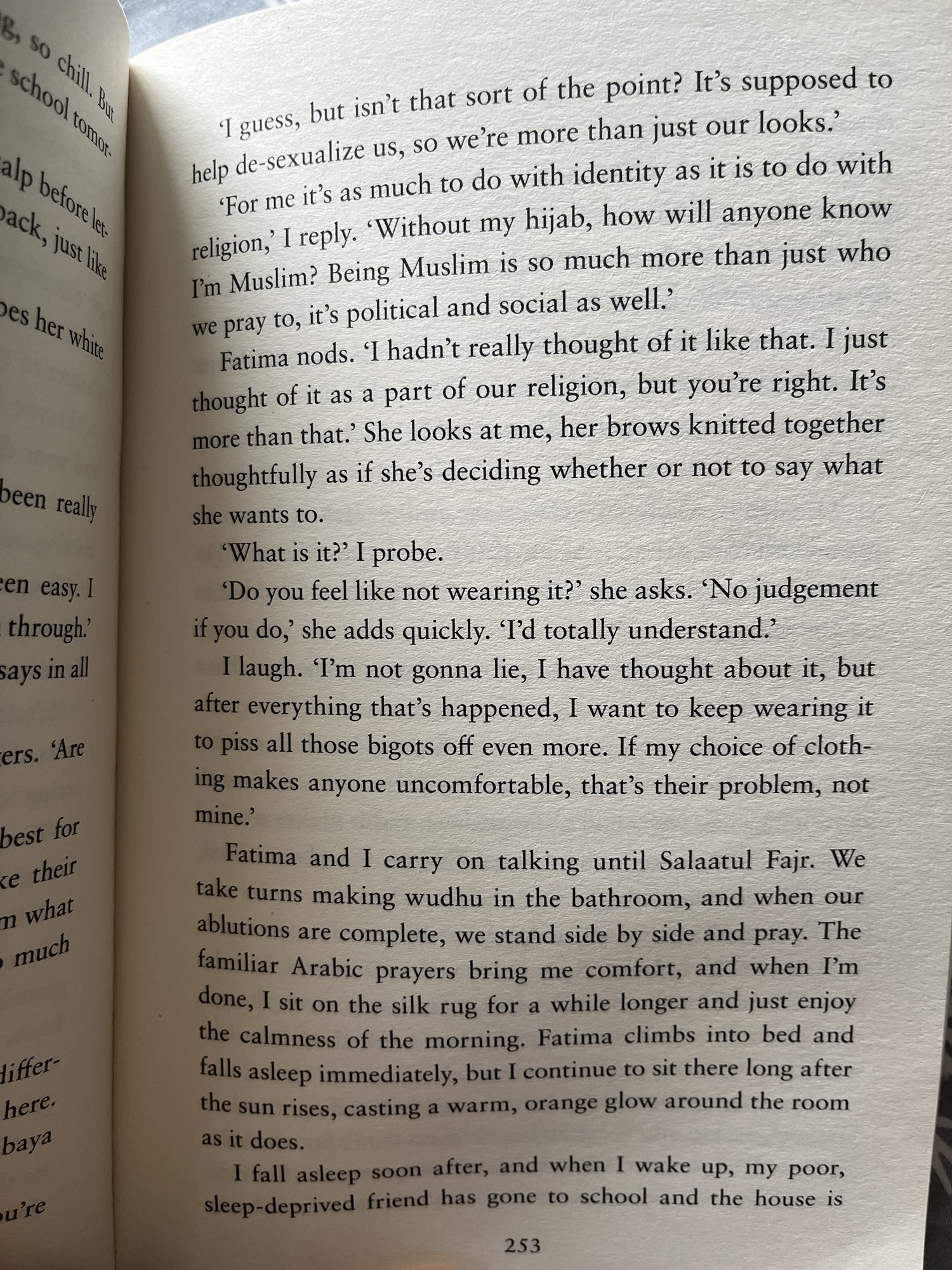
There is a little pulling of punches so to speak of asserting that the boundaries are Islamic, but for the most part I think Muslim readers will see that Maaryah does view a lot of what she experiences through an Islamic lens which I appreciate. I also like that the protagonist’s connection to salat and faith is hers, it isn’t forced on her and I think for this demographic that is good micro messaging and framing.

I was very grateful that the book answered the questions about Maaryah’s family dynamic, so often parental problems are pushed to the void and let to be resolved or understood off the page. And while in the first half it was teased a little as we aren’t having that conversation right now, I did ultimately by the end feel like it was sufficiently resolved.  I also felt the mom was blaringly absent at weird times and I get that it was a plot device to get her out of the way, but if you are dragging at the 100 page mark, I do encourage you to keep reading, it does pick up.

This book isn’t meant to be didactic, and I recognize I’m putting that on it a bit, but I do think the Gaza framing missed an opportunity to show readers how to navigate that very real scenario through the power of fictional characters.
FLAGS:

Copied from above: There is swearing, hand holding, a side hug, normalized boy girl friendships, lying, running away, deceit, cheating, alcohol, mention of hookups, dating, vaping, music, flirting, hijab questioning, bullying, physical assault.

TOOLS FOR LEADING THE DISCUSSION:

I would shelve this in an upper high school classroom, I think that decision to be at the party is clearly shown to be a mistake, to put herself in that situation is something she regrets, and I think showing that she comes out from it offers a lot to be discussed.

If You’re Not the One by Farah Naz Rishi

Standard
If You’re Not the One by Farah Naz Rishi

I suggest one reads my ENTIRE review of this book before deciding if it is right for you, because just the first few lines might signal that I liked this book, and honestly it was just ok, but I really liked parts of it. The protagonist is Muslim, it isn’t something that guides her view of the world or dictates her actions, but she is unapologetic, and it is not something she is grappling with. She prays, makes duas, it mentions a hadith, so I appreciate that it is there and always just below the surface. The “romance” might not be halal, halal, but it definitely isn’t raunchy and stays close to the line even when it crosses it. The male and female character are very close friends, and spend a lot of time alone together even before SPOILER there is hugging and a kiss, it is a rom-com after all. I loved the annotations, especially reading an e-version flipping to the protagonists commentary of her thoughts and then flipping back was easy and fun. I think my favorite line in a long time in the book is her translating rice to chawal (see images). My biggest frustration though, with the book is how close it mirrors the author’s biography, Sorry for the Inconvenience, which I read just over a month ago. Truly, it was like the biography was the book and this was the movie adaptation. Sure the younger brother was switched out for a younger sister, and this wasn’t as gritty or traumatic, but the romantic literary beats were all more or less the same: childhood betrothed, falling for a friend who made a bad first impression, dad being sick, parents and their on again off again divorce, medical diagnosis, it really is two versions of the same story, which meant I was never invested in the fictionalized characters, or on the edge of my seat to see what would happen next. When you have seen the behind the scenes inside scoop so to speak, it is hard to get on board with the faded carbon copy. Add in the consistent lack of communication, telling instead of showing, unlikability of the protagonist, and the non existent foundation of any of the relationships, and it made it hard to get lost in the fluff of the moment.


Side note: I had a whole paragraph rant about the cover, but when I went to post my review on Goodreads (still banned from Amazon) I saw that there is a newer cover with Marlow wearing yellow crocs. I have no idea why the illustrator and publisher would have arcs with the male lead in flip flops, but I think by now it is common knowledge there is often a lack of communication between authors and illustrators. sigh.


SYNOPSIS:
Anisa is in college, she has worked hard to get in to the all girl’s school near where her almost fiancé Isaac is already enrolled. When she takes a class on Isaac’s campus she meets Marlow, who makes a poor first impression on the very “perfect” Anisa. When Marlow and Anisa get paired up for a class paper, Marlow also offers his services as a “love coach” to help Anisa reconnect with a drifting away Isaac. The more time Anisa and Marlow spend together, and the more Anisa learns about Isaac , the more she ultimately learns about herself and what she wants out of a partner.


WHY I LIKE IT: (SPOILERS)
I’ve read a few of the author’s books, so I know she can write, which irritated me even more that this book felt so flat. Anisa and Isaac have been “together” for over six years, but know nothing about each other, don’t talk or text, and as much as the book wants to make it seem like it is an all of the sudden thing, it provides no real tangible suggestion that they have ever had any sort of connection. So why did they decide to be potentially engaged???? All the parents are on board, but how did the two of them set this into motion? With the exception of Isaac visiting her one late night before he went to school, there is so little for the reader to be emotionally invested in. Anisa has terrible communication with every character in the book, not just Isaac, even with Marlow and her family, the side characters all keep in touch just fine, and it is never addressed as a quirk, it just is accepted. If your dad was sick, or your parents divorcing, wouldn’t you be texting them periodically, or non stop? And text between characters are shown on the page, so how is Anisa texting Marlow throughout the 352 pages, but then goes MIA the last 20? It didn’t work for me clearly.

Additionally, I was so tired about hearing how perfect Anisa is, when it never seemed to show it, sure the duplicity with her outward appearance and home appearance was well done, but it never really shows up in any other facet of her life. She is unorganized, has few friends, doesn’t seem to be a very present daughter and sister, the repetitive telling and lack of showing, gave the book no foundation. I know romance-y type books often have to fudge common sense at times, but with no foundation at all, it was hard to be invested in any twists or swooning gestures. I think I just didn’t really like Anisa, and I weirdly feel guilty about it, because she so closes mirrors the author, and I liked the author’s self portrayal in her earlier memoir.


FLAGS:
Close male/female friendships, hugging, kissing, lying, “cheating,” talk of titillating role playing video games (otome) not details so much as shaming and teasing about Anisa playing them (the word porn is tossed in a few times).

TOOLS FOR LEADING THE DISCUSSION:
I think I’d shelve this book in an Islamic school library for high school students. I don’t think I would promote it, but I think those romance loving high school girls will enjoy and be able to handle this story. It won’t work for a book club, but it does make clear that Anisa “dates” with intent to marry, there is reassurance that she wants to marry a Muslim, that Marlow has been reading about Islam, but that Anisa isn’t going to force him, and that societal expectations and appearances aren’t impossible to push back on- which I think are good considerations for 16 and up readers to see fleshed out.

Queen of the Tiles by Hanna Alkaf

Standard
Queen of the Tiles by Hanna Alkaf

queen

This 320 page YA book is hard to put down and middle school readers and up that love words, a good mystery, and fantastic writing are in for a treat.  I can’t recall the last whodunit that had me absolutely sure that I knew who was guilty, while simultaneously doubting myself until the reveal.  I mean, maybe there wasn’t even a crime to unravel? And fear not, I’m not going to spoil anything in this review.  Just know that this Muslim authored, Muslim character filled, Malaysian set, Scrabble feast is worth a space on your shelf as it will undoubtedly make a place in your heart and beg to be read again and again to see what you missed.

SYNOPSIS:

It has been one year since Najwa has competed in a Scrabble tournament, one year since her best friend, Trina Low, died playing Scrabble at the very same tournament, at the same hotel, with many of the same participants.  And with Najwa battling her angry negative thoughts, splotchy memory, nerves, and grief, she is walking a fine line of functioning and faltering.  When Instagram posts and messages start popping up from Trina’s account, everyone becomes a suspect in unraveling what really happened and doing it fast enough to prevent it from happening again.

The backdrop is the Scrabble games that are still taking place, the play on words, the scoring, the plotting, the twists, the scrambling, and unraveling of so many characters that are more connected than they first appear.

WHY I LIKE IT:

I love Scrabble, my mom and I used to play weekly when I was in junior high through college, and while the games were “friendly,” and neither us very good, the game holds wonderful memories. Usually chess is referenced for strategies in real world approaches, so to see Scrabble on a competitive level and have it being in many ways a metaphor for the larger storyline truly had me giddy.  I’m still grinning in fact as I write this review.  The mixing of the two story lines is flawless, with the word play, and scoring, and definitions, that I am just beyond impressed with the writing, the clarity, the intensity, and the way it holds the readers attention.

Many of the characters are Muslim and they mention their hijabs, waking- or rather trying to wake each other up for fajr. At one point Najwa and Mark, Trina’s ex-boyfriend are meeting to talk and she acknowledges the halal gap left as they sit down and how they are both always mindful of her Muslimness and his non Muslimness.  Islam is there, but is not a big part of the story. I beamed when it popped up, but if doesn’t influence the story much, for example one night Najwa plans to sleep in her hijab incase she has to run for her life, so you know, she won’t be slowed down by trying to cover her head.  Yeah, the book has some dry humor too.

There is a large mental health role in the book, as it seems in all of the author’s books: The Weight of Our Sky and The Girl and the Ghost.  Najwa is coping with her grief and trauma and working closely with her doctor to improve her situation.  Other characters mention going to therapists and likewise getting professional help.  I love that it isn’t just a character trait, but that it is a big part of the story, and not in a negative way, but in an actively working to manage it way.

I like how the gender neutral character is handled and pronouns are used.  It is not opined upon, it is not in your face, it is a side character, they have a preference of how to be referred to as, a quip is made that if they win they don’t want to be queen of the tiles, but a more less gendered term perhaps monarch, and that is it.  It is not a judgement, it is not a big part of the story, and no one makes it a huge issue, the character isn’t fleshed out much, but they are respected and have more to their personality than this one facet.  I think that provides a great approach in seeing something in literature that can perhaps spark important conversations in real life in need be.

The only slight pauses the book gave me were when it talks about how incredibly wealthy and distant Trina’s parents were, but then for much of her life she lived in a modest town house style house.  Also, despite Mark and Najwa’s awareness of boundaries, and Najwa being called out for crushing on Mark, at one point he hugs her and I don’t know if that is an oversight or was intentional.

FLAGS:

There is death, murder (?), poisoning, deceit, plotting, cheating in multiple ways, kissing, crushes, relationships, multiple mental health threads, intense competition, danger.

TOOLS FOR LEADING THE DISCUSSION:

I would love to do this as a book club selection.  I think as long as no one spoils the outcome there would be so much to chat about: the twists and turns, the way Islam and Malay culture is shown, the influence of western culture, concept of competitive Scrabble, pronoun sensitivities, and healthy friendship.  Girls and boys in middle school will be drawn to the story, and I can’t wait to share.

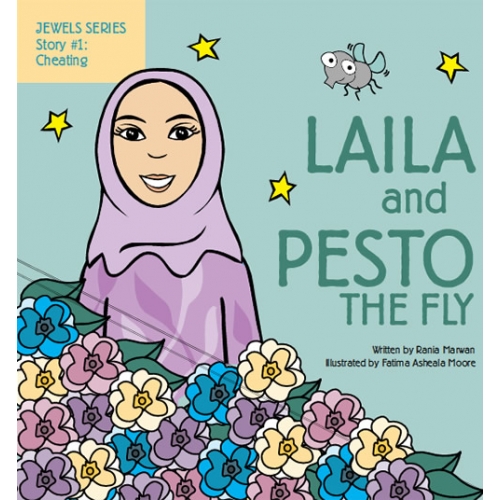
Laila and Pesto the Fly by Rania Marwan illustrated by Fatima Asheala Moore Jewel Series Story #1 Cheating

Standard

laila-and-pesto-the-fly

I ordered this book with the hopes that it would be the first book of a wonderful series teaching values in an Islamic context.   It says that it is book #1 in the Jewels Series and it focuses on cheating.  However, the book was published in 2009 and I can’t find any other books in the series.  Sadly, I can possibly see why.  The book is not great.  The illustrations make it so tempting even if all the girls are gorgeous and the illustrations simple, they would seemingly work well with a book aimed at 4 to 8 year olds, and just 24 pages long.

laila1

Unfortunately the text is lacking and doesn’t create a story worth reading more than once. The sentences are repetitive. And the same words are used over and over.  The first page alone says the word “play” four times in three sentences.  It is about 4th grade girls that play, watch cartoons and essentially hold lessons/ book clubs for each other once a week.  A lot going on for a book that on the second page says the word “flies” three times in three sentences.  Needless to say the repetition makes it hard for a story time selection, and the run on sentences hard for young readers.  The first page features a font that is probably about a size 20 and the next page it drops down to one that is about 11, the third page is about a 14 and the trend of the ever-changing font size continues throughout the book.

laila-text

Example of repetitiveness from Laila and Pesto the Fly

The story idea is a good one at its core.  A girl teaches her friends about flies.  Then the fly talks about Laila and how she is kind and honest. Then the next sections returns to Laila not being ready for a math test and she is tempted to cheat when Pesto, the fly, distracts her and writes a message for her in glitter.  I’m not sure how the glitter stays on the page, but, the message is received by Laila and emphasized by the author sharing a hadith, “He that deceives us is not one of us.” The last page of the book is a bulleted list emphasizing the harms of cheating, and how to overcome the temptation as the girls urge you to join their Cheat Deceit Foundation.

Overall, the book is awkward and doesn’t work for me.  There are a lot of better books out there.  That being said, if the author wrote another book, I may give her another chance, it isn’t hopeless. It just needs some tweaks. The fly is a silly likeable character, but the group of friends are a monolith and have no individual roles.  The message is clear and important, and we need books like this, but alhumdulillah the standards have gone up, way up, and the writing quality isn’t where it needs to be to attract Muslim children or their parents.