Category Archives: Picture book

Yasmine’s Belly Button by Asmaa Hussein illustrated by Charity Russell

Standard

Yasmine's Belly Button

This book is fun, fun, fun.  The mere mention of the word belly button to little kids gets them giggling, and the words and pictures in the book kept them engaged and happy through out.

The story is a simple dialogue between 4 year-old Yasmine and her mother about belly buttons as she heads off for her first day of school full of butterflies.  We learn that everyone has a belly button, even cats! And the students have a fun time following along with Yasmine’s confusion of why it is called a button, to her understanding that it allowed her to receive food while in her mother’s tummy.  yasmine2The illustrations are bright and colorful and have a lot going on.  The expressions on the character’s faces compliment and complete the text seamlessly to tell a well thought out story.  They keep the audience’s attention even after the text is read, with the kids telling me to “wait” so that they could soak it all in before I turned each page.  The mom and teacher’s expressions on the last page amused the daycare through Kindergarten students and made them feel like they were in on the silliness.

A lot is conveyed even with just a few words on its 28 pages.  The reader sees what she thinks, they see the mom without hijab at home and with hijab when she goes out, they see a diverse classroom, a patient mom, and a way to deal with being nervous in a new situation.

I read this book to many students at school and to my own children at home, and can tell it will be an often requested book in both settings, mashaAllah, I highly recommend it.


Bismillah Soup by Asmaa Hussein illustrated by Amina Khan

Standard
Bismillah Soup by Asmaa Hussein illustrated by Amina Khan

Bismillah Soup

It is always a cause of giddiness to find a good book, but to have one recommended by a mutual friend of the author, makes it all the better. Bismillah Soup is a spin-off of the Stone Soup folktale, but without the “trickery” of the classic.  Hasan, wants to surprise his mom with a feast, but money is tight and when Hasan is sent to ask the local Imam for some rice, a plan: Bismillah Soup, forms that brings the entire community together.  The story takes place in Somalia and the cultural words that are peppered in to the story add detail and talking points to have with the kids.  As each community member shares something small, the enormous feast that is created is a wonderful example of what can be achieved when we each give our best to help others.  The book is 40 pages with a glossary at the back and is definitely one that can be read over and over to kids of all ages.  Even the littlest ones are able to grasp the beauty of coming together through the colorful and playful pictures.

soup-gallery-img1 (1)The real treat of the book however, is how it all comes together: the words, pictures, sentence structure, font, size, and diction all compliment each other on the same level.  I read a lot of books aloud as a children’s librarian, and while the rhyming ones are great for the littlest listeners, there is often a void of read-out-loud stories for the kindergarten and first grade levels.  And I am talking about all books, not just Islamic ones.  Most picture books in my experience are written on a third grade level, with longer blocks of texts, smaller fonts, a wider range of vocabulary and longer sentences.  These books are often beautiful and very tempting, however when I read them during story time I end up “summarizing” them, and telling the story rather than reading it.  Similarly, early readers often find them frustrating and too difficult to read independently. Bismillah Soup strikes a wonderful balance, mashaAllah.
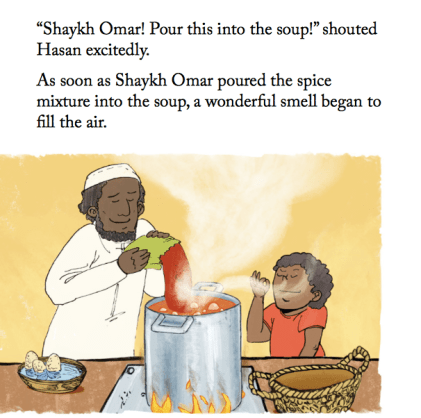
I read the story to my own children who enjoyed it and have found my first grader reading it independently twice this week.  Each time beaming with excitement to tell me something new he has gained from the book.  When I read it aloud to them, my kids marveled at how having a good intention and being so generous could benefit everyone. The first time my son read it independently he was in deep thought about how grateful Hasan was even though they didn’t have much food and how he was a determined problem solver.  The second time I found him reading it, he was so very impressed at the kindness of Shaykh Omar.  He really started to understand the subtle beauty of the character not just in helping Hasan’s family with food, but also supporting and working with the young boy to make the feast happen, alhumdulillah.  Screen-Shot-2015-08-29-at-12.06.00-AM

I highly recommend the book and I can’t wait to read it to my students at school next week, inshaAllah.  For more about the book, the author, and her other work you can go to the author’s website  http://www.ruqayasbookshelf.com

Amira’s Totally Chocolate World by J. Samia Mair

Standard
Amira’s Totally Chocolate World by J. Samia Mair

Amira' totally chocolate wold

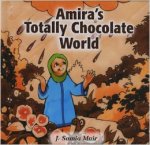
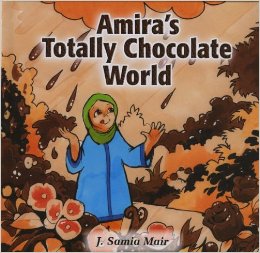
Amira’s Totally Chocolate World is a sweet story based on the idea of a young girl’s wish for the world to turn into chocolate.  As she imagines all the wonderful things that would be made better by being chocolate: flowers, grass, rain, the ocean, etc., she asks Allah swt to make a totally chocolate world.  The night before Eid ul-Fitr her mom promises to make Amira a chocolate cake with chocolate icing in celebration of Amira fasting for a part of each day in Ramadan.  When Amira wakes up the whole world is chocolate, and Amira runs out to enjoy all the chocolate around her.  Soon enough she misses the colors of the world, and the different smells, and misses the texture of grass too.  Amira remembers an Ayat of the Quran about the many colors of creation and asks Allah to turn the world back to the way he created it.  Naturally her alarm clock then wakes her up and she is now wiser, more appreciative and happy to eat her chocolate cake on the kitchen table.

Overall, the story touches on ideas of Ramadan, Eid, asking Allah swt for everything and anything, being appreciative and being thankful.  However, when read aloud I have found that the students have to be made aware of these topics to grasp them.  The text is a bit wordy and the author’s message seems to get lost in the chocolate-ness of everything.  I feel like there is just too much going on in the 23 pages of the story for a child younger than 1st grade to get much out of independently.  On the surface however, it is a fun story with adequate illustrations that kids, especially those that love chocolate, will enjoy.

(NOTE: the book is written in British English, and American children are quick to notice the difference in spelling the word color/colour.)

Time to Pray by Maha Addasi, Arabic translation by Nuha Albitar, illustrated by Ned Gannon

Standard

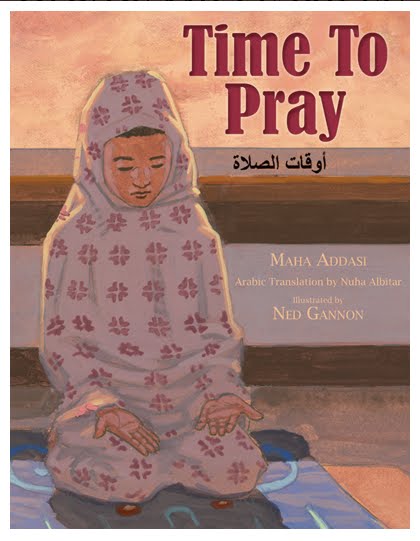
Time to Pray by Maha Addasi

On the surface this book presents itself to be fabulous: the large size, the dual language, the length (32 pages), and concept.  But alas, sadly, I was a little let down with the story, the characters, even the pictures.  The details about the characters are vague, the reader doesn’t know where the story takes place, where the girls parents or the rest of her family are (until the end), why she doesn’t know how to pray, and the climax isn’t really much of a surprise.  After reading this post from the author I appreciate that she left the location vague, to as not be burdened by one specific country, and I can see the origins of why the call to prayer from her own childhood is what the story focuses on.  I can also imagine the wealth of information and details that she had to sort through to decide what is needed to carry the story and what would ultimately repel a young reader.  All that in to consideration however, still didn’t connect me to the story of young Yasmin and her Grandma. Not to mention I didn’t have all the author’s justifications or rationale before reading it.

 IMG_3163

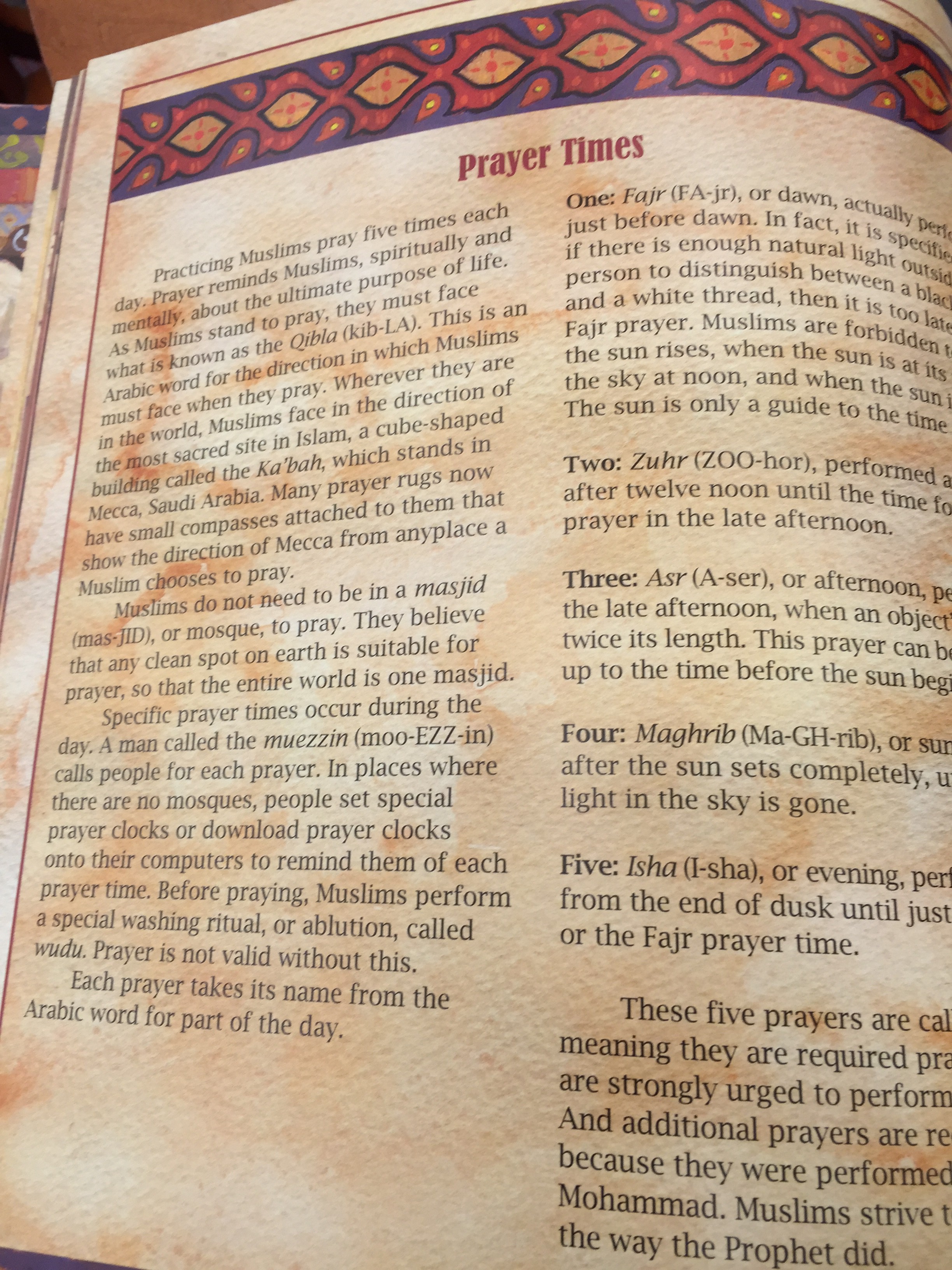
The pages have both English and Arabic text and is written for older children. Despite the initial appearance of being a children’s picture book, it has an AR level of 4.2 and has some Arabic words in the text, an Author’s Note in the back and detail of Prayer Times in the back, as well.

IMG_3164

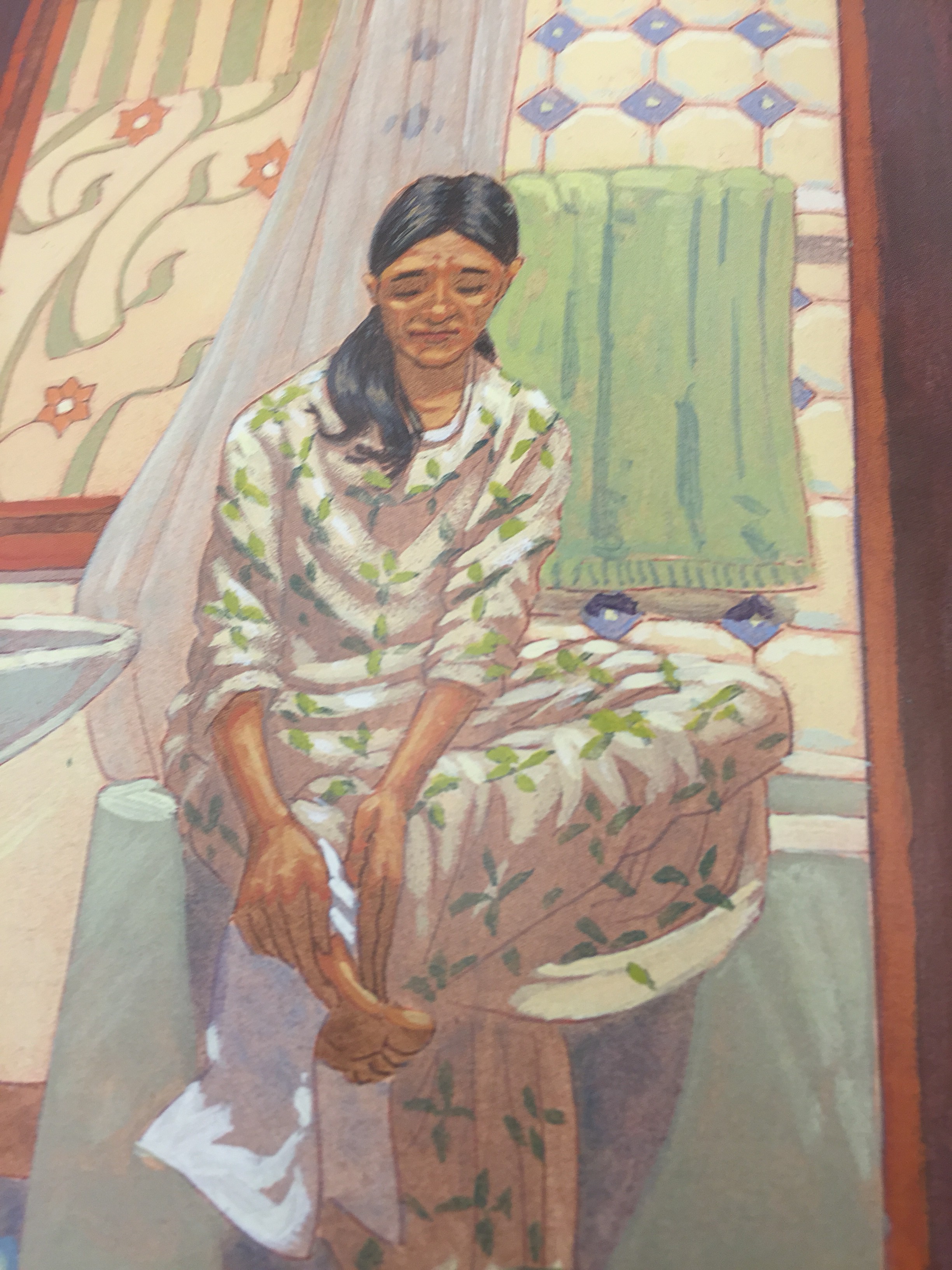
The pictures I want to say are beautiful, but for some reason I didn’t love them.  I am no art critic and they are detailed and large and I should probably ask a child, but here is one for you to decide your thoughts about them on your own.

IMG_3162

Additionally I’m not sure if she is washing her foot her, as part of Wudu, the obligatory cleansing before prayer, which in this case, would be portrayed erroneously, or if she is drying her foot, either way Grandma looks sad to me and not content or excited to prostrate to her creator.

All is not lost though in this book about a girl learning about prayer with her grandma and being surprised by a prayer outfit. prayer rug, and Athan clock when she gets home and finds while unpacking.  But some of the best parts are subtle and might not be gleamed by unassisted readers.  For example how Grandma dresses at home versus when she is out, that because Yasmin is young she is not reprimanded for not praying, or how patient and loving the Grandma is in a slower paced environment.  Overall, the book is unique in that it gives an introduction to Muslim’s prayers to both Muslim and non Muslim readers alike, but for such potential I felt it fell short of being fabulous.

Going to Mecca by Na’ima B. Robert illustrated by Valentina Cavallini

Standard

Going to Mecca

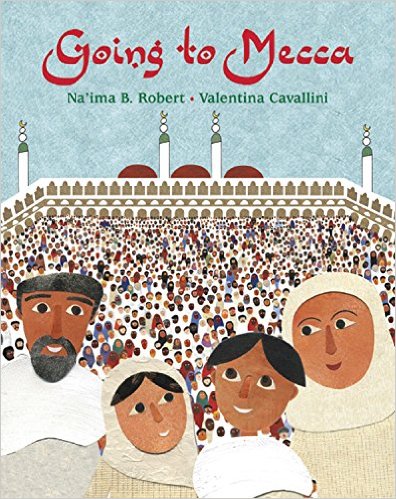
With Hajj starting in the next few days, this is a wonderful book to share with children (and adults) of all ages. The simple text flows, although it doesn’t rhyme, and is action oriented as the reader is encouraged to accompany a family on the rituals of Hajj.  The short sentences keep the book flowing and give the Arabic terms for the actions being performed.   The pictures show what each step looks like and are large, inviting, and colorful.  While the text doesn’t give abundant detail to someone unfamiliar with Hajj, there is basic information about Hajj at the end of the book.

Overall the book, in my opinion, works best for those familiar with Hajj and Islam. For those who are not, they will understand the basics, but probably be at a loss to delve much deeper or to answer any questions without further research. I plan to read it for story time at school and use a storyboard with the students after the initial reading to see what they can recall about the steps of Hajj, supplement, and share with their peers.  I also plan to read it with my own children to do the same, as it leaves plenty of holes where those with more knowledge about the details will feel empowered in contributing to the story discussion and thus making the book enjoyable and engaging for older aged children.

The book is not AR, but most second graders should be able to read it independently without trouble.

Jameela’s Great Idea by Surriah Igram

Standard

jameela's great idea

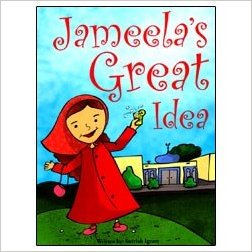
Jameela’s Great Idea by Surriah Igram is a good read-a-loud story for small groups.   A simple story of a girl seeing her father give sadaqa, charity, on a nightly trip to the masjid, wants to also give charity.  But, to do so, she must first find a way to acquire some money.  Her ideas are lavish, over the top and  silly, but her ever patient mom let’s her pick one idea to bring to fruition, which luckily, alhumdulillah, is the only reasonable one presented.  I feel like discussion is needed with this story to provide commentary on why the ideas are not practical even though her intention is so noble.  The story is very simple, linear, and age appropriate.  It works well for preschool and kindergarten age groups with big colorful pictures, large font, and its oversized presentation.  The message is beautiful as are the pictures.  Little Jameela has a supportive involved family, they enjoy going to the mosque, they behave in the mosque, yet have fun outside in the yard, and images of covered and uncovered characters are present.  Arabic and English signage decorate the landscape and the book isn’t too long at 30 pages.  After reading it, I think children will enjoy going back to look at the pictures, however, I don’t see it being a high demand repeat read request.  Once through is pretty sufficient in getting the message, chuckling, having a little talk about it, and then moving on.  The book is a great introduction to the importance of charity in Islam, but would need to be supplemented to fully convey to even the little ones, the value of giving to others.

Allah Created Everything by C. Alta

Standard
Allah Created Everything by C. Alta

allah created everything

The version I have is called Allah Created Everything, but it seems that the more common edition is God Created Everything, regardless the book is beautiful, timeless, and a perfect book for story time with the little ones.  The simple words and beautiful illustrations are the perfect level for Daycare through Kindergarten students.  They can gaze at the pictures and absorb the simple text, and even participate in a powerful conversation after about how Allah/God created us all, and everything around us.

The Blades of Grass,
The Oceans and Seas ,
The Rocks-
The Soil-
The Beautiful Trees,
The Majestic Mountains That We See,
Allah Created Everything.
The Dog-
The Cow-
The Whales-
The Birds, The Spiders and Bees,
The Wild-
The Tame-
Allah Created Everything.
The Sun,
The Moon,
The Rainbow-
The Clouds, Tornadoes, Volcanoes,
Lightning Shattering the Skies.
People of the World,
Shapes-
And Colors We See,
Allah Created Them
Just like You and Me.

Four Feet Two Sandals by Karen Lynn Williams & Khadra Mohammed Illustrated by Doug Chayka

Standard

four feet

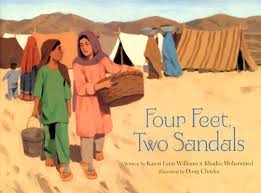
A beautiful hardback picture book I picked up at the Scholastic Warehouse sale, at 32 pages long and an AR level 3.2, Four Feet, Two Sandals, works well as both a story time selection to younger students and as independent reading for up to 5th grade.  The story is about two refugee girls that come to know each other when relief workers throw donated clothes for the people and Lina and Feroza each end up with one sandal each of a beautiful pair.  Rather than fighting or being ungrateful, the girls work out a plan so that they can both enjoy the sandals and in the process, become friends.  The girls share their stories with one another, and thus the reader, about how their families have been affected by war and how they came to be at this refugee camp in Peshawar, Pakistan.  The girls dream of school and their futures and show the readers a bit of their daily struggles getting water and doing chores.  When Lina’s name shows up on a list to go to America, and Feroza’s does not, the friends must part and decide who gets the sandals.

While it probably bothers some that America is seen as the saving grace to sweep Lina to a better life and pander to an American audience. I think it makes sense seeing as the book was co-authored by the executive director of the Pittsburgh Refugee Center and was inspired by a refugee girl who asked “why there were no books about children like her.”  Clearly refugees do get a chance at a new life when other countries open their borders and stories like this that give our children insight into the world they have left behind, with the hopes of fostering compassion, is something that I definitely want to share with my own children and students.

The author’s website and reading guide: http://www.karenlynnwilliams.com/files/sandals_guide.pdf

The Apple Tree by Mariam Al-Kalby, Illustrated by Yee Von Chan

Standard

appletree

I have been looking forward to obtaining this book for a while (it was back ordered on Amazon) and over all it was worth the price $16, and worth the wait.  The illustrations are absolutely beautiful.  At story time the kids constantly urge me to take my time in turning the page.  They aren’t incredibly detailed, just very whimsical and engaging, that you want to take a peek and stay a while to play with little Shaima.

The book’s moral comes from two hadiths (sayings of Prophet Muhammad (p.b.u.h.)) “When a Muslim plants a tree, whatever is eaten from it is charity from him, and whatever stolen is charity, and whatever is subtracted from it is charity” (Sahih Muslim), and ” There is no Muslim who plants a tree or sows seeds and then a bird, or a person, or an animal eats from it except that it is regarded as charity for him” (Sahih Bukhari).

The main character, Shaima, wakes up one morning at fajr to find her Baba planting an apple tree.  The two discuss what “reward of charity” means and the value of sharing.  Time presumably passes, although the tree does seem to grow and produce incredibly fast.  Once the apples are ready to be picked, Shaima finds everyone taking her apples: a little boy, a squirrel and her babies, some birds, what can she do?  The solution is both a lesson and inspiration for the character and the reader and makes for a fun book to get the discussion rolling on a wide variety of topics: patience, charity, sharing, generosity, humility and more, alhumdulillah.

The book is not AR, but is relevant to 4 year old children and up.  The book is hardcover and 32 pages. There are six Arabic words which are explained in the glossary and do not impede the story in any way.

Magid Fasts for Ramadan by Mary Matthews illustrated by E. B. Lewis

Standard
Magid Fasts for Ramadan by Mary Matthews illustrated by E. B. Lewis

Magid Fasts for Ramadan

The intent of this 48 page chapter book is good, however, a few things rubbed me the wrong way about how Ramadan and Islam are presented.

Nearly eight-year-old Magid wants to fast on the first day of Ramadan, but everyone says he is much to young.  He decides to deceive everyone and fast anyway.  I’m actually okay with this main story line, as I could genuinely see a child wanting to do it so much they would lie about it.  The author even has the family sit down after the truth comes out and discuss how honesty is important and this is not how Ramadan should be celebrated.  Lesson learned for Magid and the reader, right? Nope, the author kind of blows it and takes it to the other extreme.

Magid’s sister Aisha is twelve and is “forced” to fast so she isn’t the only girl not fasting at her all girl’s school in Egypt.  What a sad reason to fast, The whole reason Magid wants to fast is to be a “truly obedient Muslim” which sounds great on the surface, but it get’s repeated so often that Magid at one point is judging a classmate who isn’t fasting and isn’t always at Jummah (Friday) prayers.  The parents decide at the end to let Aisha fast until school is out, hence shortening the day for appearance purposes, and Magid can fast til lunch.   He is told he can fast full days when the days are shorter.  Again a really odd reason to wait when fasting has been prescribed for us, to make it an issue of convenience.

So aside from the very negative view of Ramadan and the kids rejoicing at the end that they don’t “have” to fast, the lying, the disobeying your mother, and the judgmental laden diction of being truly obedient, the book does cover a lot of ground well.  The book shows the characters doing wudu and praying, it shows them trying to be kind to one another, it talks about how the Quran was revealed in the month of Ramadan and it does have a plot.

The water color illustrations are nice, and I also like how it showed a bit of Egyptian culture with the lanterns, singing, and food.  Interestingly the author says it is harder for Muslim’s in America to fast, but elsewhere says that Aisha has to watch the girls at school not fasting, eat lunch.

I really wouldn’t recommend this book, for the intended audience of 3rd through fifth graders I think it would do more harm than good in promoting Islamic values in Muslim children and in showing non-Muslims what Ramadan means to Muslims.