Once again Mina Javaherbin retells a Rumi story in a fun, charming way to children that probably have never heard his stories before. The illustrations bring this 32 page tale written on an AR 4.6 level to life. While written for older elementary children, this book works well for kindergarteners and 1st graders in story time as well. The pictures and descriptions make for an engaging story for all levels and the twist at the end make you want to go back and read it again and again.
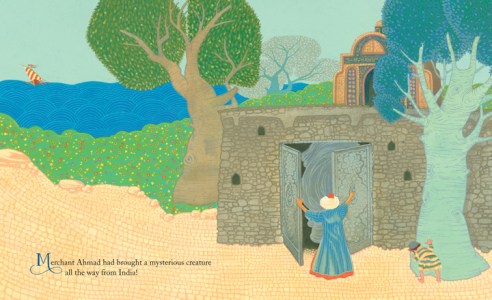
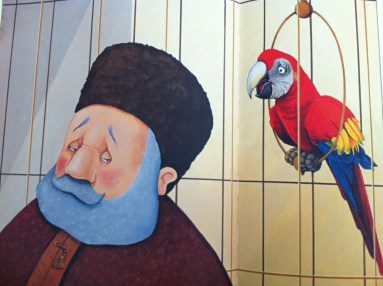
A wealthy Persian merchant brings a parrot from India to call and sing to those passing by to come in to the shop. The parrot helps make the merchant famous and before long he has completely sold out of all his wares. He plans to return to India and asks his family what they want him to bring back, he even asks the parrot. The parrot asks for nothing but a message to be delivered to his friends about how he misses them and about his new home and cage. The story follows the merchant to India and through it, showing and telling about the sites and goods. On the way back the merchant stops in a tropical forest to deliver the parrot’s message. The birds listen carefully and then one by one, fall off their branches with their backs on the ground and their feet in the air. When the merchant returns he delivers the message and the same thing happens to his parrot. (SPOILER). Sad that he has caused his parrot to die, he takes him out of the cage where in an instant the parrot flies out of the hole in the domed ceiling all the way home to his friends in India.
Islam isn’t shown, and I debated including it, but culturally it is relevant with the character journeying from Iran to India and the author being from Iran. Plus it is based on a Rumi poem. There is nothing un Islamic in the book, and there is plenty of little places in the book to get kid’s opinion on the action, thus making it a book definitely worth your time.
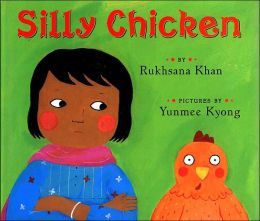


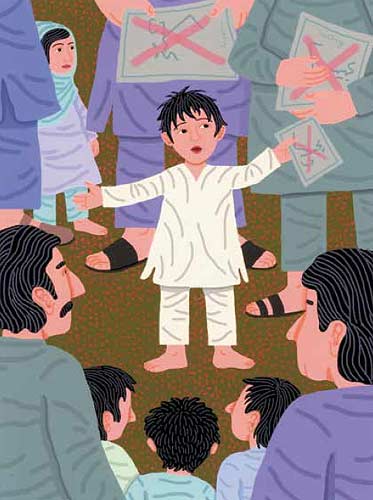
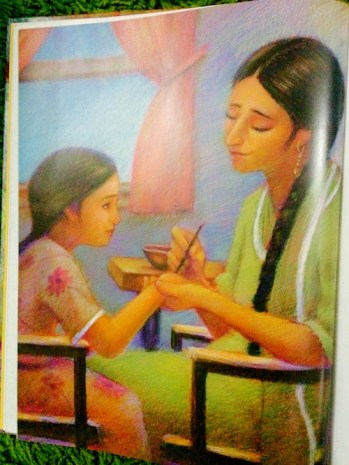
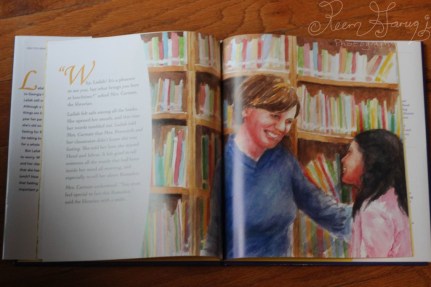
 Nadia’s aunt is getting married and she gets to be the flower girl in the Pakistani-American wedding. She also will get mehndi put on her hands for the big event. Her cousins warn her that she might mess up and even in the midst of her excitement she begins to worry what the kids at school will say when they see her hands on Monday. As her aunt prepares the mehndi and the application process begins, various uncles peek in on her and her aunt gifts her a beautiful ring. The mehndi has to sit on the skin for a while to set and as Nadia practices sabr, patience, I couldn’t help but think something seemed off in the story. I’ve been at, in, and around a lot of Pakistani and Pakistani-American weddings, and this story didn’t seem to reflect the tone of such occasions. The book doesn’t reflect the hustle and bustle and near chaos, it doesn’t sound like the tinkle of jewelry and laughter as the women sit around chatting and getting mehndi put on together, the pots on the stove are referenced but not described so that the reader can smell the sauces thickening and hear the pans crashing and taste the deep rich flavors. It is lonely. Nadia is lonely and filled with anxiety about Monday. Durring the wedding she is walking down the aisle and suddenly freezes when she looks down and doesn’t recognize her hands. Her cousins seem to show unsupportive “I-told-you-so” expressions as she searches for some comforting encouragement to continue on. When she finishes her flower girl duties, her grandma asks if she understands why looking at her hands makes her feel like she is “looking at my past and future at the same time.” Nadia doesn’t understand and the author doesn’t explain. At the end she is ready to embrace that her hands are in fact hers and that she will show her friends on Monday. But the reader has no idea how it goes, or what exactly the significance of her painted hands are. The book fails to give any insight or excitement for a culture bursting with tradition at a time of marriage.