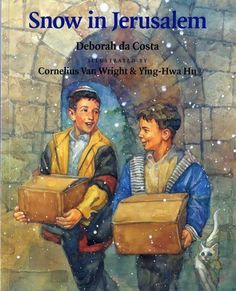
The world is always in need of kindness for animals and for one another, so when I saw this book written in 2001 about two boys who live in different quarters of Jerusalem coming together when they learn they are caring for the same stray cat, I was definitely excited to dive in.
The book starts with a Jewish boy, Avi, caring for a fluffy white stray cat and his mom teasing him for caring for him. He begins to wonder where the cat goes and resolves next time he comes around to follow him. The reader then sees the cat journey through a market place and have the exact same interaction with Hamudi, a Muslim boy. Both boys go days without seeing their beloved cat and when they begin to look for her, they find each other. The boys fight over her as it begins to snow and the cat takes them to see where she has been, with her new kittens.
Again the boys fight and ultimately resolve to divide up the kittens to care for them and let the mama cat go back and forth to feed them. Needless to say, I was a little let down by the book, I had hoped the boys would bond or see how similar they are. Instead they simply work out a solution for this one situation. I can’t help but thinking the kitty family getting broken up and the poor mom having to go back in forth is rather selfish on the boys behalf.
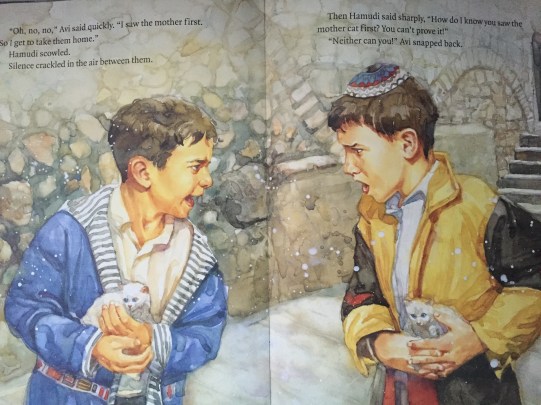
The book is 32 pages and written on an AR level 3.1. Third grade and up can probably understand the similarities of the boys and how they come together to care for the cat and appreciate it with a simplistic understanding of Jerusalem’s complexities. Kindergarten and 1st graders could probably handle it as a story time selection, and understand working together to help a cat. I’m sure fifth graders and up however, will be a little concerned for the mama cat and disappointed in the boys at a lost opportunity to provide hope in a troubled region.
There is an Author’s note and Glossary of Arabic and Hebrew words at the end, and a simple, yet valuable map of the Old City at the beginning.


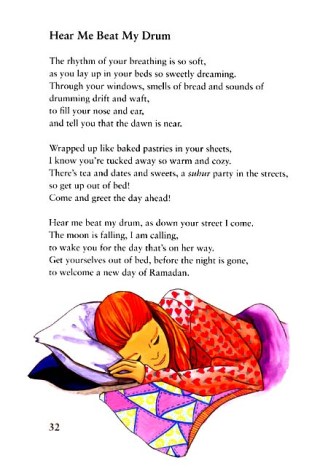

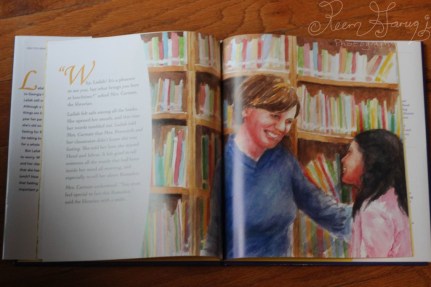

 The next tab has George helping Kareem get up for a predawn meal, keeping his mind off food and keeping him busy. Not the normal mischievous George in this book, but rather a very helpful one.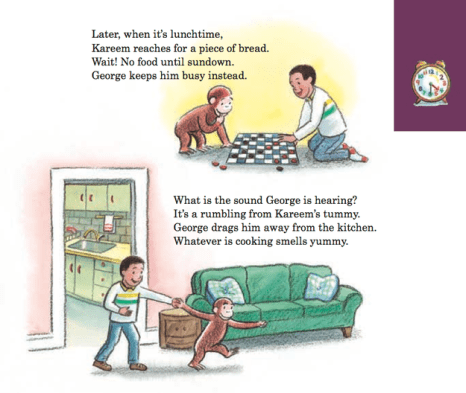





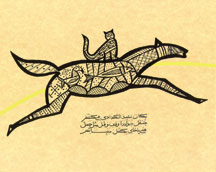
 A calabash cat in the middle of Africa wants to see where the world ends. When the road stops at the edge of the great desert he thinks it stops there. But a Camel corrects him and offers him a ride on his back to show him where the world ends. When they get across the desert, the camel puts him down on the edge of the grassland and tells him this is where the world ends. A horse corrects him, that in fact this is not where the world ends and offers to show him where it does. He climbs up on the horse and the gallop through the grassland. This continues through the jungle on a tiger, the ocean on a whale, then on the back of an eagle all the way home. Written on a 3.3 level, there are 32 pages with a author’s note about where the idea for the story came from. The book works well for story time and the repetition makes it good for bedtime too.



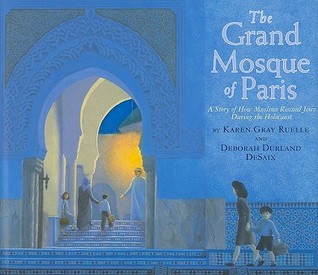 This beautiful, beautiful book tells of a little and sparsely known event in history. During the holocaust The Grand Mosque of Paris served as a place of refuge for many North African Jews. Many who passed through the vast gardens and beautiful Mosque were given fake documents of conversion, tombstones with their family names inscribed, and access to truly underground passageways (subterranean mazes), as the Muslims of Paris offered assistance to keep their Jewish brother’s and sister’s safe from the Nazi regime. Many of the stories were recently uncovered and with the passage of time, so much of the information has been lost. As a result the book is a bit choppy, each page tells what is known about the Muslims’ assistance in some capacity, but does not flow to the next page. So there are generalized recountings of children being hidden with other families, the efforts of the Kabyle Ressistance (Berbers from Algeria) to smuggle Jews to safety, etc.. There are also a few specific examples of Salim Halali, a young Berber Jew from Algeria, two friends one a Muslim the other a Jew seeking shelter, a Tunisian Jew who stayed at the Mosque for over two years,and a few others, but with the exception of the use of the Grand Mosque and a Doctor Ahmed Somia very little flows throughout the book. Thus making it more of a historical account than a story.
 Islamic School Librarian