Category Archives: Elementary Fiction

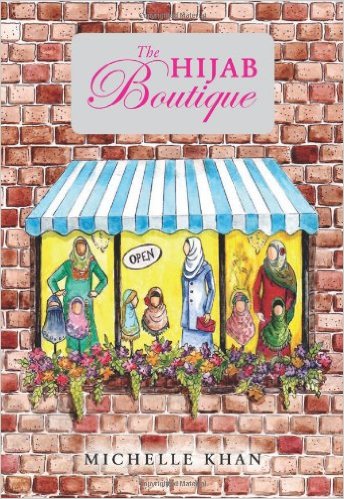
The Hijab Boutique by Michelle Khan

Standard

The Hijab Boutique

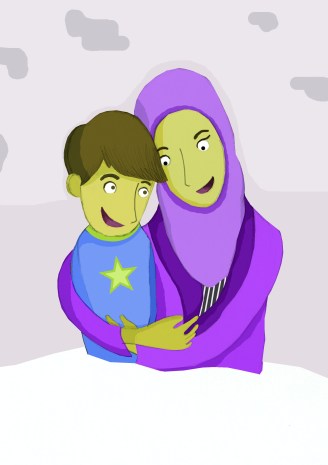
I was really hoping this book would help out the sparsely populated early chapter book section.  And it should, at just 52 pages with beautiful full page pencil style drawings, it just somehow seemed confused instead.  The content is much more young adult in story line, but because of the short length, the characters seem flat and underdeveloped.  My fourth grader read it in less than a half an hour. Yet, I don’t think a 1st or 2nd grader would get much out of the book.  I don’t know what kind of editing process the Islamic Foundation puts its books through, but back when I was a teacher, I would have told the student they have a wonderful, wonderful rough draft with so much potential, they just need to flesh it out and add more detail so the reader connects with the characters. The back of the  book suggests the book for ages 10 and up and content wise that is fine, but it also has a list price of $7.95 and for something that can be read in less than a half an hour, it seems a little steep. If it didn’t have so much potential, perhaps I wouldn’t be so bothered, I just feel like if she stretched it out to being 200 pages, it could be so powerful.

Farah is a fifth grader at an all girls art school.  She has a best friend, who’s mom is a soap opera star, but some popular girls still make  her nervous.  When her Social Studies teacher assigns the girls to bring in something representing her mother, she can’t find anything to share about her mother that she doesn’t think is boring.  Farah’s father passed away two years prior and with money tight, Farah’s mom is opening up a Hijab Boutique.  No real details are given about her family life with her father or the impact his death had on her, which is unfortunate.  The story discusses why the mom started wearing hijab and why it is important, but makes it seem like Farah knows so little about her mother.  Again a hole that if explored would make the book that much more interesting. Not to mention that it could prod young girls to talk to their own mothers about such things.  To no one’s surprise Farah brings in some hijabs to represent her mother and Alhumdulillah the book ends on a positive note with little fanfare, catharsis or drama.

Farah and her mom are practicing Muslims who are an active part of their western community.  It would seem Farah is the only Muslim in her school and it doesn’t seem to be an issue.  They are all upper class and a bit snobbish, but there are no flags.  If your library has the book, reading it is by no means a waste of time.  I don’t know that you’d read it more than once if you purchased it, but 4th through 6th graders might enjoy the short read, and be inspired by fashionably fabulous hijabs while furthering their understanding about why Muslimah’s are required to cover.


Adam in Lost and Found by Zanib Mian illustrated by Maria M. Goncalves

Standard
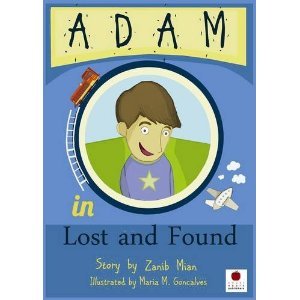
Adam in Lost and Found by Zanib Mian illustrated by Maria M. Goncalves

Adam in Lost and Found

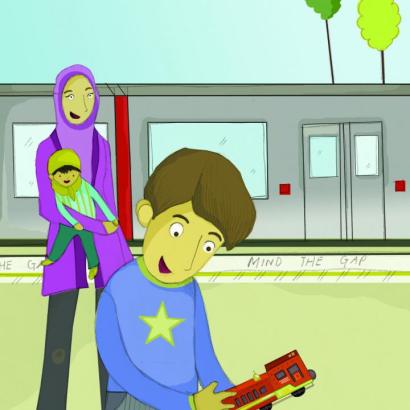
This book resembles kindergarten and 1st grade leveled readers in both appearance (shape and size) and appeal.  It very easily could have been a picture book, with its sparse words and simple linear story, but by making it a smaller size, with a variety of playful fonts, it really excites beginning readers who pick it up and are thrilled to see Muslim characters in an Islamic book on their level.  The book is 32 pages and has nice large age appropriate pictures that work very well, even when reading the book aloud to small groups.

adam 1

The  story explores the concept of “finders keepers losers weepers” in a fulfilling way.  Adam, a young boy on a train with his family, finds a toy train and desperately wants to keep it.  His father kindly explains to him the two options before him and lets him choose.  Adam, Alhumdulillah,  chooses to give the train to the lost and found man and earn Allah’s reward.  Later, Adam realizes after much searching and help from his family, that when he found the train, he left his toy airplane.  The moral is cemented in the readers, as they too hope, with Adam, that whomever found his plane, also did the right thing and gave it to the lost and found. By coming full circle the message is conveyed, and a happy ending is had by all.

The book takes place in Britain and is book two in the Adam series.adam 2


Zak and His Good Intentions by J. Samia Mair illustrated by Omar Burgess

Standard

Zak and his good intentions

Zak  and his sister Hana compete to do good deeds, but nothing goes as Zak intends.  Each time he sets off to help someone or do something kind, he is thwarted by something unexpected.  As frustration mounts with each failure, his mom steps in to reassure him that, “Prophet Muhammad (saw) said that whoever intends to do a good deed, but does not do it, still gets a good deed for his or her intention.” With his spirits restored Zak appreciates Allah’s mercy and accepts that even when we try and plan, it is Allah’s plan that ultimately prevails.

The beauty of the book is in its simple message that is reiterated four times and brought to life with simple straightforward text and detailed, but not overwhelming illustrations.  The book is written on about a second grade level and would appeal to ages 4 to about 8.  It has 32 pages and contains discussion points at the end.  The book is fun and funny and conveys a message and moral in a relevant non preachy way.  Young kids can definitely relate to the character’s desire to do good, disappointment when he fails, and comfort in knowing that Allah swt knows all and is the most just.

Overall a good book with a strong message that can be read more than once and referenced often in both the home and school setting.


The Turtle of Oman by Naomi Shihab Nye

Standard

The Turtle of Oman

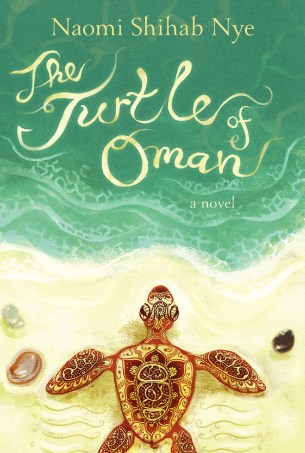
This slow, aimless, subtle, quiet prose-like book, is unexpectedly charming and endearing, and so not like most every young adult book out there.   I truly want to make all 4th through 8th graders read it, absorb it and ruminate in the love shared between a nine-year-old boy, his grandfather, and their home.  The easy 299 pages flow by on a 4.6 reading level and make you long for a kind grandfather to help you see the amazing in the ordinary, and provide you with gentle strength when facing life changing events .  The Turtle of Oman has no climax and no conclusion, yet it offers hope and warmth in a reassuring manner that makes you feel better for having read it.

SUMMARY:

Aref is moving from Oman to Ann Arbor Michigan for three years while his parents pursue their education.  To say he is dreading the move is an understatement.  Lucky for him, and the reader, Aref’s grandfather Sidi, helps him create some memories to take with him to America.  While they spend time together, travel around the country, and talk, the reader is drawn into a world where Aref and Sidi, finish each other’s sentences, and blur the lines of fact and make believe with their stories.  Their love and ease with one another is so seamless that not only are they best friends, and relatives, but they are so intertwined the thought of their separation is heartbreaking.

“Aref kept thinking that no matter what you say, there is something more inside that you can’t say.  You talk around it in a circle, like stirring water with a stick, when ripples swirl out from the center.  You say something that isn’t quite right and that’s worse.  Then you want to say, sorry!  But no one knows what you mean.

He wished he could tell Sidi, you are the king of my heart forever, I don’t care who else I meet, I don’t care about traveling and new friends and different flavored yogurts, I only care about how nice you are and how much I cannot stand the thought of being far from you, ever, ever, ever.

But he could never say this.”

Sidi has passed his love of rocks on to Aref and each adventure involves Sidi slipping a rock to Aref as a token for him to remember their adventures and each other.  From exploring the beach, camping in the deserts, sleeping on the roof, and going out on a fishing boat, the duo relishes in the details of everyday life that make life worth living.  Along the way Aref keeps lists of interesting facts and the reader learns about animals, Oman, Michigan and so much more.  But no matter how much prodding and reassurance Sidi and Aref’s mom try and impart on him ,the book pivots around the inevitable need for Aref to pack his suitcase.  As much as packing a suitcase can be a climax or a conclusion, that is what the author gives, and the reader must be content to understand that like Aref’s beloved turtles, he will have to find his way to the ocean only to return once more to Oman.

WHY I LIKE IT:

I love that it meanders and cannot be rushed.  I love the cultural warmth and the emotional depth.  While the setting is Islamic, there is no religion mentioned other than the call to prayer heard in the market place.  Quiet books usually border on boring for young adult readers, but I feel like this one doesn’t.  I am leaning toward doing it for the Junior Book Club to see if it has the emotional appeal that I think it will.  The main character is scared and unsure about the big move, feelings many children have felt.  But his way of handling it, while childish and whiny in his stubbornness to pack, also offers nuanced hope.  Aref is allowed to work through his thoughts and feelings, and while some characters rush him, his time with Sidi doesn’t feel rushed and forced.  His time with Sidi is reassuring and patient, a fictional soft place for the scary unknown.

“Talking with Sidi felt like a sky of floating words,” Aref explains. “You could say anything.”

FLAGS:

None, the book is completely clean.

TOOLS FOR LEADING THE DISCUSSION:

Interview with the author:  http://www.hbook.com/2014/12/talks-with-roger/naomi-shihab-nye-talks-with-roger/#_

https://www.readingtokids.org/Books/BookView.php?pag=5&bookID=00001192


Ilyas & Duck Search for Allah by Omar S. Khawaj illustrated by Leo Antolini

Standard

Ilyas and Duck  Search for Allah

I might have squealed in delight after reading this book.  Alhumdulillah, since starting this blog I have found that there are indeed a lot of good quality children’s books out there, but this one, well it just does it all.

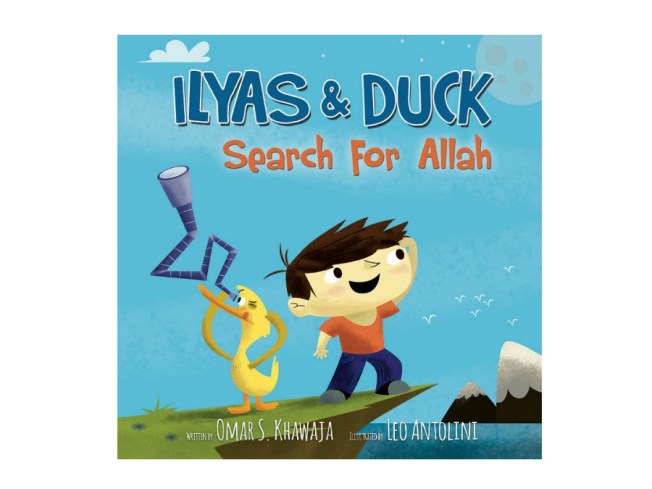
Ilyas & Duck Search for Allah is concise in words, but somehow successfully tackles the huge concept of understanding Allah (swt) through His creation in a powerful way.  And I think a big part of its power comes from its humor and silliness.  The book says it is for ages 3-6 on the inside cover, and I think that is spot on.  The dialogue between Ilyas and duck and the animals they meet on their adventure is written on a child’s level of understanding, and is silly, but not demeaning, and my favorite part is that Ilyas and Duck figure it out on their own.  There are no adults in the book telling them what Allah is or where Allah is, they ask the various animals they meet in the rain forest, underwater,  in the mountains, and come to their own understanding.  This progression makes the book pure gold at story time.  You can almost see the kids brains turning right along with the characters’ brains in the book and when they get it, forget asking them to wait to raise their hands to be called on and explain it, they are so gleefully excited they can’t contain their understanding.

The book starts with an ayah from the Quran and is not preachy or cultural.  There is a glossary of sorts at the end telling a little bit about the four animals they meet and each of the 39 pages are beautifully illustrated.  The dialogue and interactions remind me a lot of the show Justin Time, which is neither here nor there, but conveys my impression of the story’s tone.

ilyas and duck inside Whether you have students or children that are naturally curious and have asked where they can find Allah or not, this book is engaging and fun and one the kids want read to them over and over again, alhumdulillah.

Bismillah Soup by Asmaa Hussein illustrated by Amina Khan

Standard
Bismillah Soup by Asmaa Hussein illustrated by Amina Khan

Bismillah Soup

It is always a cause of giddiness to find a good book, but to have one recommended by a mutual friend of the author, makes it all the better. Bismillah Soup is a spin-off of the Stone Soup folktale, but without the “trickery” of the classic.  Hasan, wants to surprise his mom with a feast, but money is tight and when Hasan is sent to ask the local Imam for some rice, a plan: Bismillah Soup, forms that brings the entire community together.  The story takes place in Somalia and the cultural words that are peppered in to the story add detail and talking points to have with the kids.  As each community member shares something small, the enormous feast that is created is a wonderful example of what can be achieved when we each give our best to help others.  The book is 40 pages with a glossary at the back and is definitely one that can be read over and over to kids of all ages.  Even the littlest ones are able to grasp the beauty of coming together through the colorful and playful pictures.

soup-gallery-img1 (1)The real treat of the book however, is how it all comes together: the words, pictures, sentence structure, font, size, and diction all compliment each other on the same level.  I read a lot of books aloud as a children’s librarian, and while the rhyming ones are great for the littlest listeners, there is often a void of read-out-loud stories for the kindergarten and first grade levels.  And I am talking about all books, not just Islamic ones.  Most picture books in my experience are written on a third grade level, with longer blocks of texts, smaller fonts, a wider range of vocabulary and longer sentences.  These books are often beautiful and very tempting, however when I read them during story time I end up “summarizing” them, and telling the story rather than reading it.  Similarly, early readers often find them frustrating and too difficult to read independently. Bismillah Soup strikes a wonderful balance, mashaAllah.
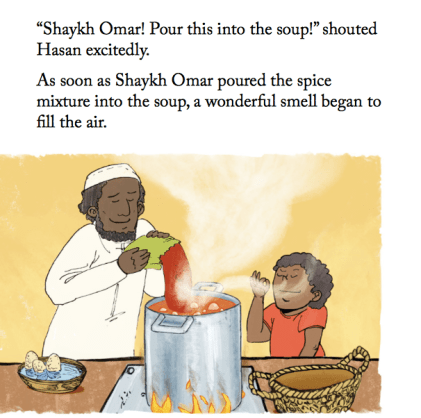
I read the story to my own children who enjoyed it and have found my first grader reading it independently twice this week.  Each time beaming with excitement to tell me something new he has gained from the book.  When I read it aloud to them, my kids marveled at how having a good intention and being so generous could benefit everyone. The first time my son read it independently he was in deep thought about how grateful Hasan was even though they didn’t have much food and how he was a determined problem solver.  The second time I found him reading it, he was so very impressed at the kindness of Shaykh Omar.  He really started to understand the subtle beauty of the character not just in helping Hasan’s family with food, but also supporting and working with the young boy to make the feast happen, alhumdulillah.  Screen-Shot-2015-08-29-at-12.06.00-AM

I highly recommend the book and I can’t wait to read it to my students at school next week, inshaAllah.  For more about the book, the author, and her other work you can go to the author’s website  http://www.ruqayasbookshelf.com

Invincible Abdullah: The Car Theft Kidnapping by Haji Uthman Hutchinson

Standard

invincible

 I don’t usually post a review of the second book in a series so close to the original, but I wanted to read this one and see if it would be a better fit for Book Club being it takes place in England.  Nothing against  Invincible Abdullah and the Deadly Mountain Revenge, but we’ve done a lot of books for Book Club set in Pakistan and Afghanistan, and I want to make sure that the students see Muslims in a variety of settings. This book has the same main character, but is not dependent on the first book for understanding in any way.  Writing style is about a fourth grade level and it is just 152 pages, with sporadic pictures and a glossary of terms at the back.

SUMMARY:

Abdullah and his Malaysian friend Zaki are karate buddies that train and worship together while attending college.  The book opens with the two sparring and Abdullah going home to a letter from an old karate friend, John, who got mixed up with drugs and stealing cars and is now in prison.  John asks Abdullah to come visit him to answer some questions he has about Islam.  After a few visits John takes shahada and changes his name to Abd ur-Rahman. When Abd ur-Rahman gets out Abdullah and his family support him and the sensei even lets him back in to the dojo.  However, things don’t stay calm for long and when Zaki’s car gets stolen, and Abdullah is kidnapped, the boys friendship, loyalty and faith is tested.

WHY I LIKE IT:

The story is face paced and action filled, it also never waivers from being a strong Islamically based book.  The characters balance religion, and day-to-day living in a realistic and inspiring way that engages the reader and makes the character’s morality seamless and believable.  I love that the characters forgive a convict in words and actions and that the friends are from a variety of ethnicities that again, seem realistic and not preachy and forced.  The twists and turns in the story keep the reader’s interest and although you know things will end up alright, the author does keep you curious.

FLAGS:

Obviously there is an element of criminals and drugs that while presented in a negative light is central to the story.  There are not a lot of details about the drug use, but there is some violence that the characters go through, and mention of guns.   There is also brief mention of a bar in the book that is visited to make a few phone calls from.  The only concern that I have, was that it could be perceived that John had to change his name when he takes shahada and I don’t know if I agree that, that is mandatory.  In the book it weaves a little bit of a side story and is presented very positively, but it is something to be aware of none-the-less.

TOOLS FOR LEADING THE DISCUSSION:

I will probably use this book for the 3rd to 5th grade Book Club selection later this school year, because I think there is a lot to talk about. Topics of rehabilitation, taking shahada, and being a good friend are prevalent through out and something I think kids can wrap their heads around and have opinions about.  There doesn’t seem to be a lot of information about the book online and I’ve heard from one distributor that the book is out of print, but on some sites there are still copies available and there is also a workbook.

Amira’s Totally Chocolate World by J. Samia Mair

Standard
Amira’s Totally Chocolate World by J. Samia Mair

Amira' totally chocolate wold

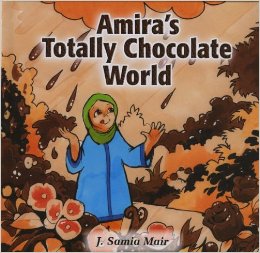
Amira’s Totally Chocolate World is a sweet story based on the idea of a young girl’s wish for the world to turn into chocolate.  As she imagines all the wonderful things that would be made better by being chocolate: flowers, grass, rain, the ocean, etc., she asks Allah swt to make a totally chocolate world.  The night before Eid ul-Fitr her mom promises to make Amira a chocolate cake with chocolate icing in celebration of Amira fasting for a part of each day in Ramadan.  When Amira wakes up the whole world is chocolate, and Amira runs out to enjoy all the chocolate around her.  Soon enough she misses the colors of the world, and the different smells, and misses the texture of grass too.  Amira remembers an Ayat of the Quran about the many colors of creation and asks Allah to turn the world back to the way he created it.  Naturally her alarm clock then wakes her up and she is now wiser, more appreciative and happy to eat her chocolate cake on the kitchen table.

Overall, the story touches on ideas of Ramadan, Eid, asking Allah swt for everything and anything, being appreciative and being thankful.  However, when read aloud I have found that the students have to be made aware of these topics to grasp them.  The text is a bit wordy and the author’s message seems to get lost in the chocolate-ness of everything.  I feel like there is just too much going on in the 23 pages of the story for a child younger than 1st grade to get much out of independently.  On the surface however, it is a fun story with adequate illustrations that kids, especially those that love chocolate, will enjoy.

(NOTE: the book is written in British English, and American children are quick to notice the difference in spelling the word color/colour.)

The Visitors by Linda Delgado (Book #1 of Islamic Rose Books)

Standard

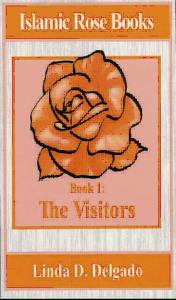
Islamic Rose Books The Visitors

I first read this book in 2004 and it was pretty much my first introduction to what elementary aged/young adult Islamic fiction could and should be.  It set the standard and I think subconsciously I’ve held every other Islamic fiction book up to this series as a comparison.  I’ve taught it to 4th graders and 5th graders, I’ve purchased the series and left it for the students at every school I’ve ever been a part of, I’ve even exchanged emails with the author with students’ questions and been impressed by her responses.  So, after reading so many other books in putting this blog together, I thought it is finally time to revisit a book and series that is dear to my heart, and see if my memories are accurate.

Alhumdulillah, they are.

The book is a bit bumpy at first with the chattiness of the main character Rose, but either like real children, you grow accustomed to her and find her endearing, or the author pulls back as the story progresses and the book finds a more readable and engaging rhythm.  Either way, I still felt a pull to keep reading the book, and feel confident that those that read it, and the entire series (I haven’t read the latest book, “Reunion”) are better for it, alhumdulillah.

SUMMARY:

Nine-year-old Rose is excited that her grandparents, who live next door, are going to be hosting two Saudi Arabian Police Officers who are coming to America to learn English and train with the Arizona Police Department.  In anticipation of their arrival Rose and Grandma do what they can to learn about the food, culture and religion.  Rose’s dad however, is not comfortable with Abdul and Fahd being so close to his family, and for Rose to be so curious about Islam.  Rose works on PLAN after PLAN to try and help her dad and the officers connect, but will it be enough?

WHY I LIKE IT:

The book actually addresses some harsh realities of how Muslims are perceived, yet does so in a tender way.  When Rose wants to go to the Islamic Center and her father objects, or she talks about Muslims at school and her teachers get mad, it opens the discussion for why people may have negative views of Muslims, how to deal with such negativity and how to move past stereotypes.  The book also does a really good job of introducing Islam and Saudi culture to its readers in a fairly non preachy manner.  The inner workings of Rose’s family are also surprising raw and relatable.  Her Mom is not in the picture and Rose must deal with the stresses of a single parent home, luckily her grandparents are next door, but even then, there are stresses and issues that arise.  Rose also deals with a friend moving away, teasing at school, and disappointment.

FLAGS:

None, just some of the stereotypes from Rose’s Dad that may introduce some negative views non Muslims have of Muslims, such as: Muslims as terrorists, Muslim’s being abusive and controlling to women, etc.

TOOLS FOR LEADING THE DISCUSSION:

There are a few different versions of the book, mainly just cover changes depending on the publisher, but this version:

The Visitorshas appendixes in the back that include a glossary and recipes and facts about Islam as well as Arizona.  The newer version (as pictured at the top of the post) doesn’t include everything and refers those looking for more to see a website.  That website however and all other links to online study guides and reader guides are no longer available or now have different owners.  I’m not sure what happened to Linda Delgado, and if anyone knows how to contact her, I’m hoping you will let me know.

So as of now there are no links to suggest for teaching the book unfortunately.

Layla Deen and the Case of the Ramadan Rogue by Yahiya Emerick

Standard

layla deen

I remember my 2nd graders reading this many years ago and strongly disliking it.  And I vaguely remember agreeing with them, but perhaps at the time, there weren’t a lot of Islamic fiction options for the age group, so I decided that the pros out weighed the cons and left the book on the classroom bookshelf.  Fast forward to today where mashaAllah there are more options, yet this book is still often a staple on most school and family book shelves.  That being said, I thought a revisit was in order, and yikes I agree with my 2nd graders of so long ago, and I have major issues with this book.  At 42 pages, the clipart illustrations and wide spaced font seems a bit dated, but with the short chapters and Islamic backdrop the book overall would still appeal to 2nd to 4th grade Muslim students. The story is sweet in merit and intention, however, some of the details make me hesitate to recommend this book.

Overall, I feel like the author tries too hard, he is trying unsuccessfully to relate on a students level, trying to sound cool, and ultimately in the process uses unnecessary language in my opinion.  The manner in which siblings Layla and Ahmed speak to one another is incredibly harsh, and while perhaps realistic for some families, there is no reprimand or apologizing.  The name calling and yelling at one another throughout makes their collaboration at the end seem unlikely.  Even how Layla talks to her mom about the homeless man at the store, saying he is dirty and gross and a “stinky bum”, seems jarring to a book that is trying to teach a moral lesson.  Layla’s mom gently reminds Layla that Prophet Muhammad (saw) was kind to those in need, but I feel like the mom doesn’t go far enough in correcting Layla, and Layla dismisses rather arrogantly what her mother has to say.

Later, some bullies taunt Ahmed, and while in her head Layla defends her brother which is nice, out loud she resorts to calling the bullies “idiots” and “freak squad” which seems to be a form of bullying as well, and at the very least don’t empower the students to know how better to deal with bullies.  She then remarks that they smell bad and smoke pot and hopes her brother will “kick their butts.”  If the author wanted to make a comment on the ill effects of recreational drug use ok, but for this reading level to mention it as an insult in passing does little to benefit the story and even less to help the reader grasp what pot is and that children using it (irregardless of how one feels about adults using it) is not a joking matter.  Later when something is stolen Layla assumes it is the bullies who have committed the crime and sets up a sting to catch them.  Needless to say it isn’t them, and I wish the author would have at least had her feel bad that she assumed someone to be guilty when in fact they were innocent. A premise that I feel needed some addressing or reflective growth to benefit the reader.

My next concern, would not have been a concern ten years ago, but with the current situation regarding how police are being treated in response to the actions of a few, I wouldn’t want to perpetuate a stereotype that widens the gap between police and the communities they work for.  In the book when a crime is committed Ahmed dismisses going to the police remarking that the police do little and just sit around eating donuts.

And finally the climax of finding out who stole the food and why is sweet, but I really felt could have been handled so much better.  (SPOILER) The homeless man stole the food to feed it to some kittens he found in a garbage bag.  On the surface that is sweet, but I don’t think that, that justifies theft.  Furthermore he didn’t want to take the cats to the shelter because they would be gassed. Again, like the pot reference, that is a bit heavy to just leave hanging out there without explanation or background for such a young reading audience.  Layla then offers to take the cats to her friends and assures the man they will have good homes.  To me a better option would be to purchase the cats from the man so he can have some income and also assure the cats a good home.  It seemed to me that she took them from him in a rather abrupt fashion as if because he was homeless he didn’t have a right to his property, and getting a meal in exchange didn’t cut it for me as the happy ending I was hoping for.

SUMMARY:

Layla and her family are preparing for Ramadan, which starts in a few days, Layla joins her mom for a trip to the grocery store to stock up and they see a homeless man begging for money.  Disgusted Layla not only can’t stand to be near the man, but it is appalled that her mother stops to talk to him.  When the food set out for the nightly iftaar goes missing from the kitchen window, Layla and her brother take advantage of a night when their parents are out to try and catch the thief or thieves.  They discover the homeless man, and in a change of heart, Layla arranges to meet him at the grocery store the next day with her mom so that they can invite him to dinner.

WHY I LIKE IT:

I appreciate what the book tried to do: blend a fictional story in an Islamic context for a younger elementary aged Muslim child.  I also like that it showed a Muslim family, praying, fasting, and going about their normal life so to speak.

FLAGS:

Pot drug reference, less than ideal handling of bullies, negative unsupported stereotypes.

See beginning of this review for detailed concerns.

 TOOLS FOR LEADING THE DISCUSSION:

For some reason, despite all my concerns with the book, I have been trying to find a way to still utilize it.  And I think the only way I could comfortably convey this story to kids would be to read it aloud and self edit it while reading.  I think there are too  many issues to let a second or third grader read it independently and then discuss, but I think if I were to edit out some of the random comments that have no bearing on the story, and then paused to discuss some of the bigger issues of bullies, assumptions, treatment of the less fortunate, and a better way to help others and animals the book might still be successful.  I think it could be read aloud in less then an hour and if today’s students are as perceptive as my students years ago, they not only will pick up with what is wrong in the story, but also devise ways to make it so much better.