Tag Archives: solving

A Tariq Twins Mystery: Murder for Two by Niyla Farook

Standard
A Tariq Twins Mystery: Murder for Two by Niyla Farook

I don’t know what I was expecting, but woah once the actual crimes started piling up and the sleuthing began, I was invested in Riri and Ani working out their differences, solving the case, and freeing their accused dad.  At 336 pages, a full on murder, attempted murder, arson, thieving, and arrests all taking place, the book is definitely for older middle grade readers. The premise and dual points of view of 11 year old twins being reunited after 3 years apart by their divorced parents, getting to know how their OCD, ADHD, and autism factor in to their personalities, learning about TUSC, the town of Castlewick, and the side characters that will turn suspects, result in it taking the story a while to get going.  But if you can get through it, and can suspend belief, the book is a fun mystery that takes on heavy topics, and crime, but somehow keeps it light and consumable by the intended audience. The twins are Muslim, one wears hijab, and there are Islamic references, but once the identity is established, it really doesn’t play a role, or shape the characters’ view of the world or approach to dealing with their grief, anxiety, and obstacles they face.  There is mention of halal marshmallows and hijab, but they never say a quick dua or pray, and by the end is not really even shown to be a big part of their daily lives.  I have no idea if the neurodivergent rep is accurate, but the tone and approach is very positive and normalizing.  Parents may want to know that the book starts on the last day of school and the teacher is non binary, referred to as Mx Henderson with they/them/theirs pronouns. The character is mentioned a lot in the first nine pages, and then never again.  Pronouns for other characters are listed on their profile cards.  There is teasing of a girl having a crush on a boy, a few couples dating, a character being born out of wedlock, and a male character being in a relationship with someone named Toby that is mentioned a few times, but only on the final mention in the last few pages of the book, does it clarify that it is a boyfriend.  The book seems to be intentionally diverse in ethnicities, religions, identity, and orientation, but the story is a murder mystery, and a family reconnecting, and the mentions in passing are not detailed, or overly explored.  I mention all this for adults to determine what is best for their children.

SYNOPSIS:

Supersleuth Imani Tariq aka Ani lives in Castlewick with her father, Abderrazzak and spends time at Cafe Vivlio with Mrs. Kostas.  The small town is Ani’s stomping grounds for sleuthing and carrying out the cases her TUSC (Tariq Ultrasecret Supersleuth Centre) organization takes on.  She knows everyone, and everyone knows her, and she is not looking forward to spending the summer with her “evil twin” visiting from California.  Riri short for Noori, lives with her mom and is heading to the UK so her mom can set up a new office for her company, and the twins can reconnect after being apart for three years.  There is a lot of animosity in the former family of four, but the girls slowly start to rely on each other when they find Mrs. Kostas’ dead body in the secret garden, alibis not checking out, relationships coming to light and their dad being arrested for the murder.

WHY I LIKE IT:

I naively thought it would be a murder of a distant side character that the girls tried to solve, or maybe a trick and it looked like a murder, but ended up not being one, so I was really kind of shocked that in fact a murder occurred, that the girls found the body, and that the story of lies, deceit, art theft, secret identities, relationships, and webs of coincidences and manipulation was just getting started. The girls’ voices are distinct, but as they pop around doing what they do, the reader is often just expected to go along with it an not over analyze. I kind of liked that the ending spelled it all out, like a good villain in cartoons the culprit gets their moment to detail and confess what they did, how they did it and why.  In full disclosure though, with about 30 pages left in the book, I was genuinely still curious who the guilty person would be.

The book balances very real mirroring threads with absolutely bonkers ones.  The girls get counseling for grief, talk about their OCD and ADHD.  They also run circles around the police, unravel the plot through research, interviews, crime scene analysis and get the murderer to confess to only them.

The Islamic rep at the start really got me excited, but it stopped rather abruptly and there was no longer even any Assalamualaikums or walakumsalams after about the first 40 pages or so. The characters are of Pakistani decent, but I have never heard “hudafiz” as a farewell before, Allah hafiz and KhudaHafiz, yes, but never with an H.  It appears a few times in the book, and even the internet, for whatever it is worth, says it is probably a mistake.

FLAGS: (Things parents might want to know the book contains):

Murder, attempted murder, assault, framing, deceit, lying, arson, teasing, close boy/girl friendships (Muslim characters), hetero and lgbtq+ relationships, romantic interests, child out of wedlock, jealousy, revenge, name calling, parents are divorced, therapy/counseling, ADHD, anxiety, grief, abandonment, loss, OCD, autism, unemployment.

Detective Aunty by Uzma Jalaluddin

Standard
Detective Aunty by Uzma Jalaluddin

The author may have returned to her fictional Golden Crescent neighborhood, but with her best writing yet, the focus is not romance like in her earlier books, it is a murder mystery.  If you think of it, who better to solve a mystery than an unassuming Desi Aunty with a knack for observations, getting people to talk, and prying into other people’s business? I say it with love, this book was such a fun read, I’m sure I should have paid more attention to craft and arcs and writing style, but honestly I devoured the 336 pages in two settings, and genuinely hope that Kausar is just getting started. The adult read isn’t salacious, it does feature a murder, some marital dramas, crime, fraud and the like, I think mature teens that aren’t bothered by a grandmother protagonist will enjoy the read. The first chapter is a bit dry and feels like an info dump, luckily it isn’t a long chapter and I ultimately, appreciated it getting the stage set and then slipping out of the way so the story could get good. The telling and not showing takes a while to flesh out, the author does a good job of threading it through, and by the mid point you really get a feel for the characters and appreciate the early statements that set the tone, and the book’s ability to tie up nearly every thread it presents.  There isn’t a ton of Islam, many of the characters are Muslim; the traditions and cultural expectations are plot beats in the story, even if the action and expectations are not overtly seen through an Islamic lens or with Islamic boundaries.  

SYNOPSIS:

Kausar Khan has always noticed things around her, and when needed, used those observations to position certain outcomes.  When she gets a call from her daughter in Toronto that she needs her mom to come help with the kids as he is wanted for murder, Kausar Khan leaves North Bay and returns to a city filled with memories of tragedy to try and help.  Sana asks her mom not to get involved and to just help with the cooking, cleaning, and childcare, but old friends, new secrets, and the high stakes of a murder are not going to keep this Aunty from unraveling the truth.

WHY I LIKE IT:

I love the concept, the execution, and that it didn’t unravel at the end.  I read the last few pages with the same intensity as the climax, trying to figure out whodunit.  The play on traditions and stereotypes to lure suspects in, and the wit and charm of using the religion and culture to advance the plot were flawless.  Sure, I wish the characters threw in some commentary on men and women being alone together not being ok, or some Islamic insight into marriages and rights.  It seemed intentionally lacking, and that is unfortunate. I also felt the thread with the son coming from the UK was painfully underdeveloped, the heart of the book though was strong.  And I loved the side commentary on marriage and women’s roles.  It was insightful and added depth, it didn’t come across as angry or like the author had an axe to grind, which was refreshing.  

FLAGS: 
Murder, affairs, fraud, pyramid schemes, theft, racism, gentrification.

TOOLS FOR LEADING THE DISCUSSION:
The book won’t work for a school book club, but is a perfect summer read to giggle about and chat about with friends.

An Ayesha Dean Novelette: The High School Heist by Melati Lum

Standard
An Ayesha Dean Novelette: The High School Heist by Melati Lum

ayesha deen mg

If you are a long time fan of Ayesha Dean and you have been waiting for some children in your life to grow up just a little, so you can share the strong Muslim detective books with them, you are in for treat.  This book is a short novelette for middle grade readers!  It isn’t a prequel detailing her personal backstory, but it does show how she got her first taste of sleuthing at age 13.  If you are new to the series: the book like all the others is Islam centered, fast paced, authentically voiced, and an overall fun read.  Unique to this book is that it is for ages 8 and up, and takes place in Ayesha’s home country of Australia.

SYNOPSIS:

Ayesha is at a new school, she has recently started wearing hijab and she just wants to settle in to it all with friends Jess and Sara.  Things have been going missing from year eight lockers, but it isn’t until Ayesha is a victim does the concern really hit home.  Add to that getting paired with the jerk Dylan Wyley for a project in Indonesian class, and Ayesha is not having a good day.  When she senses some suspicious activity, she is on the case: ready to get her stolen book back, take down a bully, put her Tae Kwon Do training to use, and make it to the library to pray her salat on time.

WHY I LIKE IT:

I really enjoyed the relatable voice of young Ayesha, having read all of the other books in the series, it was sweet to get a peek of her in her younger school days.  I love how much Islam is in the book, and not in a preachy way, but rather in a ‘I’m Muslim and this is how I see the world and this is what I do’ sort of way. I’m not going to lie though, I wanted more backstory on how she became friends with Jess and Sara, how she settled in to living with Uncle Day when her parents died, and all the backstory four books solving crimes around the world just couldn’t get to.  But I fully realize, that is just something I may never get (hint, hint) and will have to be content with the fast paced, culture and Islam rich stories that we thankfully get.  I’m not complaining, I just get overly invested.

To all my arrogant ignorant readers out there, that like me, might be a bit confused about Australian schooling and culture- I embarrassed and humbled myself and annoyed the ever gracious author to learn more about Ayesha’s world.  In Australia the lockers are located in the students’ homeroom classrooms (tute rooms), hence they don’t often padlock them.  High school refers to ages 12-17, and sometimes 11th and 12th grade are called senior school, and “How did you go” is a phrase in Australian English.  See, aren’t you glad I asked, now we know, and can widen our view together.

The only thing that I think I would have liked to see would have been a bit of pause before Ayesha got into a fight.  It is high energy, and she does it to help someone, but I feel like at 13 years old, in a book for 8 year olds, and as someone familiar with Tae Kwon Do, it should have been more articulated that she was nervous to engage in a physical altercation, and was only doing it because she could not diffuse the situation, get the victim away, and thus had to step in.  I recognize that pulling out of the scene might have made it lose momentum, but I felt a little off celebrating a school fight without that pause of introspection.

FLAGS:

Fighting, stealing, bullying, Islamohobia, racism, bigotry.

TOOLS FOR LEADING THE DISCUSSION:
The book is short and for a younger age than I meet with, but I look forward to purchasing the book on February 20, 2022 to have available in the school library for anyone to pick up and read, inshaAllah.

The Great (Food) Bank Heist by Onjali Q. Rauf illustrated by Elisa Paganelli

Standard
The Great (Food) Bank Heist by Onjali Q. Rauf illustrated by Elisa Paganelli

food bank

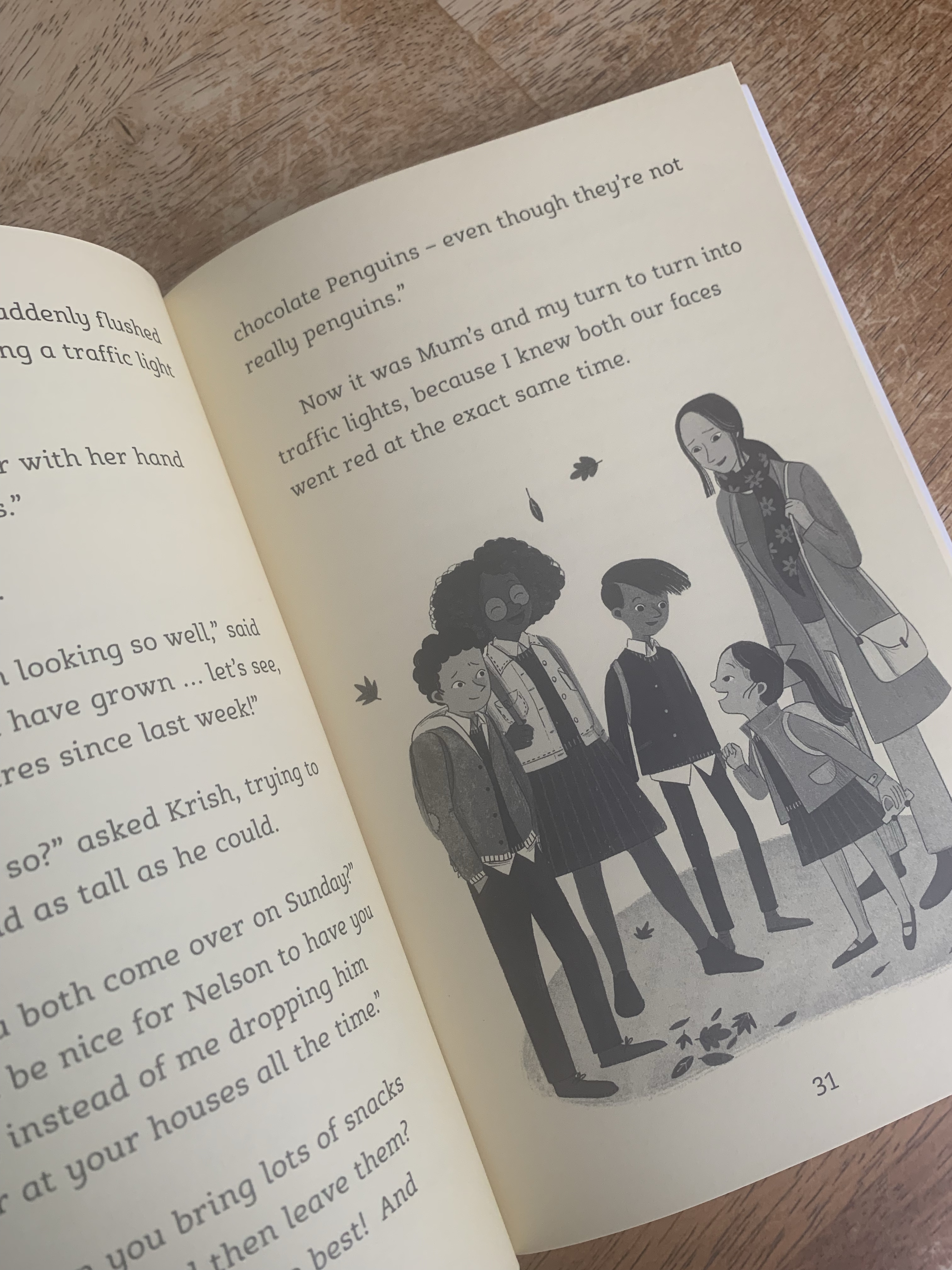
As an adult setting out to read this book, I imagined that the goal of the book was to bring awareness to a specific issue, food insecurity, and to rally support to help others with this basic need.  The beauty of Muslim author and activist Onjali Q. Rauf, however, is that even with such a clear intent, the storytelling, character building, and  enjoyment of the book makes you connect to the plot and issues and feel the message, not just be told it.  For children seven through 12  with no prior expectation of the book, they will be emotionally effected by the reality shown and feel empathy and compassion for characters that will hopefully translate into their real life.  My 10 and 12 year old boys read the book in about an hour, not realizing what the book was going to be about and hounded me to read it with glowing reviews.  This 103 page middle grades book has diverse characters (none are Muslim), and is a great story, a great educational tool, a great empathy check, and a great resource for how to get involved to start helping food banks, and breakfast clubs, all while being funny, relatable, kind, and engaging.

img_3836

SYNOPSIS:

Nelson, his younger sister Ashley, and their Mum work together to make hard “tricky” months manageable.  They are creative with their meals, they go to breakfast club, and they use their vouchers on Thursdays at the food bank.  Some times though, it isn’t enough, Mum has to pawn her jewelry, they go without meals, and generous friends share their snacks.  When the food bank starts running low, Nelson breaks his secrecy about breakfast club and his close friends Krish and Harriet are determined to help figure out why donated food isn’t reaching the bank and what they can do to make sure it does.

img_3837

WHY I LIKE IT:

I love that it shows how the family has food insecurities on a day-to-day basis and how never feeling full affects so much of the characters’ attention.  I also love that it shows their mom works, she is a nurse and works really hard, they don’t steal or load up on food that is donated, they are very grateful for all assistance given and their friends don’t judge them.  It shed light on a different narrative that many children perhaps don’t think about: that people they know and are close with, might be hungry.  I think the maturity of the kids is a lesson to adults reading the book too, that reminds us that kindness and assistance doesn’t need to come with judgement or arrogance.  The characters are all really likeable, they aren’t perfect, but even though the book is short, you feel your heart being affected by them in their handling of the mystery and the larger concept of hunger.

img_3838

FLAGS:

None

TOOLS FOR LEADING THE DISCUSSION:

I would read this book aloud in a classroom (2nd-5th), and if I get a chance to participate in Lunch Bunch (where a book is read to children while they eat their lunch) at our local Islamic School, I will start off with this book.  I think kids have bigger hearts than we often think they do, and while they might not recall the less fortunate when you want them to finish all the food on their plate, they often notice kids without lunches at school and share without prompting.  

Here’s a great clip and reading by the author: https://www.youtube.com/watch?v=NVYBLh0kODc

Happy Reading!


The Sign of the Scorpion by Farah Zaman

Standard
The Sign of the Scorpion by Farah Zaman

scorpion

This is the second book in the Moon of Masarrah series, but can be read as a stand alone book if you are looking for a linear story with fast paced action, intense twists, decently developed characters and quality writing that brings the sleuthing of Muslim characters to life.  At 229 pages including the glossary, the book reads to me as a middle grades book, but the last 50 pages place a lot of emphasis on accusations of a character molesting servants in the castle and another character having an affair, which might be more appropriate for older readers.  Perhaps middle school readers would be a better target audience, but I’m waiting to hear back from the author regarding who she had in mind when she wrote it.  The author said she wrote it for Young Adult, ages 12 and up in mind.

SYNOPSIS:

Brother and sister, Adam and Layla are reunited with their friends, siblings, Zaid and Zahra after last summers intense adventure involving a diamond.  This summer as a result, they are the honored guests of Shaykh Sulaiman at his dessert home, Dukhan Castle. They arrive to find out that the Shaykh is bedridden from a stroke after learning his son has died.  With a house full of relatives with reasons to want their claim to the Shaykh’s fortune, the four teenagers start putting odd occurrences of a ghoul in white, a hooded horseman, a gypsy woman’s tale, and the idea that there has been foul play, together to try and arrive at the truth of what is going on.  As they piece more and more together about the tutor, the cousin, the fiance, the grandson, and a mysterious mole-man following them, they themselves get tangled in the sinister plot of revenge and must keep an eye out to figure out who the scorpion, Al-Aqrab, is before one of them ends up dead.

WHY I LIKE IT:

Set in a fictious land, the detail is the perfect balance between setting a stage and over describing it.  The book did not drag for me at any place, nor did I find myself confused about what was going on and why.  Granted I probably could not tell Adam apart from Zaid and Layla from Zahra, but the book is about their adventure and figuring out whats going on, not about their relationships or back story.  And with the focus on all the possible perpetrators and their motives taking center stage, having four people gathering clues makes the information come easier and smoother.

All the characters are Muslim.  Some of the women cover and some do not, some stop to pray and make regular references to Islamic hadith or Quranic Ayats, and some are suspects.  For example when they are exploring the dungeons beneath the castle, they liken the caves to the Sleepers in the Cave mentioned in Surah Kahf.  The book never gets anywhere near preachy, nor do the few references ever get annoying, they just flesh out that the characters are Muslim, and thus they see the world through that lens.

FLAGS:

The book has murder, lying, deception, all the ingredients for a good who done it.  And while the details are all clean regarding how the four teens interact with the opposite genders, the climax of the book is the coming to light of allegations of molestation and a failed marriage is attributed to a presumed affair.  No definition of the words is given, and I reread many of the passages and I don’t know that there is even enough context clues to decipher what the word molest means in the text.  Most kids however, could easily ask Siri or Hey Google or whatnot and may have more questions about what it means to sexually assault a person, specifically a woman or child, and why someone would do it.  I leave that for parents to decide at what age those in their charge can grasp such a word and concept.

TOOLS FOR LEADING THE DISCUSSION:

I’m torn on teaching the book as the linear telling might not appeal to older kids, but the motive and revenge isn’t appropriate for younger kids.  I think if used to discuss broader issues the book could be really powerful, and not just a fun read.  I could see discussing with 9th graders or so the seriousness of false accusations, drawing on the Me Too movement and how sexual crimes and transgressions should be handled and treated.  I think the book could be a springboard for those discussions and seeing the effects of believing or not believing, and perhaps suspending judgement until research can be done.  In the case of the book, it would not have been difficult to pursue the allegations, while protecting any potential victims.


NOTE:

The first book in the series, The Moon of Masarrah, was originally published under the title, The Treasure at Bayan Bluffs, some changes have been made in the new printing, so while I don’t normally review second books in a series, I felt this book might bring attention to the new title of the first book and drum up interest for the upcoming third book in the series.  No, I don’t benefit in any way and I purchase my copies just like you, the stories are just really well done and I want readers to give them a try.  Happy Reading!