This highly anticipated book came with a lot of expectations and hope for many of us born and raised in America. Alhumdulillah, Hena Khan did a great job and everyone’s favorite monkey learns and enjoys Ramadan and Eid.
The 14 page rhyming board book is festive and inviting as the tabbed ends head different aspects of Ramadan and Eid The first tab is George helping his friend Kareem and his family get ready for Ramadan while explaining to the reader how Kareem is going to try and fast all day. The pictures show Kareem’s mom in hijab and dad helping in the kitchen. A banner they are hanging says Ramadan Mubarak, but there is no mention of religion or Muslims or Islam.
 The next tab has George helping Kareem get up for a predawn meal, keeping his mind off food and keeping him busy. Not the normal mischievous George in this book, but rather a very helpful one.
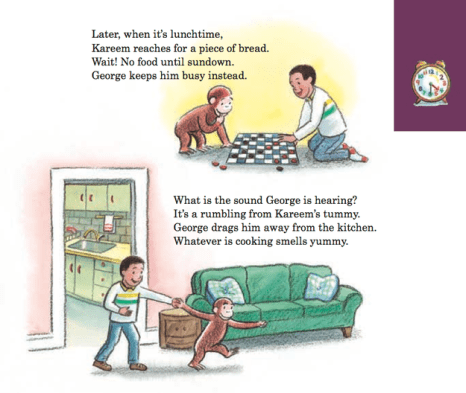
The next tab talks about dates and breaking the fast and the sounds of prayer, but again no specific mention of religion or belief. The pictures show men and women of different skin colors, veiled and un veiled, visiting together. The next tab is all about food, in all of its diverse glory. The next tab has Kareem inviting George to the mosque to make food baskets for those in need. George gets a little silly, and inspires the imam to add a clothing drive next year. The final tabs are spotting the moon and celebrating Eid. Gifts are given to George and the man in the yellow hat. Kareem and George are sad the month is over, but George enjoyed celebrating his first Ramadan with his friend.

Overall the book is great for Muslim kids, non Muslim kids, and also notably for non Muslim kids with Muslim friends. The book does not label and discuss belief or even spirituality, but rather shows how Muslims celebrate Ramadan and Eid in its most basic way, and shows that it is a part of American culture. For as excited as my family (and myself) were to see Curious George enjoying Ramadan and doing things we do, I can see many of my neighbors and kid’s friends also identifying that they know what George is doing too because of their Muslim friends, and getting excited. The book works for all ages, to be read independently or aloud.
MashaAllah, don’t judge it by its size, it accomplishes a lot in just a few pages, a lot like a curious little monkey!





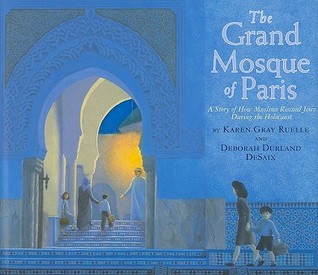 This beautiful, beautiful book tells of a little and sparsely known event in history. During the holocaust The Grand Mosque of Paris served as a place of refuge for many North African Jews. Many who passed through the vast gardens and beautiful Mosque were given fake documents of conversion, tombstones with their family names inscribed, and access to truly underground passageways (subterranean mazes), as the Muslims of Paris offered assistance to keep their Jewish brother’s and sister’s safe from the Nazi regime. Many of the stories were recently uncovered and with the passage of time, so much of the information has been lost. As a result the book is a bit choppy, each page tells what is known about the Muslims’ assistance in some capacity, but does not flow to the next page. So there are generalized recountings of children being hidden with other families, the efforts of the Kabyle Ressistance (Berbers from Algeria) to smuggle Jews to safety, etc.. There are also a few specific examples of Salim Halali, a young Berber Jew from Algeria, two friends one a Muslim the other a Jew seeking shelter, a Tunisian Jew who stayed at the Mosque for over two years,and a few others, but with the exception of the use of the Grand Mosque and a Doctor Ahmed Somia very little flows throughout the book. Thus making it more of a historical account than a story.