Tag Archives: Muslim Characters

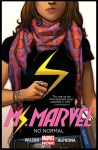
Ms. Marvel No Normal & Generation Why by G. Willow Wilson illustrated byAdrian Alphona & Jacob Wyatt

Standard
Ms. Marvel No Normal & Generation Why by G. Willow Wilson illustrated byAdrian Alphona & Jacob Wyatt

I have to be completely honest these are the first comic books I’ve ever read from cover to cover.  So, while I’m in no position to review the art work, or historical role of the original Ms. Marvel or even have a valid opinion on the superhero story lines, I do want to cover the Islamic elements because even as someone as outside the comic book world as I am, I knew that Marvel’s new Ms. Marvel is a Pakistani-American Muslim girl from Jersey and that’s pretty big.

I was intimidated to read No Normal, I ordered it from Scholastic and have had it on my shelf for a while, I was excited, but nervous. But then I ordered the second one, which is also a collection of 5 comic books, and thought, let’s do this.  Both collections are easy reads, and the text and what to read first in each story frame is clear.  As with comics and graphic novels the pictures convey much of the story so there isn’t a lot of “explanation,” but the story is compelling enough, that even a novice like me didn’t get too hung up on what was going on and how it could be possible.   While it may tempt younger children, I would hold off until the reader is a teen, especially if the reader is Muslim.  There is a bit of drug use and alcohol in No Normal and obviously violence, but at it’s core it is a story of a girl trying to discover who she is and there is some angsty teenage stuff that someone who hasn’t gone through the emotions, might take as attacks on Islam, parents, and culture.

Kamala Khan is a high school student in Jersey City, New Jersey.  She has a Muslim friend, Nakia, who wears hijab, and non Muslim friends of both genders that seem to support her faith and culture, almost more than she does.  The story opens with her sniffing bacon and her friends humoring her oddness.  Having grown up with the same group of friends around her, they understand her quirks and nerdiness and she seems to fit in.  As with most teens though, she feels on the “outside” and Kamala right away tries to seem cool with the more popular crowd.  She  is struggling to find herself within her Pakistani culture, her American life, her Islamic beliefs and teenage friends, information all presented in the first few pages while at the local convenience store hangout.  A lot for Kamala to balance and she hasn’t even discovered her “powers” yet.

Kamala’s parents initially seem more “cultural” than religious as her father chastises Kamala’s brother Aamir for being too religious, yet is constantly on Kamala, presumably because she is a girl.  In a fit of defiance against her parents strict curfew, Kamala sneaks out of the house to attend a party, accidentally drinks alcohol (she spits it out) and gets caught in some “fog” that gives her morphing, stretching, embiggening, and quick healing powers.

As Kamala tests how her powers work, and what they mean, there are a few funny asides that appeal to Muslim readers: she attempts to use her Burkini as a base for her super hero disguise, and her mother threatens to send her to the Sheikh if she gets caught sneaking out again.  Her parents start to grow on you though, the mom is a very stereotypical immigrant mother who cares for her daughter in a worrying nagging way, the dad actually tries to communicate with Kamala and comes across a little more genuine toward the end of the first collection.  Her brother seems to be level headed, but a minor influence.  He sticks up for her and tries to help, but it doesn’t seem like they are that close.   The final scene in No Normal left a little bit of a bitter taste in my mouth and I was glad that I already had Generation Why to dive right into and not let the conclusion of the first one fester in my head.  Kamala shows up to a wedding late, complete in Shalwar Kameez (Pakistani clothing) and gets in an argument with her mom.  Kamala says, “You and Baba want me to be a perfect little Muslim Girl–straight A’s, med school, no boys, no booze, then some hand picked rich husband from Karachi and a billion babies.”  The mom says, “Your father and I want the best for our only daughter our expectations are high so that your successes will be many.”  It goes back and fourth then the mom says she is grounded and the book ends with Kamala retorting, “wanna bet…?”  While I’m sure most every Muslim American teen has felt this way, I don’t think I’d want my 9 year-old-daughter thinking that is how narrow success is defined, or that being the best you can be is a punishment. It’s probably a realistic gripe, but to have it be the last impression, naturally brought out my defensive instincts.

A lot of the awkwardness and stage setting in No Normal is resolved by Generation Why and I found I enjoyed it a lot more than I thought I would.  I might even be anxiously waiting to see what happens next.  Kamala is sent to the Sheikh and while she is intentionally vague about telling him what is going on with her, she does suffice it to say she is trying to help people and he responds by telling her to do it with as much honor and skill as she can. I love that he wasn’t putting her down, but rather trying to mentor her spiritually to find her self and do so honorably.  Really the only other religious/cultural scene is when Lockjaw a giant dog with transporting abilities shows up to help Kamala and her parents say he can stay, but outside because he isn’t clean.  I don’t know if non-Muslims will fully understand why, but it made me chuckle.  It also made me like her family a bit more.  They are strict, but not unreasonable.  They didn’t say, “no” they found a compromise.

Generation Why contains more action than back story.  I’m not entirely sure why Wolverine shows up, I have no idea who the lady in charge of stuff is with Captain America, and I’m not sure why no one finds it odd that the Inventor is a bird man, but hey it is fun.  And it definitely had me cheering on Ms. Marvel as she empowers her generation and learns that being American Muslim might be the easiest of her identity issues when she learns she is inhuman.  It gets a little cheesy, but the foundation of comic books being good against evil, lends itself to that right?

Overall, I think I would recommend both collections are read together, as it gives a better picture of what Ms. Marvel is and can be.  I think thus far the author has done a good job of showing that she is Muslim and that her faith adds depth to the character.  Her tenacity, persistence, determination, compassion for animals, her humor, her nerdiness, all make her very like-able and admirable.  I probably wouldn’t do it as a Book Club selection, because our school only goes to 8th grade and being an Islamic School I don’t know that most of the students feel the identity crisis until possibly much later if at all.  But I think the books would work well for discussion with older kids.  Topics of what youth can do, their role in preserving the planet, discovering your sense of self and purposes are all there in comic book, super hero, action packed form!

Kamala Khan


Sana’s Startling Sneeze by Sumaiya Noori illustrated by Ridwaan Naik

Standard

Sana's Startling Sneeze

I got this book at the same time as Sajaad is Sick, and thought they would go together nicely.  They did, Alhumdulillah, but I was honestly a little underwhelmed by this book.

For the most part. the pictures are detailed and fun, but they have the appearance of being done with either crayon or colored pencils and don’t pop off the page and grab the reader’s attention.  If they were a little brighter and bolder, it would definitely help the overall story, especially since the illustrator is clearly talented.

The story itself is clever and funny, but kind of unresolved at the end.  Once the Pre-k 3 through KG students were done laughing, they wanted to know why her sneeze was tiny.  Was it because she put both hands over her mouth or because it was just a little sneeze? They got a little annoyed that I didn’t know the answer and that there was no moral, or lesson, or conclusion.  I think after so many sneezes and so much repetition they were a bit unsettled that she would again resume her out of control startling sneezes, with no more hope of containing them.

Something else that struck me as being odd about the book is that the main character and her family are visibly Muslim in a diverse environment, yet Sana never says “Alhumdulillah” and her family never says “yarhamukum Allah” following her sneezes.  I added it in when I read it aloud, since that is basic Islamic etiquette, but a few of the Kindergartner’s in the first row caught on that it was missing and wanted to know why.  Again I had no answer.

A layout criticism I have of the book is the inside margin. It is too small and when reading aloud to a group, I could not see the last word of the line without moving my head or the book, and thus blocking the students from seeing the illustrations.  The font and text and overall book size is adequate, but the first few readings, until I practically memorized the book, were a little cumbersome.


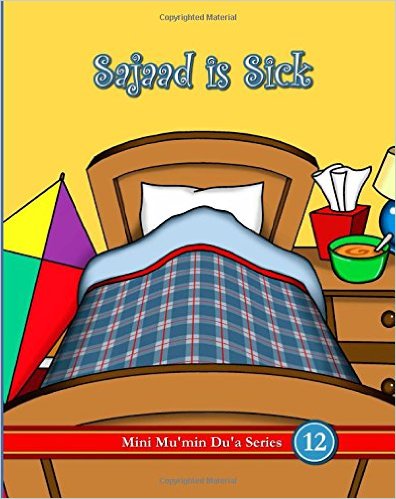
Sajaad is Sick by Mini Mu’min Du’a Series

Standard

sajaad is sick

I picked this book up on a whim to go with my “being healthy” or “community helpers” story time themes.  I had never heard about it and the pictures, while colorful, aren’t very detailed or engaging.  I was hoping the rhyming couplets and familiar concept of going to the doctor would at least review some key concepts in an Islamic manner.  Alhumdulillah, the book not only met my expectations, but exceeded them.

The first fabulous surprise is that the Doctor is female, not that it should be an issue, but it is nice to find books that definitely don’t assume a familiar stereotype.  The second surprise is that at 28 pages, the rhymes never seem forced or awkward, it flows very nicely, mashaAllah. I read the book to 3,4, and 5 year old students and it managed to keep everyone’s attention.  The students got concerned when Sajaad worried if he would have a shot, they tried to remember the name for “stethoscope,” they enjoyed learning the dua for being sick and the dua to make for those that are sick, and they even liked that they often also get lollipops when they leave the doctor’s office.

Overall the book was a good review of what happens at the doctors office in an Islamic tone.  It would work well to reassure children that might be nervous about what they might experience.  It was interesting to watch the kids “read” the book after story time to each other imitating a teacher.  For most students it is a topic that they feel mastery over and you could see their confidence when they retold the story.

I’ll be keeping my eye out for other books in the Mini Mu’min Du’a Series to see if they are of similar quality and can serve in a similar capacity in the library.


Yasmine’s Belly Button by Asmaa Hussein illustrated by Charity Russell

Standard

Yasmine's Belly Button

This book is fun, fun, fun.  The mere mention of the word belly button to little kids gets them giggling, and the words and pictures in the book kept them engaged and happy through out.

The story is a simple dialogue between 4 year-old Yasmine and her mother about belly buttons as she heads off for her first day of school full of butterflies.  We learn that everyone has a belly button, even cats! And the students have a fun time following along with Yasmine’s confusion of why it is called a button, to her understanding that it allowed her to receive food while in her mother’s tummy.  yasmine2The illustrations are bright and colorful and have a lot going on.  The expressions on the character’s faces compliment and complete the text seamlessly to tell a well thought out story.  They keep the audience’s attention even after the text is read, with the kids telling me to “wait” so that they could soak it all in before I turned each page.  The mom and teacher’s expressions on the last page amused the daycare through Kindergarten students and made them feel like they were in on the silliness.

A lot is conveyed even with just a few words on its 28 pages.  The reader sees what she thinks, they see the mom without hijab at home and with hijab when she goes out, they see a diverse classroom, a patient mom, and a way to deal with being nervous in a new situation.

I read this book to many students at school and to my own children at home, and can tell it will be an often requested book in both settings, mashaAllah, I highly recommend it.


Bismillah Soup by Asmaa Hussein illustrated by Amina Khan

Standard
Bismillah Soup by Asmaa Hussein illustrated by Amina Khan

Bismillah Soup

It is always a cause of giddiness to find a good book, but to have one recommended by a mutual friend of the author, makes it all the better. Bismillah Soup is a spin-off of the Stone Soup folktale, but without the “trickery” of the classic.  Hasan, wants to surprise his mom with a feast, but money is tight and when Hasan is sent to ask the local Imam for some rice, a plan: Bismillah Soup, forms that brings the entire community together.  The story takes place in Somalia and the cultural words that are peppered in to the story add detail and talking points to have with the kids.  As each community member shares something small, the enormous feast that is created is a wonderful example of what can be achieved when we each give our best to help others.  The book is 40 pages with a glossary at the back and is definitely one that can be read over and over to kids of all ages.  Even the littlest ones are able to grasp the beauty of coming together through the colorful and playful pictures.

soup-gallery-img1 (1)The real treat of the book however, is how it all comes together: the words, pictures, sentence structure, font, size, and diction all compliment each other on the same level.  I read a lot of books aloud as a children’s librarian, and while the rhyming ones are great for the littlest listeners, there is often a void of read-out-loud stories for the kindergarten and first grade levels.  And I am talking about all books, not just Islamic ones.  Most picture books in my experience are written on a third grade level, with longer blocks of texts, smaller fonts, a wider range of vocabulary and longer sentences.  These books are often beautiful and very tempting, however when I read them during story time I end up “summarizing” them, and telling the story rather than reading it.  Similarly, early readers often find them frustrating and too difficult to read independently. Bismillah Soup strikes a wonderful balance, mashaAllah.
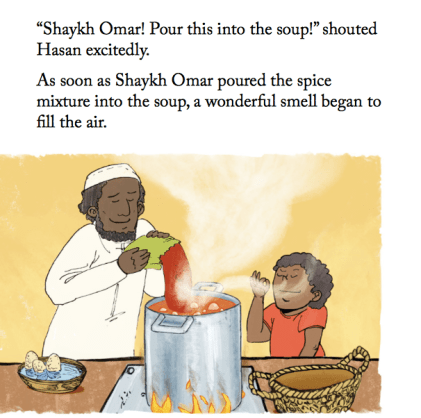
I read the story to my own children who enjoyed it and have found my first grader reading it independently twice this week.  Each time beaming with excitement to tell me something new he has gained from the book.  When I read it aloud to them, my kids marveled at how having a good intention and being so generous could benefit everyone. The first time my son read it independently he was in deep thought about how grateful Hasan was even though they didn’t have much food and how he was a determined problem solver.  The second time I found him reading it, he was so very impressed at the kindness of Shaykh Omar.  He really started to understand the subtle beauty of the character not just in helping Hasan’s family with food, but also supporting and working with the young boy to make the feast happen, alhumdulillah.  Screen-Shot-2015-08-29-at-12.06.00-AM

I highly recommend the book and I can’t wait to read it to my students at school next week, inshaAllah.  For more about the book, the author, and her other work you can go to the author’s website  http://www.ruqayasbookshelf.com

Invincible Abdullah: The Car Theft Kidnapping by Haji Uthman Hutchinson

Standard

invincible

 I don’t usually post a review of the second book in a series so close to the original, but I wanted to read this one and see if it would be a better fit for Book Club being it takes place in England.  Nothing against  Invincible Abdullah and the Deadly Mountain Revenge, but we’ve done a lot of books for Book Club set in Pakistan and Afghanistan, and I want to make sure that the students see Muslims in a variety of settings. This book has the same main character, but is not dependent on the first book for understanding in any way.  Writing style is about a fourth grade level and it is just 152 pages, with sporadic pictures and a glossary of terms at the back.

SUMMARY:

Abdullah and his Malaysian friend Zaki are karate buddies that train and worship together while attending college.  The book opens with the two sparring and Abdullah going home to a letter from an old karate friend, John, who got mixed up with drugs and stealing cars and is now in prison.  John asks Abdullah to come visit him to answer some questions he has about Islam.  After a few visits John takes shahada and changes his name to Abd ur-Rahman. When Abd ur-Rahman gets out Abdullah and his family support him and the sensei even lets him back in to the dojo.  However, things don’t stay calm for long and when Zaki’s car gets stolen, and Abdullah is kidnapped, the boys friendship, loyalty and faith is tested.

WHY I LIKE IT:

The story is face paced and action filled, it also never waivers from being a strong Islamically based book.  The characters balance religion, and day-to-day living in a realistic and inspiring way that engages the reader and makes the character’s morality seamless and believable.  I love that the characters forgive a convict in words and actions and that the friends are from a variety of ethnicities that again, seem realistic and not preachy and forced.  The twists and turns in the story keep the reader’s interest and although you know things will end up alright, the author does keep you curious.

FLAGS:

Obviously there is an element of criminals and drugs that while presented in a negative light is central to the story.  There are not a lot of details about the drug use, but there is some violence that the characters go through, and mention of guns.   There is also brief mention of a bar in the book that is visited to make a few phone calls from.  The only concern that I have, was that it could be perceived that John had to change his name when he takes shahada and I don’t know if I agree that, that is mandatory.  In the book it weaves a little bit of a side story and is presented very positively, but it is something to be aware of none-the-less.

TOOLS FOR LEADING THE DISCUSSION:

I will probably use this book for the 3rd to 5th grade Book Club selection later this school year, because I think there is a lot to talk about. Topics of rehabilitation, taking shahada, and being a good friend are prevalent through out and something I think kids can wrap their heads around and have opinions about.  There doesn’t seem to be a lot of information about the book online and I’ve heard from one distributor that the book is out of print, but on some sites there are still copies available and there is also a workbook.

The Visitors by Linda Delgado (Book #1 of Islamic Rose Books)

Standard

Islamic Rose Books The Visitors

I first read this book in 2004 and it was pretty much my first introduction to what elementary aged/young adult Islamic fiction could and should be.  It set the standard and I think subconsciously I’ve held every other Islamic fiction book up to this series as a comparison.  I’ve taught it to 4th graders and 5th graders, I’ve purchased the series and left it for the students at every school I’ve ever been a part of, I’ve even exchanged emails with the author with students’ questions and been impressed by her responses.  So, after reading so many other books in putting this blog together, I thought it is finally time to revisit a book and series that is dear to my heart, and see if my memories are accurate.

Alhumdulillah, they are.

The book is a bit bumpy at first with the chattiness of the main character Rose, but either like real children, you grow accustomed to her and find her endearing, or the author pulls back as the story progresses and the book finds a more readable and engaging rhythm.  Either way, I still felt a pull to keep reading the book, and feel confident that those that read it, and the entire series (I haven’t read the latest book, “Reunion”) are better for it, alhumdulillah.

SUMMARY:

Nine-year-old Rose is excited that her grandparents, who live next door, are going to be hosting two Saudi Arabian Police Officers who are coming to America to learn English and train with the Arizona Police Department.  In anticipation of their arrival Rose and Grandma do what they can to learn about the food, culture and religion.  Rose’s dad however, is not comfortable with Abdul and Fahd being so close to his family, and for Rose to be so curious about Islam.  Rose works on PLAN after PLAN to try and help her dad and the officers connect, but will it be enough?

WHY I LIKE IT:

The book actually addresses some harsh realities of how Muslims are perceived, yet does so in a tender way.  When Rose wants to go to the Islamic Center and her father objects, or she talks about Muslims at school and her teachers get mad, it opens the discussion for why people may have negative views of Muslims, how to deal with such negativity and how to move past stereotypes.  The book also does a really good job of introducing Islam and Saudi culture to its readers in a fairly non preachy manner.  The inner workings of Rose’s family are also surprising raw and relatable.  Her Mom is not in the picture and Rose must deal with the stresses of a single parent home, luckily her grandparents are next door, but even then, there are stresses and issues that arise.  Rose also deals with a friend moving away, teasing at school, and disappointment.

FLAGS:

None, just some of the stereotypes from Rose’s Dad that may introduce some negative views non Muslims have of Muslims, such as: Muslims as terrorists, Muslim’s being abusive and controlling to women, etc.

TOOLS FOR LEADING THE DISCUSSION:

There are a few different versions of the book, mainly just cover changes depending on the publisher, but this version:

The Visitorshas appendixes in the back that include a glossary and recipes and facts about Islam as well as Arizona.  The newer version (as pictured at the top of the post) doesn’t include everything and refers those looking for more to see a website.  That website however and all other links to online study guides and reader guides are no longer available or now have different owners.  I’m not sure what happened to Linda Delgado, and if anyone knows how to contact her, I’m hoping you will let me know.

So as of now there are no links to suggest for teaching the book unfortunately.

Time to Pray by Maha Addasi, Arabic translation by Nuha Albitar, illustrated by Ned Gannon

Standard

Time to Pray by Maha Addasi

On the surface this book presents itself to be fabulous: the large size, the dual language, the length (32 pages), and concept.  But alas, sadly, I was a little let down with the story, the characters, even the pictures.  The details about the characters are vague, the reader doesn’t know where the story takes place, where the girls parents or the rest of her family are (until the end), why she doesn’t know how to pray, and the climax isn’t really much of a surprise.  After reading this post from the author I appreciate that she left the location vague, to as not be burdened by one specific country, and I can see the origins of why the call to prayer from her own childhood is what the story focuses on.  I can also imagine the wealth of information and details that she had to sort through to decide what is needed to carry the story and what would ultimately repel a young reader.  All that in to consideration however, still didn’t connect me to the story of young Yasmin and her Grandma. Not to mention I didn’t have all the author’s justifications or rationale before reading it.

 IMG_3163

The pages have both English and Arabic text and is written for older children. Despite the initial appearance of being a children’s picture book, it has an AR level of 4.2 and has some Arabic words in the text, an Author’s Note in the back and detail of Prayer Times in the back, as well.

IMG_3164

The pictures I want to say are beautiful, but for some reason I didn’t love them.  I am no art critic and they are detailed and large and I should probably ask a child, but here is one for you to decide your thoughts about them on your own.

IMG_3162

Additionally I’m not sure if she is washing her foot her, as part of Wudu, the obligatory cleansing before prayer, which in this case, would be portrayed erroneously, or if she is drying her foot, either way Grandma looks sad to me and not content or excited to prostrate to her creator.

All is not lost though in this book about a girl learning about prayer with her grandma and being surprised by a prayer outfit. prayer rug, and Athan clock when she gets home and finds while unpacking.  But some of the best parts are subtle and might not be gleamed by unassisted readers.  For example how Grandma dresses at home versus when she is out, that because Yasmin is young she is not reprimanded for not praying, or how patient and loving the Grandma is in a slower paced environment.  Overall, the book is unique in that it gives an introduction to Muslim’s prayers to both Muslim and non Muslim readers alike, but for such potential I felt it fell short of being fabulous.

Burning Boats by Zaynab Dawood

Standard
Burning Boats by Zaynab Dawood

burning boats

This book came highly recommended from a friend that read it aloud to her Kindergartener and I ordered a class set based on her raving review.  After trying to get into the book on three separate occasions I concluded that yet again I should have waited and read the book myself before ordering it.  So I handed it over to my avid reading eight-year-old who read it in a day and said it was pretty good, asked a few questions, and continued on her way confused as to why I couldn’t finish it.  So, I started it again determined to get through it and with Ramadan quickly approaching I thought I could motivate myself to do so.  However, I could not, and it sat on the shelf for the entire month with a book mark only a few chapters in.  At the prodding of my guilty conscious to return the book to my friend, I continued reading from where I left off, rather than starting over, again, and found that by dismissing completely who any of the characters are and how they are related, the story does get off the ground and I was able to finish it.  That being said, I think the story might have appeal if read aloud one chapter at a time. To read it in one setting did not help the story that can’t seem to decide it if wants to be character driven or action driven.  The sheer number of characters is completely over the top, there are at least 20 characters mentioned by name and the book is only 137 pages.  And honestly I never bonded with any of them.  There is action in the book, but the details seem misplaced.  The author details characters all saying salam and walaikumasalam to one another and giving moral reproaches based on Quran and Sunah, but I never felt I understood why the main characters were leaving, why the villain was so bad, or how (spoiler alert) a pivotal character in the book died. I guess by never connecting to the characters or feeling an emotional tie, positive or reproachful, the book didn’t live up to it’s potential.  The book is recommended for ages 12 and up, but I think younger children could read it and even younger could listen to it being read to them without any major concerns.  With guidance the book is by no means a waste of time, but if you recommend it to a child and they struggle to get into it, you might just have to let them find something else to read.

SUMMARY:

A small fishing village is being harassed by a corrupt businessman’s attempts to take over the entire industry in Tobay.  The principal of the school and a few close friends are trying to stop him, but have decide they cannot and thus are planning to move elsewhere.  The children are forbidden to go to the harbor as boats are being burned and crimes committed to persuade the local fisherman to abandon their solo endeavors.  With few places to play, the loss of the harbor affects the children greatly as well.  A tropical storm complicates matters as it tears through the village destroying the poor inhabitants meager dwellings as well as the damaging the school and the mosque.  With friends taking in homeless neighbors and the main family planning to leave the children plan one last game that turns dangerous when all the boats in the harbor are set a blaze.

WHY I LIKE IT:

There are some definite good qualities in the book, despite the holes.  It opened up a good discussion between my daughter and I about preparing a body for ghusl and Janaza.  It does show that people can change and that when people are sincerely apologetic and are striving to correct their behaviors, those around them should offer forgiveness in not just their words, but in their actions as well.  It also shows that good kids can make bad choices, and that the consequences can also be very real.  Similarly it shows that adults also don’t always know what to do, and that they can be forced to reconsider as well.

FLAGS:

There is violence in the book and death.  Nothing too graphic, but one might have to explain to younger, more sheltered reader,  that just because someone has a Muslim name doesn’t mean they are practicing Islam and are good people.

TOOLS FOR LEADING THE DISCUSSION:

There aren’t any online tools, but I would suggest having the readers keep a character journal.  Every time a new name appears, write down who they are, (and who they are related to), so later they can look back on it if they become confused.

Because of the “holes” in the story I would probably ask the students to give their thoughts as to what happened or why the characters decided to do what they did and then turn it back on them and ask them what they would do.

Why was Ibrahim leaving? Would you have left? What made Nasser change? Would you have forgiven him? How do you think Ayesha died? Etc.

Jameela’s Great Idea by Surriah Igram

Standard

jameela's great idea

Jameela’s Great Idea by Surriah Igram is a good read-a-loud story for small groups.   A simple story of a girl seeing her father give sadaqa, charity, on a nightly trip to the masjid, wants to also give charity.  But, to do so, she must first find a way to acquire some money.  Her ideas are lavish, over the top and  silly, but her ever patient mom let’s her pick one idea to bring to fruition, which luckily, alhumdulillah, is the only reasonable one presented.  I feel like discussion is needed with this story to provide commentary on why the ideas are not practical even though her intention is so noble.  The story is very simple, linear, and age appropriate.  It works well for preschool and kindergarten age groups with big colorful pictures, large font, and its oversized presentation.  The message is beautiful as are the pictures.  Little Jameela has a supportive involved family, they enjoy going to the mosque, they behave in the mosque, yet have fun outside in the yard, and images of covered and uncovered characters are present.  Arabic and English signage decorate the landscape and the book isn’t too long at 30 pages.  After reading it, I think children will enjoy going back to look at the pictures, however, I don’t see it being a high demand repeat read request.  Once through is pretty sufficient in getting the message, chuckling, having a little talk about it, and then moving on.  The book is a great introduction to the importance of charity in Islam, but would need to be supplemented to fully convey to even the little ones, the value of giving to others.