Tag Archives: Muslim Author

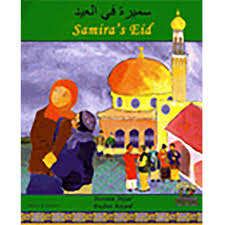
Samira’s Eid By Nasreen Aktar Illustrated By Enebor Attard

Standard

samiras eid

Samira’s Eid is a dual language story (my copy is English and Arabic, other languages are prevalent online as well) about Samira and Hassan, siblings enjoying Ramadan.  It is Hassan’s first time fasting and he is afraid fasting may hurt,  Samira and their mom explain that it won’t and continue to walk him through each step of a Ramadan day as he experiences them.  This point of view allows the reader to see what  Ramadan is like, how it feels, and what it means. The story carries on through Eid and explains as well as shows how Eid ul-Fitr is celebrated by Samira and her family.   The story concludes with a lovely surprise ending involving an Eid Card and Samira’s Nani (grandma), that adds to the book’s appeal at bedtime or story time.

The story is sweet, and level appropriate, it doesn’t get preachy and the dialogue doesn’t seem forced.  It is story driven and would be engaging to both Muslim and non- Muslim children with a little discussion.  The pictures are mediocre. They are colorful and for the most part a good accessory to the story. There are a few pictures however, where the faces are a bit “droopy” and jarring.  Particularly the one of Samira’s teacher, Mrs. Qadir.

It is unclear where the story takes place exactly, presumably the Asian subcontinent as Samira receives a shalwar-kameez to wear for Eid and the use of the term Nani. The author makes a point of following  the moon sighting for Saudi Arabia that may need to be discussed based on personal and community views and practices.

Overall a good story and at 22 pages a nice read-out-loud selection.


The Three Muslim Festivals By Aminah Ibrahim Ali Illustrated By Aldin Hadzic

Standard

Image

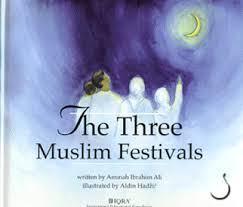
The Three Muslim Festivals is a very informative book about Ramadan, Id al-Fitr, and Id al-Adha, at over 60 pages however, it is a bit long for story time or smaller children.  Broken up into three parts, each told from a different character, the book would work well for second through fourth grade students.  It reads like a very basic chapter book, with information mixed in with a simple story.  The morals are clear, hadith, ayats and dua’as are shared and the illustrations help support the fictionalized portions.  The pictures aren’t engaging, but they do show a variety of ethnic groups and happy families.  The book is content, not character driven, but the families are supportive of the children, there are actively involved moms and dads, grandparents, and siblings.  The mom in one story is a physician and the dads help in the kitchen and around the house, showing some diversity. I like how it serves as both a review of basic Islamic principals while reinforcing elements that a child may not know or may have forgotten in a non condescending manner.  I would imagine the average seven year old could read it independently and comprehend it without being bored.  It isn’t the best written story out there, but it should be engaging enough to convey a lot of good information to an elementary aged reader.  Based on the style it is probably more intended for Muslim readers, but there is a three page glossary of terms in the back.

Eid Kareem Ameer Saab By Fawzia Gilani-Williams

Standard

This book made me laugh. It is essentially the story of Scrooge in the Christmas Carol simplified for a younger audience and switched to an Islamic perspective.  Don’t get me wrong, despite its unoriginal foundation, it is a good story.

The main character is grouchy, wealthy Ameer Saab who we see in a typical day berating his servant Raheem, refusing to help a woman and her young baby, refusing to help the poor, and neglecting his Salah.  Meanwhile Raheem is scrounging up his money with his wife to provide food, while still managing to help a widow, and others.  That night Ameer Saab has three dreams, in the first he is reprimanded by his father, the second by his mother, and in the third his money and jewels strangle him.  He wakes up a changed man on Eid morning.

This book is great for 2nd through 4th graders, with colorful pictures and well spaced text, it invites rather than intimidates this age group.  The morals are also clear and influential as the reader can see clearly which side is more desirable to Allah swt.

There is a verse from the Quran explained, and there are a few Arabic words, nothing off-putting for a newly independent reader and at just 24 pages, I think most elementary age students will enjoy and benefit from the story.

Ramadan By Suhaib Hamid Ghazi Illustrated by Omar Rayyan

Standard

ramadan

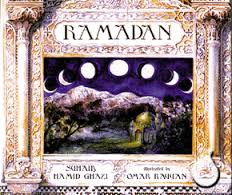
I remember when my parents first acquired this book (maybe they ordered it or it was a gift, I’m not sure), in 1996 there weren’t a lot of Islamic picture books to choose from and I took it to Sunday school to share with my students.  My preschool class loved the pictures, but the text was way over their heads and I had to summarize it to keep their focus.  Nearly twenty years later, there are a lot more options, yet the illustrations of this beautiful book are still mesmerizing to children, and the text is still too lengthy, factual, and complex to engage most children under 10 years old.

Hakeem, the main character in the book, explains not only Ramadan and fasting in detail, but also the basic tenets of Islam, words in Arabic with English descriptions, and makes numerous comparisons to other religions.  Everything is tastefully done, and probably was written to appeal to both Muslim and non Muslim children, allowing the reader to identify with Islam through whatever background they come from.  The result, unfortunately, results in a book with very little “story” and a whole lot of information.  It reads like a research paper on Islam, with a fictional boy thrown in to tell it in a simple way.  However, it isn’t a child’s voice speaking, and if the pictures weren’t so wonderfully done, no child would be at all tempted by the book.

That being said, if you have multiple aged children in your family, it works well to let the little ones look at the pictures while you “tell” them about Ramadan, and later letting the older ones build on their knowledge of Islam and Ramadan.  It doesn’t lend well to story time or larger groups in my experience, but could be a way to share information on Islam to curious adults, new converts, or young adults looking for the basics without being consumed by a text book.

Zaki’s Ramadhan Fast By Ann P. El-Moslimany Illustrated By Erica L. Butler

Standard

zaki


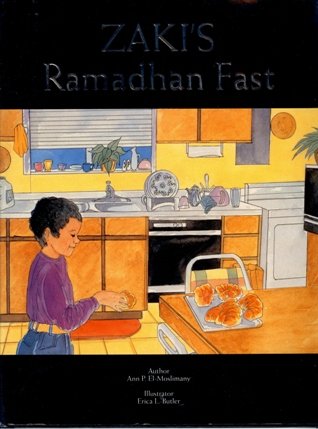
Zaki’s Ramadhan Fast is an age appropriate picture book for kids trying to fast for the first time (Little ones to 8 or 9 years old).  The illustrations drive the story and the short paragraphs explain the excitement and difficulties Zaki experiences on his “first real fast.”  The book talks about the rituals of waking up early, the importance of not fighting and getting angry, and the mercy of Allah.  Zaki makes his way through the day with the help of his supportive family and climaxes with Zaki forgetting he is fasting and eating a muffin.  The book is a great introduction to Islam and Ramadan to children of all backgrounds, but is definitely more applicable to young Muslims trying to fast, especially during these long hot summer days.

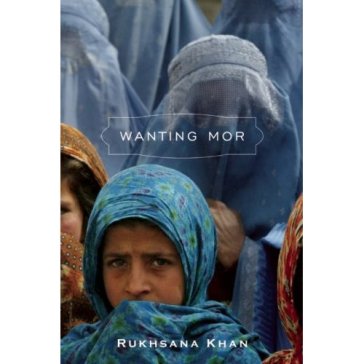
Wanting Mor By Rukhsana Khan

Standard

Image

SYNOPSIS:

Jameela has a lot of obstacles as the book opens: poverty, her mother, Mor, has just died, a cleft lip, and an angry  father that returns to drugs and alcohol.  As the book progresses however, things don’t get better in fact they get worse.  In war-torn Afghanistan Jameela and her father move from their small village to the bustling city of Kabul, recently freed from Taliban control. With only her faith in Allah and her memory of Mor, Jameela endures being a virtual slave in one home, before being whisked away for her father’s inappropriate actions with the lady of the house.  Desperate for a place to live, Jameela’s father marries a widow for her money and Jameela becomes a slave to her new stepmother.  When her stepbrother Masood, tries to teach her how to read and write her name, her stepmother convinces Jameela’s father to take her to the busy market place and leave her.  Alone, lost, and with no where to go a kind butcher tries to help her, but ultimately she ends up in an orphanage.  Prospects look up for Jameela as she finally is allowed an education, friends, and security, however, issues with her father and stepmother must be resolved and ultimately this serves to be the biggest test for Jameela.

WHY I LIKE IT:

The story in a nutshell, is heartbreaking, yet Khan never seems to diminish the hope felt for Jameela and the belief that she will find a way to have a full life.  Based on a true story, it is hard to put the book down and the 183 pages fly by quickly.  Jameela is very devout in her prayers, her modesty and her imaan, illuminating  a story where so much sadness prevails. Her faith in Allah swt brings her peace and strength and Khan successfully passes that message on to the reader.  Jameela not only has to navigate her family issues, but also the challenge of making friends, dealing with her appearance, taking control of matters regarding her education, and so much more than most student’s coming of age have to endure.  I think Jameela’s strengths and faults will inspire and serve as lessons to the readers, most likely girls who have it much, much easier.  And who after reading the book, inshaAllah, will appreciate how much harder their lives could be.  

This is the second book I’ve read and blogged about by Rukhsana Khan, the first was a children’s fiction book My Big Red Lollipop.  The two books are both well written and I enjoy her voice as an author, this book however, Wanting Mor, while only an AR Level 3.7, I would reserve for a more mature audience.  The reading is easy and fluid, the story is powerful and well told and I think would be fine in a 7th or 8th grade and up environment.  I would be nervous to recommend this book blindly to a young adult reader without context, direction, and some background.  The incident after a party, with alcohol, where Jameela’s father enters a married woman’s room, implies more than I would want a 3rd or 4th grader inquiring about.  Details aren’t given, but it causes a huge turning point in the story and is thus critical.  At one point a character is groped in the street and Jameela laughs, highly inappropriate that it happens and equally inappropriate that Jameela laughs at her friend.

Another point I would want to discuss with anyone reading the book before hand is the concept that, If you can’t be beautiful, you should at least be good.”  Mor tells it to Jameela, presumably because of her birth defect, but I think that a young girl reading the book shouldn’t take it at face value, I would want to explain the culture, the environment, and talk about such a statement on many levels.

FLAGS:

 Implied sexual violence, drug and alcohol use

TOOLS FOR LEADING THE DISCUSSION:

Given the right group of older students, this book would make a decent book club selections with plenty to discuss and plenty of emotion.

The author’s website page:  http://www.rukhsanakhan.com/books/wantingmor.html

Teacher’s guide:  http://www.rukhsanakhan.com/teacherguides/Wanting%20Mor%20Teacher’s%20Guide.PDF

Wanting Mor Presentation:  http://www.rukhsanakhan.com/teacherguides/Wanting%20Mor%20Presentation%20Guide.PDF


Beneath My Mother’s Feet By Amjed Qamar

Standard

Image


I was so surprised by this book, subhanAllah.  I picked it up at a used bookstore and didn’t think much of it, tossed it in my bag one day as I headed out with my children’s class on a field trip and seriously didn’t want the bus ride to end I was so caught up in the book.  An easy 200 page read if you are familiar with Pakistani culture, even more so if you have ties to Karachi (specifically Defense), the detail takes you to the streets and gullies you know and you want to stay and look around.  If you don’t have these reference points, the book might be a bit hard to connect with, but I think the Author still gets her story across if you are willing to try (there is a glossory in the back).  Beneath My Mother’s Feet is a 4.9 reading level, and because of the heavy cultural references I don’t think I would do it as a book club book, but I have already suggested it to certain students that I know will find a connection and appreciate their mothers and their opportunities in America all the more.

SYNOPSIS:

Nazia is a typical fourteen-year-old Pakistani girl in the large and bustling city of Karachi, Her working class family suddenly is thrown into chaos when her father gets injured at his construction job.  As we learn more about her father, Nazia and the reader discover how lazy, selfish, and dishonest he is, despite Nazia’s determination to see the best in him.  While the family has had hard times before, this time something more than Nazia’s mom scraping and sewing to get by is needed.  As a result Nazia is pulled out of school to help her mom be a maid, masi, in wealthy families’ homes.  The family eventually loses their home, and Nazia’s older brother steals all the jewelry and clothing intended for Nazia on her wedding.  Her father disappears and the women of the family are left to find the strength and resources to carry on.  While the cover teases the idea that Nazia is a “perfect daughter” and that she is such a “good girl” I found these to be incredibly misleading statements and pulled quotes.  I think the story, shows how determined Nazia is, but not at a rebellious level, more as a girl finding her self and willing to risk it all for what she believes, a trait very much in line with her mother’s example.  

WHY I LIKE IT:

I like that it shows self resilience and self reliance both from Nazia and her mom, Naseem.  Nazia holds on to her friendships, her dreams, and isn’t afraid of hard work.  She explores what it means to be a good daughter, good sister, good friend, and good worker. She also is emotionally sympathetic and generous to a small servant boy, all wonderful concepts to present to a 4th through 6th grade audience.  I like that although Nazia isn’t terribly religious she does rely on Allah (swt) and her faith to help her endure the various hardships she encounters.  Islam isn’t at the forefront, but clearly she Muslim.  The book is heavily steeped in culture, the concept of a dowry, how masi’s are treated are not Islamic in the least, and unfortunately the author doesn’t articulate that it is only a cultural norm.  While the women tend to be highlighted in different colors throughout the book, the men seem to be brushed over in a very negative light.  On the surface it is nice to see strong women of various socio/economic spheres coming together and making decisions, but to push all the men aside as being worthless, isn’t realistic or fair.  I liked the uncertainty at the end, usually I prefer books that wrap up all loose ends, but here i think it opens the door to imagine what would have happened and discuss it.  

FLAGS:

The book is remarkably clean, There is lying, but consequences are clear.  There is some violence in the mistreatment of the masis, but the author shows Nazia bothered by it and it is discussed.  Nazia and her friends remark at some of the cute cricket players, but nothing is done about it and it seems innocent enough.


TOOLS FOR LEADING THE DISCUSSION:

A reading guide by the publisher:  http://www.amjedqamar.com/Reviews.html

A bit about the author and where the story idea came from:     https://www.webjunction.org/content/dam/WebJunction/Documents/ohio/Beneath_My_Mothers_Feet_toolkit.pdf

Amjed Qamar’s official website:  http://www.amjedqamar.com/

Interview with Amjed Qamar from A Year of Reading:  

    http://readingyear.blogspot.com/2008/05/sneak-peek-keep-your-eye-on-this-new.html


Jennah’s New Friends By: Suzy Ismail

Standard

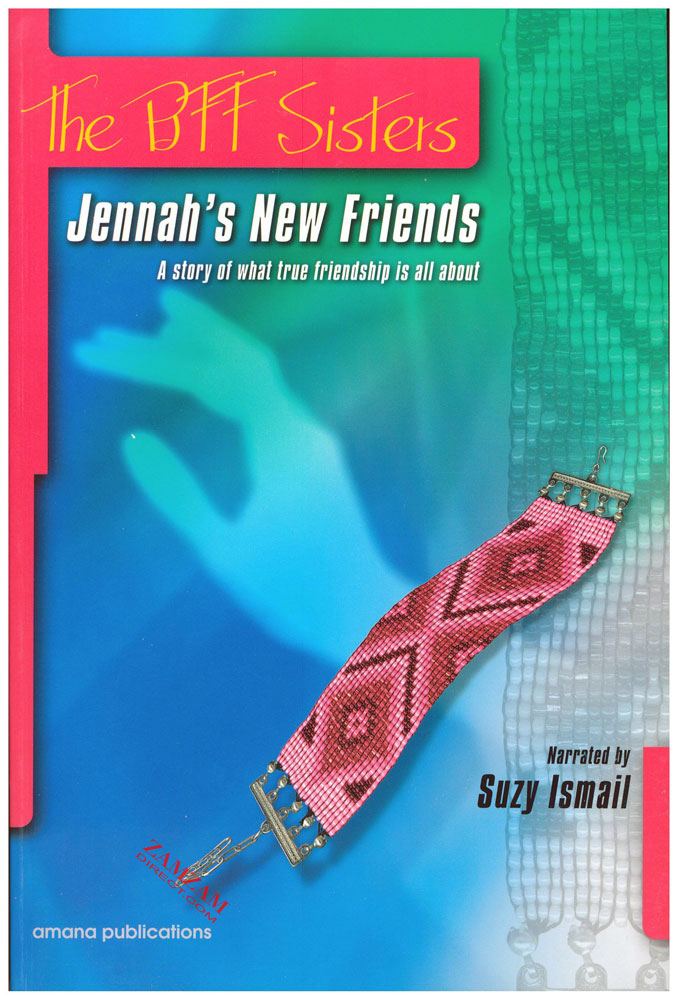
ImageThis book is presumably book one of the BFF SISTERS series, however, the author’s website doesn’t list any other books in the series and it was published in 2001, so it is unknown if more books are in the works.  At 64 pages, the intended audience is girls between ages 7 and 12, but I would note that there are no illustrations and while it is broken into chapters (on average about 10 pages long) the text and layout would be daunting to the average 2nd and possibly 3rd grade student. 

SYNOPSIS: 

Jennah lives in a neighborhood with lots of Muslims and lots of friends, but when a new girl moves in, Jennah is afraid that her best friend Yasmeen would rather be best friends with the new girl, Mariam.  Jennah not only is afraid of losing her friend, but there is a lot going on at home too, her mom is about to have a baby, her younger sister is always bothering her, and her dad is constantly away on business.  Alhumdulilah, Jennah is surrounded by supportive adults, forgiving and generous friends, and an Islamic foundation that allows her to sort out her feelings and create a Hadeeth club with All her new friends.

WHY I LIKE IT:

I love that it is a clean book for the elementary age group, the girls do not have boyfriends and while hijab is mentioned in passing, the girls are a group of kids that are dealing with the constant struggle of all girls that age: friends.  Each girl in the BFF club is from a different background, Arab, Pakistani, African American, one’s parents are converts, and at the end a non-Muslim joins the group, truly someone for every reader to identify with.  I think most every girl reading this book can relate to the struggles amongst friends, being the new kid, having younger siblings, trying to fit in, and jealousy, all topics touched on, however the book is an awkward read.  I can’t decide if the book is a short story that got too long, or a novel that wasn’t fleshed out.  The beginning drags on as the foundation of who all the characters are is established, and at times Jennah seems very whiney and immature with problems that wrap-up with little explanation or insight.  Everything often seems too “perfect” and Jennah’s problems petty when all the surrounding characters are so over the top forgiving and generous.  The book left me wanting to know more about the backgrounds of the supporting characters, and more about how Jennah felt.  I think readers may get lost with all the characters, but if they can sort it out, I think they will see themselves and their friends in the pages dealing with the same issues they deal with every day.

FLAGS:

Clean

TEACHING THIS BOOK:

I probably wouldn’t teach this book for the intended audience, or share it as a book club, however, one-on-one the book would be a great starting point for a discussion with a girl having problems with friends. 

I am Malala By Malala Yousafzai and Christina Lamb

Standard

malala pic big

Naturally we all have heard Malala’s story and while some are inspired by it, some seem to have major hostility toward her and her approach.  Chosing to take her at face value and be inspired by her, I was generally looking forward to reading her story before I ever entertained thoughts of using it as a teaching tool in a school.  It is an AR reading level of 7.1 so once I obtained the book I rushed to read it before the end of the school year to see if perhaps our 7th and 8th grade students could read it and leave for the summer realizing the blessing that an education can be from someone who has had to risk it all, just for the chance to learn.  However upon completion I think that the dates, and history of Pakistan would ultimately drag the book on for the majority of Middle-Schoolers and her message and inspiration would be lost.  For adults looking for a book club book however, I would highly recommend it.  As a half Pakistani-American growing up spending my summers in Pakistan, I could relate and recall so much of what she wrote about.  I think most adults of any background would similarly be able to recall major news events, and be able to follow along.  I think anyone younger would find it incredibly difficult and possibly dull to get through.  I think that students would benefit from learning about her story and then only reading excerpts from the book.  There are some very moving sections that I think the average middle schooler would be impacted by, and the included pictures amongst the 327 pages would give them a glimpse into her world.   I on the other hand, couldn’t put it down, the book reads very quickly and bounces around all over the place, which actually didn’t bother me, I enjoyed her descriptions of her town and family and friends.  While Malala wrote it with an author, I think the tone is very much that of a young girl and thus the style works for me.  Political views aside the book made me smile, made me cry, and makes me feel better off having read it.

SYNOPSIS:

Malala is a Pashtun girl in the Swat Valley in Pakistan.  In a culture that keeps females behind doors and cloth, her father is the anomaly and encourages her to be educated, free, and vocal.  As 9/11 occurs, the Taliban sets in, the west wages war on Afghanistan, Osama bin Laden is killed, governments change in Pakistan, floods and earthquakes destroy the land, Malala and her family struggle to survive, improve their community, and advocate for the right of women to be educated.  All this climaxes in the Taliban boarding her school van and shooting her in the face at point-blank range.  She is then rushed to various hospitals before being taken to Birmingham, England. 

WHY I LIKE IT: 

It gives hope and shows that there are people making a differences and despite the risks, do want to change things in the world.  It is a great example that one person can make a difference.  Her family and her are active Muslims, that reflect on the Quran and try to understand where the Taliban is wrong in their interpretation.  Religion is a defining factor in every aspect from personal to culturally to government, and presents just how different each person seems to manipulate religion to their own benefit.   It might seem odd for some that she is writing this memoir of sorts when she has barely lived a long enough life to reflect back upon.  It also is perhaps overly optimistic as the story is ongoing, what she will do now is unanswered because it is not yet been given a chance to unfold.  I think the story is strong enough to cut through the criticism, and can be very powerful from both a child’s point of view, and from her parents.  Most readers if they can get through the intermingling of her story and that of her country will be affected by her plight.

FLAGS:

Violence, but done in a newscast style, not overly sensationalized, but details are given.


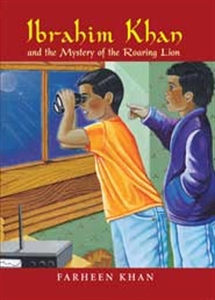
Ibrahim Khan and the Mystery of the Roaring Lion by Farheen Khan

Standard

Image

Perhaps it was timing, or maybe the book just lacks a lot, but having just read Rashid and the Missing Body, did not do this book any favors. This book also features an elementary boy working to solve neighborhood crimes,. who just happens to be Muslim.  The target audience would probably be any 2nd to 4th grade student, girl or boy, as it is a quick, clean 45 pages.  The book is beautiful from the outside, the font and pictures inside are spot on, the story itself isn’t half bad, but the rationale for the crime and the conclusion, just seem  weak and forced.

SYNOPSIS:  

Ibrahim Khan and his cousin Zayn are third graders that solve crimes in their part time.  One day they get a call from Yusuf that there are lions in his backyard, he can hear them, but can’t find them.  The Khan boys are on the case and with support from parents picking and dropping them off at each other’s homes around salat times, and their trusty brown bag, they figure out what is really in Yusuf’s backyard.  

WHY I LIKE IT:

The book is clean, it is perfect for a young or struggling reader in terms of presentation and writing style, and is a decent foray into Islamic fiction for elementary aged students. There is no unnecessary religious, or family, or boy/girl drama, but the reason for the perpetrators scaring Yusuf is very, very unbelievable and weak.  Without giving it all away, it may work to talk to your child at the end about the moral, but I think any student in a school setting would find the ending a bit disappointing.

FLAGS: 

None. Clean and framed well to give the reader a sense that Ibrahim comes from an Islamic family and environment, he is a Muslim, and at the same time he has friends and adventures just like any other character in any other book.