Tag Archives: Muslim Author

The Great Race to Sycamore Street by J. Samia Mair

Standard

the great race to sycamore street

A fun book for elementary aged children looking for a fast paced, energetic read, with Islamic morals and lessons.  Overall a great book about character, being a good neighbor, and never giving up, The Great Race to Sycamore Street is not in the AR database, but I estimate it at about a 4.3 level and think even for higher readers there is plenty to learn about archery and peach trees, and plenty to enjoy as Amani and Hude take on bullies, grumpy neighbors, dogs, and making the most of a summer with their grandma in the country.  There are 180 pages followed by acknowledgements, references, and glossaries explaining archery terms, Islamic terms, and where the hadith and Quranic ayats come from, theoretically making the book accessible to Muslim and non Muslims alike.  I however, think the book would be a bit preachy to non Muslims or to those unfamiliar with Islam.

SUMMARY:

Siblings Amani and Hude arrive in Fairfax County, Maryland to spend the summer with their Grandma Hana in the quiet town of Cherry Hill, for what they think will be a slow laid back summer of reading, swimming in the lake, and preparing for the County Fair.  Grandma Hana has the undisputed best peach tree in the county and makes the best pies to enter in the pie competition at the fair, and this year Amani gets to help.  Hude is a budding archer and with his recently deceased grandfather’s journal and old archery regalia he is determined to compete and win the archery competition.  But their simple plans quickly meet twist after twist: from bullies on the train, to swarms of cicadas greeting them on arrival, to a new neighbor who discovers the beloved peach tree is actually on his property and he wants it gone, to the bullies on the train ruling over the lake and proving to be great archers themselves.  Can the  peach tree be saved? Can they be victorious at the fair? With lots of stories about Prophet Muhammad (Peace be upon Him) woven in, and ayats from the Quran used to emphasize points, not only is the book a quick action packed story, but it is also poignant, educational, and memorable as well.

WHY I LIKE IT:

I love that it is clean and requires the brother and sister duo to work together to do something that is bigger than themselves.  I also love the way that Islam is given practical uses for the children, it isn’t taught in the abstract they must pull on their understanding of their deen to decide what to do, how to act and what the next step should be.  I also like how the fast paced story is set in contrast to the slow thematic ideas of a peach tree, baking, archery, and a stereotypical summer with grandma.  Most readers I would assume don’t know that much about fruit trees and county fairs and archery, and I think the author does a good job of introducing the audience to these concepts and weaving Islam into it while keeping the story exciting and moving along.

FLAGS:

Clean, alhumdulillah.

TOOLS FOR LEADING THE DISCUSSION:

The plot is pretty linear, and a quick discussion of what every one liked and perhaps what surprised them would be a sufficient review of the story. From there I would probably go through the reference of hadith and ayats from the Quran to guide the discussion, you can get the online reference of that here:

http://www.kubepublishing.com/the-great-race-to-sycamore-street-free-reference-sheet/

scroll to the bottom and click on the link to download the text.

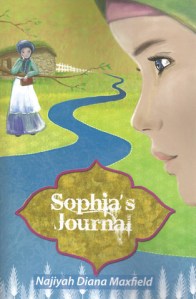
Sophia’s Journal by Najiyah Diana Maxfield

Standard

Sophia_s_Journal_Final_large

It is not terribly uncommon for my mind to remain stuck in books long after I have read the last page, but it has been a while since an Islamic young adult book has held me hostage.  This book was recommended to me by Anse Tamara Gray whose Daybreak Press published the book, and while I tried not to have any expectations, even if I had, the book would have blown them out of the water, mashaAllah.  The book is not in the Accelerated Reader database, but I added it to our school’s so that the students could read it, test on it, and then gather together during our next book club to discuss it.  I estimated it at about a sixth grade level fifth month, and would recommend it for middle school, high school students, and adults alike.

SUMMARY:

Sixteen year-old Sophia is on a family bike ride when she finds herself falling into the Missouri River and waking up in 1857 Kansas.  The acclamation of a 21st century Muslim girl in to what history will name Bleeding Kansas is both heart warming and inspiring in its details of every day life.  Sophia takes a hands-on active approach to helping the kind family, the Sampsons, that takes her in, and she learns everything from shooting to cooking to riding a horse.  As she learns the skills needed to survive, she truly becomes one of the family.  The beautiful way that Islam is woven in as such a seamless part of Sophia, whether she is in the present or the past, is inspirational for readers of all ages and made me at least question if I would be that strong.  Sophia’s relationships with the other characters is what makes the story so magical, getting to see the humanity and strength of people coupled with the same emotions of heartache, longing, and love we can relate to, in our own lives, draws the reader in and makes the story fascinating and hard to put down.  In addition to the story, the historical setting of slavery and relations with the native populations add depth that many students should already know about, and will enjoy seeing in a fictionalized account.  The twists and climax keep the reader engaged, and keep me from spoiling too many plot details in this admittedly vague summary.

WHY I LIKE IT:

I enjoy historical fiction and to blend that with a Muslim character is a great premise in my eyes.  Seeing a strong Muslimah lead in a quality entertaining book that is tactfully done is such a rare find.  Sophia’s strength is quiet, yet powerful, and the slower pace forces the reader to analyze themselves as they discover the characters.  It reminded me of Anne of Green Gables in its tone and style and I think that our middle schoolers need this change of pace and I can’t wait to see how Book Club goes.  I love how strong Sophia is with her deen, her convictions about slavery, her determination to help others, and to learn.  She easily could whine and complain that her cell phone is dead and she misses her family, but she doesn’t, she has a tenacity and attitude that elevates her to a status that you want the readers to look up to her and emulate her.

I also like that Sophia is respectful of other’s religions and they are respectful of hers, the author draws on similarities and discusses Islam in a way that shows it as a living breathing part of life, that is truly a breath of fresh air.  The climax and ending are not predictable and I appreciate that as well.

FLAGS:

There is referred to violence violence, slavery, racism, a tinge of  romance (in an 1857s kind of respectful way), but nothing overly graphic or sensationalized.  Overall nothing a middle school student and up could not handle.

TOOLS FOR LEADING THE DISCUSSION:

There are no reading guides or outlines to teach the book, however, I think there is PLENTY in the book to discuss and if you are like me and the few students I’ve already asked to read the book, not talking about it is harder than finding meaningful points to discuss.

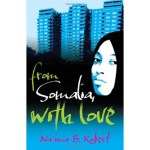
From Somalia With Love By Na’ima B. Robert

Standard
From Somalia With Love By Na’ima B. Robert

somalia

This book was a great glimpse into Somali Muslims in the UK, a world I admittedly know nothing about.  Whether accurate or not, I loved the incorporation of words, foods, culture, all of it.  And most of all I love that the main character Safia is a Muslima.  Yes, the point of the book is a coming of age story as she searches to find herself and define who she is, but in every sphere she is defining herself in, Islam is present.  Her home-life, her friendships, her poetry, all of it.  My only concern in recommending the book to my students. I think 7th and 8th graders, even in an Islamic School, can understand the temptation of going to the movies with someone of the opposite gender, of sneaking out, I think they can understand dealing with someone they love that is making bad decisions, in this case her brother experimenting with drugs and alcohol (the author doesn’t go into explicit detail).  But, truly one page (page 128) just goes too far for my students.  Had he tried to hold her hand, or kiss her even, I think the message would still come back to her conscience and her repentance, but the implied attempted rape pushes the issue over the line in my view, for my sheltered students.  High School students I think can handle it and I think lends itself well to a discussion on boundaries, respect, and sexual violence.  The AR level of the book is a 5.1 and it is a quick 159 page read.  There is a glossary of terms and phrases in the back and the font and book size make it very approachable and inviting to readers.

SUMMARY:

Safia Dirie is a 14 year-old-girl living in East London with her Mom, two brothers, and in close proximity to her large extended Somali family.  Safia is a good student, very close to her mother and very devout in her Islamic faith.  Like most teenagers she is defining who she is in a world that doesn’t seem to understand her.  Unlike most however, she has the added burden of being a religious and cultural minority.  In addition to handling friends, and temptation, she also learns that her father who has been missing in Somalia for the last 12 years has been found and is coming to live with them in London. The focus through the whole story is Safia and the reader is definitely drawn into her struggles of how to help her brother, who is rebelling, how to be a good daughter, and with her internal debates to drift closer to a less religious cousin who encourages her join in activities that Safia is hesitant to be a part of. Once her father arrives everything she has known is threatened and the issues and struggles intensify.  Despite efforts Safia can’t connect to her father and the changing dynamic of the family tests her in ways that while fiction and extreme, I think many can relate to and sympathize with.

WHY I LIKE IT:

The book does a good job of showing how people are not “good” or “bad” and how often mistakes, are just that, mistakes. It also provides hope that people can recover and improve.  The heart of this book is Safia’s and Safia’s heart is pure and has a strong connection to Allah (swt).  She sways and swerves, but never loses sight of who she is at her core, and i think for many young Muslim’s today that is an incredibly strong message.  That mistakes can be made, and Allah (swt) will forgive.  That intentions and repentance are real and valid, irregardless of where you are in life.  From friends Safia wrongs, to a brother who realizes what he is doing is wrong, to a cousin who is passed around without a permanent place to belong, to a mom trying to balance a returned husband, every character is fallible, yet not beyond hope.

FLAGS:

 The attempted sexual violence.  The implied drug abuse and lying of Ahmed, Safia’s brother.  The lying of Safia to her mom and parents about her whereabouts.

TOOLS FOR LEADING THE DISCUSSION:

The Author’s blog about the book: http://fromsomalia-withlove.blogspot.com/

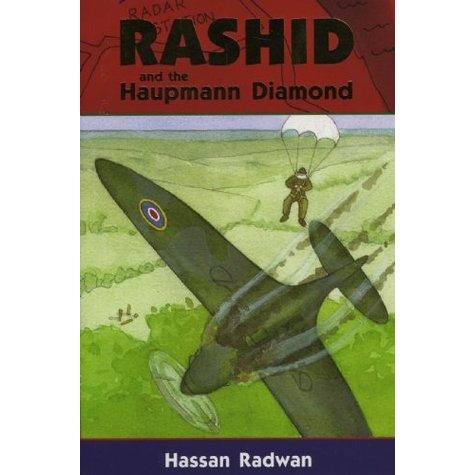
Rashid and the Haupmann Diamond by Hassan Radwan

Standard

haupmann diamond

This is the second and seemingly last book in the Rashid series, which is unfortunate, because like its predecessor Rashid and the Missing Bodythe book is a quick fun read aimed at 3rd through 5th graders with Muslim characters solving a mystery.  At just 110 pages the book reunites friends Rashid, Gary, and Chris, three boys of different religious backgrounds with plenty of respect and understanding to inspire readers of all ages.

SYNOPSIS:

Rashid and his friends hear screaming in the middle of the night and rush outside to see robbers in their neighbor’s house. Once the police come and no evidence of a break in can be found, the boys do their own investigating to see what is going on.  Pieces of information start to come together from the elderly neighbor and her stories of her father, mysterious contacts online, old WWII veterans at retirement homes, and good old fashioned library research, to lead the boys on an adventure to find a lost diamond.  Never a dull moment as the boys are chased by the burglars, family issues at home bring Rashid’s sister and baby into the story, some bullies at school and more.

WHY I LIKE IT:

The book is incredibly fast paced, it hops around from one story-line to the next.  While this format seemed more cohesive in the first book, it was a little jarring for me in this one.  I didn’t mind the side stories at school, or even the soccer matches, but the story of the sister, Huda and her marital problems with her husband Ahmed seemed a bit out of place.  I see what the author’s intent was, but in such a short book aimed at elementary aged boys, it seemed  a heavy story-line to interweave into an adventure story.  The deeper understanding of mixing cultures and expectations I am positive would be lost on all young adult readers.  Once again, the author however, does do a great job of telling a story where the character’s Islam adds to the character, and doesn’t distract from the adventure on hand.  Rashid uses islamic terms, the family prays together, they go to the masjid and laugh with the imam and congregation, they talk about proper ways to correct people and the value of intentions, overall, I’d say they convey a “normal” Muslim family.

FLAGS:

No flags, the book is clean and inspiring, alhumduillah

TOOLS FOR LEADING THE DISCUSSION:

There isn’t a lot out there about the book or the author, nor is the book in the Accelerated Reader database.  I think with its linear story, keeping track of the clues and throwing in some highlights of Islamic manners and morals, however, would make a discussion on the book easy and natural enough for all to enjoy.

Saving Kabul Corner by N.H. Senzai

Standard

kabul corner

For all of us waiting to see what happened to the characters from Shooting Kabul, N.H. Senzai answers that question in Saving Kabul Corner, while maintaining a stand alone story of mystery and family.  It is not necessary to read Shooting Kabul first, and if you have not recently read Shooting Kabul you may not even realize that some of the characters cross over into this book.  The books are drastically different in tone and style and purpose.

SYNOPSIS:

Saving Kabul Corner takes a while to get going, nearly 100 pages.  There are so many characters that I started reading this book months ago, put it down and forgot about it.  I picked it up two nights ago and resolving to just read it and not worry about who all the characters were, I finished it in two sittings and enjoyed it.  The buildup is important to set the stage, but young readers might have to be encouraged to get through all the pettiness of the characters, the numerous back stories and sub plots to get into the flow of the novel and the who-done-it aspect of the book.

Ariana is a 12-year-old Afghani-American girl with siblings, cousins, aunts, all living in their cramped townhouse.  The family owns Kabul Corner an Afghan grocery story in Freemont, California.  Things are going along fairly well, despite the recent arrival of Ariana’s cousin Laila who couldn’t be more different than Ariana, resulting in jealousy and disdain.  When a new Afghan store opens in the same plaza as Kabul Corner, tempers and old country feuds resurface.  Tribal concepts of badal, revenge, and honor start to make their way into their American lives.  When the feuding escalates to vandalism, theft, and arson, the kids of both families are convinced that a third party is pitting the stores against each other and set out to find the real culprit.

WHY I LIKE IT:

I like that the characters are American, but cultural too.  They are Muslim and mention going to the mosque, but their actions unfortunately don’t depict Islam in a consistent manner.  Most notably they do celebrate Halloween, and they lie a lot.  Because the book is a A.R. level 6.1 I haven’t completely ruled out using it as a book club book.  I think it might be a way to discuss with the students the purpose of literature.  How some books leave the reader with a moral, or something to ponder, while some are just entertainment.  The lying in this book is quite extensive and yet, both the kids and the adults have to lie to get the truth.  The author makes note of it, so at least it is identified as an anomaly, but still I’ve not yet resolved if I can explain to the kids that the ends don’t justify the means in real life.  I like that the book is a mystery, so many books with cultural twinges focus on all the “cultural” obstacles and injustices and hardships, it was nice to read a book where the characters and the store just happened to be ethnic in nature.  I think the characters’ culture adds depth, but won’t turn readers away as it is clearly written for the typical American young adult reader.  There is a glossary in the back, but it isn’t as daunting as other novels out there.  The book is 273 pages and also has an Author’s Note and a Further Reading Section.

FLAGS:

The lying for sure, and the theft.  There are no concerns with relationships, language, violence, or disrespect.

TOOLS FOR LEADING THE DISCUSSION:

Click to access 365.pdf

My Name is Bilal by Asma Mobin-Uddin, Illustrated by Barbara Kiwak

Standard

bilal

The other book I discussed during my Story Time theme of bullying was, My Name is Bilal, by Asma Mobin-Uddin,  The book is an AR 3.5 so I summarized parts when reading it aloud, but at bedtime one-on-one my five-year-old was able to grasp what the characters were going through and how best to handle “mean” people.

The premise of this 32 page, fairly content heavy picture book, is a new family starting at a new school.  The main character Bilal does not stand up to some boys teasing and pulling off his sister’s hijab, and then chooses to tell people his name is Bill instead of Bilal so that no one knows he is Muslim.  Fortunately, Bilal has a Muslim teacher who doesn’t jump in to “save” Bilal, but instead shares with him a book about Bilal Ibn-Rabah, the slave who was tortured by the people of Mecca in their attempts to get him to renounce Allah (swt) and Islam.  Young Bilal, finds strength in this story to stand up to the bullies as well as compassion in giving them a second chance.  He even finds there are more Muslim’s around him and being true to yourself is something even those different than you can understand and respect.

Yes, the book is to neat and tidy and it all works out in the end.  But, I think it is a good introduction to being proud of who you are and not backing down.  I like that the kids essentially handle things on their own and that no one is painted singularly as “good” or “bad,” both Bilal and the other kids are flawed and figuring things out. When I read this during Story Time we talked about it from the “bullies” point of view of what a better way to handle someone or something that you don’t understand would be, a scarf in this case, and how asking questions is always more respectful than teasing. We also talked about being the different one in a new environment and how to be prepared if someone does give you a hard time.  The characters in the book are older presumably than 4th or 5th grade allowing this to be a gateway into discussing bullying a bit abstractly, inshaAllah not once it has already begun.

The illustrations are colorful and realistic, not detracting from the seriousness of  the subject matter.  Overall the book serves a purpose and tells a good story.  Plus, the reader learns a little about Bilal and how the early Muslim’s struggled and encourages them to seek out what their own names mean and represent.

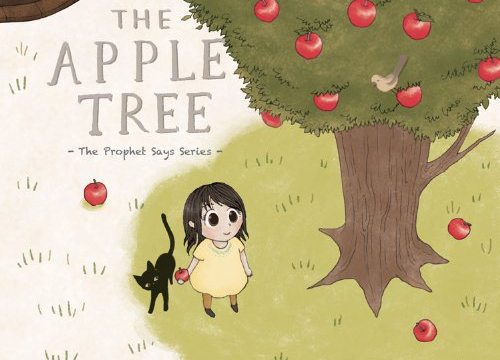
The Apple Tree by Mariam Al-Kalby, Illustrated by Yee Von Chan

Standard

appletree

I have been looking forward to obtaining this book for a while (it was back ordered on Amazon) and over all it was worth the price $16, and worth the wait.  The illustrations are absolutely beautiful.  At story time the kids constantly urge me to take my time in turning the page.  They aren’t incredibly detailed, just very whimsical and engaging, that you want to take a peek and stay a while to play with little Shaima.

The book’s moral comes from two hadiths (sayings of Prophet Muhammad (p.b.u.h.)) “When a Muslim plants a tree, whatever is eaten from it is charity from him, and whatever stolen is charity, and whatever is subtracted from it is charity” (Sahih Muslim), and ” There is no Muslim who plants a tree or sows seeds and then a bird, or a person, or an animal eats from it except that it is regarded as charity for him” (Sahih Bukhari).

The main character, Shaima, wakes up one morning at fajr to find her Baba planting an apple tree.  The two discuss what “reward of charity” means and the value of sharing.  Time presumably passes, although the tree does seem to grow and produce incredibly fast.  Once the apples are ready to be picked, Shaima finds everyone taking her apples: a little boy, a squirrel and her babies, some birds, what can she do?  The solution is both a lesson and inspiration for the character and the reader and makes for a fun book to get the discussion rolling on a wide variety of topics: patience, charity, sharing, generosity, humility and more, alhumdulillah.

The book is not AR, but is relevant to 4 year old children and up.  The book is hardcover and 32 pages. There are six Arabic words which are explained in the glossary and do not impede the story in any way.

The Friendship Matchmaker Goes Undercover

Standard

friendship

I’m posting yet another Randa Abdel-Fattah book that my mom stumbled upon and sent me 10 copies to do for our Book Club. I didn’t love the book, but it is clean and brings up the issue of bullying, friendship and honesty.  So, I’ve decided to do a 3rd- 5th grade Jr. Book Club and use it as a starting point to discuss this critical social realms that they are facing.  The book is a 4.4 Accelerated Reader level and has no Muslim characters or themes.

SYNOPSIS:

This book is the second in the series, and, thankfully, having not read the first book, The Friendship Matchmaker, didn’t hinder my understanding.  Told from the perspective of Lara Zany, a former friendship matchmaker of Potts Middle School, the reader gets to know the major characters at the school and their problems.  Lara now has a best friend and has retired from the matchmaking business, but old habits are hard to kick, and as a new student from Somali out plays the school bully in soccer, Lara is forced to go undercover to help her classmates.

WHY I LIKE IT:

The book doesn’t stand out in the genre, but it is fun because I think 3rd through 5th graders deal with everything in the book, every day.  The book shows restraint where a lot of books over do it.  The characters show growth, they aren’t disrespectful and they aren’t all painted with a simplistic brush stroke.  The bully has redeeming qualities and no one is perfect or hopeless.

FLAGS:

The book is clean in regards to violence, relationships, and language.  The only concern I have is there are two major instances where the characters lie, and there are no consequences.  The smaller breaches of honesty the characters in some way or another must own up to, but there are two scenarios: a forged field trip signature, and an untruthful excuse given for being late to class, that rubbed me the wrong way.  Before allowing students to check it out for the purposes of Book Club, I sent a note to the parents with these two concerns and left it to them to encourage or discourage their student’s from checking it out.  My goal is to discuss why the author included these in the book, and realistic alternatives that would promote honesty, but still allow for a happy ending.

The Perfect Gift by J. Samia Mair

Standard

The Perfect Gift

Is there anything sweeter than a little girl feeling sad that she doesn’t have an Eid gift for her mother and then finding the perfect gift in nature? Probably, but it is still a great premise for a sweet story about a young girl named Sarah and how remembering the hadith “Allah is beautiful and loves beauty” starts a new Eid ul-Adha tradition for her family.

The Perfect Gift is simply written with adequate pictures that move the story along.  The text is short and clear leaving the reader or listener with a clear message about Allah’s perfection and gifts, but keeps it on a preschool to first or second grade level.  The book is 28 pages and has a few words defined at the end for clarity.  While the book takes place close to Eid ul Adha, there is no mention about what the holiday is for and how it is celebrated, the focus is on the beauty of nature and perfection of Allah (swt).

The Best Eid Ever by Asma Mobin-Uddin Illustrated by Laura Jacobsen

Standard

best eid ever

For some this book may have a lot going on it’s 32 pages: Eid ul Adha, parents at Hajj, refugees, charity, Pakistani culture, but if you are reading this book to Muslim children (or they are reading it independently, it has an AR level of 3.8) i think it is delightful.

Aneesa wakes up on Eid morning missing her parents who are in Saudi Arabia performing Hajj. Her grandma, Nonni, surprises her with three new outfits complete with bangles and shoes for each of the days of Eid and is preparing her favorite dinner, lamb korma, for them to eat after Eid prayers.  At Eid prayers Aneesa meets some refugee girls and wants to do something to make their Eid a little brighter.  Nonni and Aneesa come up with a plan and the result is “the best Eid ever!”

I love that it has morals and plot and sparks dialogue.  The message is so simple yet beautiful, that it stays with the reader, adult and child alike.  The illustrations are beautiful and warm providing a nice balance to the long passages.  There is an author’s note and Glossary in the back, but I think this book is really intended for a Muslim audience familiar with Hajj, Eid, and Paksitani culture.  It wouldn’t be lost on someone new to the vocabulary and customs, but definitely wouldn’t be as magical or memorable.

My 3rd grader loved the book and we were able to talk about it and reflect upon it long after the initial reading.  My younger boys enjoyed it, but didn’t get as much out of it.  I think this book works better in smaller groups rather than story time, or simply to have on the shelf to sweep the reader up and allow them to draw their own conclusions on what it means to do something for someone else.