Tag Archives: Muslim Author

Wanting Mor By Rukhsana Khan

Standard

Image

SYNOPSIS:

Jameela has a lot of obstacles as the book opens: poverty, her mother, Mor, has just died, a cleft lip, and an angry  father that returns to drugs and alcohol.  As the book progresses however, things don’t get better in fact they get worse.  In war-torn Afghanistan Jameela and her father move from their small village to the bustling city of Kabul, recently freed from Taliban control. With only her faith in Allah and her memory of Mor, Jameela endures being a virtual slave in one home, before being whisked away for her father’s inappropriate actions with the lady of the house.  Desperate for a place to live, Jameela’s father marries a widow for her money and Jameela becomes a slave to her new stepmother.  When her stepbrother Masood, tries to teach her how to read and write her name, her stepmother convinces Jameela’s father to take her to the busy market place and leave her.  Alone, lost, and with no where to go a kind butcher tries to help her, but ultimately she ends up in an orphanage.  Prospects look up for Jameela as she finally is allowed an education, friends, and security, however, issues with her father and stepmother must be resolved and ultimately this serves to be the biggest test for Jameela.

WHY I LIKE IT:

The story in a nutshell, is heartbreaking, yet Khan never seems to diminish the hope felt for Jameela and the belief that she will find a way to have a full life.  Based on a true story, it is hard to put the book down and the 183 pages fly by quickly.  Jameela is very devout in her prayers, her modesty and her imaan, illuminating  a story where so much sadness prevails. Her faith in Allah swt brings her peace and strength and Khan successfully passes that message on to the reader.  Jameela not only has to navigate her family issues, but also the challenge of making friends, dealing with her appearance, taking control of matters regarding her education, and so much more than most student’s coming of age have to endure.  I think Jameela’s strengths and faults will inspire and serve as lessons to the readers, most likely girls who have it much, much easier.  And who after reading the book, inshaAllah, will appreciate how much harder their lives could be.  

This is the second book I’ve read and blogged about by Rukhsana Khan, the first was a children’s fiction book My Big Red Lollipop.  The two books are both well written and I enjoy her voice as an author, this book however, Wanting Mor, while only an AR Level 3.7, I would reserve for a more mature audience.  The reading is easy and fluid, the story is powerful and well told and I think would be fine in a 7th or 8th grade and up environment.  I would be nervous to recommend this book blindly to a young adult reader without context, direction, and some background.  The incident after a party, with alcohol, where Jameela’s father enters a married woman’s room, implies more than I would want a 3rd or 4th grader inquiring about.  Details aren’t given, but it causes a huge turning point in the story and is thus critical.  At one point a character is groped in the street and Jameela laughs, highly inappropriate that it happens and equally inappropriate that Jameela laughs at her friend.

Another point I would want to discuss with anyone reading the book before hand is the concept that, If you can’t be beautiful, you should at least be good.”  Mor tells it to Jameela, presumably because of her birth defect, but I think that a young girl reading the book shouldn’t take it at face value, I would want to explain the culture, the environment, and talk about such a statement on many levels.

FLAGS:

 Implied sexual violence, drug and alcohol use

TOOLS FOR LEADING THE DISCUSSION:

Given the right group of older students, this book would make a decent book club selections with plenty to discuss and plenty of emotion.

The author’s website page:  http://www.rukhsanakhan.com/books/wantingmor.html

Teacher’s guide:  http://www.rukhsanakhan.com/teacherguides/Wanting%20Mor%20Teacher’s%20Guide.PDF

Wanting Mor Presentation:  http://www.rukhsanakhan.com/teacherguides/Wanting%20Mor%20Presentation%20Guide.PDF


Beneath My Mother’s Feet By Amjed Qamar

Standard

Image


I was so surprised by this book, subhanAllah.  I picked it up at a used bookstore and didn’t think much of it, tossed it in my bag one day as I headed out with my children’s class on a field trip and seriously didn’t want the bus ride to end I was so caught up in the book.  An easy 200 page read if you are familiar with Pakistani culture, even more so if you have ties to Karachi (specifically Defense), the detail takes you to the streets and gullies you know and you want to stay and look around.  If you don’t have these reference points, the book might be a bit hard to connect with, but I think the Author still gets her story across if you are willing to try (there is a glossory in the back).  Beneath My Mother’s Feet is a 4.9 reading level, and because of the heavy cultural references I don’t think I would do it as a book club book, but I have already suggested it to certain students that I know will find a connection and appreciate their mothers and their opportunities in America all the more.

SYNOPSIS:

Nazia is a typical fourteen-year-old Pakistani girl in the large and bustling city of Karachi, Her working class family suddenly is thrown into chaos when her father gets injured at his construction job.  As we learn more about her father, Nazia and the reader discover how lazy, selfish, and dishonest he is, despite Nazia’s determination to see the best in him.  While the family has had hard times before, this time something more than Nazia’s mom scraping and sewing to get by is needed.  As a result Nazia is pulled out of school to help her mom be a maid, masi, in wealthy families’ homes.  The family eventually loses their home, and Nazia’s older brother steals all the jewelry and clothing intended for Nazia on her wedding.  Her father disappears and the women of the family are left to find the strength and resources to carry on.  While the cover teases the idea that Nazia is a “perfect daughter” and that she is such a “good girl” I found these to be incredibly misleading statements and pulled quotes.  I think the story, shows how determined Nazia is, but not at a rebellious level, more as a girl finding her self and willing to risk it all for what she believes, a trait very much in line with her mother’s example.  

WHY I LIKE IT:

I like that it shows self resilience and self reliance both from Nazia and her mom, Naseem.  Nazia holds on to her friendships, her dreams, and isn’t afraid of hard work.  She explores what it means to be a good daughter, good sister, good friend, and good worker. She also is emotionally sympathetic and generous to a small servant boy, all wonderful concepts to present to a 4th through 6th grade audience.  I like that although Nazia isn’t terribly religious she does rely on Allah (swt) and her faith to help her endure the various hardships she encounters.  Islam isn’t at the forefront, but clearly she Muslim.  The book is heavily steeped in culture, the concept of a dowry, how masi’s are treated are not Islamic in the least, and unfortunately the author doesn’t articulate that it is only a cultural norm.  While the women tend to be highlighted in different colors throughout the book, the men seem to be brushed over in a very negative light.  On the surface it is nice to see strong women of various socio/economic spheres coming together and making decisions, but to push all the men aside as being worthless, isn’t realistic or fair.  I liked the uncertainty at the end, usually I prefer books that wrap up all loose ends, but here i think it opens the door to imagine what would have happened and discuss it.  

FLAGS:

The book is remarkably clean, There is lying, but consequences are clear.  There is some violence in the mistreatment of the masis, but the author shows Nazia bothered by it and it is discussed.  Nazia and her friends remark at some of the cute cricket players, but nothing is done about it and it seems innocent enough.


TOOLS FOR LEADING THE DISCUSSION:

A reading guide by the publisher:  http://www.amjedqamar.com/Reviews.html

A bit about the author and where the story idea came from:     https://www.webjunction.org/content/dam/WebJunction/Documents/ohio/Beneath_My_Mothers_Feet_toolkit.pdf

Amjed Qamar’s official website:  http://www.amjedqamar.com/

Interview with Amjed Qamar from A Year of Reading:  

    http://readingyear.blogspot.com/2008/05/sneak-peek-keep-your-eye-on-this-new.html


Jennah’s New Friends By: Suzy Ismail

Standard

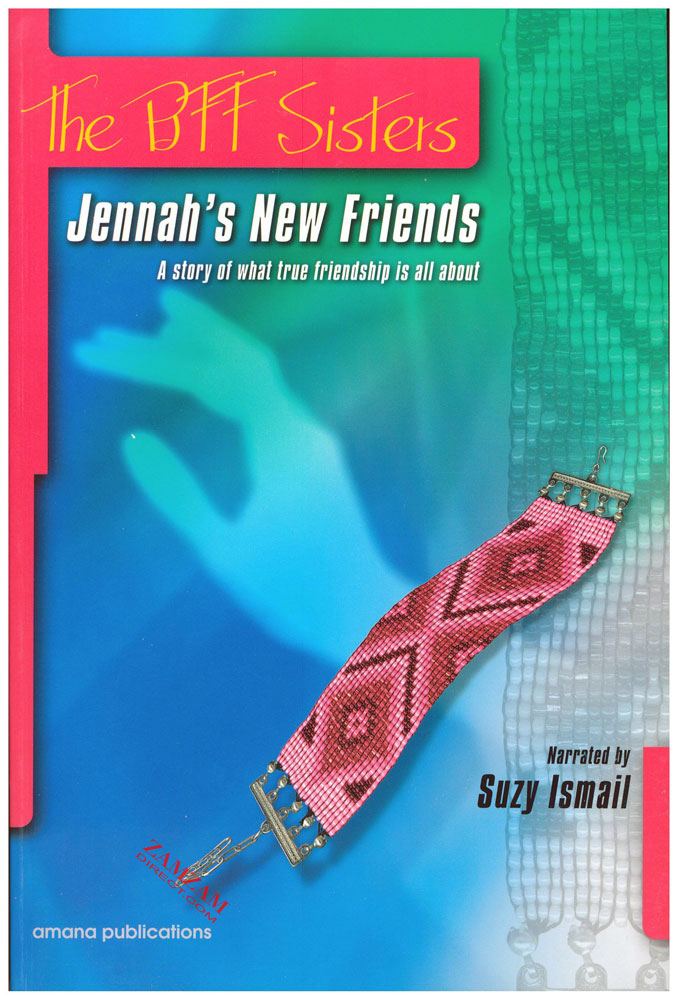
ImageThis book is presumably book one of the BFF SISTERS series, however, the author’s website doesn’t list any other books in the series and it was published in 2001, so it is unknown if more books are in the works.  At 64 pages, the intended audience is girls between ages 7 and 12, but I would note that there are no illustrations and while it is broken into chapters (on average about 10 pages long) the text and layout would be daunting to the average 2nd and possibly 3rd grade student. 

SYNOPSIS: 

Jennah lives in a neighborhood with lots of Muslims and lots of friends, but when a new girl moves in, Jennah is afraid that her best friend Yasmeen would rather be best friends with the new girl, Mariam.  Jennah not only is afraid of losing her friend, but there is a lot going on at home too, her mom is about to have a baby, her younger sister is always bothering her, and her dad is constantly away on business.  Alhumdulilah, Jennah is surrounded by supportive adults, forgiving and generous friends, and an Islamic foundation that allows her to sort out her feelings and create a Hadeeth club with All her new friends.

WHY I LIKE IT:

I love that it is a clean book for the elementary age group, the girls do not have boyfriends and while hijab is mentioned in passing, the girls are a group of kids that are dealing with the constant struggle of all girls that age: friends.  Each girl in the BFF club is from a different background, Arab, Pakistani, African American, one’s parents are converts, and at the end a non-Muslim joins the group, truly someone for every reader to identify with.  I think most every girl reading this book can relate to the struggles amongst friends, being the new kid, having younger siblings, trying to fit in, and jealousy, all topics touched on, however the book is an awkward read.  I can’t decide if the book is a short story that got too long, or a novel that wasn’t fleshed out.  The beginning drags on as the foundation of who all the characters are is established, and at times Jennah seems very whiney and immature with problems that wrap-up with little explanation or insight.  Everything often seems too “perfect” and Jennah’s problems petty when all the surrounding characters are so over the top forgiving and generous.  The book left me wanting to know more about the backgrounds of the supporting characters, and more about how Jennah felt.  I think readers may get lost with all the characters, but if they can sort it out, I think they will see themselves and their friends in the pages dealing with the same issues they deal with every day.

FLAGS:

Clean

TEACHING THIS BOOK:

I probably wouldn’t teach this book for the intended audience, or share it as a book club, however, one-on-one the book would be a great starting point for a discussion with a girl having problems with friends. 

I am Malala By Malala Yousafzai and Christina Lamb

Standard

malala pic big

Naturally we all have heard Malala’s story and while some are inspired by it, some seem to have major hostility toward her and her approach.  Chosing to take her at face value and be inspired by her, I was generally looking forward to reading her story before I ever entertained thoughts of using it as a teaching tool in a school.  It is an AR reading level of 7.1 so once I obtained the book I rushed to read it before the end of the school year to see if perhaps our 7th and 8th grade students could read it and leave for the summer realizing the blessing that an education can be from someone who has had to risk it all, just for the chance to learn.  However upon completion I think that the dates, and history of Pakistan would ultimately drag the book on for the majority of Middle-Schoolers and her message and inspiration would be lost.  For adults looking for a book club book however, I would highly recommend it.  As a half Pakistani-American growing up spending my summers in Pakistan, I could relate and recall so much of what she wrote about.  I think most adults of any background would similarly be able to recall major news events, and be able to follow along.  I think anyone younger would find it incredibly difficult and possibly dull to get through.  I think that students would benefit from learning about her story and then only reading excerpts from the book.  There are some very moving sections that I think the average middle schooler would be impacted by, and the included pictures amongst the 327 pages would give them a glimpse into her world.   I on the other hand, couldn’t put it down, the book reads very quickly and bounces around all over the place, which actually didn’t bother me, I enjoyed her descriptions of her town and family and friends.  While Malala wrote it with an author, I think the tone is very much that of a young girl and thus the style works for me.  Political views aside the book made me smile, made me cry, and makes me feel better off having read it.

SYNOPSIS:

Malala is a Pashtun girl in the Swat Valley in Pakistan.  In a culture that keeps females behind doors and cloth, her father is the anomaly and encourages her to be educated, free, and vocal.  As 9/11 occurs, the Taliban sets in, the west wages war on Afghanistan, Osama bin Laden is killed, governments change in Pakistan, floods and earthquakes destroy the land, Malala and her family struggle to survive, improve their community, and advocate for the right of women to be educated.  All this climaxes in the Taliban boarding her school van and shooting her in the face at point-blank range.  She is then rushed to various hospitals before being taken to Birmingham, England. 

WHY I LIKE IT: 

It gives hope and shows that there are people making a differences and despite the risks, do want to change things in the world.  It is a great example that one person can make a difference.  Her family and her are active Muslims, that reflect on the Quran and try to understand where the Taliban is wrong in their interpretation.  Religion is a defining factor in every aspect from personal to culturally to government, and presents just how different each person seems to manipulate religion to their own benefit.   It might seem odd for some that she is writing this memoir of sorts when she has barely lived a long enough life to reflect back upon.  It also is perhaps overly optimistic as the story is ongoing, what she will do now is unanswered because it is not yet been given a chance to unfold.  I think the story is strong enough to cut through the criticism, and can be very powerful from both a child’s point of view, and from her parents.  Most readers if they can get through the intermingling of her story and that of her country will be affected by her plight.

FLAGS:

Violence, but done in a newscast style, not overly sensationalized, but details are given.


Ibrahim Khan and the Mystery of the Roaring Lion by Farheen Khan

Standard

Image

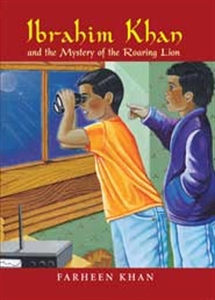
Perhaps it was timing, or maybe the book just lacks a lot, but having just read Rashid and the Missing Body, did not do this book any favors. This book also features an elementary boy working to solve neighborhood crimes,. who just happens to be Muslim.  The target audience would probably be any 2nd to 4th grade student, girl or boy, as it is a quick, clean 45 pages.  The book is beautiful from the outside, the font and pictures inside are spot on, the story itself isn’t half bad, but the rationale for the crime and the conclusion, just seem  weak and forced.

SYNOPSIS:  

Ibrahim Khan and his cousin Zayn are third graders that solve crimes in their part time.  One day they get a call from Yusuf that there are lions in his backyard, he can hear them, but can’t find them.  The Khan boys are on the case and with support from parents picking and dropping them off at each other’s homes around salat times, and their trusty brown bag, they figure out what is really in Yusuf’s backyard.  

WHY I LIKE IT:

The book is clean, it is perfect for a young or struggling reader in terms of presentation and writing style, and is a decent foray into Islamic fiction for elementary aged students. There is no unnecessary religious, or family, or boy/girl drama, but the reason for the perpetrators scaring Yusuf is very, very unbelievable and weak.  Without giving it all away, it may work to talk to your child at the end about the moral, but I think any student in a school setting would find the ending a bit disappointing.

FLAGS: 

None. Clean and framed well to give the reader a sense that Ibrahim comes from an Islamic family and environment, he is a Muslim, and at the same time he has friends and adventures just like any other character in any other book.


Rashid and the Missing Body By Hassan Radwan

Standard

Image

I picked this up in my school library and started to read the small and uninviting text (it looks like an essay) and was quickly swallowed up by the kid detective story of not only who-done-it, but how.  At 80 pages, the book is both compelling and charming, in its simplicity and ability to bounce around.  The back of the book suggests the book for ages 11 to 15, but I think it would appeal to anyone seven and up, particularly boys. The book is not AR, but I plan to make a quick 10 question quiz so that students can read the book and get class credit by logging in, taking the test, and hopefully passing.

SYNOPSIS:

Rashid and his new (non-Muslim) friends are playing a simple enough game of cops and robbers when they stumble upon a dead body in a shed at the park.  The rush home to call the police, but by the time they return, the body is gone.  The story is the adventures of the boys trying to figure out what happened and how to make sure the culprit doesn’t get away with his crime.  The backdrop of Rashid’s family, his Muslim and non Muslim friends, a few bullies, is all beautifully woven into a moral and uplifting story where the characters are practicing Muslims, and the supporting characters are respectful to the point that Rashid’s religion is a non-issue, just a strong defining characteristic.

WHY I LIKE IT:

Superficially the book appeals to a hard to inspire boy demographic, that alone prompted me to pick up the book.  I love that the book doesn’t get bogged down in preaching, it truly comes from a Muslim perspective of handling Islamic events in your daily life, and in this case solving the case.  When scared Rashid asks Allah for help, he prays, he fasts in Ramadan, he helps his brother, the author has Rashid’s sister get married and has Rashid’s annoying cousins come over; there is no over the top drama in the home life, the suspense and climax of the book is the dead body, not who Rashid is and what he believes.  I think to see a character so like themselves tracking down suspects and having such a grand adventure will be a big hit with our students.  I don’t think it lends itself well to a book club book, but I can’t wait to recommend the book to individuals.

FLAGS: 

Clean.  As the back of the book says “It brings into play life-enriching Islamic values of standing up for truth, a strong sense of duty and bond of sincere friendship.  The story throws light on Muslim family life, their morals and manners and outlook on life.”


The Garden of My Imaan By Farhana Zia

Standard

Image

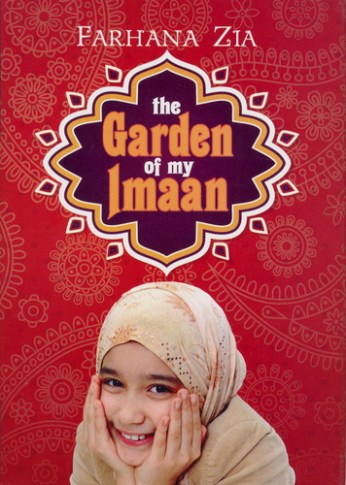
I really, really wanted to love this book, I saw it in last month’s Scholastic catalog and without even reading it I ordered a copy for me and two classroom six packs (total of 13 books).  I was so excited, a 3.6 AR reading level, 226 pages, a sweet hijabi girl on the cover, a Muslim author, good reviews online, I was waiting to be swept away.  Nuts, perhaps it was over anticipation or perhaps the book just fell short.  Either way we will not be using this in our current book club, nor will I kick off a 3rd grade book club with this book, sorry parents.   As I type this my printer is spewing out the return label to send the classroom copies back. 

SYNOPSIS:

Aliya is a fifth grader dealing with typical pre-teen issues of friends, family, and school.  The book starts with her at religious Sunday school surrounded by diverse friends.  Some friends are contemplating wearing hijab full-time, some preoccupied with their new boyfriends, some excited about fasting in Ramadan and others dismissing it completely.  On the way to Sunday school, Aliya’s mom is taunted by stereotypes from an angry motorist that has Aliya rattled and confused.  Immediately the author establishes that Aliya is unsure how to fit in because she is unsure where she stands on many of these issues.  Her home life involves multiple generations of Pakistani immigrants, and US born characters in one home, her great grandmother, grandmother, parents and her brother.  Later a great Aunt comes to visit as well.  At school Aliya has a best friend, Winnie, who is by far the best character in the book, a bully she has to deal with, a girl that Aliya is intimidated by, a boy she has a crush on, and a new student, Marwa. Marwa is Muslim from Moroccan heritage, wears hijab, and while religiously is the same as Aliya, culturally is worlds apart.  Marwa also is confident, strong, and devout; characteristics that Aliya slowly comes to admire and draw strength from as she defines who she is and wants to be in some aspects of her life.

Although there seems to be a lot of characters, there is no problem keeping them straight, the writing is very simplistic and at times weak, but clarity is never a concern. The first 15 pages of the book bring up stereotyping, discrimination, bra sizes, boyfriends, hijab, menses, and fasting.  All told from a very naive, innocent character’s voice which makes for an awkward start in my opinion.  As the book progresses she begins writing letters to Allah (swt), which, while I don’t imagine is wrong, seems odd, but that is probably my own background projecting.  My concerns with the book are that for as open as Aliya is with all the mulit-generations living in her home, there is no moral compass.  No one guiding her to be a better Muslim, to help her develop her internal conscious of what is right or wrong.  They all read her letters and no one discusses her infatuation with a boy? Seems a bit odd to me.  She tries to fast, against her families protest then breaks her fast with pepperoni pizza (she took it off) isn’t that a learning moment? I’m not saying the book should have become preachy, but the lack of basic parent-child interactions make it seem that everything she does is basic common sense, and I cannot with a good conscience encourage my little 3rd and 4th graders to read the book.  They will think I’m supporting Aliya’s actions and frame of mind.  Had the author opened the door to discussion or even had Aliya’s conscious question her actions, as a teacher/librarian the students and I could discuss the issue, but there is no pause, the story just states it and moves on.  Same goes for the fact that her father doesn’t fast regularly because he has important business decisions to make.  A concept so contrary to what we teach our kids, we teach them to fast when they have a big decision to make. Once again had the author taken just a few sentences to explain that the dad travels for work and that travelers are not required to fast, readers would get a more accurate view of what Islam teaches, not that fasting in Ramadan is optional.  

The one character that is presented as religious is described as being OCD, belligerent, rude, uneducated and a nuisance.  The character eats only halal, religiously raised and slaughtered meat, and the family essentially refuses to accommodate her, lies about what they feed her, and bully her.  Seemed to me the same treatment they are whining about receiving from society as a whole, they were projecting onto their great aunt within their home.   Finally the tipping point was when this same great aunt started praying/asking Bibi Sayeda for help, a saintly person who helps people find lost things…what? Islam is pretty clear we pray to Allah swt and only Allah.

WHY I LIKE IT:

I like that the book shows diversity within the religion, it isn’t preachy, and it shows the balance that non-Muslim kids often have to balance.  I think if my daughter picked this book up at the public library and we read it together we might be able to talk our way through it.  I think students in public school who have to face more of Aliya’s struggles or students that have non-Muslim family members will see themselves at some point in the book and find comfort in it.  But again, because of the reading level, I can’t justify handing it to a Islamic school student to read without numerous warnings and disclaimers.

I like that the characters do discuss their different view points on hijab, and that Aliya forms her own opinion on it.  And while it takes awhile to make the point and does involve Aliya yelling and insulting the bullies, she does find a way to handle them by being kind, which for this age level is a nice, albeit optimistic, message. 

FLAGS: 

Questionable basic Islamic facts, minor characters with boyfriends discussing kissing.
 

Big Red Lollipop By Rukhsan Khan

Standard

Image

I love that Scholastic offers this book in the school market and that the story is universal to all ages, and all cultures.  The mom is Ami and the names are Indian/Pakistani the illustrations show the mom in traditional clothing including a scarf on her head, giving the story a tinge of culture and religion, but not distracting from the beauty and charm of the story.

The basic story is of a girl, Rubina, presumably new to America (or any western country) being invited to a birthday party and running home to ask her mom if she can go.  The mom asks what is a birthday party and why would one celebrate it, implying that it is not a traditional practice, but not something she opposes.  Rubina is allowed to go on the condition that she take her younger sister Sana, who is begging to go along.  Embarrassed about the idea, Rubina arranges to bring Sana, even though her friends find it odd.  At the party Sana spoils all the fun, and afterwards eats Rubina’s treasured red lollipop.  Rubina is no longer invited to parties, however when Sana is invited to a party, Rubina shows tremendous heart and takes a surprising and praiseworthy course of action.

Beautifully illustrated the story works wonderfully during story time, with each child identifying to different characters, yet understanding the same message.  The book is an AR level 2.2, and lends itself easily to discussion.  Even older students can explore points of view with this book, and imagine what they would do in any of the characters’ shoes.

Completely clean and enjoyable.

The author’s website: http://www.rukhsanakhan.com/books/bigredlollipop.html offers a reading of the story, teacher’s guides, and the truth behind the fictionalized account.


Does My Head Look Big in This? By Randa Abdel-Fattah

Standard
Does My Head Look Big in This? By Randa Abdel-Fattah

Image

I think I have purchased this book at least twice before and have never gotten around to reading before loaning it off to someone, that is until we were snowed in a few days ago.  Similarly bizarre, whenever I’ve asked someone who has read it what they thought of it, I’d nearly always get a a smirk, a shrug a nod of the head, and a vague response.  So when the book came in the mail and the snow hit the roads, I decided to put an end to all this none sense.  Needless to say I’m very tempted to make a video of me shrugging, smirking, and shaking my head instead of writing a synopsis, ya, it’s got a lot going on.

According to Accelerated Reader it is a 4.9, so fourth grade ninth month reading level, however, I wouldn’t encourage anyone that young to read it, you would need to be at least a junior or senior in high school for content.  It has 360 pages that fly by and is one of those books that if you put it down you could pick it up a month later and not miss anything, or you could read it in one sitting and not find it to be a daunting task.  I akin it to empty calories, a half hour sitcom, or books like Janet Evanovich’s Plum novels or Sophie Kinsella’s Shopoholic books; entertaining, light, and with a happy ending.

SYNOPSIS:

Australian born Amal Mohamaed Narullag Abdel-Hakim is considering wearing hijab and as she makes the decision, she is forced to handle obstacles in every relationship her sixteen-year-old life contains.  The only child of her Palestinian born parents, her mother is a dentist, her father a doctor, Amal seems to have it all: a few close Muslim friends from her days in an Islamic School, a few close friends at her current prep school, an amazing relationship with her parents, brains, looks, opportunity.  There is really no climax as she navigates all this other than the fact that she is a teenager and doesn’t often know what she wants.  Additionally she is Muslim and as various terrorist plots occur she is challenged with coping at school, deciding if she can achieve her goals and cover her head, if she can have male friends and go to parties, and if she can win over her critical elderly neighbor.  This book honestly has it all: Islam vs. culture, boy girl issues, gender roles, immigrant and assimilation, extremism vs liberal, weight and self esteem issues, Ramadan, cousins and family members who make things difficult, female circumcision, terrorism, drug and alcohol use, smoking, racism and bigotry,  and even at times a poignant moment or two.

But, to cram all that in to a YA book is really just too much that it gets lost and ultimately doesn’t leave a memorable place in the reader’s head or heart.

Never really getting into Amal’s head about why she wants to cover, the book stays superficial with her infatuation with Adam and her poor choices regarding her relationship with him.  A constant struggle she has is wondering if she can ever get a job and be taken serious as a professional while wearing a hijab, which seems really silly since her mom is a successful dentist who covers, but that never even is addressed.  Amal fights with her Principal, fights with classmates and at times even her parents regarding her decision to cover, and while yes you cheer for her, it seems to almost contradict how flighty she is in other capacities of her life.  The other main story line is with Amal’s Muslim friend Leila who’s parents are “cultural” and not very religious and thus oppressive in letting Leila practice Islam.  A worthwhile story line, however it almost makes Amal’s family in contrast seem “too perfect” which after a while just seems unrealistic.  The character fasts and prays and does many of the prescribed aspects of faith, but Amal seems in many regards to lack spirituality or enthusiasm or even a deeper connection for Islam.  She is a character who is Muslim, but not necessarily defined internally by her love of Allah, she just wears it on her head.

WHY I LIKE IT:

Many reviews of the book remark that it is a book that “needed to be written and needs to be read,” and I think yes, if you are an avid reader that is looking for a quick entertaining read about a Muslim, by a Muslim, go for it.  I don’t foresee me using this as a book club selection, but i think in a few years there are some students that I would recommend picking it up and reading it.  To some non-Muslims I think it would show that Muslim’s have the same everyday problems that everyone has, and in fact we are not all extremists.

FLAGS:

There is a little cursing in the book, girl/boy issues of dating, kissing,  mentioning of porn and prostitution, there is alcohol, drug use by a minor character, smoking, and lying to parents as a norm.

TOOLS FOR LEADING THE DISCUSSION:

Click to access RA-DMHLBITNotes.pdf

A little about the author and why she wrote the book:

http://www.randaabdelfattah.com/index.asp


Golden Domes and Silver Lanterns By Hena Khan

Standard
Golden Domes and Silver Lanterns By Hena Khan

Image

As a librarian I do a few story time sessions a week, so I will include the Islamic themed books that the students and I particularly love. Golden Domes and Silver Lanterns: A Muslim Book of Colors by Hena Khan, is currently at the top of the list.  The pictures are beautiful and engaging, the text is simple and poetic, and the fact that the students first saw the book at the Scholastic Book Fair, made it all the more appealing.  For such youngsters to see themselves, their religion, their culture, so simply and beautifully presented elicits smiles from even the youngest story time listener.  Recently the intermediate Language Arts teacher even borrowed it to review adjectives, and the students loved it.  From orange henna, to black ink writing Allah, the book presents, eid, hijab, prayer rugs, mosques, and love.  An absolute must on any book shelf, you won’t regret it.

To see some pages from the book online:

http://www.books4yourkids.com/2012/09/golden-domes-and-silver-lanterns-muslim.html