Tag Archives: media

We Are Big Time by Hena Khan Illustrated by Safiya Zerrougui

Standard
We Are Big Time by Hena Khan Illustrated by Safiya Zerrougui

With themes of being new in school, balancing sports and school, teamwork, focusing on the positive and pushing back on media stereotypes, this 240 page middle grade graphic novel inspired by a true story is a feel good story that can be enjoyed by all.  The all hijab wearing Muslim high school girls’ basketball team is researched and noted in the backmatter, and while often Hena Khan books feel performative, the tone of this is not identity based. The characters are Muslim, they are not questioning their religion, and in fact push back on the media who try and make it about what they have to overcome by practicing their faith, rather than on their abilities on the court.  That isn’t to say that the Islamic representation is strong.  For characters in an Islamic school, a whole page is dedicated to being the new kid in each class, but only one “salaam” is offered.  The team informs their non Muslim coach when they need to pray which is nice, but surprisingly with a Muslim author and Muslim illustrator when the protagonist prays at home with her family, the men and women erroneously stand together.  The framing, the setup, the accomplishments are all Muslim centered, but the book is not particularly Islam centered. The take away of teamwork, hard work, and normalizing Muslim hijabi women in sports is well done, and I think an easy book for kids to identify with as they read the panels of Aliya dealing with stresses and changes, on and off the court. This book releases next month, and I encourage you to consider for yourself if you feel the author has done enough with her platform to speak about Palestine before supporting or not supporting the book.

SYNOPSIS:
The book starts with Aliya, her two brothers and parents stuck in a car headed from Tampa to Milwaukee.  They are relocating to be closer to her grandparents, and the kids are not excited.  The first day for the trio at Peace Academy stands out because the school is big.  Aliya who has played rec basketball in the past, now decides to try out for the school team.  Tryouts are a bust, only nine girls show, so they all make the team.  With hopes of turning a failing program around, the school has hired a new coach, a non Muslim who used to play Division 1 ball.  It seems Aliya might start to make friends with her teammates, but then she is named co-captain which ruffles some feathers, her grades start slipping, and the team still isn’t winning. When the media takes an interest in the team, the pressure mounts to represent themselves, their school, their faith, and show what they can do on the court.

WHY I LIKE IT:
I love that identity is not in question and that the characters articulate the worries they have about their representation in the media, not because of something they’ve said or even Islamophobia, but just based on the framing of the questions, and assumptions that abound.

I read a black and white arc, so at times I didn’t know who was the dad and who was the older brother, but even with that confusion, the beginning is a bit stilted.  The dad doesn’t know if his daughter was any good at basketball, and the dialogue is so flat to set the stage, that I was glad it only lasted a few pages.  I appreciated that the parents were stressing grades, but were not overly narrow minded, they were presented in a very level headed supportive way as to not fall into a common desi/immigrant stereotype.

I don’t know why the prayer scene is wrong, but the more I try and tell myself it was just a mistake, the more mad I get.  This is why beta reading is so important, Muslim kids will notice, it will make the book feel just that much less authentic, and it so easily could/should have been fixed.

FLAGS:

None, a little bit of Islamophobia, but it is pretty clean

TOOLS FOR LEADING THE DISCUSSION:

The graphic novel format makes the book a pretty quick read, and most of the discussion points are handled in the text, so I don’t know that a book club would benefit.  I do think having it on the shelf for kids to pick up and read, will keep the book bouncing from one reader to the next.  I know my kids have all read it…that’s the beauty of graphic novels, just having it around means it gets picked up, read, and often finished, despite the readers age or even interest.

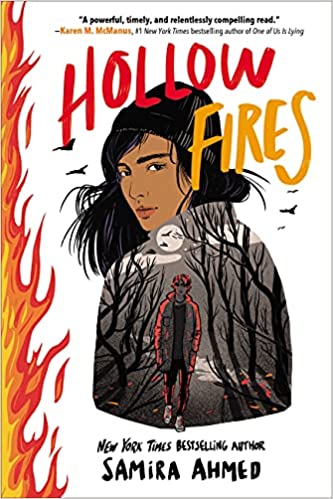
Hollow Fires by Samira Ahmed

Standard
Hollow Fires by Samira Ahmed

hollow fires

Every YA Samira Ahmed review I have written I remark at how amazing the premise is, how flat the characters are, and how forced the romance feels.  I am so happy that I did not dismiss this book, and when I return this copy to the library, I will be eagerly awaiting the purchased one to arrive so as to be placed on my book shelf.  There is connection to the protagonist, she is even likeable, the brief flirty romance is natural and not heavy handed, and the only thing better than the premise is the contemporary commentary.  The multiple writing styles, lyrical voices, and thriller/mystery elements make this 404 page teen book hard to put down.  Islam is present in different forms in different characters. There are very gentle elements of faith that really contrast the chaos of the plot and radiate peace: fajr salat, wanting a janazah, identifying as Muslim.  And while the book says 7th grade and up, I think it is more suited for high school readers.  There are strong themes of islamophobia, media, and privilege, there is killing, murder, a gay Muslim, a ghost, assault, language, planning to go to a school dance, racism, vandalism, misogyny, Halloween, relationships, hate crimes, and abuse of power, to name a few reasons that I think older readers (and adults) will appreciate and understand more deeply than most middle schoolers, how remarkable this book truly is.

SYNOPSIS:

Safiya is in her senior year at her elite private school, she’s a scholarship kid, and her passion is journalism.  As the editor of the paper she is unafraid to challenge the principal and spur others to action.  When a fellow Muslim kid, Jawad, at a nearby local school gets arrested for bringing a makerspace jetpack to school, it bothers her.  When Jawad goes missing, and events at school and in the community start putting Muslims and other minorities on edge, Safiya finds herself collecting bread crumbs and getting closer to the truth.  Throw in vandalism to her parents Desi store, smoke bombs in the bathrooms, swastikas graffitied at school, and a dead boy whispering to her and you have yourself an action packed thriller that hits close to home.  When the circumstances of how Jawad’s body are found and the clues start to fall in place, Safiya and readers will find themselves rushing against the clock.  Her to safety, and readers to see if their suspensions are correct.

WHY I LIKE IT:

I love, love, love how each chapter starts with a fact, or a lie, or an alternate fact, or truth, I keep rereading them. They are so clever, and thought provoking as the short lines stare at you in black and white and get under your skin.

I don’t think the book explains if a ghost in Islamic doctrine would be possible, but I do like that the book on more than one occasions tries to explore it.  I think for me acknowledging that it doesn’t fit, but that jinn exist and that maybe it just is what it is allowed me to overlook it and read the story for what it is.  I appreciate that the author gave the characters presence of mind to try and view it through an Islamic perspective and see answers that way, even if it did come up short.

I love the parents in the book, all of them. There is no oppression or force or lack of understanding, from the parents which was a nice break from the normal YA Muslim family dynamic presentation.  As a result perhaps, Safiya has never gone to a school dance, but when asked to Winter Formal she doesn’t have any religious or cultural hesitation in agreeing to go.  Part of me wishes it would have crossed her mind, but I think the other part wins out- that for her it is a non issue and that her view and practice of Islam is just different than mine and that is ok.  I think part of the reason I am ok with it is because there is no overly forced make-out sessions or drawn out angsty scenes.  There is a kiss on the cheek and one on the forehead, a tiny bit of snuggling, and maybe a handhold.  Suffice it to say it isn’t overboard and extreme, it never says that Safiya prays, she notes her parents do, but it seems she goes to the mosque, she identifies as Muslim and she is unapologetic, so by moving the choice to her to go or not go to a dance allows Islam to stay Islam and her actions to stay her actions.  A subtle difference I’m sure for most, but for me a very powerful one in a book that is about more than Islam’s view of premarital relationships.  I think it is also promising in that it shows how far literature has come that these nuances can exist without being overly explained or made into black and white issues.

In a similar vein is how the three Muslim characters are presented.  At one point it says they all go to different mosques because of geography or ethnicity, but to them they are just Muslim.  This includes Usman a kufi wearing Shia Hazara from Afghanistan who is always crushing on his tennis partner, or some other guy.  There is nothing more said about it, and the book carries on.

The style of the writing between the alternating voices of Safiya and Jawad are nice, but I particularly liked the inclusion of the interviews, articles, excerpts, and court transcripts.  The change of pace made it feel like it was more than a fictionalized story about the characters at hand, and a societal trend that is impactful to us all.  Which of course is a theme of the book, and was a nice way to show and convey that sentiment without having to say it over and over again to be heard.

FLAGS:

Copy and pasted from above:  There are strong themes of islamophobia, media, and privilege, there is killing, murder, attempted murder, a gay Muslim, a ghost, assault, language, planning to go to a school dance, racism, vandalism, misogyny, Halloween, relationships, hate crimes, and abuse of power. The hand of Fatima symbol is apparent in the marketing of the book, it isn’t a huge part of the story itself.  It is a key chain that was given to a character and then passed on with a message that it will keep you safe.  Clearly it doesn’t keep you safe and the irony and the passing of it from one character to another (I’m really trying not to spoil anything, can you tell) is the only significance it has on the story.

TOOLS FOR LEADING THE DISCUSSION:

I have already told my daughter she needs to read the book this summer after finals (she is 15), and while I would love to do this as a high school book club book, I don’t know that the ease of going to a dance, the normative presentation of a gay Muslim, and the ghost as a main character would be widely accepted at an Islamic school.  I think I will suggest it to high schoolers that I know, and would do so confidently as the writing, overall messaging, and critique on the media and privilege are so well executed in a compelling story, but I think the flags might keep me from “teaching” the book or shelving it in the school library.

Anything But Okay by Sarah Darer Littman

Standard
Anything But Okay by Sarah Darer Littman

anything but ok.jpg

This 345 page contemporary book is brand new from Scholastic and isn’t yet in the AR database, it is billed as appropriate for ages 12 and up and is probably pretty accurate.  The cover, in my opinion, is rather a disservice for the audience.  The book would appeal to girls and boys, and isn’t really about school drama, which is the vibe I got from the cover.  The story is actually pretty deep and thought provoking, on a wide range of issues facing many young adults today.

SYNOPSIS:

Told from Stella Walker’s perspective, the book opens with her and her friends, Ken and Farida, reviewing old movies.  Farida, an Iraqi immigrant, is constantly pointing out the stereotypes, tropes, and bias they engage in regularly and see depicted around them.  She is constantly nagging her friends to recognize their privilege and check it.  Stella tries to get it, but it’s not that easy. Nor are the obstacles that the book explores. 

Stella’s parents are vets, and her brother, Rob, has just returned from his second tour in Afghanistan and is suffering from PTSD.  Additionally, Rob’s best friend commits suicide and yet, Stella’s family doesn’t involve her in the conversations and concerns, and as a result she doesn’t talk to her best friend Farida.  This tension is amplified when Farida wants to run for class president, but her parents advise her against it, as Islamaphobia is on the rise with the mayor, up for re-election, spouting hate speech, and his son, already in the race to lead the school. 

Stella, as a result, is convinced to run with the help and support of her friends.  All should be going well, but in a desperate attempt to get Rob out of the house, a trip to the mall to watch a movie results in Rob sticking up for a Sikh kid being bullied, and breaking the instigators nose.  The police are called in, and the real drama of the book takes center stage, as social media, a bigoted mayor, and a family’s member friendship with a Muslim paint Rob as a radicalized terrorist.  The Walker’s house is vandalized and Farida’s family’s restaurant is suffering and the mayoral election and class office election will all require some tough decisions and insights into honesty, framing, perseverance and friendship.

WHY I LIKE IT:

I don’t think I was expecting the book to explore so many topics and to do it, in a rather real and raw way.  The arc of concepts covered provides a lot of juice and relevance and the quick pace, makes it a quick read.  Some pages are letters written by Rob, a number of pages are the various police reports taken after the mall assault and the various points of view are great.  It explores how media editing and framing can change a narrative to one side or another. 

I love Farida, bless her, she is annoying and one-dimensional, but yet so relatable.  She is the token minority that ties it all together and is the billboard representation of “other.”  I can so relate to her, being the minority and the one that constantly had to be the gadfly on the masses.  

The school election is a little cheesy and overly elevated in importance, but it is the catalyst, so while I wasn’t really invested in who won, I liked the concepts it brought to the forefront of the characters lives.  The family struggles and retaking the truth and owning it, was the real strength of the book, and introducing kids to the horrors of war, returning from war, mental illness, the blind eye of politicians, the struggles of the VA, the power of the media, friendship, and concepts of patriotism, privilege, pride, suicide, and moving forward.

My biggest complaint is the awkward and forced romance.  It isn’t even romance really.  After the mall incident, Stella confides in a classmate, Adam,  who comes over to see if she is okay and they hold hands and kiss.  It is so out of left field and so awkward I would imagine for most readers, not just me the conservative muslim mama looking for books for my kids and their school book club.  In all they kiss five times I think, and mentions them holding hands twice.  It isn’t lamented or dwelled on, it just kind of boom, jumps in to the story and then yes, they kind of snuggle after the election results, which is a little more fitting (but still irritating).  Rob meets a girl, and again later on when she comes to celebrate the plea deal its nice that she is there, but they talk like once and he completely falls for her, kind of intense and random.  The discussions about letting someone in to your life and all is good, and more natural and they don’t kiss, but they do have “feelings” for each other.  

There isn’t much about Islam other than that Farida is Muslim and that her mom wears hijab.  Even the Islamaphobia is mentioned more for political and prejudicial purposes than as a segway in to understanding Islam.

FLAGS:

Kissing (see above), suicide, war, violence.  Beer is mentioned at the end when a college veteran gets one out of the fridge.  

TOOLS FOR LEADING THE DISCUSSION:

I really want to do this as a Middle School Book Club choice, yes I’m hosting those again.  I need to talk to the school counselor about the kissing stuff.  I think they can handle it, but I don’t know the kids well enough just yet, to verify this.   Being it isn’t the Muslim characters, I can’t imagine it is any different from what they see on TV or in Disney Movies, but still, I can’t confidently say it will happen.  Twelve and up is the non Muslim age point, I’ll have to think it over and update this once I investigate. 

Author’s website: https://sarahdarerlittman.com/books_2/young-adult/anything-but-okay-coming.html

Reading Guide: https://sarahdarerlittman.com/books_2/young-adult/abo-teaching-reading-guide.pdf