Tag Archives: growth

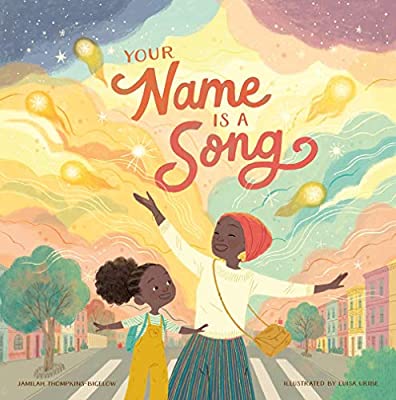
Your Name is a Song by Jamilah Thompkins-Bigelow illustrated by Luisa Uribe

Standard
Your Name is a Song by Jamilah Thompkins-Bigelow illustrated by Luisa Uribe

song

An amazingly empowering simple story that breathes pride and beauty in to names and our identities.  The 40 pages are a celebration of the rhythm of our names and the dreams and hopes that they contain for us.  Perfect for kindergarten to second graders, readers of all ages will find something valuable in this book.  Those with “common” names might reevaluate what their names mean or why they were so named, children with “unique” names will find the music and confidence to ask others to learn their name correctly, older kids might reconsider shortened nick names, and we all inshaAllah will make more of an effort to get people’s names pronounced right.

3A20341F-991D-4929-9A52-D9794E284880

A little girl has had an awful first day of school.  As she stomps toward her mom at dismissal.  No one could say her name.  Not even the teacher, it got stuck in her throat.  Her mom gently reminds her stomping is only for dancing, and tells her that her name is a song.

034DED6F-D931-4FB1-ADC0-15006AC8EAC2

The little girl is skeptical, but as they say people’s names on their way home, and find the magic and rhythm and beat in each one, they address the horrible things that have happened to the girl that day regarding her name.  At lunch girls pretended to choke on her name, and later one boy said her name was scary, some even tell her, her name sounds made up.

86E8B8E7-5336-4D72-BAC3-174F2B5B9AA2

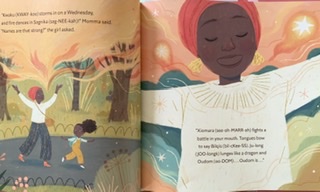
Her mother explains that some names come from deep in the heart, not the throat and cannot be choked on, that names are fire and strong, and that names are made from the sky when our real names were stolen and so new ones have to be dreamed.

8D42050F-B9BA-4813-8BD6-CB543566748A

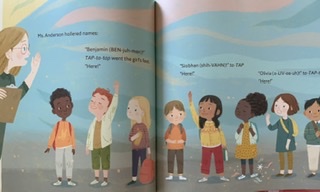
All the way home they go through names, diverse names, beautiful names.  The next day she doesn’t want to go to school, but she has a song to teach.  When her teacher starts calling  out names, the little girl starts tapping the rhythm, when Ms. Anderson starts to struggle on the little girl’s name, she starts to sing it.  She explains that her name is a song, and that she will teach it to them.  The other children then ask her to sing their names. And with a smile on her face, it is music to Kora-Jalimuso’s ears.

58B39FE0-63CA-4196-9452-4C64B517BAAA

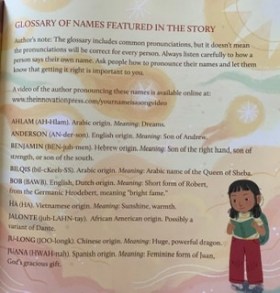
I love that there are three pages of the names mentioned in the story and their origins and meanings listed.  I also like that the little girl’s name is not revealed until the end.  The pronunciation of the names is in the text, all of them, even Bob.   And when I read the name Trayvon, I felt an added weight of saying people’s names, breathing them into our lives and not forgetting them.

74247213-AEE1-464E-A8C4-DE0ECB824335

The family could be Muslim based on the mom’s head wrap.  The author is Muslim and there are Arabic and Islamic names included in the story.

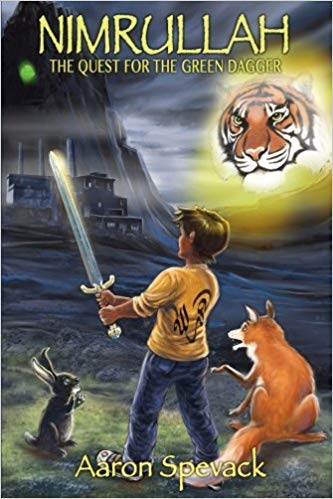
Nimrullah: The Quest for the Green Dagger by Aaron Spevack

Standard
Nimrullah: The Quest for the Green Dagger by Aaron Spevack

nimrullah

Oh this one was hard for me to finish.  It was the only thing I took to keep me entertained on a 7 hour plane ride in February as I was determined to read this, and even between the going and return flight, I couldn’t force myself to get through it.  Four months later out of sheer stubbornness I finished this 204 page book and I’m not better for it.  If it was your thing, I’m glad for you, but I didn’t get it, I don’t know what age group I’d even suggest it for, and for all the potential it could have had in being a fantasy series with religious overtones like Chronicles of Narnia by C.S. Lewis or some grand adventure with moral highlights, for me it was just a simple story made complex by huge religiously vague passages and too many dozens of characters.

SYNOPSIS:

The bare bones of the book is pretty straightforward.  Much like even Lord of the Rings or any basic video game, the main character has to do this, then do this, then do that to succeed and win and reach the end.  In this book it is a ten year old boy named Ahmad who crawls under the mimbar of his Massachusetts mosque and finds himself in a land of talking animals who need him to go on a quest to save their way of life.  His sister Amina also finds her way to this enchanted land and Nimrullah’s garden, but they have little interaction with each other or with Nimrullah, a tiger and head of the Dar al-Ashjar folk.  Along the way Ahmed meets beavers, and snakes and rabbits, and dragons, all with names and random tidbits of information flung in, but no real purpose or back story or attachment.  Ahmad is given a book by a turtle that will guide his internal journey, that quite often Ahmad doesn’t understand and the author doesn’t even share the text so the reader doesn’t understand, and when the author does share the text it is paragraphs and pages long, that what it means is baffling to me as an adult, let alone any elementary aged child.  The point of the journey is to get to a green dagger that is on an island in a crystal sea, but he isn’t going to an island to get it, he is going to a mountain and then a cave.  The villains are the Kadhibun that mine crystal and enslave the animals from Dar al-Ashjar in factories destroying the crystal sea, and thus the environment and animals’ way of life.

WHY I LIKE IT:

I love what the author tried to do.  Even comparing it to C.S. Lewis’ work gave some hope that Muslim children would find a surface level adventure story to fall in love with, and be compelled to understand the symbolic undertones of religion, morality and faith.  However, it not just fell short, it never really gave itself a chance.  There is too much telling and not enough showing.  All the characters and animals and references to things are not explained and lose the reader, and even when I would go back I wouldn’t find concrete points to fall back on.  There are too many characters that are just name dropped and become more words to skim over.  Major battle scenes are never detailed, and the narrator resorts to saying, “it would be hard to explain.”  Characters are trusted, but no reason to trust or mistrust them is provided. Litany’s are to be recited, but aren’t shared. “Ahmed opened his book again, and started reading the commentary, which contained the litanies.  Their details cannot be mentioned here, as such a sword cannot be handed to anyone.” There is a litany of the mountain, litany of the cave and a litany of the crystal sea.  But, apparently the litany of the sea is the same as the cave one, huh? It really is a mess, I’m sad to say.  It builds up to something and then just lets it drop.  On top of that, and now I’m just ranting, there are no page numbers!  

The overall moral of Ahmad learning self contron and slaying his ego and trusting Allah and being patient is all there, but it is so hidden and muddled that I don’t think the average reader will find it inspiring or triumphant.  It is almost like the author tried to put a ton of Sufi knowledge into a children’s book, but forgot to simplify it for children.  Just having the framework of a ten year old boy surrounded by talking animals isn’t enough to deliver the message, the message itself has to be palatable for kids too.  And basic writing and story telling are critical as well.

FLAGS:

The book is clean

TOOLS FOR LEADING THE DISCUSSION:

I wouldn’t use this book for a basic book club, I couldn’t even get my 9 year old son who reads over 300 pages a day to get past the first third.  If I am missing major Sufi tenants, which I definitely could be as I know very little about Sufism, and this book is a foil for much bigger and more critical concepts then perhaps someone with Sufi knowledge teaching children in a clever way, will find this book useful, unfortunately I’m not that person, so I think I’ll have to pass on suggesting the book to others.

Other Words for Home by Jasmine Warga

Standard
Other Words for Home by Jasmine Warga

other words for home.jpg

Three hundred and forty pages written in verse that beautifully consume you and leave you emotionally changed and vulnerable and humbled all at once.  The book claims it is for middle grades, but I think middle school will appreciate it more, and I sincerely hope everyone of all ages will take a couple of hours to fall under the spell that is woven to tell a story of a refugee leaving home and starting anew in America.

SYNOPSIS:

Jude is a 12 year old girl living on the beach in Syria, watching American movies with her friends and hanging out at her dad’s store.  With an older brother and a little sister on the way, life as told from her own perspective is pretty good.  Until it is not.  Until the crimes they only hear about happening in Aleppo and Damascus start to hit closer to home.  Until her brother starts sneaking out to meetings with other youth hoping to change the politics of their country.  Until a raid almost catches Jude and her brother and her parent’s decide it is time for Jude and her mother to journey to America, for a little while, to visit her mom’s brother and deliver the baby.

America is not like it is in the 90’s movies that Jude loves: Pretty Woman, Legally Blond, Miss Congeniality.  Her American aunt and her Uncle that seems to have forgotten his Syrian upbringing, are gracious and welcoming and their daughter, Sarah, who is less than a year older than Jude waxes and wanes in her approach to her cousin.  Adjusting to school, life without baba and her brother, and all the other adaptations that moving to a new country entail are brought to life through Jude’s eyes and understanding of the world around her.  As she comes of age and decides to wear hijab, as Islamaphobia shakes her sense of justice, and her little sister is born, the reader sees her grow and change and mature and find themselves hoping that she will soar.

WHY I LIKE IT:

I love that the style of the story telling somehow gives life to so much.  With verse some things are highlighted in detail and other things skimmed over and yet at the end, not only do you feel like you understand Jude, but a lot of the side characters as well, which caught me off guard.  Truly the writing is strong and deliberate.  A lot of the politics and war crimes occurring in Syria are not detailed, and I have to assume that is because the point of view is a 12 year old girl that is blissfully in her own world.  I imagine this is also why the target audience is listed as 8-12 year olds, because it simplifies a truly horrific situation.  Also because despite moments of raw vulnerability, the book stays pretty optimistic and hopeful.  

I like that the characters are Muslim, and that the mom scolds her brother for not going to the mosque.  The book does talk about Jude’s period starting and thus Jude starting to wear hijab, which is one of the reasons I feel like early middle school might be a bit more appropriate age group.  There isn’t too much talk about faith and Islamic beliefs, but a few tidbits are sprinkled in, prayer, not eating pork, modesty.  The book is not gender exclusive, but I think girls will gravitate much more to Jude’s perspective, experiences and voice.

The only thing I found a bit off is that the book takes place in modern time, present day, yet none of them have cell phones or social media.  Jude Skypes her dad, yet writes letters to her friend back in Syria and is distraught when they don’t have a forwarding address to send them to after her friend also leaves home.  It seems that social media, email, a cell phone number, something would be available for them to all keep in touch.

FLAGS:

There is mention of Jude and her friends having to sneak in to see Pretty Woman because Julia Roberts is a prostitute, and mention of blood between one’s legs and periods starting.  The book otherwise is pretty clean.  It hints at her kind of crushing on a boy that is in the play with her, but nothing more than friendship is explored.  Violence mentioned is minimal and language is clean even when dealing with hate crimes in America.

TOOLS FOR LEADING THE DISCUSSION:

There is a good chance that next year the students joining the middle school book club will be all girls, so if that is the case and the school counselor feels all the girls can handle the puberty aspects mentioned I would totally do this book.  The book reads very quick and might be a good way to get new kid to give a book club a try as well.

Author’s website: http://jasminewarga.com/about

Q & A with the Author: https://www.publishersweekly.com/pw/by-topic/childrens/childrens-authors/article/80127-q-a-with-jasmine-warga.html

Interview with the Author: https://www.hbook.com/2019/04/authors-illustrators/publishers-previews/spring-2019-publishers-preview-five-questions-for-jasmine-warga/


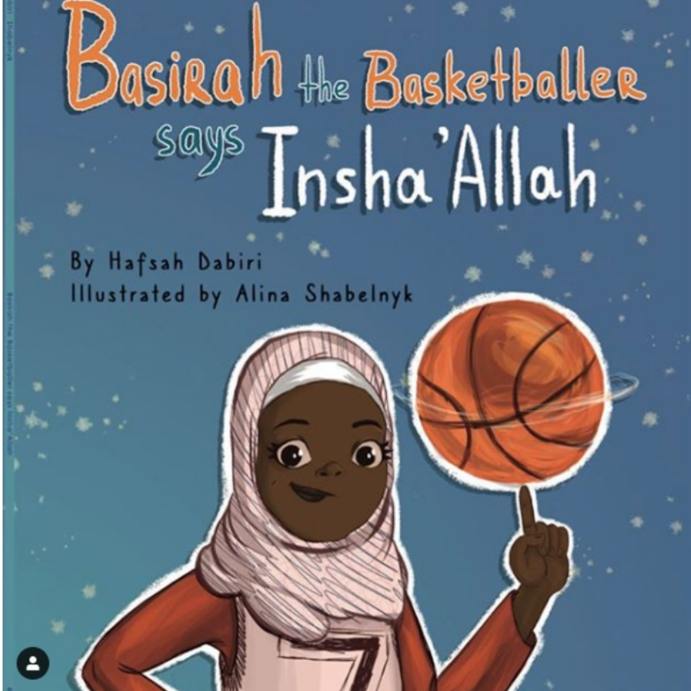
Basirah the Basketballer says Insha’Allah by Hafsah Dabiri illustrated by Alina Shabelnyk

Standard
Basirah the Basketballer says Insha’Allah by Hafsah Dabiri illustrated by Alina Shabelnyk

basket.jpg

Another sports book starring a smart girl with a supportive father, seems like a trend, and I like it.  The book is relatable to ages 5 and up whether they play basketball or not, and will remind even slightly older children how “insha’Allah” really works.  It features a girl, but boys will gain a lot from the book as the lessons are for us all.

basirah1

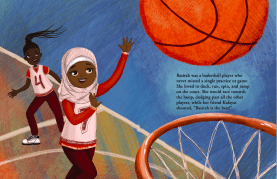
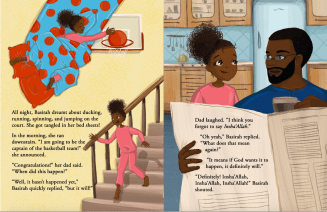
Basirah loves basketball and with supportive teammates and mad skills, she should be a shoo-in for team captain.  But when her dad reminds her that if it hasn’t happened yet she needs to say insha’Allah, she realizes the power of leaving things to God.  

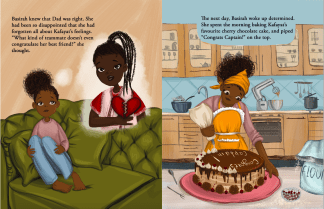
Testing out her new knowledge of asking God to make happen things she really, really wants, over many of the 30 pages in the story, makes the climax that much stronger and her dad’s wisdom that much more memorable. I’m trying not to spoil the story, even though it is a children’s picture book, it isn’t without a bit of tension and resolution that really makes the book shine.

basirah2

This book can be taken at face value with a little bit of a lesson for little ones, or a lot deeper for more reflective readers.  Understanding that things we ask God for often come or don’t come to test us, is a lesson we all need. I hope if read with an adult, the adult will also push the listener to consider why we should do things in the first place, what are intentions are, as Basirah leaves the door open for that discussion at the end, but doesn’t quite articulate it for independent readers.

basirah3

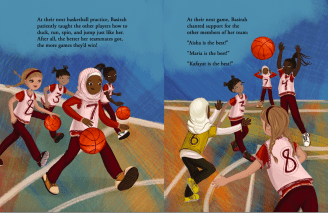
I love that at home Basirah is not covered, but is when she is out.  I love that her school is diverse with students of different colors and head coverings and that her coach is female and a muhajaba as well.  I love that Basirah and her father seem incredibly close, and that she listens to him, and he to her, before lessons are espoused and course of action plotted.  The book is not preachy, but lessons are there and the reader will get “it” right along with Basirah allowing her strength to radiate off the page and inshaAllah empower the reader as well.

basirah4

I find it interesting that the book doesn’t mention Allah and uses the word God, given that the phrase the book focuses around is insha’Allah.  I would imagine the intended audience is Muslim, but there is not specific mention of Islam.  It would work for non Muslims, but I think they would wonder why she says such a phrase and where it comes from.

basirah5

Basirah is presumably in middle school, as she has multiple classes and can bake a cake independently, her age seems a bit fluid, but many 11-14 year olds do tend to be independent in some areas and rather clueless in others, so while I did notice that she seems very naive in knowing what insha’Allah means and how it works in some parts of the story and very mature, and hijab wearing, and willing to grow from her situation in others, I’ve concluded it is plausible.

The book is 8.5 x 11 vertical, well bound, shiny glossy full color pages with clear and easily readable font.  The sentence length and amount of text on the page is not too overwhelming and the spacing keeps it inviting for new fluent readers.  

I love that Ruqaya’s Bookshelf (https://ruqayasbookshelf.com/) has new books out, three to be exact.  Whether the stories work or don’t work for you, I think their presentation and quality, give the books a longevity and find themselves being pulled out for different kids, at different times, when different lessons are needed.  They are well packaged in terms of illustrations and colors and size for the most part, and when I hear they are publishing new stories, I find myself ordering them without even reading the content synopsis.  Thank you for helping get these stories out, may Allah swt reward you!


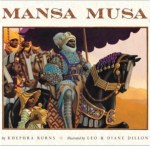
Mansa Musa: The Lion of Mali by Kephra Burns illustrated by Leo & Dianne Dillon

Standard
Mansa Musa: The Lion of Mali by Kephra Burns illustrated by Leo & Dianne Dillon

mansa8

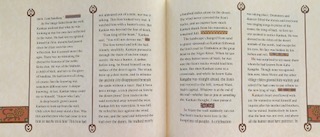
This beautiful work of historical fiction/folklore is both moving and visually breathtaking.  The 56 page book presents as a picture book, but with an AR 6.4 and the amount of text, it reads like a chapter book.  Thus, I’m going to review it as a chapter book, but keep in mind that it is hard bound, 11 x 9, horizontal and while there are frequent small story breaks, there are no chapter breaks.  

IMG_3078

SYNOPSIS:

There is little historical fact about Mansa Musa as a child, thus this story while rooted in fact about the time, about Mansa Musa as an adult, and about what is known regarding Mali and the Malinke and Tuareg tribes, is a work of imagined fiction.  The story begins with premonitions and dreams from Kankan Musa of the Kaba Kangaba tribe.  Kankan and his two brothers live with their mother, and do not know who their father was, a source of stress and teasing for the young boys.  Having just turned 14, Kankan is treated as an adult, but because he has yet proved himself as a hunter, he may sit with the adults, but not yet join their conversations.  Mali in the years after the great King Sundiata had passed away has begun to fade, but their wealth and hospitality still prospers in the desert. 

One day a desert nomad from the Tuareg tribe dressed in flowing blue robes appears and is welcomed by the village elders.  That night he regales stories about jinns, and the sea, and time spent in the desert, and fears he has for their King, when slave raiders tear through the night and kidnap Kankan.  When Kankan awakens days later, enslaved, the same mysterious man, Tariq al-Aya, again appears and buys him from the raiders.  Tariq vows to accompany Musa on his journey to learn who he is and the two spend seven years together learning about the desert, about the larger world, about themselves, in trial and test and challenges.

When Musa journeys back to his home, and Tariq disappears as mysteriously as he appeared, Musa must make himself known to the new Mansa of Mali and see if his wisdom and knowledge can ensure the success of Mali in the future.

IMG_3079

WHY I LIKE IT:

I’m not from Africa and my heart was cheering Musa on as if, my own families success was rooted in his growth and understanding of the world.  As a Muslim, I was proud to know of the success Mali found in Mansa Musa and the historical significance of his rule throughout time.   I wish there was more Islam in the book, his Hajj is well documented and thus tidbits of Mecca and his understanding of it is sprinkled through the story.  There is no talk about prayer or what Islam is, just that he is Muslim and that most of the villagers “had converted to Islam, but at the same time, they had not given up their traditional religious practices or their belief in the ancestors.”  It mentions at the end that he built mosques wherever he went, but prior to this it never mentions him spending any time in a mosque or worshiping in any way. 

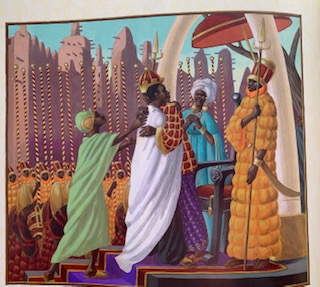
I love that the story is told like all great stories, it makes you want to settle in and drink up the details and imagery and got lost in the pictures.  The author weaves in cultural phrases and descriptions, that hopefully readers can unravel from the context as there is not a glossary.  There is a map at the beginning, and author’s note at the end that reveals what is fact and what is fiction in the story.

IMG_3080

FLAGS:

None

IMG_3081

TOOLS FOR LEADING THE DISCUSSION:

This book should be in every school library and used in classrooms to learn about West Africa, cultures, 14th Century, Islamic history, culture, you name it.  I think this book would work wonderfully in home school environments, where the child could dictate how much to supplement, how much to cover, and the wisdom shared could really be understood.  This isn’t a book that most kids would pick up and read, they would need prodding and guidance, but be better for it.  

IMG_3082

Escape From Aleppo by N.H. Senzai

Standard
Escape From Aleppo by N.H. Senzai

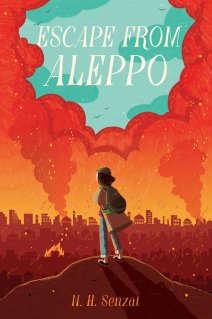
escape from aleppo.jpg

N.H. Senzai’s newest book (published in January 2018), gives a face and a voice to the grave situation in Syria.  Like Senzai’s other books, she uses the rich culture and history of a country to inform the reader, and a compelling front story to keep middle school readers entertained.  This 336 page book is not in the AR data base yet, but fourth grade and up should be able to follow the story and be able to handle the violence and destruction presented.  The story is unique in the genre, in that it doesn’t focus on getting to a safe country, but rather on the heroine’s journey to simply get out of a dangerous one, Syria.  The storyline is fairly linear with flashbacks of life before the war making the story informative, but not necessarily gripping.  I wanted to love it, but found myself forgetting about it when I stopped reading.  

SYNOPSIS:

Fourteen-year-old Nadia, has a fun full life in Syria: a large extended family, she stars in a commercial, has good friends, and a lot of opportunity and perhaps privilege.  All that, however, slowly disappears as civil unrest and ultimately war consume the country.  As a child she gets glimpses of the changes coming, but is able to still hide in her ignorance and focus on things like her nail polish and Arab Idol.  As food gets short however, she sneaks out to get bread with some cousins, and is hit by shrapnel.  While, her leg is able to heal, her anxiety of going out alters her life and makes her family’s attempt to get to the Turkish border later, a hard mental obstacle she must face.  Her inability to move quickly with the family on their covert escape route, and the bomb that hits their home, separates her from her family and leads to her getting left behind.  As she tries to remember how to get to the designated meeting location, she must navigate Syrian soldiers, rebel factions, ISIS, secret police, violence, hunger, and being lost.  With her cat, Mishmish, for companionship, Nadia reaches the location only to find that her family has left for Turkey and will wait on the border for her.  Luckily for Nadia, amidst this devastating news, she meets an old man, Ammo Mazen, and his Donkey, Jamilah, willing to help her reach the border.  Along the way the two face long odds of surviving, not only from the war around them, but also the weather, the old man’s illness and lack of food and water.  As they journey through Aleppo, snippets of history and culture are shared, two more children join their journey and mysteries as to who Ammo Mazen really is come to light. 

WHY I LIKE IT:

The book’s premise is simple, allowing the reader to focus on Nadia and her companions and not get bogged down in the political factions and names and alliances.  The book is not about all of the aggressors, it is about a girl trying to reach her family, and the growth and ability to choose kindness that she learns along the way.  The girl is not religious, but culturally it is a part of her environment.  Her companion Tarek, is religious and he spouts Islamic tidbits as they journey, adding some knowledge to be conveyed about Islam which is sometimes informative and sometimes comical as his character is often a bit awkward. 

I love the cultural beauty that is conveyed, and the heaviness in Syrian’s heart that “What had taken five thousand years to build had taken less than two to ravage.” The saving of historical artifacts, the showing of cooperation between people of different faiths as the characters meet in mosques and churches and meet people of all backgrounds, makes the loss of humanity and history so palpable. 

I also love that there is an Author’s Note at the end.  The whole book I kept having to shush my mind as I felt like this was the story of Mariam in Senzai’s book Shooting Kabul.  Yes that takes place in Afghanistan, but it was so similar in that it was a girl getting separated from her family in an escape attempt during a war, and sure enough she mentions that, that is where Nadia’s story grew from.  

FLAGS:

There is a lot of violence and death, but nothing gruesome or sensationalized.

TOOLS FOR LEADING THE DISCUSSION:

This would be a great Book Club choice, because it would encourage readers to keep at it and finish the book.  While reading it, the book is wonderful, but for some reason, I had to urge myself to pick it up and start it again.  Perhaps it is because I have read all of Senzai’s books and I was pretty confident all would end well, or because I’ve read quite a few books now about war and refugees and Syria, but while it reads quick it did take me longer than it should to finish it.  I think parts of the book that detail a lot of the skirmishes and fighting might be hard to visualize in the mind’s eye so as an assignment or Book Club selection would benefit the readers to allow them to discuss all the mini climaxes, understand the terrain and architecture, and to really put themselves in Nadia’s shoes.  The transformation in Nadia from a brat, more or less, to a compassionate, strong, determined young woman is a journey that I would love to hear feedback from other kids about.  I think they would definitely have thoughts and opinions that would really bring the humanity of us all out, and make us connect with the plight of those trying to get out of such horrific circumstances.

Publisher’s Page: http://www.simonandschuster.com/books/Escape-from-Aleppo/N-H-Senzai/9781481472173

Teaching Guide: https://www.teachervision.com/teacher-discussion-guide/escape-aleppo-reading-guide

Author’s Page: http://www.nhsenzai.com/escape-from-allepo/