Tag Archives: growing up

My Own Special Way by Mithaa Alkhayyat retold by Vivian French translation by Fatimah Sharafeddini illustrated by Maya Fidawi

Standard

FullSizeRender (83).jpg

A mainstream Early Reader book with a cute little muhajaba on the cover and a premise that she’ll be a big girl when she wears hijab seemed like a book I should adore.  And while it isn’t bad, and I’m glad it was in the library,  really I’m not sure how I feel about it.

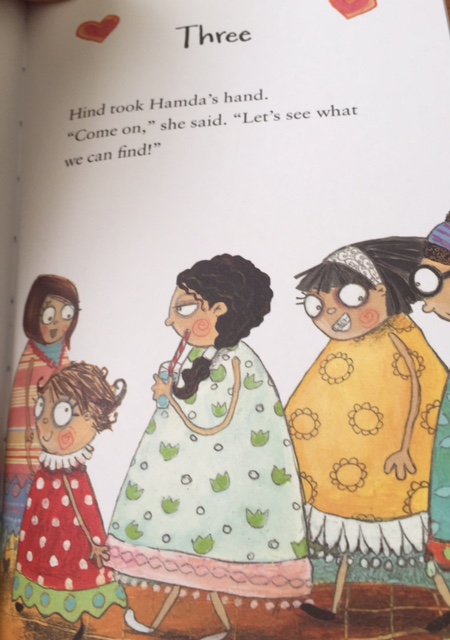
In someways, I’m just confused.  Why would you pick one of the characters to be named Hind, in a book urging readers away from picture books and into chapter books, it isn’t going to be pronounced with a short i sound, it is going to be pronounced like a “be-hind,” umm not so good for the age demographic you are trying to show another culture to, there will just be giggles and jokes.  Also, many of the illustrations are cute, but what is wrong with the dad and with Jamila’s sleepy eyes, they kind of border on creepy. And not the creepy, in a cool way, more like creepy in an awkward way.  And finally, with an author, a retold by, and a translator, and presumably a ton of editors and proofers at Orion Children’s Books, I found veil to be a very formal word to use throughout.  It does say it is a scarf at one point, but the word of choice throughout is veil, and I think to be culturally accurate, hijab would have been a better choice.  Even for English readers, scarf would have been a better fit.

The book is 62 pages, there is no glossary and it is not AR, but is a transition early reader book for kindergartener and first graders.

SYNOPSIS:

Little Hamda wants to spend time with her four big sisters, but they all say she is little and have other plans.  When her mom reminds her that they were small at one time too, she realizes that when they were small they didn’t wear hijab, or in this book, a veil, and now they are big and where one when they go out.  So, in her mind, once she starts wearing one, she too will be big, and thus the challenge of finding a way to wear it comfortably begins.  She is helped and supported by all her family and finally she finds her own special way to wear her veil.

I like that it is a mainstream book trying to include some diversity.  The family is relatable and the themes universal even if portrayed in a minority muslim framework.

FullSizeRender (80)

WHAT I LIKE ABOUT IT:

I love the premise of the book and that it is very clearly Hamda’s idea to wear a veil, no one is forcing her.  The text and illustrations align to show the girls cover when they go out, not in the home.  The dad needs help at one point finding his shoes to go to the mosque.  However, it doesn’t tell what a mosque is, or explain that the family is Muslim and wearing hijab is an Islamic act, which might be a comprehension block for young readers.

I really go back and forth on the illustrations.  On the first reading I thought they were creepy, when I went back to write the review they were kind of cute.  When I asked my kids, two said they were fine, and one said they were ugly and was positive I am the only one to have ever checked out the book.  Yeah.

FLAGS:

Fine, and Islamically nothing erroneous.

TOOLS FOR LEADING THE DISCUSSION:

Obviously not a book club level book, but I would be very interested to have some first and maybe even second graders read it and give me feedback, like I said I’m on the fence with this one.  Check to see if your library has it, read it, have your kids read it, and let me know.
FullSizeRender (82)

My Mum is a Wonder by Michele Messaoudi illustrated by Rukiah Peckham

Standard
My Mum is a Wonder by Michele Messaoudi illustrated by Rukiah Peckham

my mum.jpg

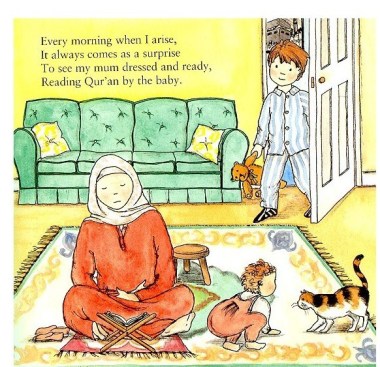
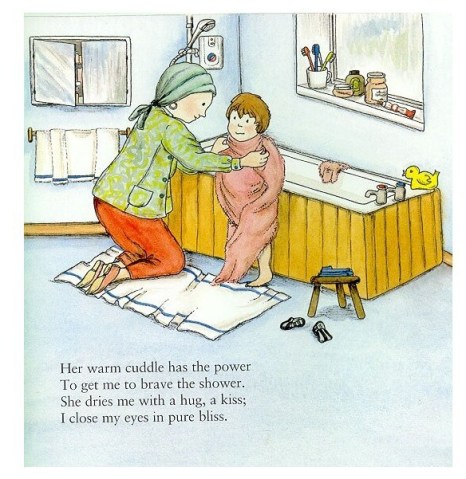
This book published in 1999 was one of the first books I remember reading regularly to my Sunday school class, and reading it now as a mum myself makes it warm me all the more.  In 34 warmly colored illustrations, this 8×8 book shares the story of how a little boy sees his mom.  How impressed he is by her and how truly he loves her for all that she does, all that she is, and all that she shares with him.

inside-mum.jpg

As the story progresses from what she does within the home and family, to what she does for others, the little boy also imagines himself all grown up and his mum as a nan.  He imagines that she will need him and he is ready and willing for when that time comes, to take care of her.

mum-inside-3.jpg

The book and illustrations target ages 3-6.  Written in rhyming couplets, four lines per page, the story moves at a steady pace and the pictures are detailed and familiar enough to engage most kids at bed time or in small settings.

mum inside 2

There are little Islamic specific tidbits sprinkled throughout that give parents or readers a chance to use it as a more specific teachable moment.  Saying “salam, reading Quran, thanking Allah for the food they have, praying salat, giving charity, visiting the elderly, celebrating eid, obeying her, and caring for her in her old age to achieve jannah, inshaAllah.


Hamza’s First Fast by Asna Chaudhry

Standard
Hamza’s First Fast by Asna Chaudhry

hamza fast

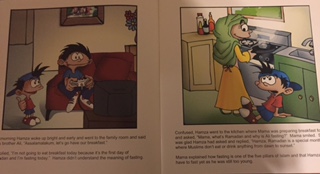
Hamza’s First Fast starts out a bit wordy as the author tries to explain what Ramadan is and who is required to fast and why, before getting to the actual story line of the book.  The premise that Hamza’s siblings are fasting and that Hamza doesn’t know why or that it is Ramadan is a little questionable to me, but I doubt most 2-6 year olds are as cynical as I am.  Once the story gets going, however, the amount of text on the page drastically decreases to fit the younger demographic and the point of the book is charmingly exposed.

hamza4

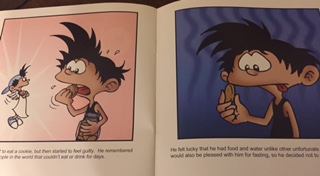
Hamza understands that he doesn’t “have” to fast, but decides he “wants” to try. He prays with his dad, his sister helps him to understand how fortunate he is to have food, he goes outside to play, and he even tries to get lost in some video games.  But, it still isn’t time to break his fast and he is hungry! As his frustration mounts he decides to sneak a cookie, but when he gets it, he will have to decide to eat it or not.

I like that it is realistic that fasting for kids is hard, and can be really frustrating. It still encourages them to try, and the family members support him which is nice.  It also stays positive framing it that Allah will be pleased if he fasts, not that Allah will be disappointed if he eats the cookie.  Overall, there isn’t much religious rationale for why we fast and the Islamic traditions celebrated as the book stays on age level in what Hamza does.  This leaves the door open for discussion, lessons, insights, and interpretation, but does not weigh the book down with it.

hamza3

Perseverance is the theme of the story and that it feels good to do something hard.

Amina’s Voice by Hena Khan

Standard
Amina’s Voice by Hena Khan

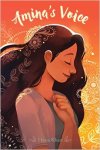
amina voice

This book really marked a shift in Islamic fiction for me and the genre.  First of all I was waiting for the book to come out.  I didn’t stumble upon it or hear about it from someone else.  I knew when it was going to be released, and I knew I wanted to read it. Additionally it was the first books published by Salaam Reads, an imprint of Simon and Schuster. Which according to their website was “founded in 2016, Salaam Reads is an imprint that aims to introduce readers of all faiths and backgrounds to a wide variety of Muslim children and families, and offer Muslim kids an opportunity to see themselves reflected positively in published works.”  This is big, huge in fact.  The bar has been raised, and a platform has been given, no more excuses.

Alhumdulillah, Amina’s Voice is a beautiful 197 page book for children ages 8-12.  The book is not AR, but probably will be in a few weeks.  I think it is spot on for 3rd through 5th grade in terms of content, message, and appeal.  The book caters to females and Muslims, but naturally is not limited to those two demographics exclusively.  There are characters of a variety of ethnic and religious backgrounds in the novel that play significant roles in saving the day and keeping the book powerfully optimistic and inspiring.

SYNOPSIS:

Amina is starting middle school and everything is changing for Amina. Her friends are acting different, her older brother is skirting with trouble and her religious uncle is coming to visit from Pakistan.  Internally, she doesn’t like the spotlight but desperately wants to get out from behind the piano to sing.  All of this combines in a climax that pivots around the destruction of the mosque she attends and her having to find her voice, and use it to take center stage in her own life.

WHY I LIKE IT:

There is a lot going on in the book, but it doesn’t get over whelming with Amina’s voice keeping the reader focused on her and her view of the events around her.  The author does a good job of getting inside a 12 year-old girls head without being condescending or heartless.  The reader feels her stress that she is losing her best friend, Soojin to Emily, a girl who used to torment the two “ethnic” girls, without belittling her concerns.  You also feel her love of Islam and struggle to understand if music and singing is permissible within Islamic rules.  The book is realistic fiction with school, friendships, and family guiding the story.  Everything from the ups and downs of group projects, inside jokes between siblings, and trying to pronounce the big HAA in Arabic.  The macro of middle elementary years combined with the micro facets of culture, religion, and current events, and you speak to a section of readers that will connect with Amina and what she goes through in a very authentic, relatable story.

The only points that gave me pause is the premise and music in the book.  It is a point of disagreement amongst nearly every group of Muslims, so to have the Imam sitting and listening to her play the piano, is a bit hard for me to accept as the norm, no matter how cool Imam Malik is.  Additionally, I wish that Amina’s mom had some depth, and the relationship between Amina and her uncle, Thaya Jaan, was fleshed out just a tad more.  In both cases I felt something was lacking, and I wanted more.

FLAGS:

Nothing major, but a few minor issues, that a parent may want to be aware of for younger readers.  Mustafa, Amina’s brother, is seeing skipping Sunday school class and reeking of cigarette smoke.  He denies it, and the issue is definitely not glorified.  There is also crushes discussed amongst Amina’s friends and when Amina spills a secret, she has to own up to it and work it out to maintain her friendships.  The destruction of the mosque could also be upsetting to younger readers.  It isn’t graphic, but her emotional response and the intensity of it, is the climax, and a very real part of our world sadly. For parents, this fictional vandalization could possibly be a great place to start a discussion from if your children are somehow unaware of the current status of Islam in the west.  It also shows that people are good, as the whole larger community, comes together to show unity, love, and respect are values to us all, alhumdulillah.

TOOLS FOR LEADING THE DISCUSSION:

This book would be perfect for a 3rd through 5th book club.  If I was starting a new book club I would start with this book.  It has it all. It has real issues, religious issues, universal issues, and heart.  All while staying on age level and all in a realistic fiction safe space to have an opinion about objectively.  The discussions after the book is read will flow naturally, but just in case:

Reading Group Guide:  http://www.simonandschuster.com/books/Aminas-Voice/Hena-Khan/9781481492065/reading_group_guide

Author’s Page: https://www.henakhan.com/