Tag Archives: fruit

Everything Grows in Jiddo’s Garden by Jenan A. Matari illustrated by Aya Ghanameh

Standard
Everything Grows in Jiddo’s Garden by Jenan A. Matari illustrated by Aya Ghanameh

This sweetly illustrated 32 page rhyming book starts off introducing a little girl living in one place, and having a home in Palestine that she has never been to, but loves.  The book then becomes pretty universal with her and her grandfather talking about what grows, his “green thumb superpowers,” and the magic of planting small trees that change and produce. The pages then add in more Arabic words of what is grown, and then when Jiddo is drying his eyes recounting why he had to flee his home and his roots, I too, found I was emotionally invested in light of everything current and past, and the simple words weaving a heartfelt story of family, connection, and home. I do wish that there was some Islam in the text or illustrations: a dua, a plea to Allah swt, a hijab on a main character not just on background memories, but there is not. There is also nothing overtly political or named in the text. The backmatter does discuss the Nakba without naming names and highlights the author’s inspiration, but inshaAllah nothing that will get the book banned or kept off shelves. The rhyme and cadence are pretty good, it doesn’t feel overly forced, but when reading aloud in a group, as always, I suggest practicing a few times to make the flow consistent.

The book starts with a beautiful spread of a mother and daughter looking through a photo album, and imaging going to Palestine one day, the subsequent pages show how Jiddo’s garden helps bring Palestine to them. The “sour green janarek plums,” “crunchy green khiyar,” and “plump red bandora.” Mama makes warak enab and Teta sings for more.

One day the little girl wonders how her Jiddo learned to grow everything and he shares that he learned from his father how to care for the land.  She then wants to know why they left Palestine, and he says, “our land was taken from us…and our family had to flee.” The hope is to return, the illustrations show the key to their occupied home being held on to, and reinforces the symbolism that Palestinians are like seeds that will flourish wherever they are, reaching toward the light.

The book contains a glossary with words written in English and in Arabic script, and an author’s note in the backmatter with presumably personal photographs of the author and her family.  I read a digital ARC and look forward to release day for my preorder to arrive.

These Olive Trees: A Palestinian Family’s Story by Aya Ghanameh

Standard
These Olive Trees: A Palestinian Family’s Story by Aya Ghanameh

these olive

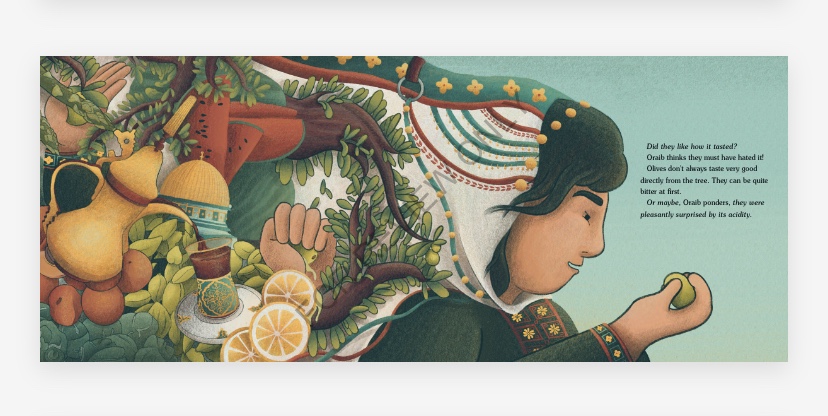
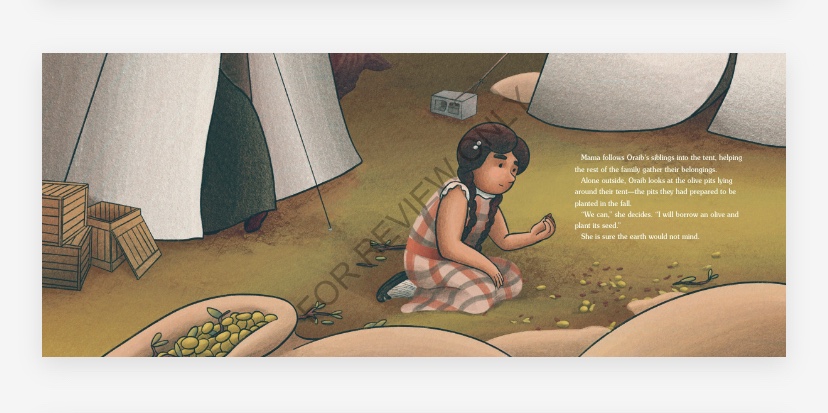
This stunningly illustrated OWN voice Palestinian book for early elementary kids is an important story and I love that it is coming out to the world, but I do have some issues with the literary aspects and target demographic.  The story bounces around from being factual about the brining and curing process of turning the bitter olives into numerous things, to Oraib’s present life in the refugee camp, to memories of the family’s life in Al Tira.  When war once again drives the family from their home in the Balata refugee camp, Oraib, plants seeds and vows to return one day to harvest the fruit.  The language at times is very mature and complicated for ages 5-8, I felt uncomfortable with the family moving being attributed to war and not occupation, and at one point it clearly articulates there are many olive trees located outside the camp and that they are leaving the seeds that would be later planted, so why is the climax her asking the earth permission to plant one more and for the sky to water and care for it until she can return? The backmatter allows the book to be used to spread awareness about Palestine and the process of harvesting olives, but the illustrations will appeal to younger readers, and the concepts contained seem more geared for slightly older ones.  There is nothing religious in the book, there is depiction of the Dome of the Rock in an illustration and I believe the author/illustrator identify as Muslim.

img_8540

The writing style of the book is fairly surface level with concepts not fleshed out to allow difficult concepts to reach younger readers.  When describing the taste of the fresh olives, Oraib wonders if long ago people were, “pleasantly surprised by its acidity.”  No insight into what that acidity tastes like, or bitterness, or what curing and brining means.  Often the paragraphs seem long winded and repetitive, adding very little to advance the story.

img_8541

There is little lyricism in the text, and the first time some tries to peek out, the metaphor is quickly abandoned, and it is notable that it doesn’t return.  The occasional enjoying of the bitter fresh olives is juxtaposed with the surprising joy occasionally found in the camp, it seems that with the uprooting of the family once again at the end, this thread would have been a natural inclusion to reinforce the patience for something better to occur.

img_8544

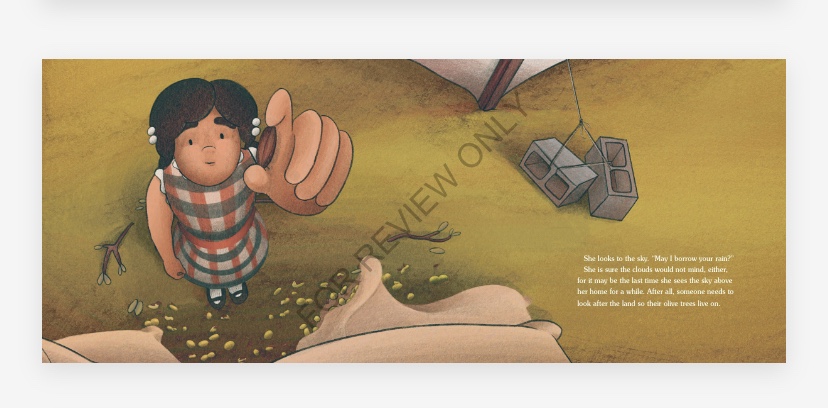
The dramatization of asking the earth and sky when planting a seed upon their departure, didn’t make much sense to me.  It is noted there are olive trees already there, the illustrations show the ground littered with seeds that were to be planted had they stayed, so why not have the little girl pocket some of the seeds to take with her wherever they go.  That is after all what the mother is doing at the beginning.  Why not have the little girl invest in the cause herself and share in that ownership that they will always endure and prosper. The personification of the earth, sky and rain also doesn’t seem to fit the flow of the story, so much is internal observation and reflection of the main character, that this seems like an attempt to bring it back to a child’s level that instead just reads disjointed.

img_8545

I might have missed something as I am not Palestinian, but the book to look at is incredibly beautiful, I just don’t think it will be read and remembered by young children.  One of my first thoughts when reading it was that it was an early draft, but it is to be published soon and this review is based on the most recent version sent to me. I also wondered in the back of my mind if the book was allowed to be used to check a box, and wasn’t given the editing and polishing that it deserved on purpose.  It depresses me to even think that, and I guess I’ll never know, but I would love to hear your thoughts, and I do hope you will request your local libraires to shelve the book as a show of support to authentic Palestinian voices.

img_8546

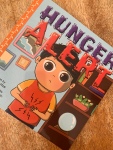
Hunger Alert by Shazia Afzal illustrated by Sania Hussain

Standard
Hunger Alert by Shazia Afzal illustrated by Sania Hussain

img_6919

On my first read through, this book came across as a bit text heavy and the presentation didn’t quite fit with the content for the target audience, but when my seven year old read it, then reread it, and my 12 year old picked up and read it and both said, “it’s good,” I realized, the target audience is not little kids, nor is it adults, it is kids who have fasted and have felt the pangs of hunger.  The character is getting through his first day, but the relatability is for kids everywhere fasting for the first time the hundredth time and everywhere in between.  It is Islam centered, I appreciate the healthy food temptations and the unwavering that fasting needs to be done, but as an adult and an educator, so often I wanted to interject Islamic touchstone to getting through the day asking Allah for help, talking your self up and increasing your determination by knowing the Angels are recording your struggles and you will be rewarded in the akhira, and while Quran is read, and a surah loved, and Islamic phrases included, the focus of the book is a little boy in a very idyllic family trying to keep hungry thoughts away. The small 8 x 8 soft back book with 22 thick cardboard pages would be a bit hard to share at story time, but the simple concept story is fine in smaller groups and at bed time.

img_6920

The books starts with Ahmed fasting for the first time in Ramadan, he has a list of things he needs to complete his fast: 1-Keep busy, 2- Don’t think about food, and 3-Stay away from the kitchen.  I found when reading it to my younger kids I would pause here to discuss why we fast, and that we are doing it for the sake of Allah, so we need Him to be successful, not distractions.

img_6921

Ahmed starts with reading his favorite book about a charitable boy, the illustrations though had baskets full of shiny, big, read apples.  “Grr, Hunger Alert!” He runs to his brother’s room to keep busy with a soccer video game, but the prize on the screen are big, yellow bananas. “Grr, Hunger Alert!” This continues throughout the day, including while reading Surah Rahman, and the pomegranates trigger yet another Hunger Alert. When Grandpa asks him to take strawberries to his mom and his mom is in the kitchen, each of his rules will have to be broken.

img_6922

With iftaar approaching and fruit chaat waiting, Ahmed will have to persevere to complete his fast.  There is a glossary at the back and the book you can search online to find where the book is available near you http://www.compassbooks.ca

img_6923