Tag Archives: fairly clean

Say Something, Poupeh Babaee!: A Graphic Novel by Haleh Massey illustrated by Ghazal Qadri

Standard
Say Something, Poupeh Babaee!: A Graphic Novel by Haleh Massey illustrated by Ghazal Qadri

I had planned to just flip through this 176 page middle grade graphic novel to see primarily if there was any Islam mentioned, and if so, to see how it was framed. The blurb makes it clear it is culturally Iranian immigrant in focus, and set during the Muslim ban.  The heightened intrigue is that it isn’t just metaphorically about finding your voice, the character is labeled as having selective mutism and the author who is a clinical psychologist truly has her protagonist voiceless in nearly every setting for the majority of the book. The bright illustrations, and easy read though, had me reading the book front to back and finding that Islam is by-and large-not present. The flashbacks to her life in Iran show her wearing a scarf, and praying, and the memories are warm and inviting, with no internalized Islamophobia or political commentary, or Islamic practices at all following Poupeh to America. In fact when sought after news is finally heard the family exclaims, “it’s a Christmas miracle.”  It is hinted that the female cousin has a girlfriend, and the book features a lot of stereotypes about aggressive men, name mispronunciation, bullying for ethnic foods, and anti immigrant ideologies.  On the plus size it normalizes therapists, shows character arcs for the main and minor characters, and shows that inability to speak, doesn’t mean someone doesn’t understand.  While the book was better than I thought it would be in many ways, it ultimately didn’t have a climax, all the build up for two questions, really fell flat for me.  I also felt like while the Muslim ban was a fairly unique premise (shout out to Kareem Between!) all the other tropes are overly done, and render the book forgettable even though the format of a graphic novel should make it a standout.

SYNOPSIS:

Poupeh Babaee has come to America from Iran alone, her parents were held up settling their affairs, and they didn’t want her to miss more school, so she is sent ahead to stay with her aunt, uncle, and cousin. She understands English, but when she messes up the national anthem on her first day of school and is teased, she simply stops talking, not even to correct when everyone starts calling her “poopy baby.”  When the Muslim ban blocks travel for her parents to come, the fate of her family rests on being able to plead their case in an immigration interview. Yes, she is 10 and will be asked two questions to determine if her parents are terrorists or not.  There is teasing, tension with the cousin she has to share a room with, and a sympathetic therapist that flesh out the story of trying to get Poupeh to say something.

WHY I LIKE IT:

I like many of the pieces, and I like the format, but I really felt that the build up to the interview, the pressure she was under, was not warranted by the interview itself.  Had some commentary existed about the brevity of the interview or the chaos of America’s immigration policies perhaps it would have been worth the anticipation.  As written though, it felt rushed.  Same for the portrayal of the men in the story: from Poupeh’s own father, her uncle, to Trevor’s dad, all are aggressive, and I’m glad her own father apologizes, but again, it felt rushed and anti-climatic.  I don’t expect literary masterpieces from most mg graphic novels, but some of the “meanness” seemed abrupt for shock value, and made the cousin, the dad, the uncle read very inconsistent.  I had hoped a therapist author would have brought not just a storyline of mental health, in this case, selective mutism, but some nuance to the immigrant experience, moving beyond food, clothes, and names.  Speaking of names, I googled what Poupeh’s name means in English, and it really should have been in the book, or at least the backmatter.

FLAGS:

Stereotypes, racism, hate speech, hints and relationships, mental health, anger, homesick, bullying,

TOOLS FOR LEADING THE DISCUSSION:

The level and format would not make it a good choice for a book club read.  I probably would not unshelve this book, but I wouldn’t seek it out either.

Yours, Eventually by Nura Maznavi

Standard
Yours, Eventually by Nura Maznavi

It has been a while since I’ve read Austen’s Persuasion, and I should probably remedy that, but alas, here I am reviewing another adult, Desi-fied, Muslim tinged retelling, and am embarrassed to admit I was absorbed and invested, as if I had no idea how it would play out. Sure there were author liberties, but the heart of the story hits the same beats (that I recall) and works so well when adapted for our faith and culture. It isn’t halal halal, nor is it Muslim focused, the culture and cultural expectations are definitely more centered for the Pakistani American Muslim cast. The characters are all Muslim, a few wear hijab, they abstain from alcohol, date with intent to marry, attend Bismillahs, but they aren’t shown praying, or viewing life through an Islamic lens, or Muslim conscience. There are a few kisses and hand holds, and male/female close friendships, but for an adult read, the Muslim authored 400 page novel is pretty notably clean.

SYNOPSIS:
Asma is in her final year of Emergency Medicine residency and the pressure to get married is ever mounting. With her father making poor financial choices, he and Asma’s oldest sister Iman, are moving out of their Palo Alto mansion and heading back to Sacramento. Culture won’t let Asma live alone, so she is forced to crash on an air mattress at her youngest sister, Maryam’s house in the room of her three year old twin nephews. Asma feels it is her responsibility to take care of everyone since her mother passed away, but with the family splitting up, she has to decide for once, what she wants. Eight years ago she did what she was told and broke off her engagement with Farook. Unfortunately, she has regretted it every day since and never moved on. When of all people, Farook’s sister moves into Asma’s old house, a chance encounter brings the two face to face. When Farook starts courting Maryam’s sister in law, things get particularly tense. Throw in a dozen or more side characters, amp up the drama, and settle in to see how it all unfolds.

WHY I LIKE IT:

If my recollection of the original source material holds, it takes a while to get all the characters in their desired place and position for the story to sweep the reader away, and this version does the same. At times I worried that threads and characters were being overlooked, but by the end, most everything felt resolved. I did feel Fatima’s story was underdeveloped and showed Asma as being a bit of a bad friend, and there is no way three year olds would recognize someone from a picture taken 8 years earlier, but I know, romance books require some suspension of reality to work. The premise of the plot is even a bit shaky, but once you are rooting for the characters you aren’t too worried about why they need a second chance. For the most part the writing is fairly smooth, a fair amount of characters the author managed to keep annoying, but not completely unredeemable, and I appreciated the restraint. The pacing at times was a little sluggish, with a lot of characters that the reader needed to connect with resulting in telling and not showing, so I was a bit disappointed that end felt rushed. I wanted to bask in the resolution of all that angst, longing looks, and obstacles being overcome.

There is quite a bit of commentary about pushing back on stereotypes, expectations, and cultural weight. There are aunties doing the match making and gossiping, and plenty of folks chasing wealth above all else, it doesn’t weigh down the storyline, but it at times does get a bit repetitive and shallow.

FLAGS:

Romance, kissing, hugging, holding hands, lying, death, pyramid scheme, alcohol, consumerism,

TOOLS FOR LEADING THE DISCUSSION:
I might let this be in a school library, it is clearly adult with the characters nearly 30 years old, but high school romance lovers will enjoy this, and it isn’t overly mature for ages 16 and up.

If You’re Not the One by Farah Naz Rishi

Standard
If You’re Not the One by Farah Naz Rishi

I suggest one reads my ENTIRE review of this book before deciding if it is right for you, because just the first few lines might signal that I liked this book, and honestly it was just ok, but I really liked parts of it. The protagonist is Muslim, it isn’t something that guides her view of the world or dictates her actions, but she is unapologetic, and it is not something she is grappling with. She prays, makes duas, it mentions a hadith, so I appreciate that it is there and always just below the surface. The “romance” might not be halal, halal, but it definitely isn’t raunchy and stays close to the line even when it crosses it. The male and female character are very close friends, and spend a lot of time alone together even before SPOILER there is hugging and a kiss, it is a rom-com after all. I loved the annotations, especially reading an e-version flipping to the protagonists commentary of her thoughts and then flipping back was easy and fun. I think my favorite line in a long time in the book is her translating rice to chawal (see images). My biggest frustration though, with the book is how close it mirrors the author’s biography, Sorry for the Inconvenience, which I read just over a month ago. Truly, it was like the biography was the book and this was the movie adaptation. Sure the younger brother was switched out for a younger sister, and this wasn’t as gritty or traumatic, but the romantic literary beats were all more or less the same: childhood betrothed, falling for a friend who made a bad first impression, dad being sick, parents and their on again off again divorce, medical diagnosis, it really is two versions of the same story, which meant I was never invested in the fictionalized characters, or on the edge of my seat to see what would happen next. When you have seen the behind the scenes inside scoop so to speak, it is hard to get on board with the faded carbon copy. Add in the consistent lack of communication, telling instead of showing, unlikability of the protagonist, and the non existent foundation of any of the relationships, and it made it hard to get lost in the fluff of the moment.


Side note: I had a whole paragraph rant about the cover, but when I went to post my review on Goodreads (still banned from Amazon) I saw that there is a newer cover with Marlow wearing yellow crocs. I have no idea why the illustrator and publisher would have arcs with the male lead in flip flops, but I think by now it is common knowledge there is often a lack of communication between authors and illustrators. sigh.


SYNOPSIS:
Anisa is in college, she has worked hard to get in to the all girl’s school near where her almost fiancé Isaac is already enrolled. When she takes a class on Isaac’s campus she meets Marlow, who makes a poor first impression on the very “perfect” Anisa. When Marlow and Anisa get paired up for a class paper, Marlow also offers his services as a “love coach” to help Anisa reconnect with a drifting away Isaac. The more time Anisa and Marlow spend together, and the more Anisa learns about Isaac , the more she ultimately learns about herself and what she wants out of a partner.


WHY I LIKE IT: (SPOILERS)
I’ve read a few of the author’s books, so I know she can write, which irritated me even more that this book felt so flat. Anisa and Isaac have been “together” for over six years, but know nothing about each other, don’t talk or text, and as much as the book wants to make it seem like it is an all of the sudden thing, it provides no real tangible suggestion that they have ever had any sort of connection. So why did they decide to be potentially engaged???? All the parents are on board, but how did the two of them set this into motion? With the exception of Isaac visiting her one late night before he went to school, there is so little for the reader to be emotionally invested in. Anisa has terrible communication with every character in the book, not just Isaac, even with Marlow and her family, the side characters all keep in touch just fine, and it is never addressed as a quirk, it just is accepted. If your dad was sick, or your parents divorcing, wouldn’t you be texting them periodically, or non stop? And text between characters are shown on the page, so how is Anisa texting Marlow throughout the 352 pages, but then goes MIA the last 20? It didn’t work for me clearly.

Additionally, I was so tired about hearing how perfect Anisa is, when it never seemed to show it, sure the duplicity with her outward appearance and home appearance was well done, but it never really shows up in any other facet of her life. She is unorganized, has few friends, doesn’t seem to be a very present daughter and sister, the repetitive telling and lack of showing, gave the book no foundation. I know romance-y type books often have to fudge common sense at times, but with no foundation at all, it was hard to be invested in any twists or swooning gestures. I think I just didn’t really like Anisa, and I weirdly feel guilty about it, because she so closes mirrors the author, and I liked the author’s self portrayal in her earlier memoir.


FLAGS:
Close male/female friendships, hugging, kissing, lying, “cheating,” talk of titillating role playing video games (otome) not details so much as shaming and teasing about Anisa playing them (the word porn is tossed in a few times).

TOOLS FOR LEADING THE DISCUSSION:
I think I’d shelve this book in an Islamic school library for high school students. I don’t think I would promote it, but I think those romance loving high school girls will enjoy and be able to handle this story. It won’t work for a book club, but it does make clear that Anisa “dates” with intent to marry, there is reassurance that she wants to marry a Muslim, that Marlow has been reading about Islam, but that Anisa isn’t going to force him, and that societal expectations and appearances aren’t impossible to push back on- which I think are good considerations for 16 and up readers to see fleshed out.

The Jasad Heir by Sara Hashem

Standard
The Jasad Heir by Sara Hashem

jasad

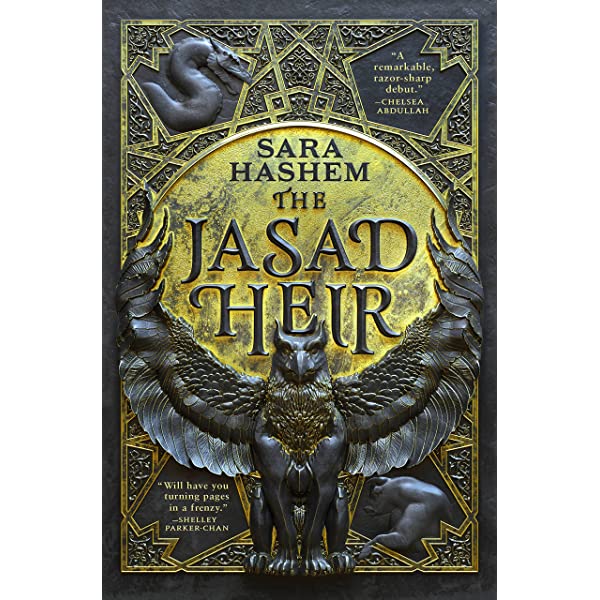
When I requested this book, I really thought it was YA, when I saw it was 528 pages I went online to see what I missed, and sure enough it is considered an “Adult Fantasy” and in the process I read some of the (negative) reviews about the book.  I grew nervous as I’m not naturally a fantasy fan, mg fantasy is more my level, with occasional YA entrapping me.  I told myself 25% is the least I could do, and if it wasn’t clicking, I’d know I gave it a genuine shot.  By about 21% I couldn’t put it down.  I think not expecting the complexities of an adult book was a benefit.  The book has no Islam, it contains Egyptian cultural references, but religion is not present, and thankfully that means no djinn either (they seem over represented these days).  The protagonist is in her early twenties, it has an enemies to lovers trope, and magic is central to the storyline, but aside from frequent unremorseful murder and torture, an intimate make-out scene at the end, and some drinking of ale, the book is fairly clean. I feel like there might have been some plot holes, but I honestly was so swept up in the story and proud of myself for understanding the world building and politicking, that I am just going to assume I missed something or it will be addressed in the next book of the series.  The author is Muslim and while it is labeled Adult, I think high school juniors and seniors and up, can and will, love Sylvia and Arin and sorting through the lies and deception to see the Jasadi heir rise.

SYNOPSIS:

The book follows Sylvia a young woman apprenticing with the village chemist, living in a keep (aka orphanage) and hiding her magic, or rather hiding that she is Jasadi, her magic is useless with the invisible handcuffs placed on her as a child before the kingdom burned in the Blood Summit.  She is unkind, harsh, and selfish, but somehow a few other orphans have not been scared off and on her birthday she is forced to acknowledge that people in her life might care about her.  There are four kingdoms that remain (Lukub, Omal, Orban, and Nizahl) and every three years they participate in the Alcalah, a battle to pay honor to the founding siblings who were entombed to cease their magic from destroying others and going mad.  The tradition makes no sense as the champions often end up dead (think Hunger Games), and the people acknowledge it, but none-the-less, they all get caught up in the excitement and entertainment.  Since the destruction of Jasad, the magic kingdom, magic everywhere has been outlawed.  Originally all people had magic, but it was lost over time.  Sylvia is the heir of the Jasad kingdom, and with no magic and no sense of obligation to Jasadis that have scattered, she carries on hoping to one day take over for the aging chemist.  When the son of the Supreme responsible for the death of her loved ones and all of Jasad crosses her path, deals will be made, a champion will be crowned and love will felt. Sylvia will also have to reexamine people from her past, her selective memories, and decide what type of future she wants to fight for.

WHY I LIKE IT:

Phew, even writing that lame summary was challenging, the book weaves a lot together and I loved the politics and world building, but clearly don’t feel confident enough to discuss it.  I think the slow burn romance was a little obvious, but I also think the author knew it would be obvious and rather than try and disguise it, she embraced it, and provided actual obstacles in their coming together (they cannot touch), not just that they want to kill each other.  I am assuming that the physical copy (I read an electronic arc), will have a map and perhaps a list of the kingdoms and characters.  It wasn’t hard to keep it all straight, but it will definitely add to the overall packaging.

I would have liked a little more explanation at points, even if it is my own weakness requiring it, but I didn’t understand the magic mining, the handcuffs, and would have liked a little more back story on the warring magic factions, their splintering timeline, and Soraya’s fallout.  I also would have liked more about Sylvia’s parents relationship and how that union came to be across two kingdoms.  Honestly I didn’t even quite get Sefa and Marek’s relationship.  I probably needed to slow down and read, but I couldn’t it was action packed, fast paced, and I needed to know what was coming next.  The climax was a little weak and the book ended on a cliff hanger as a book two is already forthcoming, but the fact that I read it and enjoyed it, speaks volumes as to the characters, story quality, writing, and approachability of the book.

FLAGS:

Mention of rape, whores, sexual assault, sex, a character is asked if a character’s needs are met by a man or a woman, an intimate male/female passionate scene at the end, using physical flirting as a distraction, theft, killing, lying, torture, murder, poisoning, breaking of a back, stabbing, it is an adult fantasy, there is all sorts of deviant behavior, but I really think 17 and up even in an Islamic school can handle it.

TOOLS TO LEAD THE DISCUSSION:

The backmatter and author reference the book to Egypt, yet aside from the names and some foods and clothing, there isn’t a lot that a casual reader would catch.  I think discussion about the Arab Spring and linking the plot to real politics could make for a fun discussion in a high school book club setting.  There is some Arabic sprinkled in that I would assume is accurate and would enjoy having translated by students as well.