Tag Archives: early chapter

Eliyas Explains: What was Prophet Muhammad (saw) Like? by Zanib Mian illustrated by Daniel Hills

Standard
Eliyas Explains: What was Prophet Muhammad (saw) Like? by Zanib Mian illustrated by Daniel Hills

Zanib Mian once again fills a void in the literary world for our children using her easy to read and relate to protagonist’s voice.  Over 149 pages, filled with illustrated doodles, details about our beloved Prophet Muhammad (saw) flow through the fictional framing of Eliyas and his family heading to the airport to pick up their Mamoo.  It starts with the standard introduction of characters that all Eliyas books have, so while it is part of the series it can be read as a standalone as well. But really if you have children 5-14, you should invest in the entire collection.  Also, as with the rest of the series, the book is checked by a Shaykh who is named at the beginning so that the reader can enjoy the Islamic details that are to follow. I know there is some debate about the cave and the spider, a story shared briefly within the pages, but I will leave it to those more knowledgeable to decide upon.  The book works well read aloud and independently, either way I’m confident children will enjoy the story, learn something new, and grow in their love of our Rasul Allah, alhumdulillah.

SYNOPSIS:

Eliyas’s dad’s uncle, Haroon Mamoo is coming for a visit, and while Mum wants to make sure they leave at a specific time to get to the airport, Dad isn’t stressed, he had a dream about Prophet Muhammad saw the night before and the kids want to hear all about it.  The story progresses weaving in things around them with Mum and Dad tying them to the sunnah.  From a fight at the airport, to a pigeon getting stuck, to Haroon Mamoo seeming to have gotten lost. The book is preachy, in the best way possible, as Eliyas and Aasiya banter, crack jokes, and learn along with the reader.

WHY I LIKE IT:

I love Eliyas’s voice and the weaving of a fictional story to convey the non fictional sunnahs that are truly the heart of the book.  The information presents in an easy way for children to hopefully remember it, and to also see how they should be behaving and acting in their own lives. The fun fonts, illustrations, and layout make it inviting to pick up and keep reading.

FLAGS;

None

TOOLS FOR LEADING THE DISCUSSION:
This book is not a journal, like some in the series are, but provides ample opportunity to discuss points on each page.  

Eliyas Explains + Bite-Size Journal: Why Does Allah Let Bad Things Happen? by Zanib Mian illustrated by Daniel Hills

Standard
Eliyas Explains + Bite-Size Journal: Why Does Allah Let Bad Things Happen? by Zanib Mian illustrated by Daniel Hills

img_3601-1

The book stems from the genocide occurring in Gaza, but expands to cover the more general concepts of qadr (destiny), tests, and sabr.  The book assumes that what is happening in Palestine is known and does not discuss specific details, allowing the book to be both timely, yet universal.  As with all the books in the series, the conversational humorous approach appeals to children as foundational Islamic concepts are broken down and explained.  The book is 73 pages with the journal portion starting on page 33. In some of the other books, the journal feels more of a hands on to already shared information, or an accompanying workbook of sorts.  In this book however, I feel like the second half continues to explain the topic at hand, and convey key components in understanding why Allah swt, lets “hard” things happen, how we should view the tests, approach difficulties, and inshaAllah triumph. The book has been checked by a Shaykh, and I highly recommend this important book for elementary, middle grade, and even middle school children. The concept of qadr is difficult, I struggle to truly grasp what we can and cannot change, but this book helps readers focus on what we can change and how to view terrible things that happen to us and to others.

The book starts with Eliyas introducing himself and his family, and then wondering why “Israel is being able to do what they’re doing in Gaza.  Why isn’t Allah stopping it?” As with all Eliyas books, mom and dad are sought out, food is somehow worked in, and time and space are given to Eliyas and his siblings to be given an answer. His parents start by being glad that Eliyas’s heart is soft for the Palestinians and that he is bothered by what is happening to them, before explaining that a lot of understanding is trusting and truly believing that Allah swt knows best.

img_3625-1

The book uses hadith, ayats from the Quran, it even shouts out other Zanib Mian books, The Mindful Book of Wellbeing, for seeing the bigger picture and Eliyas Explains Why Should I Pray my Salat on how to make yourself strong to get through the struggles of this duniya.

The book talks about why Allah swt didn’t make everyone good, and it is clear in saying that being mad and sad are ok too, as long as we are not questioning Allah swt. There are prompts and questions (with answers) and the book is not heavy, despite the subject matter, the tone and approach stay on level and allow readers to connect, alhumdulillah.

You can get your copy here at Crescent Moon Store.

Sadiq and the Ramadan Gift by Siman Nuurali illustrated by Anjan Sarkar

Standard
Sadiq and the Ramadan Gift by Siman Nuurali illustrated by Anjan Sarkar

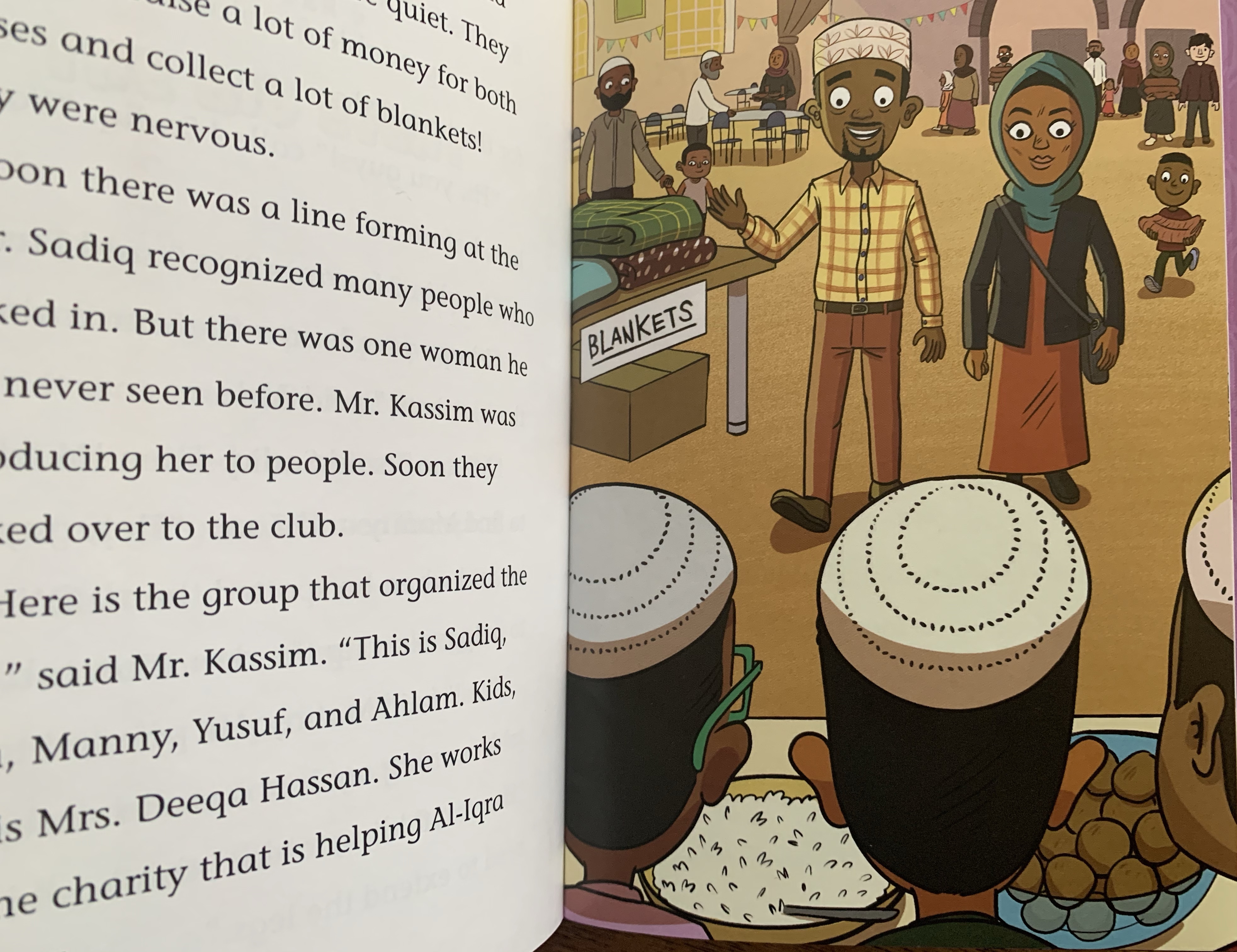
img_8554This 65 page early chapter book in the Sadiq Series does a great job of introducing Ramadan, giving a glimpse of Somali culture, and conveying a relatable and engaging story about friends with a lesson/reminder about the values of communication.  A group of boys hosting a fundraising iftar to help a school in Somalia have to figure out the logistics, the marketing, the cooking, and the execution, as they become socially aware and active in helping meet the needs of their community, both locally and afar.  This OWN voice tale doesn’t shy away from authentically drawing on religion and culture to make characters and a plot that all readers can enjoy.  The book is not preachy, but the characters know who they are in their manners, dress, speech, and environment.  A great book any time of year for first grade and up.

img_8555

SYNOPSIS:

With Ramadan starting in a few days, Sadiq and his friends at the Dugsi are reviewing the importance and values of Ramadan.  This year the masjid is raising money for a school in Somali and the students are encouraged to help, as sadaqah, or charity, is especially important during Ramadan.  The boys decide to host a fundraising iftar at the masjid and with parental help to coordinate with the Imam, the kids have to figure out how to get enough food, get the word out, get set up to take donations and more.  They make flyers, set up a website and shoot a small video.  The once excited Zaza, however, is no longer very enthusiastic in the Money Makers Club and Sadiq can’t figure out why, but with so much to do and little time to get it done, more friends and family are brought in to help, and things continue on.  When Zaza tries to tell Sadiq he wants to do his own fundraiser, Sadiq doesn’t want to listen.  I’m not going to spoil if the two friends work it out and how they handle the two ideas, but it is a good lesson in friendship, communication, and charity, Alhumdulillah.

img_8556

WHY I LIKE IT:

I love that the story starts with information about Somalia and words in Somali as well as a picture of the family.  There are activities and questions at the end as well as a glossary of religious, cultural, and English vocabulary words. The book doesn’t assume that the reader knows anything about Islam or Somalia, nor does it assumer that the readers don’t.  It strikes a balance of not talking down to the reader or getting too wordy.  It simply provides the information needed if you are curious, but allows the story and the boys dilemma to take center stage.  The whole series is remarkable in showing diversity and relatability with good quality story telling.  I think this is the only book in the series that has a religious theme, I could be mistaken.  The illustrations show the boys in kufis and the women in hijab.

img_8557

FLAGS:

None

img_8558

TOOLS FOR LEADING THE DISCUSSION:

Every elementary school library and every first through third grade classroom library should have this series.  I know my public library has it, and the copies I get from there seem to be worn and loved.  The age is too young for a book club, but would be great in small groups or for outside reading with the short chapters and engaging illustrations.