

Sitti’s Secret was published in 1994 and given the events of the week, I’d say it is more relevant today than it was when written. And if by some chance the events of the week haven’t affected your children, then the poetry and soul of the book still makes it an amazingly powerful story.
Mona travels from America to Palestine to visit her grandma, her Sitti. Without the ease of speaking the same language, Sitti and Mona learn to communicate and build a tight bond cut too short by a vacation coming to an end. When Mona returns she sees the news and writes a letter to the President, telling her Sitti’s secrets, telling him they would be great friends, and telling him they only want peace.
Truly Nye is a poet, even in Turtle of Oman her words transport you to a place where time slows down and the connection between a child and a grandparent make you nostalgically yearn for a simpler time. Having spent my summer’s abroad visiting my grandma I could relate to so much of this book and truly had to still my heart. The little things, like examining your grandma’s hand, or hanging out laundry, or brushing her hair. Even that dreaded final hug as you prepare to leave, I could relate and it was enchanting.
No where in the book does it mention the Middle East or Islam, only at the beginning does she hint at it by dedicating the book to her 105 -year-old Sitti in Palestine, it mentions that she speaks Arabic and a few words are sprinkled in. And the Grandma does wear a scarf. Other than that the book is by and large not political. If you know that Nye has a Palestinian father and American mother and often writes semi auto biographical pieces, the book can take a bit of a different role to the reader. Many reviews criticize the activism upon her return (the letter to the President), and found it disjointed to the rest of the story. But in today’s climate I found it empowering and hopeful. The world will only find peace when we put a face to those that are different to us, and even children can change our stereotypes. I love that my children are seeing that they can make a change in the world today, and to see it reinforced in literature was gratifying.
The book is 32 pages and written on an AR 3.9 level. The illustrations are beautiful. They bring the words to life in a tender and heartfelt way. The detail is subtle but deep and i have found myself thumbing back through the pages to get lost in the illustrations multiple times. I think the book works on different levels for different age groups. If you have a family that has to overcome great distances to be together, even younger readers will be able to identify with the story’s tenderness. If you are in 3rd-6th grade and are aware of what is happening in the world you will be inspired. If you just are looking for a sweet book, subhanAllah it manages to fulfill that category too.



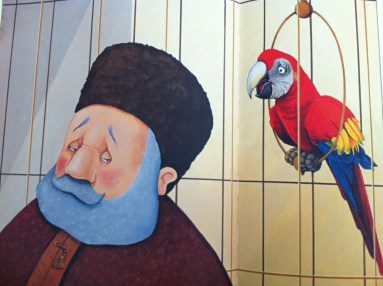
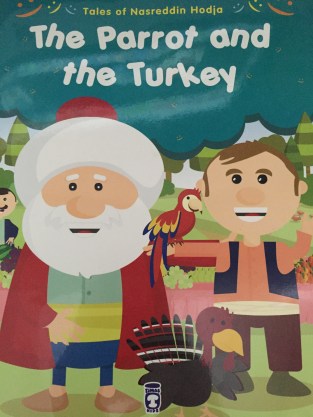 I ordered this book a while ago online. There is a whole series of Nasreddin Hodja, so I picked a title at random. I read it when it arrived and the story seemed to wander more than my attention span could follow. So naturally, I had my children read it, and they said it seemed funny, but they didn’t understand it. I glanced through it again and figured maybe it was one of those beloved cultural characters that just lost some of their charm in translation. In this case, Nasreddin Hodja is a folktale type character born in the 13th century from Konya, Turkey, who is the star of short stories that teach a point in a silly way. The opening page tells a bit about him and what you can hope to learn in the story, but it didn’t help understand why the book was so fragmented.




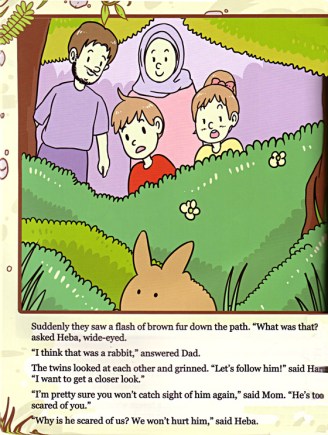 I really like how when discussing Jannah, they talk about the rivers of milk and honey, and I absolutely loved how they talk about Grandpa (hopefully) being in Jannah and being young and strong. I couldn’t figure out why when in the woods and marveling at nature the characters didn’t use Islamic expressions like, mashaAllah, subhanAllah, and inshaAllah, and when I read it aloud I had to add them when we got to the pages about Grandpa. It seemed awkward not too. The book is clearly for Muslim children, there is a reference page in the back with the ayats from the Quran and hadeeth that tell us about Paradise, and the characters are discussing an Islamic concept, so I’m not sure why their language isn’t reflective of that.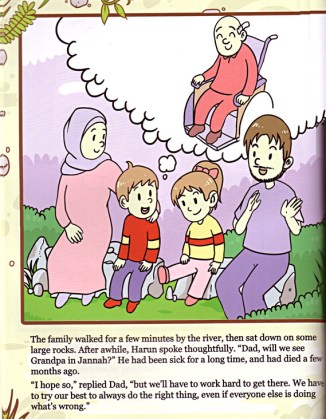







 Islamic School Librarian