Category Archives: Elementary Fiction

Hamza’s First Fast by Asna Chaudhry

Standard
Hamza’s First Fast by Asna Chaudhry

hamza fast

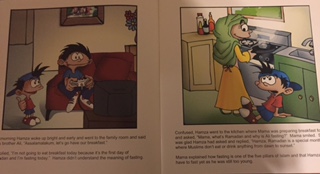
Hamza’s First Fast starts out a bit wordy as the author tries to explain what Ramadan is and who is required to fast and why, before getting to the actual story line of the book.  The premise that Hamza’s siblings are fasting and that Hamza doesn’t know why or that it is Ramadan is a little questionable to me, but I doubt most 2-6 year olds are as cynical as I am.  Once the story gets going, however, the amount of text on the page drastically decreases to fit the younger demographic and the point of the book is charmingly exposed.

hamza4

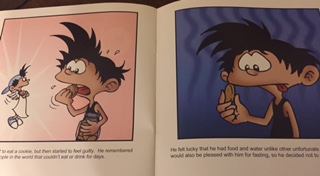
Hamza understands that he doesn’t “have” to fast, but decides he “wants” to try. He prays with his dad, his sister helps him to understand how fortunate he is to have food, he goes outside to play, and he even tries to get lost in some video games.  But, it still isn’t time to break his fast and he is hungry! As his frustration mounts he decides to sneak a cookie, but when he gets it, he will have to decide to eat it or not.

I like that it is realistic that fasting for kids is hard, and can be really frustrating. It still encourages them to try, and the family members support him which is nice.  It also stays positive framing it that Allah will be pleased if he fasts, not that Allah will be disappointed if he eats the cookie.  Overall, there isn’t much religious rationale for why we fast and the Islamic traditions celebrated as the book stays on age level in what Hamza does.  This leaves the door open for discussion, lessons, insights, and interpretation, but does not weigh the book down with it.

hamza3

Perseverance is the theme of the story and that it feels good to do something hard.

Drummer Girl by Hiba Masood illustrated by Hoda Hadadi

Standard
Drummer Girl by Hiba Masood illustrated by Hoda Hadadi

drummer girl.jpg


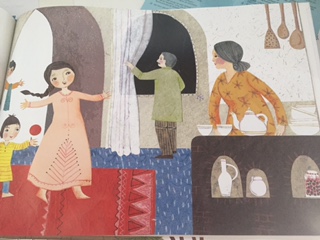
Before she was Grandma Najma, she was just Najma.  A girl in Turkey with a secret dream of being a musaharati, the person who walks the streets waking up the neighbors for suhoor in Ramadan.  But, a girl had never done this and thus the dream stayed hidden until she was 12 and the neighborhood musaharati was feeling ill.  Confiding in her baba, his love and support makes her dream come true against cultural norms and naysayers.  The line from her Baba, “Girls can be anything they like,” is so clear that her one girl revolution grabs the hearts of the reader and turns readers into cheerleaders.  The added beauty is her father’s support is not limited to his words, he accompanies her out every night almost challenging anyone to say she can’t do it.  Overtime she becomes the pride of the area, and her brothers accompany her if she doesn’t want to go alone, and then eventually her husband and her children.

drumemrgirl2The book warms the soul and uplifts the spirit.  The text seems geared to 7 year olds and up, as there is a lot of it, and at 26 pages does require some ability to focus. But with minor tweaks and condenscing the story appeals to children 4 and up and the pictures help hold their attention as they create a mood of wonder and whimsy.

drummer text

Structurally the book is hardback and dust jacket free, yay! the cover is printed on and thus easier to maintain.  The book is longer horizontally with most illustrations on the left side making it great for story time where the kids can see the pictures and the reader can hold and easily see the text without blocking the children’s line of sight.  There is a glossary, an author’s note telling where the story comes from, and a little biography of the author and illustrator and publisher in the back.

drummergirl1

A beautiful, beautiful book to share with children this Ramadan and all year long, alhumdulillah.

Rafiq & Friends’ The Ramadan Date Palm by Fatemeh Mashouf illustrated by Vera Pavlova

Standard
Rafiq & Friends’ The Ramadan Date Palm by Fatemeh Mashouf illustrated by Vera Pavlova

datepalm-cover

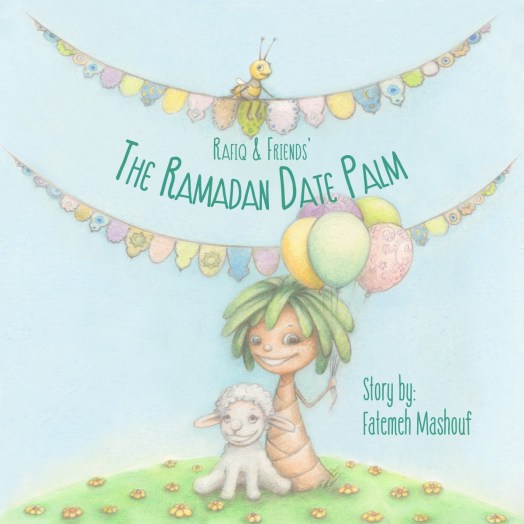
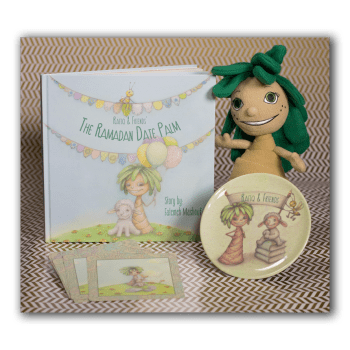
It is nearly Ramadan, inshaAllah, the most blessed time of year.  I don’t normally do product endorsements and thus I didn’t review this book that comes with a whole Ramadan kit last year when my cousin gifted it my children.  However, as I look for Ramadan Story Time books, I reread this and while it references the activity cards, it really offers a lot as a stand alone book too.  So, yes I am going to review it and plug the kit as something your kids up to age 9 or so will really enjoy, at least mine did and even went searching last week for all the components….without being asked! That’s a pretty strong endorsement right there.

rafiq-_-friends-5

Rafiq is a date palm tree that is so excited for Ramadan and is going to get you excited too.  He starts off by mentioning the fun you will have with the daily activity cards, and the role you will play in serving iftar dates on the special plate. The reader is then introduced to the cast of characters, Najjah the sheep, and later Asal the bee.

rafiq-_-friends-sample-2

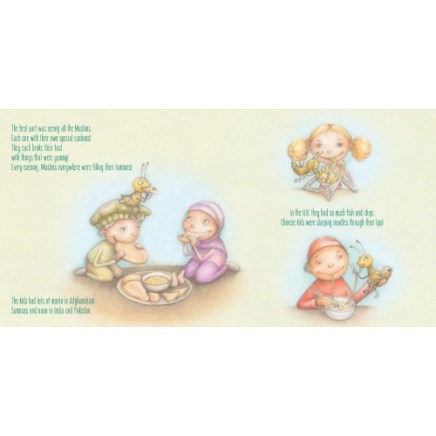
The middle of this 36 page book are my favorite, the illustrations are so sweet and welcoming you want to hang them up in your children’s rooms.  This is where the “story” begins, it talks about Ramadan and how the Quran was revealed to Prophet Muhammad (saw), and fasting, and praying and patience and having fun with friends and playing too.  It then moves on to Eid and all the different yummy foods that are eaten all over the world.  It ends on a note of community and how we all pray the same with our families and use the word salam.

rafiq-_-friends-sample-4

The book is visually beautiful from one hard back cover to the next.  It is written in rhyme and most of it flows without feeling ridiculously over forced, but there are definite sentences that are awkward, and the rhythm seems to vary a bit that you have to stay alert when reading it out loud or you will get tongue tied.  I think if you just skip the lines that reference the cards at the beginning and end, the book can work without the kit and accessories.  Kids might be confused, but I think the bulk of the book is engaging and the pictures are stunning, that kids will be able to grasp on to the overall message of the book and forget about the “product placement” so to speak.  There is a glossary at the back, and it works for ages 3-10.

Rafiq-Product-Set_dropshadow-350x350

(I wasn’t paid or asked to do this review, I wish I was, but it really is fun for multiple aged children, and gives a bit of daily Ramadan connection for those of us that want to make every day in Ramadan a craft and spiritual extravaganza, but know realistically we just won’t be able to do it all https://www.rafiqandfriends.com/)

Grandpa and Grandma Come to Stay by Asma Zaman illustrated by Azra Momin

Standard
Grandpa and Grandma Come to Stay by Asma Zaman illustrated by Azra Momin

grandpagrandma-500x500

This slim, paperback book, is actually really sweet and colorful.  It doesn’t look like much at just 14 pages, but the minimal text conveys a good message of helping elders in the home, and can easily be extended to helping those in the community.  I think this is a great book for 3 to 5 year old.  Little ones will get ideas on what they can do, and new readers will feel accomplished when they turn the last page.

grandpagrandmaprev1-500x500

Little brothers, Muhammed and Musa, are waiting for their grandparents to arrive and are confused when their daddy reminds them to be helpful, since they are little and their grandparents are adults.  The parents explain how getting old is hard to the boys and give them ideas of how they can help.   Once they arrive, the boys spring in to action by helping them unpack, getting Grandma her walking stick, and even helping grandpa find his missing teeth.  They especially love when they help put out the prayer rugs for salat.

grandpagrandmaprev2-500x500

The pictures are simple yet well done.  The women wear hijab, not just the mom and grandma, but the doctor too.  Gender roles are depicted well too, the dad takes his parents grocery shopping, is shown helping in the kitchen, and serves the tea.

I really think if you have elder family, it is a great book to introduce what changes and what responsibilities the little ones can help with.  With my own children it was a good reminder and conversation starter that they need to keep toys off the floor so no one trips, they need to listen the first time to whatever they are asked by the elders to do, and that they need to sometimes even help them walk, or slow their gate.  If you don’t have grandparents in the home, it can extend to people at the mosque, with kids helping get chairs, or even at the grocery store in being mindful of holding doors open and helping return carts.


Stairs Series: Trouble with Babysitting, Allergy Attack, Yusuf’s Robot & Time Travel by Nur Kose illustrated by Shaista Asad and Ayesha Khatib

Standard
Stairs Series: Trouble with Babysitting, Allergy Attack, Yusuf’s Robot & Time Travel by Nur Kose illustrated by Shaista Asad and Ayesha Khatib

stairs series

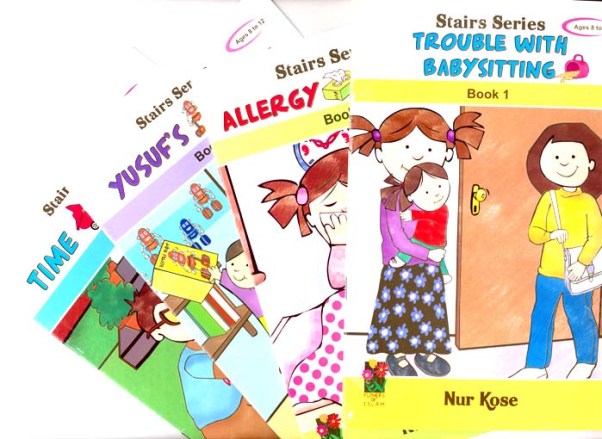
This set of books claim to be for children ages 8 to 12, but I think they work better for 7 to 10 year olds.  They look like leveled readers, and resemble them in their simple linear story lines.  They are broken up in to chapters, that really are not necessary, but because of the volume of text on each page, allows for a young reader to take a break.  All four books in the series are connected chronologically and contain the same characters.  They more or less present a problem, bring over their friends, have one of the friends offer some advice tied to a hadith or ayat from the Quran, and the advice is tested, and then shared once more.  They are about 20 pages and have activities at the end that range from solving clues to writing paragraphs.  The sentences and vocabulary are about a second grade level, with translations of Arabic and Turkish words, along with references to the Quran and Hadith appearing in the footnotes on the page they are mentioned on.

stairs series characters

The best part of the books is that they are written by an 8th Grader, mashaAllah.  I think they teach a lesson in a simple way, and while not terribly suspenseful or comical, they do succeed in showing Islamic lessons in relatable situations for kids.  Some of the details seem excesses or meandering, but again, the fact that it is written by a kid, will inspire readers to listen differently to lessons about patience, accepting Allah’s will, recognizing one’s own limitations, and putting Allah (swt) above all else.

stairs inside

The pictures are colorful and simple.  They appear every few pages in the book and provide a nice break from the text.  They are sweet and not detailed, but sufficient for the story and level.

stairs pictute

Hamza Learns about Charity by Ameena Chaudhry

Standard
Hamza Learns about Charity by Ameena Chaudhry

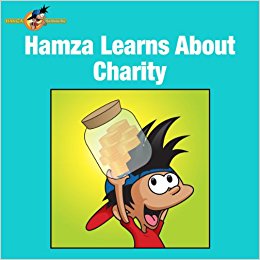
hamza learns about charity

It is hard to believe I haven’t reviewed any of the seven Hamza books in the series.  They are perfect for 2-6 year olds (older kids will enjoy them too), and all are both informative and silly.  This book is 20 pages and is seven and half inch square in shape.

In Hamza Learns About Charity.  Hamza learns what the word charity means as his mom is packing up his old toys to donate to the less fortunate.  He also learns you can give money and how donating and taking care of the poor is required in Islam.  Hamza’s mom tells how Prophet Muhammad (saw) lived a simple life and was very generous with whatever he had.  Hamza also learns the word for charity in Arabic.  When his mom leaves to take the stuff, Hamza decides to show that he understands and is ready to give everything away and live a simple life.  Alhumdulillah, mom returns in time to shoo the neighbors away and convince them that the house, and car, and household items are not for sale.  Thus, Hamza also learns that we aren’t required to give everything away, and when making big decisions we should get our parents’ permission first.

The illustrations are cute and colorful.  They are not overly detailed, but Hamza’s facial expressions are engaging and expressive.  The book works well for story time and bedtime and seems to be geared for Muslim children.

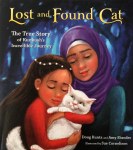
Lost and Found Cat: The True Story of Kunkush’s Incredible Journey by Doug Kuntz and Amy Shrodes illustrated by Sue Cornelison

Standard
Lost and Found Cat: The True Story of Kunkush’s Incredible Journey by Doug Kuntz and Amy Shrodes illustrated by Sue Cornelison

kunkush

Often children’s stories of refugees fleeing war are hopeful in a forced way that seems to want to protect them from the reality of what is going on in the world.  As adults we often cling to the ones with happy endings for our children and for ourselves, because the tragic ones are too numerous and overwhelming to comprehend.  This book marvelously does a great job for those older children in the middle that are beginning to understand the world around them, while not bombarding them with the severity of how cruel we can be to one another.  This true story instead focuses on a beloved cat and all the humans of different backgrounds, all over the world that help reunite her with her family.  Giving hope, but also showing the difficulty in the world, and the effects even one person can have in making a difference.
cat

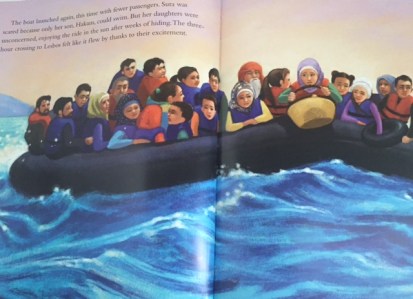
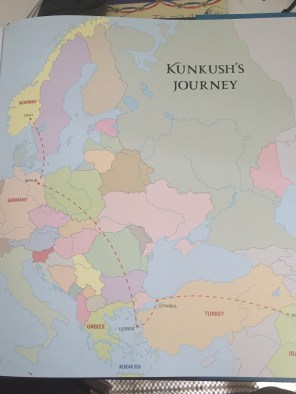
Kunkush’s family goes to great pains to get themselves (all 6 of them) out of Mosul, and away from the war.  That the fact they sneak their beloved cat with them, shows just how much a member of the family he is. They drive through the night, and walk for days over a mountain, they reach a Kurdish village where they sneak the cat on a bus to Turkey, they then have to cross the Aegean Sea to Greece, only to land in Lesbos and have Kunkush disappear.  The family searches as long as they can, but alas have to move on to their new home.  From here the story switches from following the family to following the cat and all the people determined to reunite him with his family.  Unfortunately, they don’t know where the family is.  Amy, a volunteer, takes the cat to the vet to get cleaned up, and then creates an internet campaign to try and find his family.  People from all over the world donate to his care, and his travel expenses.  Eventually, Amy takes the cat to Germany, where many refugees have resettled and continues her search.  Finally, word gets to the family in Norway, and Doug, a photographer, arranges to fly the cat to her new home. Alhumdulillah.

img_3838.jpgOne could argue that countless people are misplaced each day due to war, and we overlook it because it is easier than dealing with it, so why care about a cat.  And to that I challenge the skeptic, animal lover or not, to read this book and not have your heart-strings tugged.
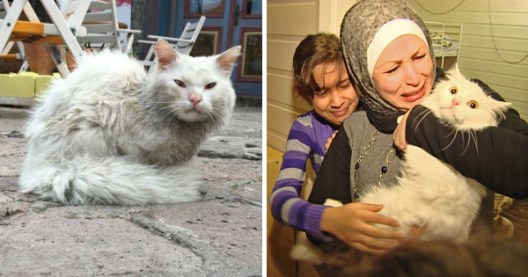
IMG_3839The book is done beautifully.  The pictures are warm and endearing and are the only proof that the family is Muslim, by their hijabs.  The love the family has for their pet is expressed in the illustrations, and even more so by the real photographs at the end of the book following the Note from Doug and Amy.  At 48 pages the book works really well for 3rd grade and up (it isn’t AR) who can marvel at the cat’s journey.  I particularly think this book is a great way to show children another aspect of refugees.  There are a fair amount of books that talk about the refugee experience or show refugees getting adjusted to a new home.  But, this is a great way to show that refugees are not just defined by a word.  They are vibrant individual people just like everyone else.  By focusing on the cat and his journey, the reader sees what a refugee goes through, particularly this family, and hopefully will stop and think about it.   But it doesn’t just show the family in that capacity, it shows them as a vibrant family who loves and desperately misses their cat- something more children may be able to relate to.
kunkush (1)

Yaffa and Fatima: Shalom, Salaam by Fawzia Gilani-Williams illustrated by Chiara Fedele

Standard
Yaffa and Fatima: Shalom, Salaam by Fawzia Gilani-Williams illustrated by Chiara Fedele

Yaffa and Fatima cover.jpg

Oh how full my heart is after reading this book, and wiping a tear from my eye.  When the daily news angers and frustrates, a story as sweet as two friends helping and worrying about each other gives hope to the future of the world. I know that is probably over reaching the impact of a children’s book, but sometimes it really is just one person helping another person, just finding similarities instead of differences, and above all having a big heart.

Yaffa and Fatima are neighbors and both grow dates.  The two women, one Jewish and one Muslim, share a lot of similarities they both fast, pray, celebrate, and help others. They often sell their dates next to each other in the market and then share their food and customs with each other.  During one growing season, rain is scarce, and each woman begins to worry about if the other has enough- not just to sell, but to eat as well.  Secretly they both help each other and prove the power of friendship and kindness is universal and powerful.

Dino-Wresting

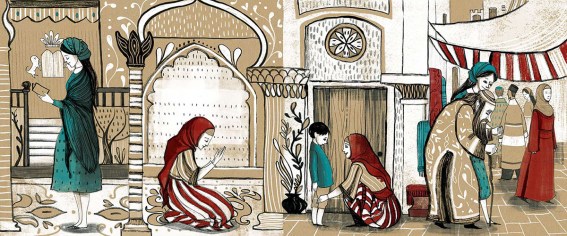
The illustrations are smartly done.  This isn’t the book for bright and colorful or overly cartoonish depictions.  The simplicity of the words introduce the reader to Islamic traditions and Jewish traditions, but the purpose is to show their similarities and the illustrations mimic that sentiment beautifully.  The contrast of red and blue show the differences with the larger muted tones being the same. The warmth in the characters faces mirror the warmth of their actions and the detail is balanced with intriguing the reader without distracting from the text.  The illustrator does a good job of also showing the women covering their hair in public, albeit differently, but not within their homes. And of also showing the different ways the women worship without the words having to do so.

Dino-Wresting

The author has a note at the beginning acknowledging the roots of the story as a tale about two brothers in both Jewish and Arab traditions.  And at 24 pages it works for children of all faiths and all ages, two years old and up.  The book was recommended by a woman, who I hope to meet next week, when she and her Jewish community join us at the mosque for our monthly story time.  With a theme of friendship, this book will be the focus of what bridges and connections we can all make in our personal lives to make the wold a little better.  I can’t wait to share it with our children of both faiths!


What Does a Muslim Look Like? by Mohamed Abdel-Kader illustrated by Abdullah Badawy

Standard
What Does a Muslim Look Like? by Mohamed Abdel-Kader illustrated by Abdullah Badawy

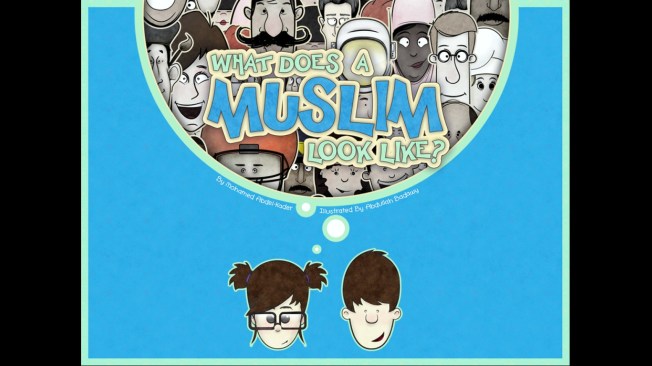
what does a muslim look like.jpeg This 22 page, simplistic book written in rhyming couplets, is such a timely and necessary book.  Much like Owl and Cat: What Islam Is… this book has value that extends far beyond its audience level (not AR but, I’d say three years and up), as the content breaks down stereotypes while being framed in a positive, non condescending way.
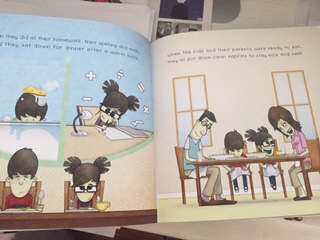
IMG_3160

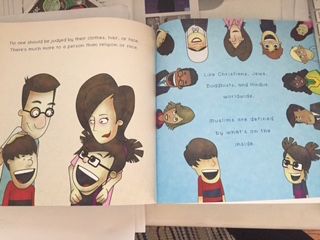
A brother and sister pair, Jack and Jane, go about their day when at dinner Jack remarks that he learned that two of his classmates are Muslim and they look like them.  Thus arises the question, what do Muslims look like?  The book then goes on to break down stereotypes and broaden views in the same rhyming manner that keeps the book light and child friendly.  The conclusion is that like people of other faiths, everyone is different, and that no one should be judged on what is on the outside.

IMG_3161

The book appears to have been started on Kickstarter in 2012 and Alhumdulillah it got the needed funding to get published.  I got my copy through the public library system, and I am beyond thrilled that I found it where hopefully a lot of people can get their hands on it.  Reading the author’s campaign on where the concept came from, he would have had no idea how much more timely the book is now, then when it was first published.  I get asked quite regularly from old school friends, how they can introduce Islam or get the ball rolling  to talk to their kids about Muslims, and this book would be a great start.  Told from non Muslim kids perspectives, with very hip parents, the book does not discuss any tenants of faith or belief, it just identifies the many shapes and sizes and colors that Muslims come in.  It would work well to show that Muslims are everywhere not just in the news, without overwhelming even the youngest of readers.

IMG_3162

The pictures in the book are absolutely perfect in complimenting the story. They are not only silly, but also diverse as the book’s text would require.  Interestingly there are ladies with hijab and those without, and scarves are not mentioned in the text, and also noteworthy is there are no bearded men in the pictures.  Overall, a wonderful book that I would love to have on my shelf with extras to hand out.

Never Say A Mean Word Again: A Tale from Medieval Spain by Jacqueline Jules illustrated by Durga Yael Bernhard

Standard

scan0019_487d580c-5aa9-45f2-b4c1-87e328c94b7e.jpg

I love when tales from the past provide timeless lessons in relevant ways.  Inspired by a medieval legend about the Jewish poet Samuel Ha-Nagid, a royal advisor in Muslim Grenada, Jules creates a story that works for children of all ages and backgrounds.

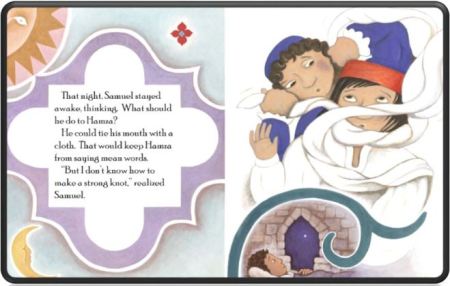
The Grand Vizier’s son, Samuel, bumps into the tax collector’s son, Hamza, and the boys don’t rub each other the right way.  Later that day, Samuel spills his drink on Hamza and can’t convince him both were accidents.  Hamza calls Samuel some mean names and storms off.  Samuel and his father think the name calling is uncalled for, but the vizier does not solve his son’s problem and instead assigns him to “make sure Hamza never says a mean word to you again.”  Samuel imagines ways to teach Hamza a lesson or punish him, but some ideas are too complicated and some just silly.  This is proving to be a hard task.  The next day Samuel shows up to Hamza’s house with a lemon.  He thinks forcing Hamza to eat it is a good punishment for a mean mouth, however Hamza thinks the lemon is to help with the stain that ruined his clothes, and tells him his mother already tried that.  Caught off guard by Hamza’s reaction, the two somehow end up playing catch with the lemon and enjoying the afternoon together.  The next day he shows up to Hamza’s house with ink and paper thinking he will make Hamza write him an apology.  Hamza however, thought Samuel showed up to draw, and once again the boys enjoy an afternoon together.  This carries on until the boys are so used to seeing each other and having fun together, they become friends.  Samuel fears that he disobeyed his father and did not handle Hamza only to realize that by befriending his “enemy” he did in fact make sure Hamza never said a mean word again.

idea

The book is 32 pages with an Author’s Note about the real life events that the story draws upon.  The book is not AR, but the large bold typeface and the warm simple pictures make this book work great for story time with young children.  It compliments themes about bullying and making friends as well as being silly.  It works well for third graders and older ones too, as they might understand people of different faiths struggling to get along or people of different socio-economic classes, or even just imaging how they would solve a problem without their parents doing it for them.  I was pleasantly surprised by the book and how it handled the Muslim/Jew staging of the characters.  Especially right now in today’s world, this story has a poignant lesson for us all. If we all spent time together having fun, we too could end up being friends, or at least getting along.  I think the story and its lessons have merit and relevance, and thus a place on the bookshelf.