Tag Archives: traditions

The Best Eid Ever by Sufiya Ahmed illustrated by Hazem Asif

Standard
The Best Eid Ever by Sufiya Ahmed illustrated by Hazem Asif

This book blends some facts about Ramadan and Eid with cultural practices, showing a day in the life of a family celebrating, and a sprinkling of a story line to keep elementary aged kids invested. The back of the book labels it as an introduction to Ramadan and Eid and I think that is a pretty solid summary.  Aisha is eight, and apparently too young to fast from sunrise to sunset.  I wonder if she is old enough to fast from dawn to sunset as Islamically prescribed? Yes, I’m petty, but it is wrong to say sunrise to sunset, and I’m not backing down. This year her aunt, Chachi Amal has made a scavenger hunt for her and her brother to find their Eid presents, but first there is henna to apply, decorations to hang up, Eid prayers to attend, desserts to be shared with neighbors, and lunch to be had, before the three question scavenger hunt can commence, and presents can be located.  The backmatter has information about Ramadan, Muslims, Eid, and a glossary.  The book would work well for a generic class or library story time. I don’t imagine Muslim kids will find it particularly memorable and ask for it more than once.  It is a Desi family, with the Chachi being Libyan and sharing desserts. hinting at the diversity of Muslims, and I can see kids wanting parents to hide their gifts and make a scavenger hunt, which is sweet and a nice idea to build on.

The book starts with Aisha looking outside to see if the moon can be spotted and Eid determined.  Samir and Dad come in and say that the mosque has declared Eid tomorrow.  Eid is Aisha’s favorite festival, she loves Ramadan, eating iftar with her fasting family, and she loves dates. This year her Chachi has hidden their gifts and made a scavenger hunt for the kids to follow.

Aisha can’t wait, but her Mom says they have other traditions first, and Aisha has henna painted on her hands.  They have to dry for at least two hours, so she watches a show while Dad and Samir decorate.  Then it is time for bed, and the scavenger hunt will have to wait.

Early in the morning is no time for a scavenger hunt, Mom is in the kitchen and they have to get to Eid prayers. After salat, and wishing everyone Eid Mubarak, Aisha is ready for the clues, but her and Samir are sent to deliver sweets to the neighbors.  When they return home, they can’t get to presents because it is lunch time. Finally, the scavenger hunt begins, the clues are solved, the presents found, and the day “the Best Eid Ever.”

I purchased this book from Crescent Moon Store, code ISL will save you 10%.

Looking for the Eid Moon by Sahtinay Abaza illustrated by Sandra Eide

Standard
Looking for the Eid Moon by Sahtinay Abaza illustrated by Sandra Eide

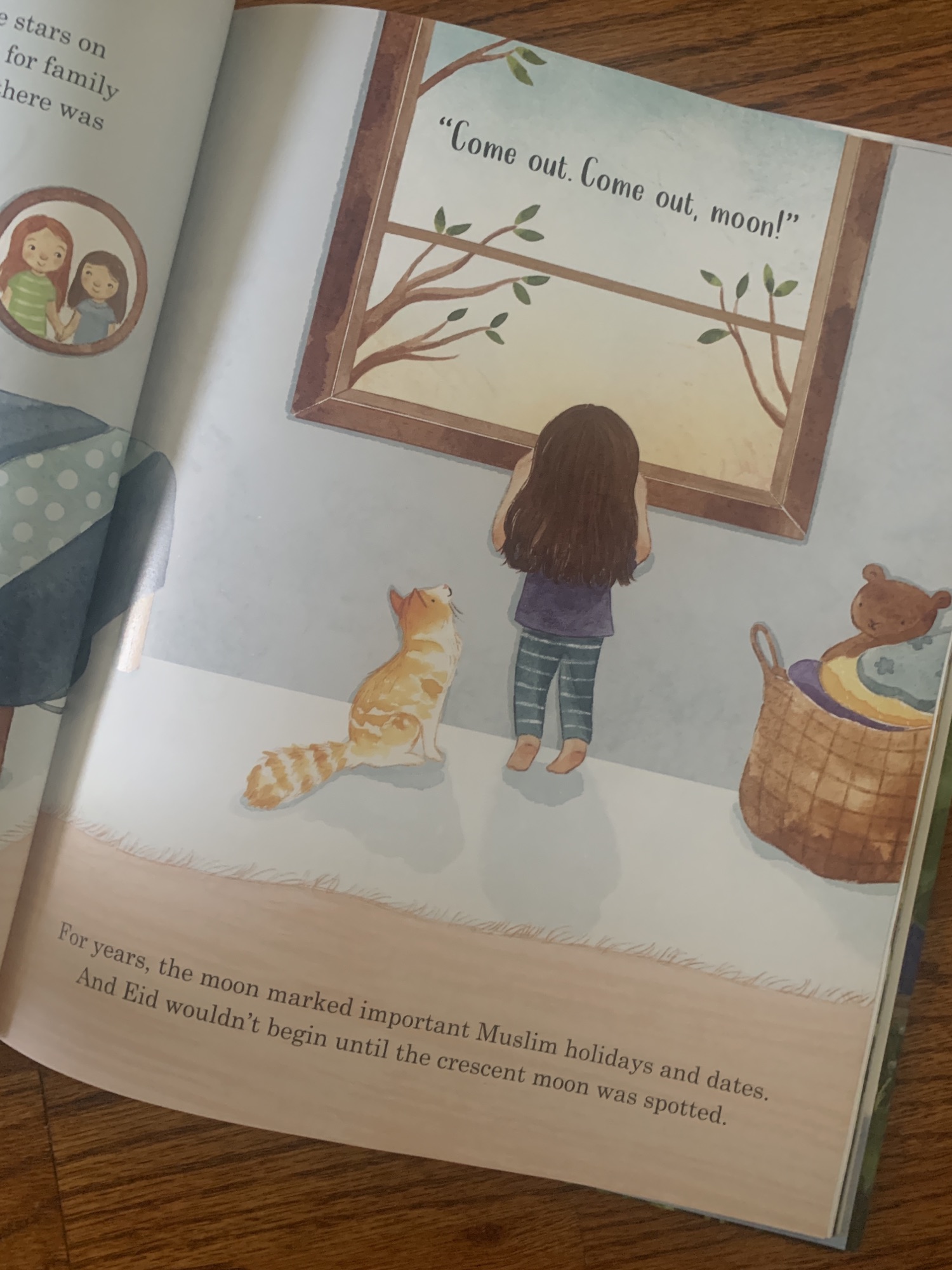
The illustrations and sister bonding in this story are sweet, but it isn’t exciting, and doesn’t feel very Ramadan or Islamic rep or even very purposeful.  I was really surprised that there wasn’t a craft activity or science tie in at the end, it seemed to be heading in that direction seeing as Eid joy, iftar, and anything religious are all completely absent. The plot really is just the title, “looking for the Eid moon.” The text feels abrupt, it doesn’t flow, and feels othering.  “For years, the moon marked important Muslim holidays and dates. And Eid wouldn’t begin until the crescent moon was spotted.” Numerous communities still rely on local sighting and have hilal committees marking all moon phases and months.   This framing of it being an antiquated practice, feels off.  The sisters are young, but Sara is old enough “to know the crescent moon is faint and hard to see,” yet she doesn’t even acknowledge iftar time, they don’t pray maghrib.  The complete removal of Islam makes looking for the Eid moon seem like they could just be looking for Mars or a comet.  It says they are excited for an Eid party, but clearly not enough to be excited it is Eid the next day, they are simply sad that they didn’t see the moon.  I’ve read the book a few times, and I truly can’t make it make sense, and I don’t understand how silver paint glows, shouldn’t it be glow in the dark paint? Sigh.

The book starts with Sara looking at her Eid dress saying she is excited for the Eid party, but first she has something to do.  She packs her flashlight and binoculars and grabs her little sister Lulu and the head out to spot the Eid moon. On their way out they pass mom hanging decorations, and she wishes them well.

In the backyard the girls watch the sky change colors and the sky is cloudy.  As it gets darker, the girls get a little scared, but mom finds them and tells them the moon has been spotted elsewhere.  The girls are sad and Sara comes up with a way to cheer up Lulu.  SPOILER she paints a ball silver, fills it with coins, and writes a note that it is from the Eid Moon, claiming this is a moon rock.  Lulu proclaims it the “best Eid ever.”

The Author’s note tells of the family’s tradition to hide and find moon rooks with coins in them, in what sounds akin to an Easter egg hunt.  It also erroneously says that Eid al Fitr is a three day holiday.  I don’t get the connection to the moon being brave and a source of light to refugees in the book, if that was the author’s intent, to show the moon as hope “when times are bleak and dark,” I’m sorry but the message was not conveyed.

Crayola Ramadan and Eid Al-Fitr Colors by Mari Schuh

Standard
Crayola Ramadan and Eid Al-Fitr Colors by Mari Schuh

img_8546

This 32 page non fiction children’s book uses colors to introduce the very basics of Ramadan and Eid from a non Muslim point of view to a non Muslim audience.  The book is done decently and shows diverse Muslims and bright colors interwoven with facts about the month, but by-and-large it is forgetable and just discusses the broader sense of celebration.  There is very little that is religious outside of the photographs showing Muslims that are used to illustrate the book.  Even the concept of colors in a book by Crayola is a little lacking.  Yes, dates are brown, but just to say that “colorful designs cover prayer rugs,” and that “people shop for red and green vegetables, and many orange and brown fruits are used for meals too,” seems really vague and half hearted.  

img_8547

The book starts out with explaining what Ramadan is and defines what a crescent moon is in a blurb under a picture of one. It then explains what happens in Ramadan and dedicates two pages to lanterns that are purple, red, blue and green and used to hang in streets and homes.

img_8551

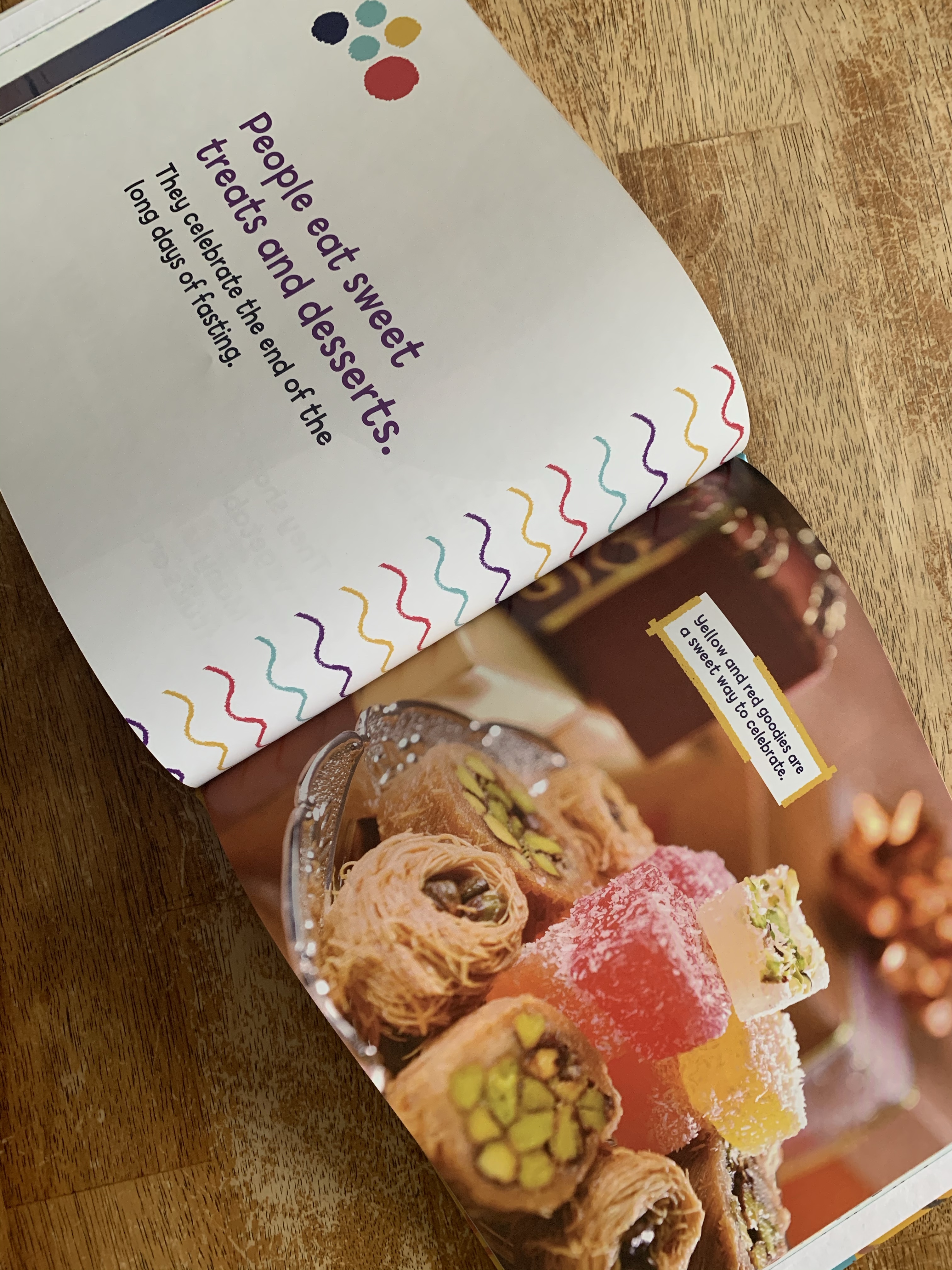
It then moves in to the celebrating of Eid Al-Fitr.  It shows children playing and having fun and receiving gifts and toys to celebrate. It talks about the food and mentions colors of the food without naming or describing them, it then does the same for desserts.

img_8548

When explaining the clothes that people wear on Eid, it says that sometimes they are colorful. It then repeats that gifts and money are given, but adds in that they are also given to those in need.

img_8550

The book concludes with a page that you can copy and color, a glossary, suggestions to learn more, and an index.

img_8549

A much better, color driven albeit not Ramadan and Eid specific choice would be Golden Domes and Silver Lanterns: A Muslim Book of Colors  by Hena Khan on in my opinion. Both are widely available in public libraries, maybe check them both out and let me know what you and your children think.

Muhiima’s Quest by Rahma Rodaah illustrated by Daria Horb

Standard
Muhiima’s Quest by Rahma Rodaah illustrated by Daria Horb

IMG_0976

This picture book for ages 7 and up, reads incredibly smooth for the amount of text on each page, and the pictures are warm and expressive in this large (8.5 x 11) 32 page book.  Clearly the author is talented in writing and passionate about empowering her character to hold on to her culture and faith, however it seems overly forced at times.  

muhima

The premise is that it is Muhiima’s birthday, but that she doesn’t celebrate birthdays, her family only celebrates both Eids.  So when her mom hands her a surprise on the morning of her birthday and Muhiima asks if it is a birthday gift and her mom says, “kinda” it seems a bit like she is walking back from the premise. The tie-ins throughout the book as she journeys from location to location on her quest as a result seem forced.

muhima1

The map first leads her to her father’s book store to get wisdom and love and a gift that she can’t open until the end.  She also journeys to her Grandparent’s house, her Uncle’s basketball game, her Aunt’s beauty salon, and oddly her Masjid Quran Class, which apparently she is skipping, but stops to get the wisdom and gift from her teacher at, none-the-less.  Oddly enough, but at least noted, she reaches home to find everyone on her quest already there.

muhima3

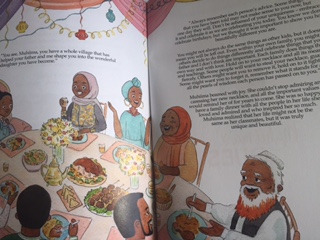
On her way home, she sees her non-muslim friend Rosie celebrating her birthday and wishes she could have a birthday gathering with gifts and family too.  When she opens the door to her own home, she gets just that.  The passages detailing why it is hard to be different are incredibly relatable and poignant, but to then have Muhiima get the same thing with a different name, again seems like the author is walking back on her premise.

muhima2

The wisdom and advice the family gives to Muhiima is wonderful and powerful. I love that the character is a strong girl of color, and that her family is supportive and consistent.  They say Salaam, they pray, they go to the mosque.  Some of the little details were jarring, like why it didn’t specify what prayer, why it was her class that she visited at the mosque, how all the people got to her house before her, etc.  This minor glitches with the forced premise of relating the quest to her birthday, make the book overall a bit awkward.  This is so unfortunate because the advice and the quest are so endearing, while not being judgementat or preachy.  I don’t know how to fix it, I just hope, like really really really hope, that the author keeps writing and that her next book is a little more revised and editted.