Tag Archives: Story Time

Deep in the Sahara By Kelly Cunnane Illustrated by Hoda Hadadi

Standard

deep-in-the-sahara

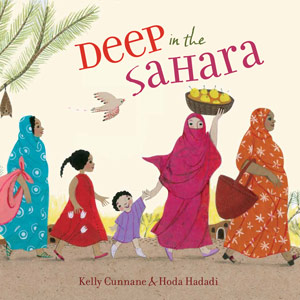
SubhanAllah, how absolutely wonderful to walk into your public library and find such a treasure of a book.  So simple and beautiful in appearance, in its poetic text, and in its message.  Set in Mauritania, West Africa and sprinkled with Hassaniya (an Arabic dialect), young Lalla wants to wear a malafa, a beautiful, colorful cloth that some Muslim women in Mauritania wear to cover their clothing and heads when they go out in public.  She wants to wear it to be beautiful like her mother, mysterious like her older sister, a fine lady like her cousin, and a long-ago queen like her grandmother but it isn’t until she understands what the malafa means and why the women wear it does she receive a beautiful blue one from her mother.

The illustrations and descriptions take you to a far a way land, with eager anticipation at what you will see, hear and experience.  Culture is shared, tidbits about Islam’s traditions are shared and a wonderfully simple, yet thought provoking story is conveyed.  With an AR reading level of 3.7 this book would be wonderful for story time listeners as well as independent readers.  Also because it is probably not a culture most are familiar with I think students up to 5th grade would enjoy the book and close the last of the 40 pages with a smile on their face and a light happy heart.  Alhumdulillah

A Party in Ramadan By Asma Mobin-Uddin Illustrated by Laura Jacobsen

Standard

BMP_8604_JT.indd

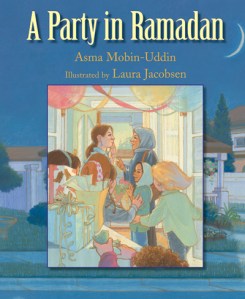
This is a great book that works on a variety of levels.  Leena is fasting the whole day for the first time, but is also invited to a friends party.  Her mom gives her the choice to fast or not as it is not yet mandatory at her age, and she decides to fast AND go to the party.  The story takes you through the activities of the party and how some parts are easy and some harder for the fasting Leena.  The end has a wonderful surprise for both Leena and the reader as the author gives us all reason to hope that respect among friends exists, and that in fact one can stay true to their beliefs and have support from their friends.

This book is  great conversation starter for older kids who maybe have tried to fast and felt the temptations of day-to-day life in a non -Islamic environment.  With an AR level of 4.2 and 34 pages the story is strong enough to hold a fourth graders attention and get them to analyze what they would do in a similar situation.  Although the book is about Ramadan and some facets about how fasting is done, what it means, and why Muslims do it, are sprinkled in, the story isn’t overly religious in nature.  The characters are simply Muslim, they pray, they thank Allah, they wear hijab, they make duaas and they also go to friend’s parties. I think non-Muslims would benefit from this book and see the beauty of diversity as Leena and her friends support one another.  The pictures also do a wonderful job of depicting the story: the characters are warm and happy, some cover some do not, they eat chocolate pudding and Baklava and the reader sees how a Muslim family is just like any other family.

The added beauty of this book is that it also works for story time. The younger ones may or may not understand the potential stress of being the only Muslim at a party, let alone being the only one fasting, but they do understand that Leena wanted to eat and drink and she remembered that when her little sister wanted her dessert.  They also understand how sometimes it is hard to do what is right, but inshaAllah the reward is sweet indeed.

Rashad’s Ramadan and Eid al-Fitr by Lisa Bullard Ilustrated by Holli Conger

Standard

rashads ramadan

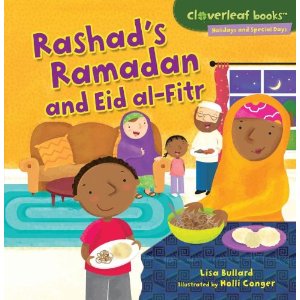
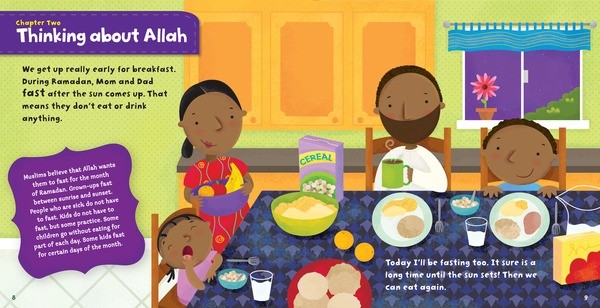
This is a non fiction picture book that tells a very basic story about Ramadan through Rashad’s young voice, with informative sidebars giving facts and details about Islam, Ramadan, and Eid. Broken into four chapters the book is very concise at just 24 pages, highlighting the key aspects of Ramadan: Where’s the Moon, Thinking About Allah, Thinking About Others, and  A Big Celebration.

?????

With an AR level of 2.7 this book is perfect to read along with your child, Muslim or non, letting them read the story, and you adding the information and answering any questions they may have about Ramadan.  There is a glossary in the back, as well as a page of “Resource Information” to learn more.  It may seem a bit “childish” for some, but it is a great introduction, and/or a good review of the basics for toddlers to third grade.

The pictures are bright and colorful, yet simple enough to not overwhelm the information being conveyed.  They definitely make you smile to see the little smiling faces and convey the excitement of the holiday.

Ramadan Moon by Na’ima B. Robert Illustrated by Shirin Adl

Standard

ramadan-moon

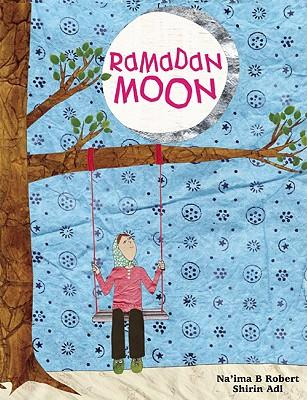
This book is fantastic and one of my children’s favorite.  The text is lyrical and simple and the pictures are charming and sweet.  I wait for the day I can read this to a larger group of children than just my own, but until then I have no problem reading this one over and over again.  It has an AR level of 4.6 and is 28 pages.

Told from a child’s perspective and voice, the free verse poetry lilts around in a playful way conveying what Ramadan is, what fasting is like, going to the mosque, what Muslim prayers entail, giving charity, being kind, and celebrating Eid.  While it would work for both Muslim and non-Muslim children, the vocabulary isn’t well defined and there really isn’t a story it is more of an overview.  Muslim children will enjoy it because they are familiar and probably have experienced most everything presented, however, if that connection isn’t made, the story may fall a bit flat.  That being said a brief explanation can easily erase that obstacle and make it a fun book for all kids pre-school and up.

I’m learning about Eid-ul-Fitr By Saniyasnain Khan Illustrated by Pulak Biswas

Standard

i'm learning about eid ul fitr

I’m learning about Eid-Ul-Fitr is a really dry book.  It is written as fiction, but it is more educational, than entertaining in nature.  Siblings Farah and Faisal are fasting, then celebrating Eid.  The story is told about them, but not really from their perspective.  They are just secondary vehicles to convey the main components of Ramadan and Eid.  The language is choppy and unimaginative.  My guess is that the story was translated from another language as grammatically it is awkward to read.  A few examples: “Maria’s parents belonged to Kuala Lumpur in Malaysia” and later, “Everyone was in his best clothes.”  The illustrations are adequate, with the exception of the pictures of a couple of Mosques from Delhi, Lahore, Kuala Lumpur, and Samarqand, which are quite nice.  Overall the book is sufficient.  If it is the only book your children have access to, there is nothing wrong with it, there are just a lot better, more engaging picture books, fiction and nonfiction, about Ramadan and Eid out there.


Samira’s Eid By Nasreen Aktar Illustrated By Enebor Attard

Standard

samiras eid

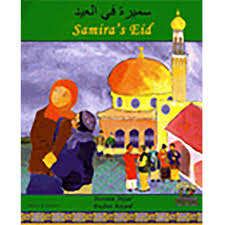
Samira’s Eid is a dual language story (my copy is English and Arabic, other languages are prevalent online as well) about Samira and Hassan, siblings enjoying Ramadan.  It is Hassan’s first time fasting and he is afraid fasting may hurt,  Samira and their mom explain that it won’t and continue to walk him through each step of a Ramadan day as he experiences them.  This point of view allows the reader to see what  Ramadan is like, how it feels, and what it means. The story carries on through Eid and explains as well as shows how Eid ul-Fitr is celebrated by Samira and her family.   The story concludes with a lovely surprise ending involving an Eid Card and Samira’s Nani (grandma), that adds to the book’s appeal at bedtime or story time.

The story is sweet, and level appropriate, it doesn’t get preachy and the dialogue doesn’t seem forced.  It is story driven and would be engaging to both Muslim and non- Muslim children with a little discussion.  The pictures are mediocre. They are colorful and for the most part a good accessory to the story. There are a few pictures however, where the faces are a bit “droopy” and jarring.  Particularly the one of Samira’s teacher, Mrs. Qadir.

It is unclear where the story takes place exactly, presumably the Asian subcontinent as Samira receives a shalwar-kameez to wear for Eid and the use of the term Nani. The author makes a point of following  the moon sighting for Saudi Arabia that may need to be discussed based on personal and community views and practices.

Overall a good story and at 22 pages a nice read-out-loud selection.


Nabeel’s New Pants: An Eid Tale Retold by Fawzia Gilani-Williams

Standard

Image


Nabeel’s New Pants: An Eid Tale retold by Fawzia Gilani-Williams and illustrated by Proiti Roy is a silly story about a shoemaker getting ready for Eid.  He goes to buy gifts for his wife, mother and daughter and gets a new pair of pants for himself.  The pants, however, are four fingers too long, and no one has time to hem them for him: Not the shop keeper, not his wife, not his mother, not his daughter, so he does it himself.  Nabeel then goes out to visit the poor and hand out charity and all the women in his life feel guilty andsneak over to hem his pants for him.  Luckily Nabeel has a sense of humor and there is just enough time to fix some seriously too short pants.

The book is 32 pages and an AR level 2.9.  It reads well out loud, with simple, yet colorful pictures for even the littlest ones to look at and enjoy.  The story is simple, and probably has a lot more relevance to a Muslim audience than a non Muslim one.  Eid is not described in any great detail, other than gifts are given, charity distributed, new clothes are worn, and lots of food is prepared, so it might put off those not familiar with the holiday.  Islam isn’t mentioned by name, but is obviously assumed.  Culturally the characters are Indian sub-continent based on the food’s being prepared.  Some of the women fully cover, some a little and some not at all.  And I particularly like that Nabeel can sew his pants himself.  The kids enjoy seeing themselves and their families in a silly story.  Even the three-year-olds get the punchline and all around it is just a fun book.  Alhumdulillah!

The Hundredth Name By Shulamith Levey Oppenheim

Standard

hundredth

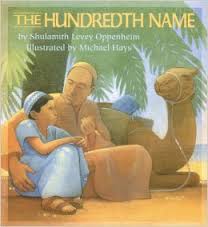
The Hundredth Name is a heartwarming story of a boy named Salah, his father, and his camel named Qadiim, Ancient One.  Salah is concerned that his best friend Qadiim is sad, and this in turn makes Salah said.  As Salah’s father gently and patiently teaches Salah about the power of prayer, the mercy of Allah and how we only know 99 names of Allah, the hundredth name is not known to us, Salah finds a way to make Qadiim happy.  Through beautiful pictures and prose like paragraphs, the reader is inspired to trust Allah with all matters, big and small.

The book has 32 pages and is an Accelerated Reader level 3.7.  I think Kindergarten would enjoy this book during story time, but the younger ones, Daycare through Pre-k,  may not truly understand the beauty and the message.

My Father’s Shop By Satomi Ichikawa

Standard

Image

What a surprisingly delightful book about a Moroccan boy named Mustafa in his father’s rug shop.  Helping his father, Mustafa finds a beautiful carpet with a hole in it and asks his father if he can have it.  His father agrees if in turn he promises to work on phrases in a variety of languages to help them sell carpets to tourists.  The boy agrees, but doesn’t put much effort in until in a moment of fun, he puts the carpet over his head, peeking through the hole, and runs out into the bazaar.  A rooster begins following him and as the tourists gather around, Mustafa, and the reader learn what a rooster says in five languages.  In Morocco:Kho Kho Hou Houuu!
In France: Co-co-ri-co! In Spain: Qui-qui-ri-qui! In England: Cock-a-doodle-doo! In Japan: Koke-ko-kooo!

The pictures really bring the story to life and connect the story to the reader.  I look forward to reading this book aloud during story time as I think the kids will see themselves in the Muslim characters in the bazaar, and see the different cultures all in one place just as they do in their classes.  At 32 pages the book is simple and memorable with large print and not too many words on the page.  It has an AR level of 2.2 and I think the kids will laugh and contribute to the sounds roosters make.  The story is completely clean, enjoyable, and memorable.

Big Red Lollipop By Rukhsan Khan

Standard

Image

I love that Scholastic offers this book in the school market and that the story is universal to all ages, and all cultures.  The mom is Ami and the names are Indian/Pakistani the illustrations show the mom in traditional clothing including a scarf on her head, giving the story a tinge of culture and religion, but not distracting from the beauty and charm of the story.

The basic story is of a girl, Rubina, presumably new to America (or any western country) being invited to a birthday party and running home to ask her mom if she can go.  The mom asks what is a birthday party and why would one celebrate it, implying that it is not a traditional practice, but not something she opposes.  Rubina is allowed to go on the condition that she take her younger sister Sana, who is begging to go along.  Embarrassed about the idea, Rubina arranges to bring Sana, even though her friends find it odd.  At the party Sana spoils all the fun, and afterwards eats Rubina’s treasured red lollipop.  Rubina is no longer invited to parties, however when Sana is invited to a party, Rubina shows tremendous heart and takes a surprising and praiseworthy course of action.

Beautifully illustrated the story works wonderfully during story time, with each child identifying to different characters, yet understanding the same message.  The book is an AR level 2.2, and lends itself easily to discussion.  Even older students can explore points of view with this book, and imagine what they would do in any of the characters’ shoes.

Completely clean and enjoyable.

The author’s website: http://www.rukhsanakhan.com/books/bigredlollipop.html offers a reading of the story, teacher’s guides, and the truth behind the fictionalized account.