Tag Archives: return

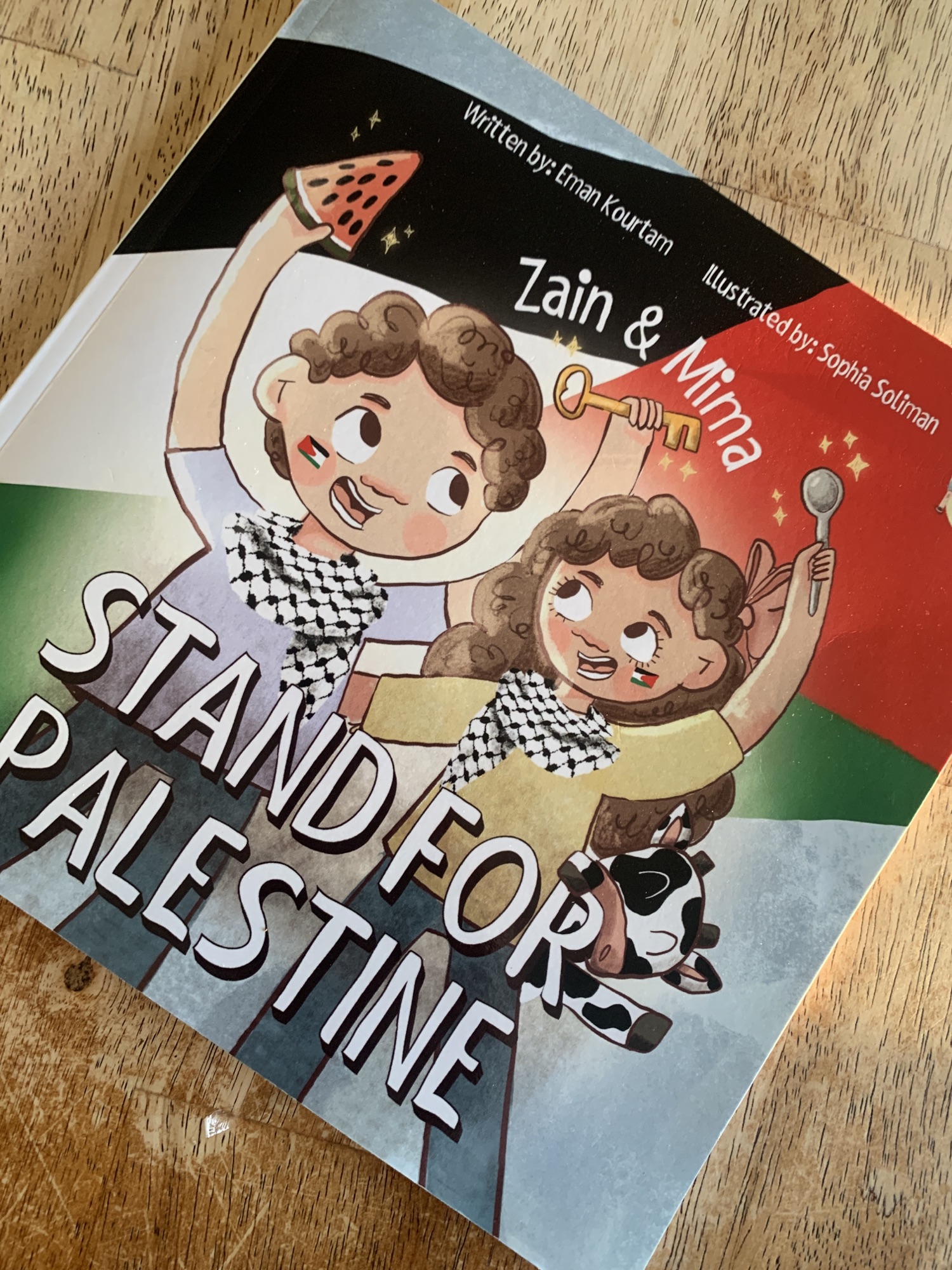
Zain and Mima Stand for Palestine by Eman Kourtam illustrated by Sophia Soliman

Standard

img_1853-1

I love this 57 page rhyming book from the perspective of a non Palestinian family pulling out their Palestine gear and taking to the streets to protest the occupation of Palestine.  Along the way the sibling duo, and thus the reader, learns about the history of Zionism, birth righters kicking people out of their homes, allyship with those on the side of Palestine, the crimes of Hitler, it shows maps of the occupation, details how movement is restricted, and even how to use BDS as a form of resistance from afar. All on an early elementary level.  There is a game at the end with an activity about resistance symbols, as well.

The book starts with Zain and Mima coming home from school tired and hungry.  They notice Mama is upset and glued to her phone, they then here noise outside and are encouraged by their mother to join the march as she hands them keffiyehs and explains that people are losing their homes in Palestine.
img_1855-1

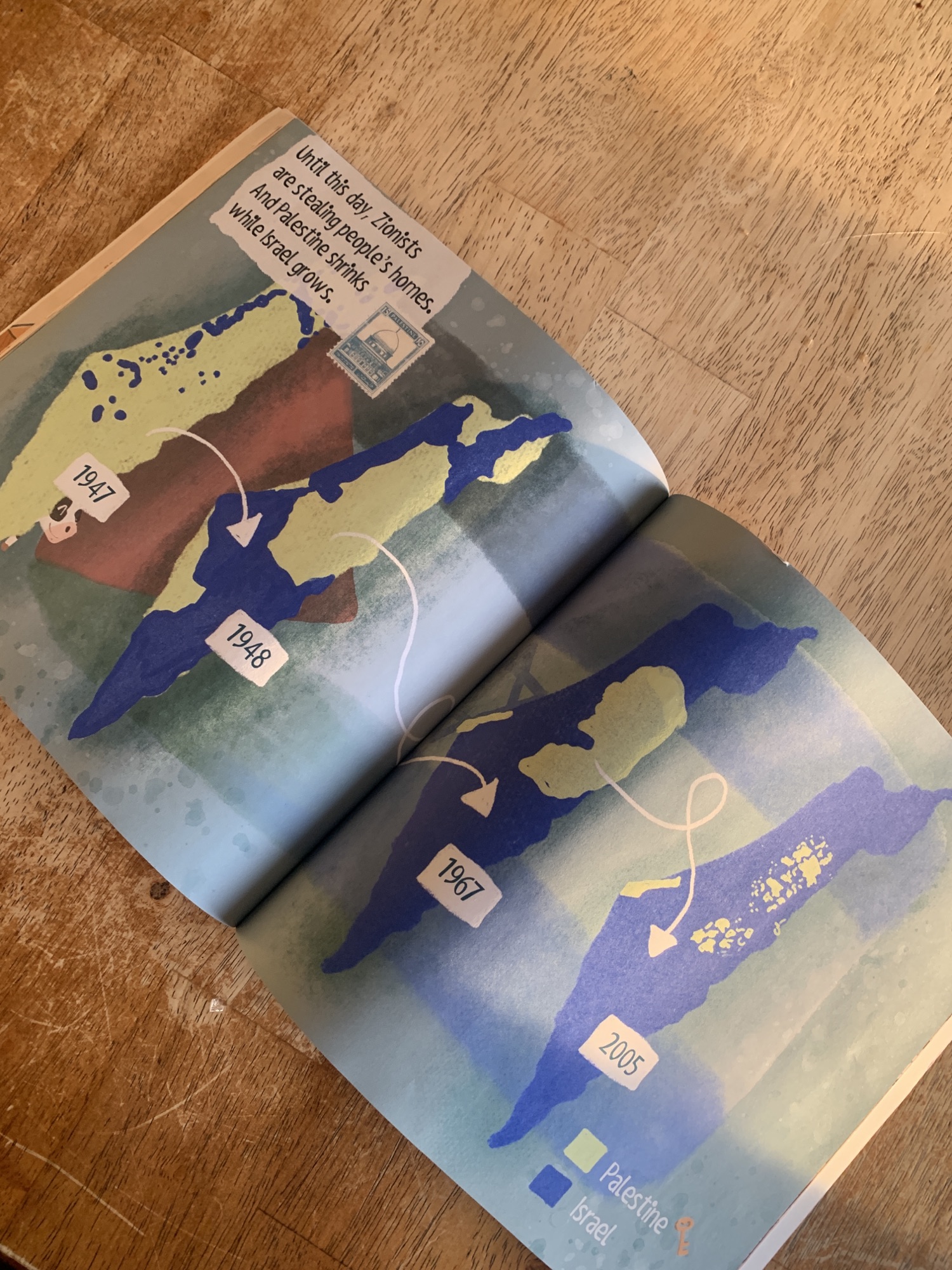
The kids are not sure of what is going on, but notice the chanting and signs and diversity of people coming together to demand freedom for Palestine.  After the protest they head home and Mama explains the history of Palestine and answers their questions.  She explains who Theodore Herzl was and his idea of Zionism.  Why it is dangerous and evil.  She then explains how Hitler’s actions in WWII gave rise to Zionism in the aftermath. A two page spread of maps show 1947 Palestine/Israel, 1948, 1967 and 2005 in easy to understand visuals. Mama then explains, without identifying any specific country, that Israel has the best weapons and Palestinians use rocks and slingshots to defend their homes and families.  It shows walls and checkpoints controlling people’s movements, and the oppression that has resulted.  When Mima asks what we can do in addition to marching and chanting, Mama explains using our money wisely with the BDS movement.  The next day, the children empowered by knowledge, make signs and are ready to stand bravely for Palestine.

img_1858-1

This book was originally written in 2022, and sadly is still so on-point.  It is available again on Amazon after being temporarily blocked, but I hope you will purchase it from a small business such as Crescent Moon Store where my initials ISL will save you 10%.

img_1857-1

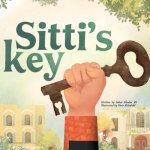
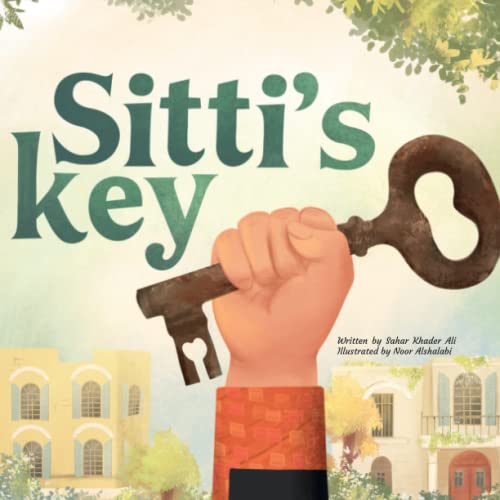
Sitti’s Key by Sahar Khader Ali illustrated by Noor Alshalabi

Standard
Sitti’s Key by Sahar Khader Ali illustrated by Noor Alshalabi

sitti key

I try and buy, read, and review every children’s book about Palestine that is published, it is the least I can do.  I also try not to compare them to each other as they present different aspects of oppression, perspectives of strength, examples of joy, and messages of hope, even among many similar themes of food, keys, traditions, and culture.  I really appreciate that this book though is incredibly blunt.  It isn’t lyrical, it isn’t poetic, and as Israel is bombing Jenin as I write this I’m glad it doesn’t mince words about the Nakba. I do think caregivers though, should probably read it first as it might be a little triggering for sensitive children.  The story is OWN voice and probably best suited for middle elementary aged children.  It is perhaps also worth noting that the book could be seen as making Jews synonymous with Zionists.  The characters are Muslim, Islamic phrases and Arabic terms are sprinkled throughout, and even despite the pain the family has endured, the book stays hopeful and proud.

Sitti is coming and Amal is excited, it has been two years since she last saw her.  She loves how excited her mom and grandma are to unpack gifts of olive oil, dates, and zataar from friends.  Amal isn’t sure what to do with the “old lady thoub” she has been gifted, but she smiles in appreciation none-the-less.  When Sitti pulls out an old key, Amal starts to ask her about it, but her mother shuffles her off to bed.

The next day at school, Amal has to work on a presentation about “culture,” but there are no Palestinian books in her school library, so she just watches the other kids.  At home they eat and listen to Sitti’s stories of long ago in Haifa, and Amal asks her why she left Palestine.  Despite her mother trying to redirect, Sitti says it is time she knew about the Nakba.

Sitti tells about living on the land for generations and how the Jews believed the land belonged to them.  In 1948 the British decided Palestine would be the homeland for the Jews.  Armed men came and arrested anyone who tried to stay in their homes. Sitti’s brother was handcuffed and never seen again.  The family grabbed what they could including the key to their home as they made their way to a refugee camp in Lebanon.  They stayed for three years, before making their way to America.

When Sitti concludes her story she hands the key to Amal and her hope that she will return to their home inshaAllah.  Feeling the pride and warmth of home, Amal has a determination to reclaim her heritage and share her “culture” with her classmates.

The illustrations are sweet, the mom and Sitti wear hijab even in the home, and the inshaAllahs and salams come naturally. The book does not stop to define zataar or marimya, which helps the flow. I also like how it shows that there aren’t books about Palestine in the school library, it is strong and important detail.  I don’t understand where Sitti is coming from though, it would seem Palestine as she is bringing gifts from friends, but in the story it says after Lebanon they made their way to America, so I’m not sure where Sitti lives, and how the logistics of the family work to be honest.  I also kind of wish there was a  recipe for zataar in the book and lyrics with translation for the song the family sings.

Book is available on Kindle or can be ordered from www.littlehibba.com

The Battle by Karuna Riazi

Standard
The Battle by Karuna Riazi

the battle

This claims to be a companion book to The Gauntlet, but it does rely heavily on details from the first to make sense of who some of the characters are as this book does little to explain them and advance their story.  In reality the book is very similar to the first book, but sadly not as fun.  I was disappointed in the 295 page AR 5.2 book, but my fourth and fifth grade boys enjoyed it as they had few expectations and the fast pace kept the book fun.

SYNOPSIS:

It has been four years since Bengali American Ahmad Mirza has left the game world, Paheli, with his sister Farah and her friends.  The old board game has been destroyed and the reboot focuses on a new video game setup.  This time around Ahmad is the main character and with his ADHD he finds himself getting in trouble a lot in school and desperate for a friend.  When a mysterious package holding a video game shows up and Winnie sticks up for him, things are possibly looking up. When all of New York freezes at the insertion of the game, however it clearly is not.  Winnie and Ahmed are off to battle the Architect and MasterMind to unfreeze their beloved city and escape Paheli.

Different battles and characters inch the duo closer to winning, but facing their fears and  being sidetracked by remnants of the last game trying to return make everything complicated.  Ahmed’s uncle returns to the game, giant mice try and help, crazy monkeys distract, and flying rickshaws populate the eastern inspired world filled with Bengali, and Arab references.

WHY I LIKE IT:

I love that it is a Muslim kid with some struggles at the helm, but there is really so very little character building that it ultimately doesn’t count for much in the long run.  Just like the first book, the characters are taken from the “real” world and transported to a game world and they must win the game to return home.  The book is fast paced and fantastical, but I constantly felt confused.  The challenges were disjointed, there wasn’t a clear objective, Ahmed didn’t recall being there before or that Vijay bhai had somehow come back with them, the mice help and then they are absent, and there wasn’t really a big reveal or explanation resolving any of it.  It felt all over the place and with little world building I didn’t feel like I could even picture what Paheli looked like, so forget feeling what the characters felt or imaging the intensity that that the game was running on.  It seemed like an updated version of the first book, but not done as well at all.

FLAGS:

Pretty clean, some intensity, some fighting/battling, death, nothing detailed nor grotesque.

TOOLS FOR LEADING THE DISCUSSION:

I think the book is great to have in a classroom or on a home book shelf especially if the Gauntlet was enjoyed, but I wouldn’t use it as a book club book because it doesn’t offer much to talk about.  There isn’t a cathartic release or even an under current of family and friendship and loyalty, it really is just surface level story telling.