Tag Archives: ramadan

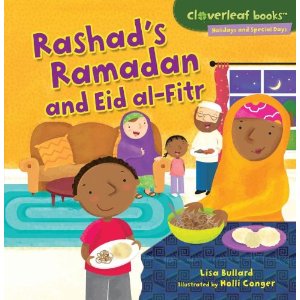
Rashad’s Ramadan and Eid al-Fitr by Lisa Bullard Ilustrated by Holli Conger

Standard

rashads ramadan

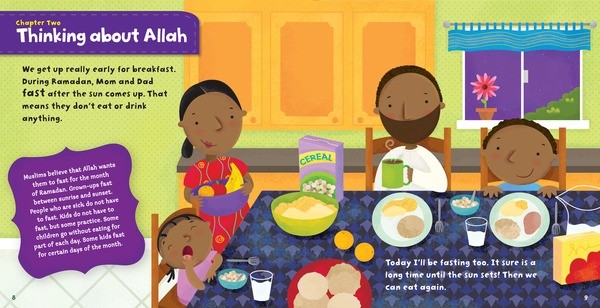
This is a non fiction picture book that tells a very basic story about Ramadan through Rashad’s young voice, with informative sidebars giving facts and details about Islam, Ramadan, and Eid. Broken into four chapters the book is very concise at just 24 pages, highlighting the key aspects of Ramadan: Where’s the Moon, Thinking About Allah, Thinking About Others, and  A Big Celebration.

?????

With an AR level of 2.7 this book is perfect to read along with your child, Muslim or non, letting them read the story, and you adding the information and answering any questions they may have about Ramadan.  There is a glossary in the back, as well as a page of “Resource Information” to learn more.  It may seem a bit “childish” for some, but it is a great introduction, and/or a good review of the basics for toddlers to third grade.

The pictures are bright and colorful, yet simple enough to not overwhelm the information being conveyed.  They definitely make you smile to see the little smiling faces and convey the excitement of the holiday.

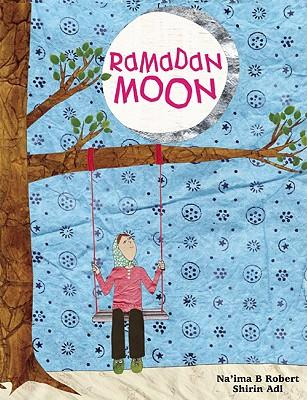
Ramadan Moon by Na’ima B. Robert Illustrated by Shirin Adl

Standard

ramadan-moon

This book is fantastic and one of my children’s favorite.  The text is lyrical and simple and the pictures are charming and sweet.  I wait for the day I can read this to a larger group of children than just my own, but until then I have no problem reading this one over and over again.  It has an AR level of 4.6 and is 28 pages.

Told from a child’s perspective and voice, the free verse poetry lilts around in a playful way conveying what Ramadan is, what fasting is like, going to the mosque, what Muslim prayers entail, giving charity, being kind, and celebrating Eid.  While it would work for both Muslim and non-Muslim children, the vocabulary isn’t well defined and there really isn’t a story it is more of an overview.  Muslim children will enjoy it because they are familiar and probably have experienced most everything presented, however, if that connection isn’t made, the story may fall a bit flat.  That being said a brief explanation can easily erase that obstacle and make it a fun book for all kids pre-school and up.

I’m learning about Eid-ul-Fitr By Saniyasnain Khan Illustrated by Pulak Biswas

Standard

i'm learning about eid ul fitr

I’m learning about Eid-Ul-Fitr is a really dry book.  It is written as fiction, but it is more educational, than entertaining in nature.  Siblings Farah and Faisal are fasting, then celebrating Eid.  The story is told about them, but not really from their perspective.  They are just secondary vehicles to convey the main components of Ramadan and Eid.  The language is choppy and unimaginative.  My guess is that the story was translated from another language as grammatically it is awkward to read.  A few examples: “Maria’s parents belonged to Kuala Lumpur in Malaysia” and later, “Everyone was in his best clothes.”  The illustrations are adequate, with the exception of the pictures of a couple of Mosques from Delhi, Lahore, Kuala Lumpur, and Samarqand, which are quite nice.  Overall the book is sufficient.  If it is the only book your children have access to, there is nothing wrong with it, there are just a lot better, more engaging picture books, fiction and nonfiction, about Ramadan and Eid out there.


Night of the Moon By Hena Khan Illustrated by Julie Paschkis

Standard

night of the moon

Night of the Moon is a beautiful book both visually and content wise.  The pictures are bright and inviting and consume the entire page, keeping even the youngest of listeners engaged.  The book has an AR level of 4.1 and has 32 pages, making it work great for story time and well for independent readers too.

The book tells of seven-year-old Yasmeen, a Pakistani-American girl experiencing Ramadan. The story is moved along by the ever changing phases of the moon. While this book is adequately called a Muslim Holiday Story, it is very cultural.  The characters go to the mosque, but the focus of the story is not why we fast, the revelation of the Qur’an to Prophet Muhammad (peace be upon him), or even manners.  The story focuses on going to iftar parties, having henna painted on your hands, presents, and the very Pakistani-tradition of celebrating chand-raat, the night of the moon.

I like that this book shows Yasmeen talking about Eid at school with classmates of other backgrounds, I even like that her grandma wears hijab and her mother does not.  I also like that they eat a variety of foods, from kebobs to cupcakes.  Thus far, so many of the Ramadan and Eid books I’ve read contain the same information in a fictionalized setting, this one is definitely different, instead of focusing on what Ramadan is, it shows how it is celebrated.  The book works well for Muslim and non Muslim children from all around the world.  If your audience lives in American and has ties to the Asian subcontinent they will see them selves in this book, and even if they don’t, they will probably want to join Yasmeen and her family is celebrating Ramadan and the Night of the Moon.

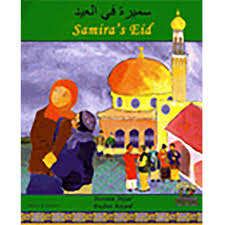
Samira’s Eid By Nasreen Aktar Illustrated By Enebor Attard

Standard

samiras eid

Samira’s Eid is a dual language story (my copy is English and Arabic, other languages are prevalent online as well) about Samira and Hassan, siblings enjoying Ramadan.  It is Hassan’s first time fasting and he is afraid fasting may hurt,  Samira and their mom explain that it won’t and continue to walk him through each step of a Ramadan day as he experiences them.  This point of view allows the reader to see what  Ramadan is like, how it feels, and what it means. The story carries on through Eid and explains as well as shows how Eid ul-Fitr is celebrated by Samira and her family.   The story concludes with a lovely surprise ending involving an Eid Card and Samira’s Nani (grandma), that adds to the book’s appeal at bedtime or story time.

The story is sweet, and level appropriate, it doesn’t get preachy and the dialogue doesn’t seem forced.  It is story driven and would be engaging to both Muslim and non- Muslim children with a little discussion.  The pictures are mediocre. They are colorful and for the most part a good accessory to the story. There are a few pictures however, where the faces are a bit “droopy” and jarring.  Particularly the one of Samira’s teacher, Mrs. Qadir.

It is unclear where the story takes place exactly, presumably the Asian subcontinent as Samira receives a shalwar-kameez to wear for Eid and the use of the term Nani. The author makes a point of following  the moon sighting for Saudi Arabia that may need to be discussed based on personal and community views and practices.

Overall a good story and at 22 pages a nice read-out-loud selection.


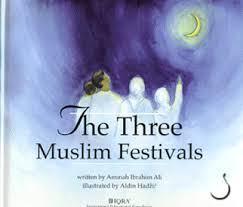
The Three Muslim Festivals By Aminah Ibrahim Ali Illustrated By Aldin Hadzic

Standard

Image

The Three Muslim Festivals is a very informative book about Ramadan, Id al-Fitr, and Id al-Adha, at over 60 pages however, it is a bit long for story time or smaller children.  Broken up into three parts, each told from a different character, the book would work well for second through fourth grade students.  It reads like a very basic chapter book, with information mixed in with a simple story.  The morals are clear, hadith, ayats and dua’as are shared and the illustrations help support the fictionalized portions.  The pictures aren’t engaging, but they do show a variety of ethnic groups and happy families.  The book is content, not character driven, but the families are supportive of the children, there are actively involved moms and dads, grandparents, and siblings.  The mom in one story is a physician and the dads help in the kitchen and around the house, showing some diversity. I like how it serves as both a review of basic Islamic principals while reinforcing elements that a child may not know or may have forgotten in a non condescending manner.  I would imagine the average seven year old could read it independently and comprehend it without being bored.  It isn’t the best written story out there, but it should be engaging enough to convey a lot of good information to an elementary aged reader.  Based on the style it is probably more intended for Muslim readers, but there is a three page glossary of terms in the back.

Eid Kareem Ameer Saab By Fawzia Gilani-Williams

Standard

This book made me laugh. It is essentially the story of Scrooge in the Christmas Carol simplified for a younger audience and switched to an Islamic perspective.  Don’t get me wrong, despite its unoriginal foundation, it is a good story.

The main character is grouchy, wealthy Ameer Saab who we see in a typical day berating his servant Raheem, refusing to help a woman and her young baby, refusing to help the poor, and neglecting his Salah.  Meanwhile Raheem is scrounging up his money with his wife to provide food, while still managing to help a widow, and others.  That night Ameer Saab has three dreams, in the first he is reprimanded by his father, the second by his mother, and in the third his money and jewels strangle him.  He wakes up a changed man on Eid morning.

This book is great for 2nd through 4th graders, with colorful pictures and well spaced text, it invites rather than intimidates this age group.  The morals are also clear and influential as the reader can see clearly which side is more desirable to Allah swt.

There is a verse from the Quran explained, and there are a few Arabic words, nothing off-putting for a newly independent reader and at just 24 pages, I think most elementary age students will enjoy and benefit from the story.

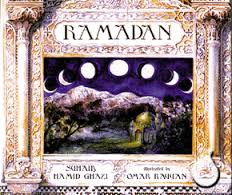
Ramadan By Suhaib Hamid Ghazi Illustrated by Omar Rayyan

Standard

ramadan

I remember when my parents first acquired this book (maybe they ordered it or it was a gift, I’m not sure), in 1996 there weren’t a lot of Islamic picture books to choose from and I took it to Sunday school to share with my students.  My preschool class loved the pictures, but the text was way over their heads and I had to summarize it to keep their focus.  Nearly twenty years later, there are a lot more options, yet the illustrations of this beautiful book are still mesmerizing to children, and the text is still too lengthy, factual, and complex to engage most children under 10 years old.

Hakeem, the main character in the book, explains not only Ramadan and fasting in detail, but also the basic tenets of Islam, words in Arabic with English descriptions, and makes numerous comparisons to other religions.  Everything is tastefully done, and probably was written to appeal to both Muslim and non Muslim children, allowing the reader to identify with Islam through whatever background they come from.  The result, unfortunately, results in a book with very little “story” and a whole lot of information.  It reads like a research paper on Islam, with a fictional boy thrown in to tell it in a simple way.  However, it isn’t a child’s voice speaking, and if the pictures weren’t so wonderfully done, no child would be at all tempted by the book.

That being said, if you have multiple aged children in your family, it works well to let the little ones look at the pictures while you “tell” them about Ramadan, and later letting the older ones build on their knowledge of Islam and Ramadan.  It doesn’t lend well to story time or larger groups in my experience, but could be a way to share information on Islam to curious adults, new converts, or young adults looking for the basics without being consumed by a text book.

My First Ramadan by Karen Katz

Standard

my first ramadan
With Ramadan here my goal is to round up all my Ramadan and Eid picutre books to share (and hopefully review). Unfortunately school is out for the summer, so it will be mostly just sharing with my own children and nieces and nephews.

Karen Katz, a popular children’s author wrote and illustrated a children’s book about Ramadan and Muslims called My First Ramadan. It is an AR 2.8 and the pictures are done in her signature style, which the kids will recognize and love. Told from a little boy’s perspective he explains Ramadan, Islamic traditions, basics of Islam (Quran, Prophet Muhammad (peace and blessings be upon him)) and some of the five pillars. Words such as iftat, suhoor, fajr, maghrib, are introduced, explained and even have a pronunciation guide in parenthesis.

A few things that I discussed with my kids while reading are that in the picture talking about Prophet Muhammad (peace and blessings be upon him) teaching his followers to break their fast with a date and water, that RasulAllah is NOT pictured and why we don’t picture him. I also explained that each family has traditions, and the one in the book sits on the floor to eat. Islamically it isn’t required. We also talked about why in the book the men and women are in different rooms when they pray and in some Masjids they are in the same room, the men in front and the women in back.

The book mentions and illustrates how happy Ramadan and Eid are, and how Muslims come from all over the world. In the pictures some woman cover, some don’t, but we are all family. All in all a cute book that introduce and reinforces Ramadan.