Tag Archives: Pakistan

Written in the Stars by Aisha Saeed

Standard

written in the stars.jpg

It has definitely been done before in books dealing with the crossing of desi and the west with a female lead, that there must be: forbidden love, physical and or sexual abuse, a a sympathetic side kick, and evil parents or in-laws.  So, perhaps this book just assembles the ingredients in a new way, or my deliberate hiatus from said genre softened my heart with time.  But, either way Written in the Stars was an enjoyable read that didn’t get caught up in the dichotomous rhetoric of good vs. bad, us vs. them, right vs. wrong, and I found that refreshing.  It is in the AR database as a level 4.1 book, but there are sexual references and rape, so while it is written very simply and linearly, I would not let an elementary student read the book.  The protagonist is 17, so really the story line is more high school relevant.

SYNOPIS:

Naila is a senior at a Florida high school with scholarships and dreams to be a doctor. She has friends and stability at home. However, she also has a boyfriend, a big no-no to her conservative Pakistani immigrant parents.  When she sneaks out to prom and gets caught her parents drag her to Pakistan and secretly work to marry her off.  The premise isn’t very original, but the author keeps it interesting by having the boyfriend also of subcontinent descent, and Naila being naively clueless about what her parents and extended family are doing to her.  As she begins to realize what her parents’ end goal is, she gets desperate to return home, putting her against her family.  The story is quick and Naila is definitely a girl of action as she tries to escape, as she gets drugged, gets married and pregnant.  And remarkably she doesn’t spend too much time bemoaning her situation, which is nice as the book is only 284 pages with the Author’s Note, Glossary, Resources, and Acknowledgements.  A long the way you meet some kind characters and minor villains, you see a bit of the culture and Naila’s determination.  The parents are underdeveloped and I wish they were fleshed out so that the reader could see their perspective.  They are presented as pretty vile and cold and nothing more than that unfortunately.

WHY I LIKE IT:

At first I found it odd that religion was not in the book, like at all.  Her rules regarding boyfriends and male friends are presented as being cultural.  While in Pakistan and being shown around a cousin points out a mosque, tells Naila her father is in there, and if she wants to see inside they can come back when it isn’t pray time. That is it. So, the characters are Muslim, but Islam is not mentioned.  The author on the jacket flap states that she is Muslim and had a good arranged marriage.  So as I’ve reflected back on the book, I think I kind of like how she left religion out of it.  Albeit leaving a gap in the narrative, it allows the book to be seen in a character driven way more than a “that’s how they do it” sort of way and thus opening it up to a wider audience.  Also, seeing both good and bad in the same cultural population removes the idea that different is bad, which is often lacking in these “cultural” novels.  I really want to meet the author and see what her reasoning is, but I think it was deliberate and thus I’m growing to appreciate her restraint on bringing the religious tinge into the book.  I wish it was written a little more complexly.  In addition to more about the parents, I wanted to know more about Saif, the boyfriend, I wanted to know about the future of her cousin Selma, who was her confidant, and about the aunt that never married, just to name a few.

FLAGS:

There is kissing, and while not detailed, Naila is raped by her husband and it is implied and reflected on. There is some additional physical violence as well.

TOOLS FOR LEADING THE DISCUSSION:

I would consider this for a selection if I did a high school book club. Definitely not middle or elementary.  I would possibly suggest the book to older middle school if they could handle it.  There are lots of talking points, and some girls are so drawn to the romance genre that at least this one isn’t too over the top.

Curriculum Discussion Guide

Author’s Blog 

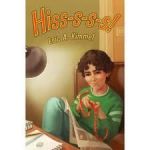
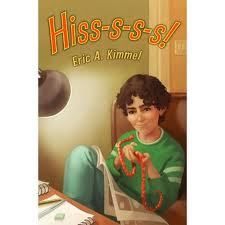
Hiss-s-s-s! by Eric Kimmel

Standard
Hiss-s-s-s! by Eric Kimmel

Hiss-s-s-s!

So um ya, its a book about a boy who wants a pet snake. Very linear, very simple, often more instructional than story, but somehow I really enjoyed it and read it in one sitting, as did my 9-year-old daughter and 7-year-old son. The book is 154 pages (including the author’s note) and is written on an AR 3.7 level.

SYNOPSIS:

Omar is an American Muslim who wants a snake.  His dad, Ahmed, supports the idea, but his mother, Hoda, is terrified of snakes, and begrudgingly gives her permission.  The rules are pretty simple, Omar will have to take care of the pet, and it is never to leave his room.  His mother basically doesn’t want to know that there is a snake under the same roof.  Little sister Zara is just excited.  The majority of the book is Omar learning about corn snakes, and everything involved in their care.  There are a lot of lists, and passages about him researching and taking notes. His friend Philip, nicknamed Samkatt-short for Samurai Cat, is the comical sidekick, who in this case also is the brains in the group, keeps the plot moving along. The author sprinkles in some anecdotes and history giving the characters depth.  We learn Ahmed’s dad is from Pakistan and while he grew up in the city he spent time in the country and with snakes.  He retells a fictional story about how snakes kept the rodent population down, and thus allowed the farmers in his family to have higher grain yields.  He also tells Omar tidbits about his time in college working in a biology lab with snakes.  Omar’s mom is an accomplished artist that often incorporates her Lebanese culture into her work and gallery shows.  The banter between her and Samkatt keep the story light and entertaining.  (SPOILER ALERT) At the climax, the snake gets loose, and Omar learns where his mother’s phobia comes from in her childhood.  During one of Lebanon’s many wars, a man with a snake tattoo beat her father extensively while she was forced to watch.  This somehow over time developed in to Ophidiophobia, the fear of snakes.  When the snake pops up, mayhem ensues, resulting in Hoda going to the hospital and Omar having to decide what to do with his snake, Arrow.

WHY I LIKE IT:

It is such a simple story, yet the warmth of the characters at the beginning and end really made it enjoyable.  I truly applaud the author for stretching a very simple idea into a full fledged YA novel.  The characters and family are Muslim, but it isn’t really discussed or made an issue.  There is nothing religious talked about or detailed.  In some ways, it would have been nice to throw a little more cultural or religious depth in to the story to connect with the characters, but being as the author is not Muslim it is kind of impressive that he presented them as just a regular American family.  Culturally there are only a few references outside of the anecdotes the parents share: Omar can’t come up with an example of when he was bullied, some of the foods served or eaten, the mother’s art work.

FLAGS:

None. Even if you don’t like snakes, the book should not make you squeamish.

TOOLS FOR TEACHING THE DISCUSSION:

There is not much to discuss with the book, and thus I wouldn’t choose it for a book club pick.  I think 2nd or 3rd graders, however,would do well with the book in small groups.  There is just a tinge of foreshadowing, symbolism, and interpretation that wouldn’t overwhelm the student, but would boost their confidence when they connect the dots so to speak.  Plus, some discussion could come from how he had to persuade his family, the responsibility he had to show, and the sequencing of events. The worksheets and questions would practically write themselves.

Author Eric Kimmel’s blog about the book http://ericakimmel.com/2012/02/h-i-s-s-s-s-s/

Invincible Abdullah: The Deadly Mountain Revenge by Haji Uthman Hutchinson

Standard
Invincible Abdullah: The Deadly Mountain Revenge by Haji Uthman Hutchinson

invincible-abdullah-the-deadly-mountain-revenge-workbook-aziza-and-uthman-hutchinson-2

I’m pretty sure I’ve seen and handled this book hundreds of times in my involvement in four Islamic Schools, as a teacher, a librarian, and host of book fairs.  So, it is a little embarrassing to admit that this is the first time I actually cracked open the cover and read the book.  Written in 1992 with a less than attention grabbing cover, I had minimal expectations, but with a newborn and down time, I thought I needed to give it a chance, and I’m glad I did.  The book is definitely geared to boys (there isn’t even a female character in it), and is pretty action packed and quick paced.  You know the boys will get out of the predicament at hand, he is “Invincible” after all, and there are three more books in the series, but you don’t feel bad reading it anyway, because it is sufficiently entertaining.  The book isn’t amazing, but it holds its own largely because it doesn’t talk down to the reader.  The characters are independent and thoughtful and yes they are teenagers battling drug carriers in the tribal areas of Pakistan, and yes they are wielding guns and hiking over glaciers, but mind you they never miss their salat or fail to thank Allah (swt) for their success which kind of makes the book that much more fun.  The book is 218 pages with a glossary at the back.  It is not an AR book, but I probably will make it into one at about a fourth grade fifth month level (4.5).  I also am considering doing it for book club, but might wait and read the rest of the series to see which one will have a wider appeal.

SUMMARY:

Abdullah travels to Pakistan from England to visit his cousin Hasan.  At the airport Abdullah’s bag gets switched with someone else’s and the boys find themselves getting accosted by the rightful owners who have a half a million dollars in their suitcase.  The boys talk to the police and learn that the money is part of a heroin operation going on in the tribal areas and that the inadvertent switch messed up the police’s sting to catch the criminals.  The boys run in to the drug runners again in the bazaar, and after an all out brawl decide when an opportunity to go into the tribal areas presents itself, that they should take it and do what they can, to put a stop to the criminal’s drug ring.

WHY I LIKE IT:

There is drugs, violence, and guns, but it is all done for the right reasons, in an action filled manner.  The “good” guys are all religious, and while the “bad” guys have religious sounding names, clearly are not, which lends it self to a decent discussion about what makes a good person and what makes one religious, clearly not just their name or culture.  It also lends itself to a realistic conversation about drugs, their effects on the users, and on drug culture as well.  The guns, well the guns are there to make threats, and to hurt people, at best it gives you a seg-way to discuss your views on guns with your children, but in the book, it is what it is, not a moral or religious issue as the drugs are made out to be.  The boys, the heroes of the book, are all very devout mashaAllah, and their actions, manners, and thoughts reflect this.  I like that this is consistent with their character.  They are respectful to their families, to each other and are ever mindful of themselves as Muslims in all facets of their adventures.

FLAGS:

Just the content of drugs, violence, and death. Mild compared to most TV shows or movies, but present, none-the-less, nothing a third grade and up can’t handle. (Spoiler, only one person dies and it isn’t directly at the hands of anyone, nature steps in to save the day).

TOOLS FOR LEADING THE DISCUSSION:

There is a workbook that apparently can be purchased to accompany and teach the book: http://www.islamicbookstore.com/b9648.html

The author gives pause as the characters have to decide what to do next and to weigh the pros and cons and possible repercussions of their decisions.  These moments would lend themselves well to a book club discussion to find out what the students would do, what they would be willing to risk, and at what cost.

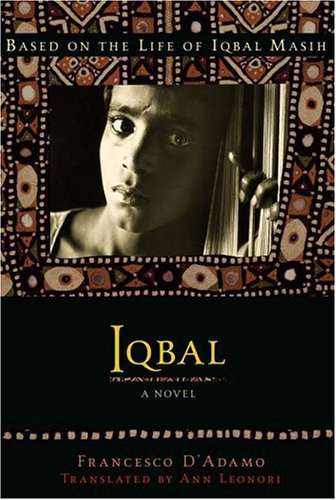
Iqbal by Francesco D’Adamo

Standard
Iqbal by Francesco D’Adamo

iqbal

Iqbal is the fictionalized story of the young Iqbal Masih, a real boy who escaped virtual slavery in a carpet factory to fight against child labor in Pakistan.  Although the book is a short read at only 120 pages, it is heavy in content.  The description of the children who work all day often tied to their looms to make the beautiful carpets desired all over the world, is both incredibly gut wrenching as well as inspiring.  The book has an AR level 5.1 and while the author and main character are not Muslim, most of the minor characters presumably are, as is the environment.  I am using this book for our new Book Club book because the message and determination of young Iqbal is something middle school students should feel empowered by, inshaAllah.

“So long as there’s a child in this world who is deprived of his childhood, a child who is beaten, violated, or exploited, nobody can say it’s not my business.”                                 …Iqbal

SYNOPSIS:

The story is told from the voice of a young girl, Fatima, bonded to a carpet weaver where Iqbal joins her and a handful of other children who are forced to make carpets to pay off their parents’ debts.  Iqbal has a reputation as being the best carpet maker and is rumored to have made one of the most difficult designs for a former master.  While good at what he does, Iqbal combats the naivety of the other children by pointing out that they will never be allowed to leave, even if they manage to pay off their debt.  This slow realization empowers all the children with Iqbal as their leader to dream of freedom, and to stand behind Iqbal as he dares to do more than just dream.

WHY I LIKE IT:

I like this book because it is vivid in detail and really takes the reader to a place they have never seen, nor thought about.  To read about another’s life paves the way for the reader to develop understanding and empathy, characteristics most middle school students rarely exhibit.  The fact that it is based on a true story, in the recent past, really hammers these concepts into the reader and changes the way one looks at hand tied carpets, and child labor in general.  I think it also makes the reader appreciate their own life, their own freedom, and educational opportunities even more.

FLAGS:

The book is clean, but the concepts are for older kids.

TOOLS FOR LEADING THE DISCUSSION:

Unit Plan:

Click to access iqbal-unit-plan.pdf


Summary with pictures:

http://desk2.sd8.bc.ca/web1/Elementary/Iqbal/iqbal.htm


A

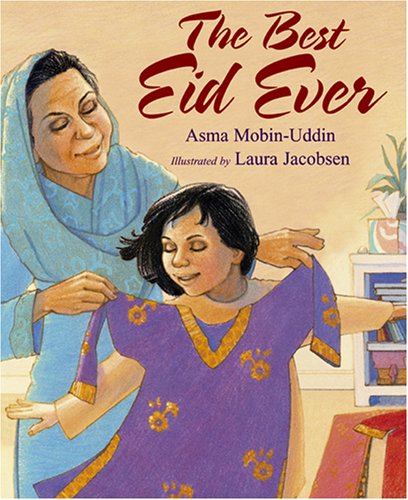
The Best Eid Ever by Asma Mobin-Uddin Illustrated by Laura Jacobsen

Standard

best eid ever

For some this book may have a lot going on it’s 32 pages: Eid ul Adha, parents at Hajj, refugees, charity, Pakistani culture, but if you are reading this book to Muslim children (or they are reading it independently, it has an AR level of 3.8) i think it is delightful.

Aneesa wakes up on Eid morning missing her parents who are in Saudi Arabia performing Hajj. Her grandma, Nonni, surprises her with three new outfits complete with bangles and shoes for each of the days of Eid and is preparing her favorite dinner, lamb korma, for them to eat after Eid prayers.  At Eid prayers Aneesa meets some refugee girls and wants to do something to make their Eid a little brighter.  Nonni and Aneesa come up with a plan and the result is “the best Eid ever!”

I love that it has morals and plot and sparks dialogue.  The message is so simple yet beautiful, that it stays with the reader, adult and child alike.  The illustrations are beautiful and warm providing a nice balance to the long passages.  There is an author’s note and Glossary in the back, but I think this book is really intended for a Muslim audience familiar with Hajj, Eid, and Paksitani culture.  It wouldn’t be lost on someone new to the vocabulary and customs, but definitely wouldn’t be as magical or memorable.

My 3rd grader loved the book and we were able to talk about it and reflect upon it long after the initial reading.  My younger boys enjoyed it, but didn’t get as much out of it.  I think this book works better in smaller groups rather than story time, or simply to have on the shelf to sweep the reader up and allow them to draw their own conclusions on what it means to do something for someone else.

Beneath My Mother’s Feet By Amjed Qamar

Standard

Image


I was so surprised by this book, subhanAllah.  I picked it up at a used bookstore and didn’t think much of it, tossed it in my bag one day as I headed out with my children’s class on a field trip and seriously didn’t want the bus ride to end I was so caught up in the book.  An easy 200 page read if you are familiar with Pakistani culture, even more so if you have ties to Karachi (specifically Defense), the detail takes you to the streets and gullies you know and you want to stay and look around.  If you don’t have these reference points, the book might be a bit hard to connect with, but I think the Author still gets her story across if you are willing to try (there is a glossory in the back).  Beneath My Mother’s Feet is a 4.9 reading level, and because of the heavy cultural references I don’t think I would do it as a book club book, but I have already suggested it to certain students that I know will find a connection and appreciate their mothers and their opportunities in America all the more.

SYNOPSIS:

Nazia is a typical fourteen-year-old Pakistani girl in the large and bustling city of Karachi, Her working class family suddenly is thrown into chaos when her father gets injured at his construction job.  As we learn more about her father, Nazia and the reader discover how lazy, selfish, and dishonest he is, despite Nazia’s determination to see the best in him.  While the family has had hard times before, this time something more than Nazia’s mom scraping and sewing to get by is needed.  As a result Nazia is pulled out of school to help her mom be a maid, masi, in wealthy families’ homes.  The family eventually loses their home, and Nazia’s older brother steals all the jewelry and clothing intended for Nazia on her wedding.  Her father disappears and the women of the family are left to find the strength and resources to carry on.  While the cover teases the idea that Nazia is a “perfect daughter” and that she is such a “good girl” I found these to be incredibly misleading statements and pulled quotes.  I think the story, shows how determined Nazia is, but not at a rebellious level, more as a girl finding her self and willing to risk it all for what she believes, a trait very much in line with her mother’s example.  

WHY I LIKE IT:

I like that it shows self resilience and self reliance both from Nazia and her mom, Naseem.  Nazia holds on to her friendships, her dreams, and isn’t afraid of hard work.  She explores what it means to be a good daughter, good sister, good friend, and good worker. She also is emotionally sympathetic and generous to a small servant boy, all wonderful concepts to present to a 4th through 6th grade audience.  I like that although Nazia isn’t terribly religious she does rely on Allah (swt) and her faith to help her endure the various hardships she encounters.  Islam isn’t at the forefront, but clearly she Muslim.  The book is heavily steeped in culture, the concept of a dowry, how masi’s are treated are not Islamic in the least, and unfortunately the author doesn’t articulate that it is only a cultural norm.  While the women tend to be highlighted in different colors throughout the book, the men seem to be brushed over in a very negative light.  On the surface it is nice to see strong women of various socio/economic spheres coming together and making decisions, but to push all the men aside as being worthless, isn’t realistic or fair.  I liked the uncertainty at the end, usually I prefer books that wrap up all loose ends, but here i think it opens the door to imagine what would have happened and discuss it.  

FLAGS:

The book is remarkably clean, There is lying, but consequences are clear.  There is some violence in the mistreatment of the masis, but the author shows Nazia bothered by it and it is discussed.  Nazia and her friends remark at some of the cute cricket players, but nothing is done about it and it seems innocent enough.


TOOLS FOR LEADING THE DISCUSSION:

A reading guide by the publisher:  http://www.amjedqamar.com/Reviews.html

A bit about the author and where the story idea came from:     https://www.webjunction.org/content/dam/WebJunction/Documents/ohio/Beneath_My_Mothers_Feet_toolkit.pdf

Amjed Qamar’s official website:  http://www.amjedqamar.com/

Interview with Amjed Qamar from A Year of Reading:  

    http://readingyear.blogspot.com/2008/05/sneak-peek-keep-your-eye-on-this-new.html