Tag Archives: mg

Sabrena Swept Away by Karuna Riazi

Standard
Sabrena Swept Away by Karuna Riazi

The gorgeous cover of this 205 page middle grade fantasy is a great motivation for kids to pick up the book and dive into a story filled with characters from the One Thousand and One Nights. Descendant from Sinbad, Sabrena’s ailing grandma is sometimes present, and sometimes suffering from dementia, but her stories have power, they always have. As Sabrena battles her own self doubt at her new Islamic school, her ability to find her voice and speak up, and her desire to protect her grandma from being taken from her home, she will be swept off to a world far away, where she must be the hero of her own story to help her new friends and find her way back.  I was nervous to embark on an Alice in Wonderland world building framed story, but the short book, the enjoyable characters, and the consistent presence of Islamic representation actually made me forget that I don’t like that style, until the text itself drew the correlation.  In many ways the story and the predictability should also have been a turn off for me, but I absolutely loved the writing of the prologue and the first two chapters, and then I switched to the audio book, and the story just pulled me in and flew by.  The characters pray, call out to Allah swt when scared, greet one another with salaam, discuss qadr, encounter jinn and ifrits, the women wear hijab, there are mentions of Bangladeshi foods and clothes, but the book is for everyone, it isn’t preachy, it is just who Sabrena is, and in the quick paced fairytale like adventure, you will be glad you spent time with her on her adventure in both worlds.

SYNOPSIS:

The Bhuiyan family loves stories, Sabrena’s grandma spins them, and her father studies and teaches them.  Sabrena feels connected to them, but when water keeps appearing, calling out to her, and showing her visions of palaces and gates, she starts to wonder what is truth and what is just family lore about Sinbad the Sailor.  As grandma’s memory slips, Sabrena and her parents move to be closer, the new Islamic school is nice, but Sabrena seems to get tongue tied when her kind classmates try and include her.  When her mom and aunt fight about what to do about grandma, she hides away dreading their arguments.  When the sea sweeps Sabrena to a new world though, she finds herself “so alone” and forced to step up.  With new friends, a longing to return to her family, and her growing confidence, Sabrena is swept away, but determined to find her voice, save the day, and find her way home.

WHY I LIKE IT:

There weren’t really any twists or surprises for me, other than the beautiful Islamic rep inclusion and the cleanliness of the book.  I think I’ve become so cynical that the bar has dropped, and it was nice to read a tale that was decently written, with characters owning their Islam in way that made them just part of who they are and how they view the world.  Sabrena doesn’t have an identity crisis, or internalized Islamophobia, everyone is just Muslim doing their things and living their lives.  I also felt the voice and tone of the grandmother dealing with her dementia was accurate.  Having my father-in-law in our home battling memory issues, I often find rep in children’s books to be performative and saccharine, this felt grounded and used to serve an important plot point in the text, which I appreciated.

The adventure was ok, honestly nothing super memorable, but I really enjoyed the voice actor on the audio book, and was not worried if the holes were big, or adequately overcome, or probable. I was just enjoying being in the story.

FLAGS:

Mention of music, there is magic, jinn, ifrit, a talking head, some trickery and deceit, and it uses the word harem a few time without going into detail.  Disclaimer with audio books I may have missed something, but I think for the genre there is nothing too ,red flag, it is a fantasy adventure.

TOOLS FOR LEADING THE DISCUSSION:

I think discussion and maybe reading of the original One Thousand and One Nights, and then talking reading, and discussing some of the retellings, and character inspirations of Aladdin, Ali Baba, Scheherazade, Sinbad, Marjana, Duban, etc would be a delightful class or book club plan.  This book is solid middle grade, but depending on the framing, could be used for discussion in broader conversations and enjoyed by readers of all ages.

Tagging Freedom by Rhonda Roumani

Standard
Tagging Freedom by Rhonda Roumani

20801TaggingFreedom

This 282 page OWN voice middle grade book weaves together two points of view that shed light on the recent events in Syria and life as a Syrian American without self-othering or over-explaining.  The characters are Muslim and while yes, I wish there was more Islam woven in,  when it did present itself in more than just a passing “inshaAllah” or “ya rab” it was heartfelt and sincere.  The book has a few plot holes, a plethora of underdeveloped characters, and the religion and cultural components take a backseat to the tropey MG themes of finding your voice, friendships, crushes, fitting in, and having hope. Despite my critiques though, I still found the book focused around graffiti and spirit squad, engaging and hard to put down.  The pacing makes for an easy read, and while the adult reviewer in me wishes there was more depth, insight, consequences, and Islamic references, I definitely appreciated the emotion and framing of this story.  The book does contain a lot of lying, crushes, sneaking out, “vandalism,” breaking laws, and mentions bombings, disappearing, and fear.  The connection though of what has been left behind and experienced in Syria is moving, and I’m glad that a book so relatable to western kids is widely available to be shared with them.

SYNOPSIS:

The chapters alternate between Kareem and his cousin Samira, aka Sam. At the beginning of the book Kareem is in Syria, spending time with his friends graffitiing in protest of Bashar al-Assad and in support of the boys from Dara’a.  They are covering their tracks, sneaking out to join rallies and finding their strength in their art, common goals, and the change that is taking over the country.  Unfortunately, his parents don’t see it that way and decide he needs to be sent to live with his uncle’s family in Massachusetts for his own safety.

Sam is Kareem’s cousin, she is great at reciting Quran, she has a best friend Eleanor who lives across the street, and is an amazing artist.  She sees people as fonts, and dreams of being a part of the school spirit squad.  Her only real problem is Cat, a girl that has bullied her for years and spread rumors about her in the past.  It is never quite articulated what was done and how bad it was, but the fact that Cat is the head of spirit squad, the daughter of influential parents, and the twin sister of Sam’s crush Dylan, has Sam trying desperately to fit in.

When Kareem arrives, he is not happy to be in America.  He calls Sam out for her inability to speak up and with Sam and her bff Ellie on the outs, Sam heads off to her new friends that have allowed her into spirit squad, and Kareem and Ellie start sharing their art around town.

Kareem’s character arc is more subtle, but Sam/Samira, finds herself with the help of her cousin as she channels the yearning of Syrians to set her free in America.

WHY I LIKE IT:
I love that it is Syrian American OWN voice MG, the news cycle has moved on, but stories are so critical to reminding the privileged outsiders what has occurred and continues to endure, so just that this book exists, is a positive for me.  I like that the code switching of being Samira and speaking Arabic at home is so clearly contrasted with Sam at school.  I struggle with the idea of dating not being a religious, but rather a cultural no-no, and her being so obsessed in the beginning with Dylan and then Amari is a bit of flag. By the end they feel like friends, but it is definitely a big part of the first half of the book that could have used some context, same with when she goes out in a tank top.  I wish there was a Muslim conscience that enters the story, to see Sam grappling with who she is from a faith perspective would have been nice.

I love that Kareem comes to America and starts school, it doesn’t have him being meek, or struggling to transition, it really is empowering that he breaks that stereotype just by allowing him to be seen from the very first day as strong and fully fleshed out.  Yes, in real life and in some books the adjustment is a plot point, but in this book it is not, and the author seems to not indulge in it deliberately.

I struggled with a few plot holes. I get that Kareem was frustrated and wanted to educate and be heard, and when Sam can’t stick up for herself and he calls her out, they are both annoyed, but to go from that to graffitiing is a big step.  A few instances of maybe trying to talk about Syria being shut down by teachers, or friends, would have made it a more logical leap.  I worry a little that there wasn’t enough hand holding regarding graffiti as a whole seeing as it is an MG book.  I understand it is expression and art, but there is some element of vandalism to it as well, and because it didn’t connect the dots that street art was the only way to be heard, I bring it up for awareness.

I needed closure on Cat, I didn’t like that we didn’t know more specifics about her torment or her thoughts at the end.  I know the story is not about her, but she was important for much of the story and to have her fade seemed a little short sighted.  I liked Ellie, but her wanting to sticker everything seemed in contradiction to her environmental activism.  Sam’s parents are barely a blip on the radar, and even some details about the supporting cast, really would have made the story that much better.

FLAGS:

Crushes, immodest clothing, lying, sneaking out, boy/girl friendships, boy/girl hugging, vandalism, breaking the law. Hearing about bombings, being taken away by the police, death.

TOOLS FOR LEADING THE DISCUSSION:

I don’t think I would use this for book club, but I would have it on the library and classroom shelf.

Drawing Deena by Hena Khan

Standard
Drawing Deena by Hena Khan

This 232 page middle grade read with a beautiful cover, has a beautiful heart as well.  A Muslim girl in a Muslim family is struggling with anxiety and family financial stresses, remarkably the book avoids tropes of blaming immigrant parents, culture, or religion.  It also doesn’t have any relationship crushes, or catty friends, bullies, or annoying sibling squabbles.  It was refreshing to see a strong character that seemed to not lack a voice, really find her voice,  advocate for herself and those she loves, apologies when in the wrong, and be surrounded by friends and family members that truly love one another.  I also appreciate that a licensed school psychologist was consulted and named in the backmatter.  As with nearly all Hena Khan chapter books, there is Islam and culture, but as an Islamic school librarian, I long for more.  There are a few inshaAllahs, mashaAllahs, salams, and references to praying, there is one solid paragraph that mentions dua, dhikr, and the Quran, but that is about it in a book that focuses a lot on fashion, make-up, social media, drawing portraits and hanging them in the home.  The protagonist is in middle school, but this is a solid middle grade read that teachers and librarians can feel confident having on the shelves and sharing with students.

img_2301-1

SYNOPSIS:

Deena loves art and to draw, she’s also really good at it.  She longs to take extra classes outside of school, but she knows it isn’t a priority with her bite guard already causing a lot of stress on the already financially strapped family.  Overhearing her parents fights about money adds to her anxiety and makes her nauseous every morning before school.  Determined to help her mom grow her basement clothing boutique, and increase the family income, she dabbles in social media, designs a logo, and sets up a website.  One of the new customers is a real life artist, who encourages Deena to look at art differently, and offers to take her under her wing to teach her about the power of art and decolonizing her mind. Things are starting to look up for Deena, but a disagreements with her cousin Parisa, feeling like she let a close friend down, and being overwhelmed at an immersive Van Gogh exhibit culminate with her having a panic attack at school.  The school counselor wants her to attend some therapy sessions at the school, but first Deena will have to convince her parents that this is something she needs and wants.

WHY I LIKE IT:

I mentioned a lot of my likes and loves above, but really it is a solid middle grade read where the character just happens to be Pakistani American and Muslim.  I like that Deena is just a sweet girl.  I think a lot of kids that have the emotional intelligence to know how fortunate and privileged they are, often push down their emotions and troubles, because they know others have it worse, don’t want to worry their parents, and/or seem ungrateful, and that this book can normalize getting help, advocating for yourself, and communicating with your parents, is really quite impressive.  Deena has a diverse group of friends, religion doesn’t come up much or seem to shape her perspective which is unfortunate, but it doesn’t make things harder for her either.  She isn’t bullied, there is no Islamophobia, or self-othering or stereotypes.  Deena is who she is, with a good head on her shoulders, and throughout the book you find yourself cheering for her and her success.

FLAGS:

She does draw faces, and they talk of hanging up the images in the living room.  There isn’t lying, but it kind of skirts the line at times. Anxiety.

TOOLS FOR LEADING THE DISCUSSION:

For even a young middle school book club, I think this book would be a quick read, but open the door for some quality discussion about anxiety that would benefit middle graders and up.  The book on the shelf will tempt readers, and handing it to kids will yield results.

The book goes on sale February 6, 2024 and you can preorder/order it here.

The Boy Who Saved a Bear by Nizrana Farook

Standard
The Boy Who Saved a Bear by Nizrana Farook

bear

There is nothing Islamic and there are no Muslim characters in this middle grade read, but this being the fourth and final standalone book on the island of Serendib, by a Muslim author, with a lot of heart, kid led adventure, and fun, made me want to share it here.  The beginning is a little bumpy, and sure you have to suspend reality a bit, but this story about a boy, expectation, friendship, perseverance and saving the day, had me invested and cheering for Nuwan to succeed.  The story is just under 200 pages, and I love the subtle references to the other three books with sight mentions of an elephant, a leopard, and a whale.  If your kids liked the other books, they will love this, and if you are in need of an easy, fast paced adventure, this book is great for readers 8-12 years old.  I felt slightly offended by *SPOILER* librarian villain, but it is a work of fiction, so I’m hoping one bad apple, doesn’t dim the light on a very honorable profession.

SYNOPSIS:

A key has been found that opens an old statue and secret treasure, Nuwan wants a closer look and combined with him wanting to prove himself to his family that he is as capable as his older brother Krish, he finds himself sneaking into the library and discovering something unsettling going on.  What starts out with him taking books from the North Library to the Kings City soon becomes him avoiding blame for stealing the key that is making its way to the queen, and saving a bear who wears the key around his neck from being captured by the wilderness authority for being dangerous.

WHY I LIKE IT:

I love that it is about a boy and a bear, but underneath the adventure it is about a boy accepting himself and finding his place in his family.  His friend Sani has to help him see his worth, but she’s a pretty fierce character and I like that they can have those kind of conversations.  Nuwan is a good kid and it is nice to see that even though he doesn’t see it, the reader sees how big his heart is, his strong his moral compass is, and how powerful his drive is.  I do wish it said what was in the statue, or what happened to the librarian and her husband, but the conclusion stayed on the kids, and it was heartwarming.

FLAGS:

Lying, sneaking, stealing.

TOOLS FOR LEADING THE DISCUSSION:

I doubt I’d do it as a book club, it is well below a middle grade reading level, but definitely is a must on school, classroom, and home book shelves.  The added beauty is how pretty the book’s cover is and how it is magnified when placed next to the “matching” books in the series.

The book is out in the UK, but not yet in the USA: you can preorder/order yours from Amazon here: https://amzn.to/42Nwilp

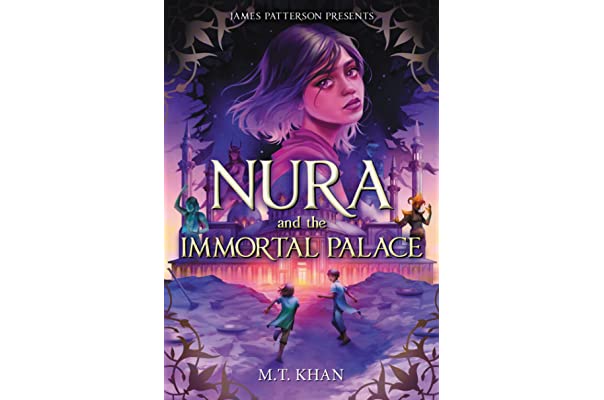
Nura and the Immortal Palace by M.T. Khan

Standard
Nura and the Immortal Palace by M.T. Khan

nura and the immortal palace

This 272 page unapologetically Muslim MG tale takes on some heavy concepts: child labor, jinn, education, and gulab jamun- I mean greed.  Through the eyes of feisty, determined, clever, and strong Nura, though, the trials of life and society are never without hope, a sense of adventure, and good intentions.  The characters are likeable, the Islam wonderfully present and often centered, the social commentary remarkable, but the framing for me, made it a bit of a struggle to read at times.  It is set up like Alice in Wonderland or even Silverworld, where the characters living in a real world stumble in to an alternate reality, and thus the world building occurs in real-time so to speak.  The reader has no idea what is going on until it is happening, no clue what the rules and constraints of the fantasy world are until some detail is needed to help or hinder the protagonist, and personally I struggle with this wandering style of narrative.  I have mentioned before that as a child I really never read fantasy, and I think this is why, I  need the context to ground the story so that I might lose myself in the adventure at hand.  If you are fine with this framing and at ease with Islamic jinn fantasy, then this book will be a lot of fun.  If you find fantasy “shirk-y” do know that Ayat ul Kursi is used to save the day, but that there is a lot of imagination regarding the beings made of smokeless fire, a casino is present along with dancing, indentured labor, and the fear of death.

The book releases in July 2022, and as always pre-orders help show support for books, authors, and the OWN voice content that they entail, so if this book seems like a good fit for your 3rd/4th grade reader and up you can pre-order it here: https://amzn.to/3MVvxQo

SYNOPSIS:

Nura lives in the small industrial Pakistani city of Meerabagh.  Her father has passed away and her family is too poor to send her to school, instead she must work so that her siblings might eat.  Her mother works in a sweat factory and Nura in the mica mines.  The illegal child labor and cruel owners provide less than ideal working conditions for the children forced to mine the sparkly mineral.  Nura’s mom wants her to quit, Nura herself doesn’t enjoy the torment, but somehow she takes it on as a challenge to be the best miner in Meerabagh, pushing her self deeper into the fragile tunnels.  With bestfriend Faisal always warning her about going too far, she decides to finally listen to her mother and quit the mines, but not after she makes one final effort to find the rumored “Demon’s Tongue” treasure.  She digs too deep though, and the mines collapse, children are lost, Faisal among them. Determined to find her best friend, she plunges in to the fallen mines and finds herself on the pink waters outside the luxurious jinn hotel, the Sijj Palace.

Nura has always been warned about jinn, qareens and the tricks they play on humans, but when a life of luxury is dangled in front of her, Nura pushes her better judgement aside to enjoy a life she has always dreamed of.  It isn’t just the food and clothes, but it is the respect and honor she is given as she wins a food eating contest, gambles in a casino, and gets decorated for a dance party.  It all comes crashing down however, when in an attempt to impress the painted boy, she cuts off his horn.  Status revoked, Nura is sent to the labor force, where she will remain for eternity, imprisoned and at the disposal of the hotel.  What is more, after the three day festival of Eid al Adha, her memories of her life before coming to the jinn world will disappear. Nura is determined to escape, but nothing in the jinn world is easy, and for a 12 year old girl with fading memories, this might be more than she can endure.

WHY I LIKE IT:

I love that Nura is unapologetically Muslim.  Even though she is poor, there is time spent on the pages detailing the feeling of Eid al Adha, the familial togetherness and community festiveness even if it all is meager, it still has value.  I also really like the relationship between Nura and Faisal.  They drive each other crazy and have nothing in common, but they never give up on each other.  They act like siblings, tolerating each other’s annoying quirks, while never wavering on their concern and worry for one another.  It is sweet and well fleshed out.

The threading of education was also done well.  Nura finds the idea of school repulsive, but it grows and changes as the obstacle of being illiterate slows her down, and ultimately she changes her mind.  The growth arc is subtle, but powerful, and Nura’s intellect, cleverness, and ingenuity is never dimmed as a result of her lack of formal schooling.

The characters, even the “bad” ones are given some depth and sympathetic qualities, and Nura has to recognize some of her own flaws and choices as she journeys through the book.  Desi culture is present primarily in food and clothing, but it adds depth to the story and flavor to the experience.

The food eating competition, however, didn’t really impress me.  I get that it was to flesh out the jinn world and show Nura’s smartness, but I thought the jinn in the water were eaten, only to have them reappearing, and the founding premise is that jinn are tricksters, so to have Nura tricking them seems to blur the lines of integrity.  Also the bird was critical, and then never seen again, the scene just didn’t read as tightly edited or as clear as it should have in my opinion.

I didn’t love that a casino either, or that it was so central to the story. If it would have said something about gambling being haram and jinn being free to do what they want, like it did when discussing how Eid is celebrated by non practicing jinn, I might have not been as bothered,  but it seems an odd setting nonetheless, for a middle grade book.

FLAGS:

Gambling, child labor, indentured servitude, magic, fantasy, jinn, destruction, bombing, fire, death, fear.

TOOLS FOR LEADING THE DISCUSSION:

I think this could work as a middle school book club read.  It is a little below level and age, but there is a lot to discuss and connect with, that I think it would be a lot of fun.  Our school is ok with fantasy reads, so for us it definitely deserves a place on the bookshelf in a classroom, school library, and possibly (depending on your views of fantasy) a home library.

The Boy Who Met a Whale by Nizrana Farook

Standard
The Boy Who Met a Whale by Nizrana Farook

whale

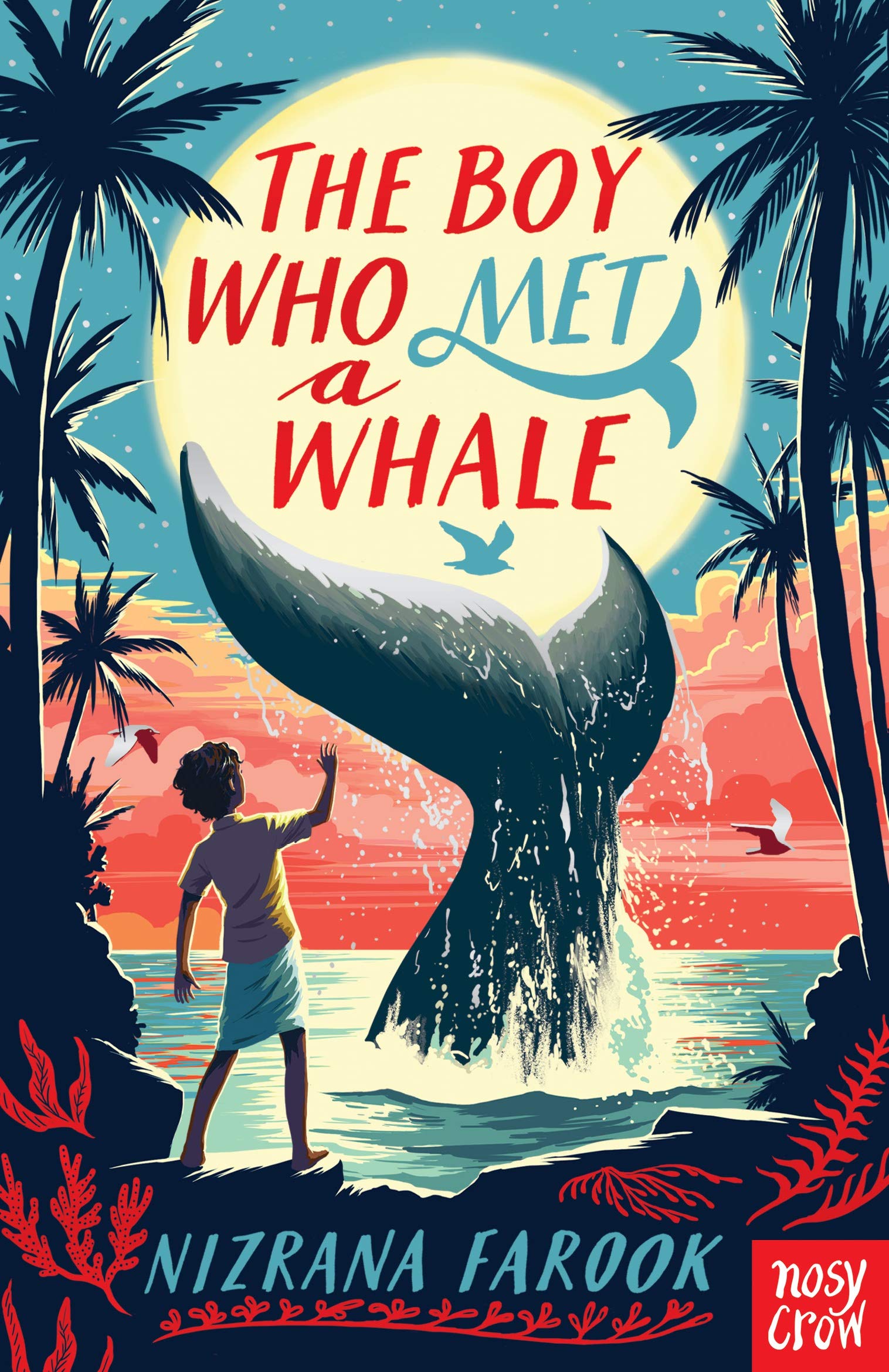
I have a vague memory of being told that this book features a Muslim family when I reviewed the author’s first book, but I can’t find the message, nor recall who sent it and to where.  The text does not suggest any religion by any of the characters, but that being said there are “Islamic” names present in this 195 page middle grades book by a Muslim author and set in Serendib, the old Arabic name for Sri Lanka.  The fast paced story pulls you in and sets three kids up for adventure, overcoming fears, outsmarting adults, and becoming heroes along the way.  I didn’t love this book as much as The Girl Who Stole an Elephant, but it probably isn’t fair to compare them.  The book was released last year in the UK and will release shortly here in the US, I don’t know that I would rush out to purchase it, but I would definitely put it on hold at the library.  It is an adventure filled read from a boy protagonist perspective, it starts with a mutiny, features treasure, plotting, close encounters with a whale, and bringing justice to murderers and thieves.

SYNOPSIS:

Zheng has never had much of a family, and when his Captain’s First Mate and the cook poison their merchant ship crew and leave them to die, Zheng escapes.  He washes up on the shore of Serendib, not far from Galle, and is found by local fisherboy Razi.  Razi is a fisherboy that doesn’t fish, or rather no longer fishes, not since his father was killed by the sea.  Razi just tries to help get Zheng some food and get him out of the sun, but when Marco and Cook question him about the whereabouts of Zheng, he protects the boy and gets himself involved.  Promising not to tell anyone about Zheng, he immediately tells his twin sister Shifa.  Shifa is the rational one int he group and doubts Zheng’s adventure stories.  Her quick thinking and clever sneakiness provides time-and-time again in the book, a chance for the three kids to rescue each other, find the treasure, and return it.  

WHY I LIKE IT:

I love that the book is so fast past and unapologetic.  The descriptions of the island, and the plants and sea life, really is impressive and insightful into a country and culture not often explored in children’s books.  My mommy heart did not like that the kids would just leave for days at a time, and they never even thought that she might be worried, spoiler, she was! 

I like how subtly the grief and loss of the father manifested in Razi.  How he had to reconcile his emotions and start to move forward.  It isn’t in your face, but I would imagine that any child who has gone through something similar, would be reassured by seeing a fictional character experiencing something similar.  It is reinforced by Zheng’s lack of family and his need to find a “home.”

I felt like a few plot holes were too quickly glossed over in the heat of action.  I don’t know that it is a result of carelessness, I think it was more to keep the story fast moving and appropriate for the target audience, but I could have used a little filling in of the gaps: the ease of pulling people in to boats, where Zheng was going at the end and how it was all figured out, how Cook and Marco found Zheng, how everyone in Galle immediately recognized the dagger, why the kids were never killed even though numerous people were drugged at the beginning without a second thought, what the praise was for the returning of the dagger, what the oxen cart owner’s response was to the damaged cart, etc..

I wish there would have been a prayer to Allah swt at some point, or a bismillah, or an Assalamualaikum. The sister’s name, Shifa, and the medicine man that she trains under, Abdul Cader, imply a tinge of Islam, but I would have liked a tiny bit more, the book sets itself for lots to be sprinkled in, the children nearly die multiple times, but it was never there.  

FLAGS:

Death, lying, sneaking, near death experiences, grief, loss, theft.

TOOLS FOR LEADING THE DISCUSSION:

This would be a fun elementary read-a-loud with the short chapters and fast paced action.

Click to access The-Girl-Who-Stole-an-Elephant-Comprehension-worksheet.pdf