

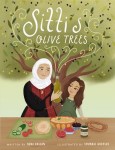
I’ve read a few children’s picture books about harvesting olives, and even some about Palestine’s olives, but this one really stands out because it is just so very joyful. There is information about picking the fruit, processing, and making soap and oil with olives, but the book’s take away is just sore cheeks from smiling, and a full heart from feeling the importance, love, and tradition of olives, family, and being together. The text and illustrations combine beautifully allowing the story of Hilwa, the olive tree, Ali and his Seedo to say a lot without having to spell it all out. And that it is traditionally published at such a critical time, is truly a gift. There is nothing religious in the text, there are a few #Muslimsintheillustrations, and the author is Muslim. Additionally there is nothing about the current situation, the politics, the upheaval, or the occupation. The book follows Ali as he arrives after a long journey to his Grandparent’s home, it is harvesting season and he is about to see all of the gifts that come from olives with the guidance of his grandfather, the cheering of his cousins, and the offerings of his beloved Hilwa.


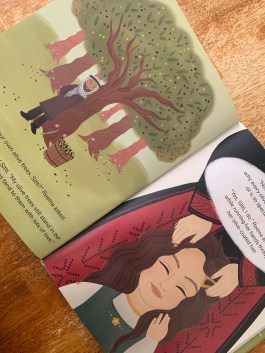
The book starts with Ali and his parents arriving exhausted after their long flight to Palestine. Greeted by Seedo, when Ali sees Hilwa, the olive tree his grandfather planted with his grandfather, the tiredness disappears. When he hears Sitty whacking the trees and his cousins singing, “Zaytoon, ya zaytoon.” He is ready to help harvest. But, he doesn’t want to hurt Hilwa and decides to pick the olives one by one. After his arms are tired and the basket is empty, he gently tries the traditional method and makes the zaytoon rain down with his grandparents and cousins cheering him on.


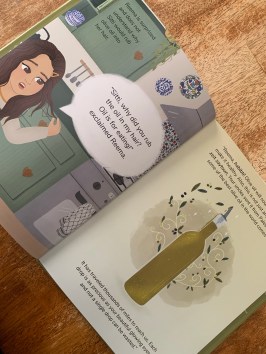
Hilwa has many gifts, and the next day they load up the olives to be taken to the press, they then prepare and enjoy the olives being pressed in to oil. They bring the oil home to cook with, eat, turn in to soap, and the pulp is used to build the fire. The best gift of all however, is the family, friends, and neighbors gathering to share and be together.


I read an early copy, and hope that the beginning will be smoothed out a bit. It actually read as if a page was missing. If the family had just arrived from overseas, and the grandfather was so excited, why wouldn’t the grandmother and cousins also leave what they are doing to great the just arrived family? It seemed a bit off, but once the story recovered, the text and story flowed without incident, so perhaps the disjointedness has been resolved.

It is so important to show the richness of cultures to those that might be unaware, for a culture that is relentlessly villainized, even more so. This 40 page picture book is great for ages 3 and up, and while it doesn’t detail Palestinian culture, it highlights a central component and shows the vibrancy and warmth of a people and their relationship to the land and the importance of olives and olive trees. There is a glossary at the end with words in English and written in Arabic scripts as well as an Author’s Note.



 Islamic School Librarian