Tag Archives: Fairytale

Aya and the Star Chaser by Radiya Hafiza illustrated by Kaley McKean

Standard
Aya and the Star Chaser by Radiya Hafiza illustrated by Kaley McKean

Most people probably don’t read as much Islamic rep fiction as I do. Add in I’m an adult reading MG, who consistently shares thoughts on books that fit a slim criteria, and the result is I’m nitpicky and hard to please.  But, because I read a lot of a very small niche genre, the stark contrast to books with Islamic representation done well, compared to those done poorly or somewhere in the middle is hard to ignore. This 213 page book has an all Muslim cast, but has very little Islam, and what is there is terribly presented. It has one Assalamualaikum, one mention of salat, a reference to shoes worn on eid, and the mother sings Quran.  Yes the characters wear hijab, but it is only ever called a headscarf, so while the pieces are there they don’t add up to much, which I predict leaves Muslim readers disappointed and non Muslim readers chalking it up to more pointless details that serve as filler, and provide no real fleshing out of the characters on the page. I forced myself to read it, the desire at page 12 when stars and meteors are used interchangeably to dnf was strong, and to the book’s credit, I was mildly rewarded with the last 65 pages or so being slightly better written. The plot holes, repetition, inconsistencies, the reliance of the mother simply refusing to answer the daughters questions, and overall surface level of the book makes it regrettable, but can I see young readers that love quirky characters, balls, royalty, and happily ever afters enjoying the read? Yes. And being there is nothing blatant in the book that would warrant you not letting them dive in, you can take my criticisms with a grain of salt, or stardust.

SYNOPSIS:
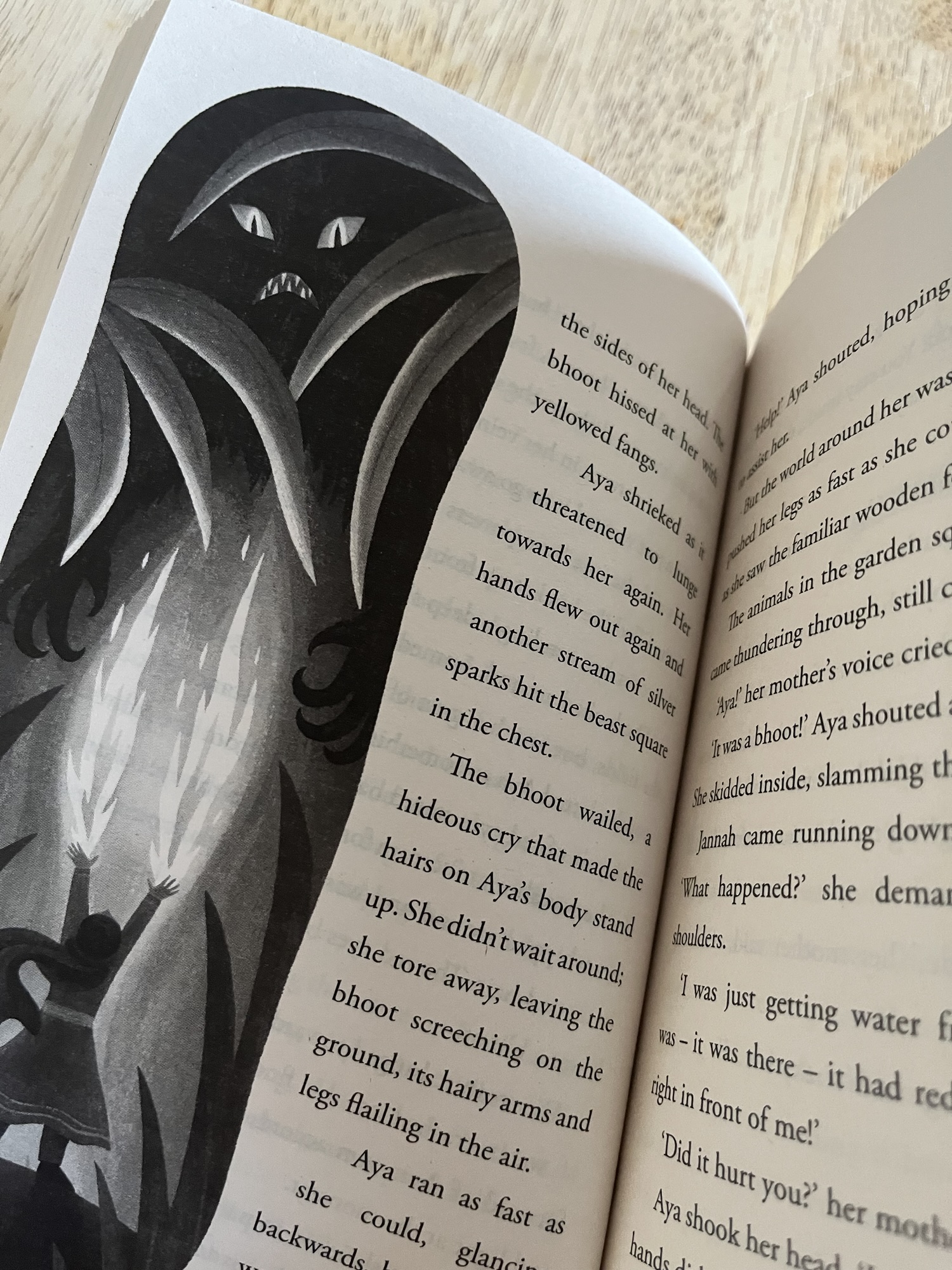
Aya and her mother, who is “stern with a big heart” live in kingdom of Alferra.  Her father has been gone for seven years, she doesn’t even know his name, as Aya and her mother, Jannah, have a strained relationship. Aya loves the ocean and the night sky and dislikes school, the only friend she has is Naznen, and on the night of the Perseids meteor shower the two girls meet in the middle of the night to watch the sky.  One star (is it not a meteor?) hits Aya and give her powers: she can shoot fire and cry flowers. Desperate for answers Aya and Jannah head to the Somerfest Ball at the palace to meet a seer.  When they do they learn of a prophecy and the remainder of the book is Aya and her mother running away to avoid the prophecy, before Aya reluctantly has no choice, but to face the villain, and thus see the prediction through.  I don’t want to spoil spoil it, but there is an Evil queen and demons of sorts with red eyes referred to as bhoots, and a battle that takes place in true fairytale format before the happily ever after occurs.
WHY I LIKE IT:

I do like that Aya is strong and determined, her strength however, is undermined by her sickness, sleepiness, and lack of determination to find the answers her mother refuses to give though, which is unfortunate.  The biggest problem with the book is the writing quality just isn’t great.  Even the religious representation aside.  Why have a whole conversation about wearing matching clothes to the ball between Aya and Naznen for Jannah to gift Aya a gown of a different color and no mention of wanting to match with her friend revisited. Why have Naznen sneak through the window just to have Aya go through the door using the spare key under the mat? Why mention a strange lady at school dismissal, that is never explained? Why is everyone scared to be out because people are missing, just to have Naznen alone, show up with Aya’s homework? I could go on and on, the book brings things up and then dismisses them using them to be page filler it seems. So many details do not provide insight in to the story or the characters or the setting, they are just random fleeting observations.

I didn’t like that the prince is described as having a “lover,” there are better less abrupt identifiers that could have been used, or perhaps in British vernacular it isn’t as pointed as it is in the US.  I also didn’t love that they bowed down to the Evil Queen Abnus. This highlights a place where an Islamic lens would have fleshed out that the characters are Muslim, not wanting to bow, as we bow to Allah swt alone, but perhaps being struck and forced.  Other easy inclusions of Islam would be seeing the meteor shower and saying SubhanAllah, being so sick from the star hitting you and asking Allah swt to heal you, asking Allah swt for strength in a dozen scenarios the book presents.  Duas before leaving the house with people going missing, it really seemed blaringly absent given the nature of the book to not have little sprinkles woven in, yet it halts the story early on to have those labels noted. It definitely could have used some polishing to make it part of the story or characters or taken out all together.

TOOLS FOR LEADING THE DISCUSSION:

I wouldn’t rush out to buy this book for your school, library, or home book shelf, but if you have it, there is no need to remove it.  There is not enough Islam nor literary value.  There is not even enough character development or details to show the change in the mother-daughter relationship to foster conversation.  One page they claim they have no secrets when the mother and her secrets is the bulk of the backstory, to the next page where the mother simply discloses all the letters and answers that Aya needs to move forward.

FLAGS:
Lying, sneaking out, scary evil villains, disowning, abandonment, disobeying parents, death, killing, prophecy, fortune tellers/seers, magical powers, abuse, imprisonment,
Shems and the Magic Seabream by Alwia Al-Hassan illustrated by Ada Konewki

Standard
Shems and the Magic Seabream by Alwia Al-Hassan illustrated by Ada Konewki

seabream

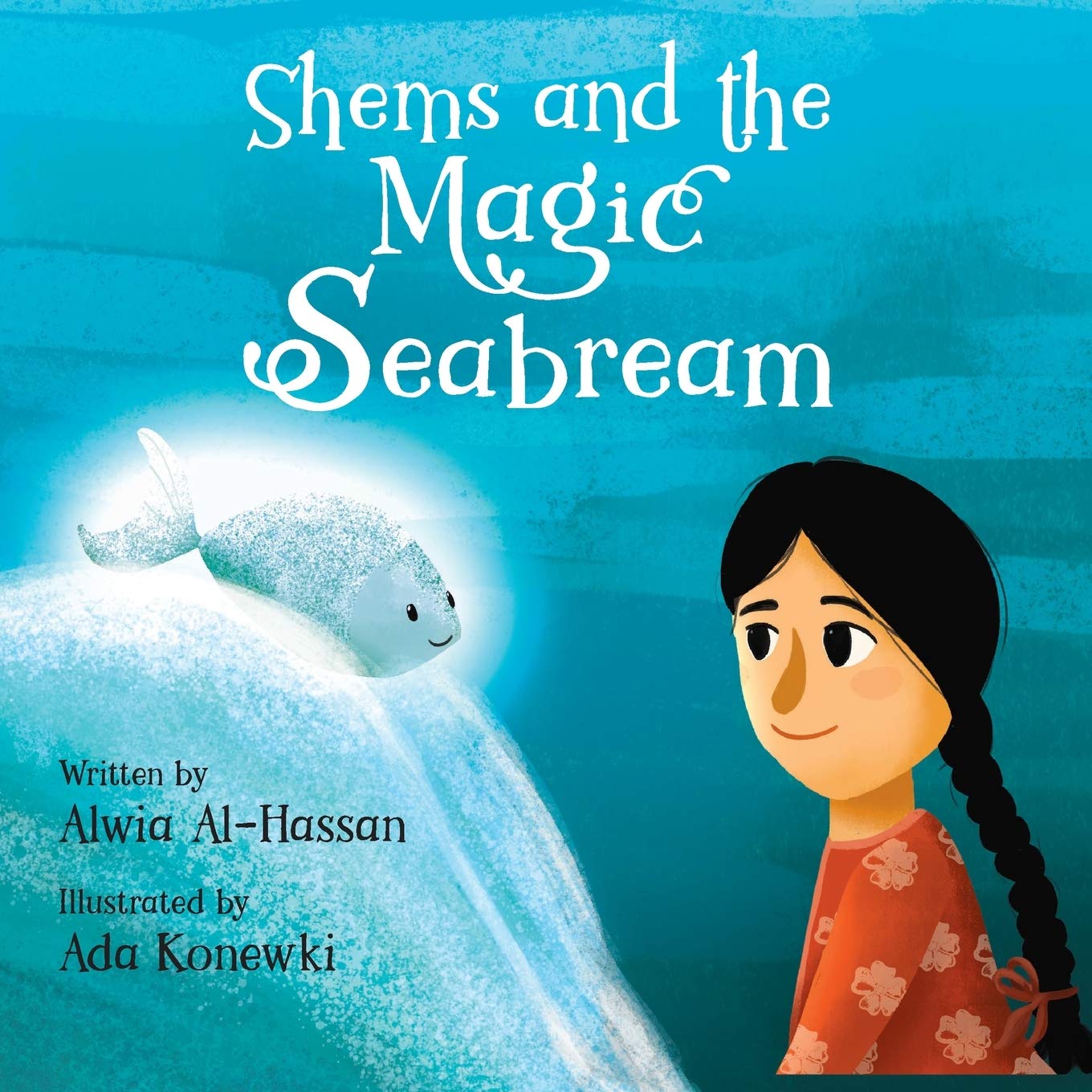
I don’t know how to review this book, I truly don’t, it claims to be based on Saudi folklore, it has #muslimsintheillustrations, and references Allah swt once, it is by a Muslim author, but it isn’t religious. And it definitely isn’t for everyone. It is terrible, and yet you can’t look away. Every stereotype about appearance and trope about step-mothers, it is all there, but EVIL CACKLE, the book is delicious, and not in the cooking the children and eating them sort of way, that is in the book too, but in the laugh-out-loud, gasp in disbelief, and be shocked at the complete disregard for political correctness, moral messaging, and lesson teaching that leaves a brightly illustrated dark tale for kids, and adults, to thoroughly enjoy. It pulls you in, it suspends reality, it makes good and bad so black and white that you accept the attempts at murder as justified, and it ultimately reminds you of the horrors that all fairytales build upon to entertain. I remember the first time as an adult I was asked to read Hansel and Gretel to a young niece. I knew the story, and started not thinking much of it, and then I froze: children are lost, they seek shelter in a home where they are not allowed to leave, the owner of the home wants to cook them and eat them. Yeah, this book is like that.

img_5299

Shems and her twin sister Shareefa live in a small town with their fisherman father. They are poor, but happy, until their father remarries and the stepmother is horrid. She is ugly and fat and covered in greasy spots, negative connotations that reflect her personality. (FLAGS: superficial judgement and body shaming). She hates children. (FLAG: Yes it uses the word hate, and calls children fat while contrasting them with cute children).

img_5300

She especially hates Shems and Shareefa. She tries to get rid of them: she puts them in the oven, abandons them in a field, tries to drown them in the night. But the girls somehow always escape and their father believes that it was all a misunderstanding. (FLAG: attempted murder).

img_5301

Now that the girls are older, they are forced to serve Mama Ouda, and when food runs low, she considers eating them. (FLAGS: abuse and threats). Luckily they are much too thin. One day when Mama Ouda is craving fish, Shems heads out to catch some seabream, yes that is a real type of fish. And the only one she catches is a magical one. (FLAG: magic).

img_5302

The next day Shems dressed as Shareefa recalls the fish’s promise near the water, and a basket of fish appears with pieces of sparkling gold. The girls eat like queens, hide the gold, and keep Mama Ouda fed. This carries on until they get caught and a murder and mermaid and moving out of their mud hut conclude the story and set up a potential sequel.

img_5298

The dad is pretty clueless and that has its own negative assumptions to counter, but if you and your kids can handle the over the top darkness, the story written in playful rhymes is sure to entertain and be asked for repeatedly. (FLAGS: stereotypes about fathers and stepmothers).

Cinderella: An Islamic Tale by Fawzia Gilani illustrated by Shireen Adams

Standard

cinderella

I’ve seen this book countless times online and honestly have never given it a second glance.  I mean Cinderella is a classic fairytale and I have a few different versions from around the world, but an Islamic one? It seemed like it would be awkward or overly preachy and forced.  I should have given Fawzia Gilani’s version a chance though, she has surprised me with her other re-tellings of Eid Kareem Ameer Saab and Nabeel’s New Pants. And, mashaAllah, to her credit she manages to weave a decent story full of Islamic tenants, void of magic, and more feminist than the Disney or Grimm versions.

I’m not going to summarize such a familiar tale, but I will point out major twists.  Zahra is a practicing Muslim who is very devout in her prayers, fasting, and reading of the Quran. Her step-sisters nickname her Cinderella after some cinders from the fire burn holes in her clothes.  A bit of a stretch, from Zahra, but I think even the youngest readers will know the original Cinderella story and be ok with it.

cinderella3.jpg

Cinderella is constantly remembering to be patient despite the treatment of her step family through various duaas, ayats in the quran, and fasting on the day of Arafah.  When an invitation to an Eid Party at the palace comes, she naturally is forbidden from going unless she completes all her chores.  Luckily her Grandmother returns from Hajj with servants to help clean the house and a new abaya to wear to the party.  At the palace the women and men are in different rooms, but Cinderella catches the King, the Queen, and Prince Bilal’s attention when passing in the hallway for being in full hijab.  She continues to impress the Queen, when she remains quiet during the athan, prays in jammat, and shows grace in her manners and speech. After winning over the mom, the slipper and happily ever after follow the traditional script, however, like the story of Yusuf (as) and how he forgives his brothers, Zahra forgives her step-family as well.

cinderella-text

The 41 page story is heavy on the text and is not AR.  I would imagine that it would be on a third grade level for Muslim children familiar with the vocabulary, and fourth grade for those that are not.  There is a glossary at the back, but not all of the Arabic words are included, and I’m not sure that the context would allow for them in some cases to be understood.  This book would be hard to do in a story time setting because of the length, at bedtime, however, the pictures are detailed and rich enough that one-on-one could hold a five or six year olds’ attention.

Overall the story doesn’t feel forced, and you’ll find your self smiling at some of the “islamicifaction” of the plot.  Most of it flows really well.  I love that it isn’t focused on her appearance alone.  I also like that she isn’t helplessly waiting to be saved or alleviated from her burdens.  By and large it doesn’t feel like a love story, Prince Bilal is pretty much a minor story point.  The book works for Muslims and non-Muslims alike.  It isn’t preachy, but it definitely is strong in it’s moral messages. I think non Muslims will find the Islamic version just as fun as the hundreds of other “twists” on Cinderella and Muslim children will love to see someone like them living happily ever after as well, inshaAllah.