Tag Archives: dystopian

Tyger by SF Said illustrated by Dave McKean

Standard
Tyger by SF Said illustrated by Dave McKean

I don’t know that I’ve ever read a book like this 304 page middle grade fantasy, dystopian, highly illustrated adventure. It delves into philosophy, alternate universes, slavery, racism, politics, magic, identity, friendship, betrayal, human rights, education, following your dreams, saving the world, and a talking immortal tiger. It started a little stilted for me, but as the book progressed, I began to see that a lot of detail about all the above mentioned threads would make for a very adult, very lengthy read, and this is meant for 9-12 year olds, albeit they would need to be able to handle the darkness of the book at times, and caregivers, be aware there is a public hanging of a child. The author is Muslim, and the protagonist and a side character identify as Muslim.  There is not much about Islam, or shown in practice, but that they are afraid to learn and practice their faith is mentioned briefly. I think kids will enjoy the read, and not get hung up on threads unexplored as I did.  The illustrations really make it a book that feels exciting to spend time with, and one that will linger with the reader.  I look forward to sharing it when it releases soon in the US, as it was published in 2022 in the UK.

SYNOPSIS:

In short the book is about a boy, Adam, living “in an alternate London where the British Empire hasn’t ended and slavery was never abolished.” In a partitioned off Ghetto as a minority from the vague “Middle East,” who is unable to go to school, or even draw, he makes deliveries for his family to help keep them afloat. During one such delivery he encounters a tiger, an animal like so many others that is extinct, her name is Tyger, and she speaks.  She is an immortal searching for Guardians to help her heal and open a portal to the city.  When Adam, who is immediately connected to her, cannot find a Guardian, she begins to train him, time is short and when he discovers his friend Zadie, short for Scheherazade, has some training from her father, the two set out to open the doors of perception, imagination, creation, and  revelation, to save the day.

WHY I LIKE IT:

I really like that this book opens up larger discussions about society, self, literature, imagination etc, and can really be adapted to mean different things depending on what the reader brings to it. The book addresses these themes in a way that doesn’t talk down to the reader, and in many ways allows the simple bad guy of the story to not be the takeaway point, but rather the journey of understanding perspective, points of view, empathy, creating something, and hope to be far more important.

The identity of the characters being Muslim initially was just a label, one that just made Adam and Zadie more “other,” but a few cleverly crafted sentences about hiding their names, their skin color, and whether it worked or not, allow the reader to reflect on if denying yourself to appease others is effective or not, or rather more importantly knowing when and in which situations it could be a benefit or a selling out of who you are.  Zadie and her father seem to practice, and one point Solomon ( Suleiman), offers his prayers, he says Assalamualaikum and Bismilliah. Adam and his family on the other hand, have hidden their faith so as to fit in better, and thus it is simply an identity label.

I liked that the illustrations weren’t just stunning in their own right, but also highlighted the mood, and metaphysical elements of the story.  I feel like I could teach not just a few lessons on this book, but dozens, and who knows if they would be correct, but I think this book would be fantastic as a read aloud in a classroom for the story at hand and for the discussions.  The darkness, the excitement, the hope, really gripped me, and while I could opine on plot holes and lack of articulation, in some key scenes, I appreciate that over explanation would take away from all that the book gets right.

FLAGS:

Racism, oppression, colonialism, slavery, hanging, power imbalance, betrayal, lying, sneaking, fighting, killing, magic, fantasy elements.

TOOLS FOR LEADING THE DISCUSSION:

Where to even start, this book needs an educators guide, stat. I looked online and couldn’t find one and I hope that will be corrected soon because if you read my thought above, you know there is a lot to discuss.

Fledgling: The Keepers Records of Revelation by S.K. Ali

Standard
Fledgling: The Keepers Records of Revelation by S.K. Ali

fledgling


This 544 page science fiction dystopian fantasy is in my humble opinion S.K. Ali’s best work, and that is saying something.  A lot actually, especially considering I am a Muslim book reviewer and there is no Islam featured in the book. As my author friend Shifa Safadi articulately put it, “it is Muslim coded,” a much more succinct term to describe my rambling thoughts of how Islam seems to be just below the surface, never breaking through, but making the book seem OWN voice and authentic. The book is for ages 14 and up and stays fairly clean, allowing for complete immersion in to the story, the world, the future, and the characters’ lives, without any fear that something drastically detailed and haram, would suddenly appear and pull me out of the flow of the story.  There is a bride market where women can be bought and mention of lovers being taken, but it isn’t normalized, it is for a purpose, and the acts are not detailed.  From start to finish this book is a gift to readers.  The writing quality is superb. The book is told from nine (?) points of view,  and I never once felt the need to flip back to see who was speaking, as each voice is clear and unique. The twists, the heartache, the triumph is all palpable and griping.  The mix of genres works because the characters have multitudes and incredible storytelling made the lengthy book, not nearly long enough. I can’t wait for the second part of the duology, from the Underground to Upper Earth, the world was not one I left willingly, and I look forward to returning for the conclusion.

SYNOPSIS:

I really am not sure how to summarize the book without giving much away, I’m actually surprised myself that I’m writing a full review for a book by a Muslim author with no Islam present, so here we are.  As with all S.K. Ali books, this book starts with a possible “romantic” relationship, in this case though, it is an arranged couple meeting, and it isn’t going well.  But where comedy and faith might normally then enter the story, this book, veers from her norm, drastically.  Set in a dystopian future where scalplinks and mind control allow the “enlightened” to live a vastly different life than those on Lower Earth who’s resources have been plundered, the union is to be between Raisa, of Upper Earth, and Lein the crown prince of Lower Earth as an attempt at achieving peace.  Politics, greed, loyalties, love, all add in to the mix of a rebellion and the hope that comes from the Fledgling.

WHY I LIKE IT:

The book starts with a character list which is an incredible tool for readers as the first half of the book is forced to simultaneously balances character development, world building, and plot progression with a lot of moving parts. The style of memory records, announcements, current events, flashbacks, and changing povs keep the book’s pacing moving, but it really took about until the midpoint for me to be unable to put the book down. What at times early on could be perceived as cumbersome, became truly what makes the book stand out.  To see each character through their own eyes, through their own lived experiences, and to see their thoughts and feelings grow and change, really pulls you in and brings the humanity to life in a book that could have become more plot than character. It also emotionally ties you to the characters and the twists and revelations and loss, hurt a little more than I would have expected as days later I am unable to stop my head from returning to parts of the story that still have a hold on me.

FLAGS:

Death, torture, abuse, killing, murder, hunting, manipulation, lying, a love scene between a coded married couple, oppression, colonization, bride markets, misogyny, cheating, it is YA dystopian, fantasy, sci fi, romance, adventure, so there is some grit at times, but not for sensational vulgarity, it is always for a point and not taken lightly.

TOOLS FOR LEADING THE DISCUSSION:

This book would be incredible to read in a high school class: Islamic school, home school, public school, private school, you name it.  There is so much to discuss about colonization, oppression, rebellions, politics, and yet none of it comes at the expense of good story telling.  I would love to hear students discuss their favorite characters, opine on their motivations, and argue right vs wrong with citings from the text.  No two people would feel the same, I would almost guarantee it.

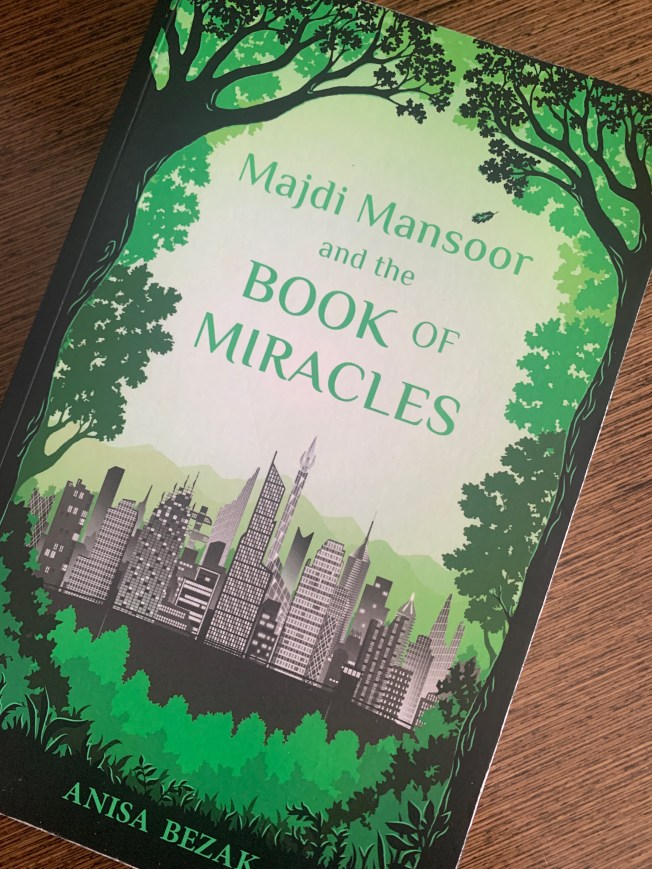
Majdi Mansoor and the Book of Miracles by Anisa Bezak

Standard
Majdi Mansoor and the Book of Miracles by Anisa Bezak

img_0030

I don’t think I have ever seen or even heard of any dystopian Islamic fiction reads, we have a handful of Islamic historical fiction, and dystopian with Muslim characters, but the genre made me curious, and with that motivation I began the 458 page book.  The beginning didn’t immediately grip me, but I told myself to read a hundred pages before deciding to DNF it or keep reading, and long before that arbitrary mark, I was intrigued by the story, invested in the characters, and impressed by the consistent writing, pacing, and role of Islam.  The book is preachy and idyllic, but that is to be expected, the way Islamic ideas and concepts and concerns were included as plot points though, is surprisingly well done.  For much of the story, I kept wondering who the target audience would be.  The vocabulary is a bit advanced, and the pages full of small text.  The book starts story wise-solid middle grade, but I think by the end I would recommend this book for advanced middle grade or early middle school Muslim readers.  I’ve heard from some adults that they read a chapter to their kids each night, and I think that aloud younger kids might also enjoy the story and be swept away to a future land run by a corporation where religion is banned, books are a thing of the past, a boy speaks only in Quranic ayats and hadith, and bullies of all sizes will have to be faced.

SYNOPSIS:

Twelve year old Jacob is an orphan in Tanas World and is unwillingly part of a gang.  One day in a boarded up old building he finds a book, a physical book, the Quran.  Religion is not allowed, Islam most of all, but he reads the book, and even though he doesn’t believe, he keeps rereading the pages.  When an attempt to steal some tech takes him outside the boundaries of the walled off city, he meets a small boy, Majdi Mansoor, who talks in a peculiar way. When threatened by the gang, Jacob decides to take Majdi’s side and that one act sets the two boys on a course that will change them forever.

I don’t want to give away too much, but Jacob is taken in by the Mansoor family who live in isolation and in hiding outside Tanas Corps patrols.  The parents are kidnapped, the children seek to save them and along the way meet smugglers, a Muslim community corrupted by bidah and djinn, Muslim Defense Unit rebels seeking revenge, and the executives who want the MEECA device to imprison the planet.

WHY I LIKE IT:

I was honestly impressed with the quality of writing, but I honestly don’t know if it was because my expectations were so low, or in fact was sufficiently edited and refined.  The characters have heart, the world building is believable, and the Islam is handled with an even hand.  At times members of the Mansoor family are too “good,” but Jacob has a sense of humor, is fallible, and curious which allows the story to stay moving and on task. There are some major plot points that are not resolved, and I’m assuming the political details will play out in the second book.  I’m hoping at least. The book doesn’t talk down to the reader, but older readers might find it too preachy.

I’m hoping my early teens who love Islamic fiction chapter books such as The Broken Kingdom series, The Adventure of Nur Al-Din books, and The Moon of Masarrah quartet will similarly enjoy this.

FLAGS:

Death, bullying, manipulation, assault, revenge, danger, whispers of shatan, bidah

TOOLS FOR LEADING THE DISCUSSION:

I would love to do this as a Middle School book club, I think it would be a bit too cheesy, but I think there would be some great discussions to be had about seeking, temptation, bidah, forgiveness, and the way that Majdi talks and Islam is woven in to the text.

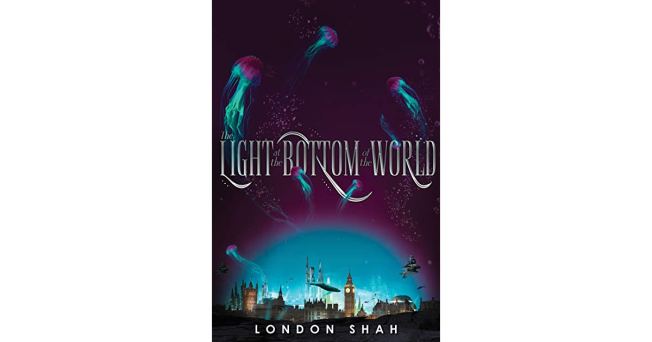
The Light at the Bottom of the World by London Shah

Standard
The Light at the Bottom of the World by London Shah

light at the bottom

At the risk of sounding pretentious or like I have written a book before, sadly this really reads like a debut novel.  At 311 pages, there is a lot to love about this Muslim authored, Muslim protagonist sci-fi/dystopian adventure, but I have so many more questions about everything after reading the book, than I did before I started, that unless the next book (assuming there will be one), really steps it up- all the world building will have fallen flat with the lack of character connection I felt. At times I had to force myself to read through the lulls in the story, while at other times, I sacrificed precious sleep to read just a bit more.  The story is pretty clean and would have no problem letting my 5th grader read it, even while knowing it will have more appeal to my 8th grader.

SYNOPSIS:

It is 2099, and Earth has flooded forcing everyone to live underwater.  Set in London, 16-year-old Leyla McQueen, a submersible racer, lives alone with her dog Jojo.  Her mother has passed away and her father has recently been taken away to an unknown place for an unknown reason.  It is Christmas, and Muslim Leyla spends the day with her best friends, twins Theo and Tabby.  With futuristic technology, the wealthy twins show the reader what life under the sea entails and the world the characters now inhabit.  Pausing to recall the day the Earth flooded, New Years brings a huge race, the London Marathon, and Leyla somehow gets one of the 100 spots to enter the dangerous submersible race.  The winner gets whatever they want, and Leyla hopes to win, so that she might ask for her father to be released.

By opting to not harm someone, Leyla’s last minute reactions earn her the championship title of the race, however, her request to have her father freed is denied and instead she is gifted a submarine and the attention of the authorities who have ransacked her apartment, and stolen and destroyed her home.  Feeling like she has no reason to stay in London, she plots to escape the borders and go search for her father alone.  A family friend, she calls Grandpa, knows more than he has ever let on, and forces a friend’s son to keep an eye on Leyla, Ari.

Ari and Leyla explore the ocean, while Leyla whines and makes poor decisions, narrowly getting out of each situation, but not seeming to really learn her lesson.  As people appear and help them along the way, she finds where her father is being held, but not much else, and then poof, a few action scenes later to try and rescue her father, and Ari is captured and the book ends.

WHY I LIKE IT:

You have to respect the author who’s bio on the back flap of a Disney, Hyperion published book starts off with, “a British-born Muslim of Afghan descent,” and who dedicates the book to “my fellow Pathans.  We too are worthy of taking the helm.” I love it! Seriously, way to be so confident in who you are, and your story, that you own it and wear it with pride.  Truly, I felt empowered and can only imagine what Pathan girls everywhere would feel opening the book.

Similarly, Leyla, owns her Islam by praying, reading Quran, saying Bismillah before she races, and inshaAllah when she hopes in for things in the future.  She does get a bit close to Ari and doesn’t find that a problem.  She doesn’t cover, and there are no other Muslim characters in the book, but she is definitely religious, and it is seamlessly woven into her character without mentioning anything about what Islam is or stands for, but giving it authentic attention.

There are a few twists, one particularly large one, but not a whole lot of answers, or details.  There is no understanding as to why Leyla’s father has been taken, what happened to everyone other than those in the UK (especially Afghanistan, where Leyla presumably would have family), why so many people are willing to help Leyla find her dad, why Grandpa tells Leyla nothing at all, about Ari’s friend who died, and so much more.  So often it just feels that Leyla is whining and getting no where in her rash and stubbornness, but everyone seems to love her. Perhaps, everyone but me.  I really never felt connected to her, and her annoyingly ever-present dog.  There is more telling about how great she is or her father is, and very little showing.  I think if there is a second book, it could really elevate this one, but as it stands, so little is resolved, explained, or emotional resonance, that I don’t know that the characters or book will leave a lasting impression.

FLAGS:

Some language and a kiss.  There is death, and disease, and battles and government lies.

TOOLS FOR LEADING THE DISCUSSION:

I’m tempted to do this as a middle school book club selection, despite the one-dimensional characters, simply because it is clean and might introduce students to a genre they might not otherwise read.

Author’s website: https://www.londonshah.com/


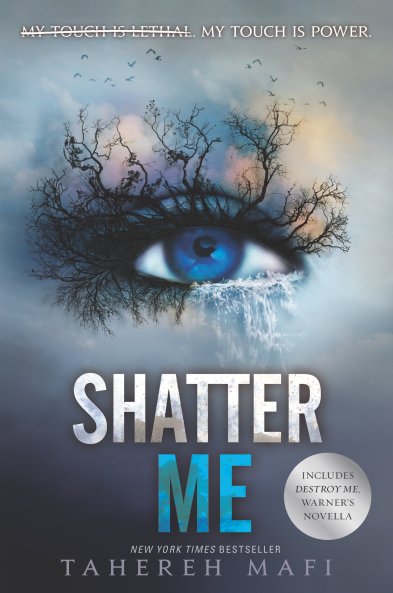
Shatter Me by Tahereh Mafi

Standard
Shatter Me by Tahereh Mafi

shatter

In many ways this 338 page dystopian YA fiction book focuses more on romance than the super human powers the 17 year old protagonist has and the role she will play in the resistance.  That isn’t to say the book is bad, just that it isn’t as high action, or reform-a-broken-world, or even use-my-super-powers-to-save-myself-and-those-around-me as I had hoped. It is more a lot of self loathing, desire, and anger.  That being said, I am on the fence about reading the rest of the series, as this is the start of a six book series, with two “half” novellas interjected in and being told from other characters’ perspectives.  If this was a show pilot, however, I would let Netflix automatically start the next episode until I had binge watched the entire season, not necessarily because the story is great, or the characters amazing, or the writing stellar, but because it is easy and fun and you really want to suspend belief and know who all these attractive mutated teens running a broken world are, and yes you will roll your eyes at the syrupy sweet lust filled pages, but it is YA so maybe I’m just overly cynical and 15 year olds and up will enjoy it.  It is an AR 4.3, but the language, violence, and romantic build ups should not be read by 4th graders.

SYNOPSIS:

The book starts with Juliette counting how many days she has been locked up in a cell, 264, void of human interaction of any sort and hinting at the reason her parents feared her and turned her in.  She is then joined by a male cellmate, Adam, one she slowly realizes she remembers from her youth and is in love with.  As he asks her questions we learn a bit about her power and the state of the world.  Juliette can kill people with her touch and apparently has killed someone, a child.  Her parents, along with everyone else, have always feared her, and not being hugged or touched her whole life has definitely been a painful existence for her.  Adam is a soldier and can touch her, he is also planted to learn about her as part of his job.  Warner, another teen, is in charge of a soldiers in the Reestablishment and has been following Juliette for a long time trying to see how they can weaponize her and use her for their cause.  Adam was playing a role, and now Juliette will have to play one in a world where the food is fake, the clouds the wrong color, and artifacts of culture and life before it all fell apart are destroyed and deemed illegal.  Along the way she will have to see the world in shades of gray and be willing to forgive and understand that people are not just for or against the way things, are, that sometimes you just have to do things to survive and protect the ones you love.

WHY I LIKE IT:

With all the talk of Iran in the news, I felt compelled to read a book with a Persian character, or at least by a Persian author, so I revisited the works of Iranian-American Muslim Tahereh Mafi.  The book reminds me of a Bollywood drama from the 90s where the hero and heroine do everything suggestive, except kiss, in this book they do a lot, but I guess don’t quite cross a line.  The scenes with Adam and Juliette are too much at times, where the story building about her understanding herself, her world, and what her powers can be, too little. The stage however, is set for the book and characters to grow in the series and with that optimism of knowing that the story stretches on, I have to hope the twists and turns make for a more interesting ride than this first book presents.  Most of the drama is already spelled out on the back cover, she can kill people just by touching them, she wrestles with seeing herself as a monster, or as being more than human.  It really doesn’t start getting good until she finds others like her, but then she is bored of them and the book ends.  The book has a huge following, so much like perhaps the Twilight series, maybe I’m just too cynical, and not in the target demographic, or maybe I need to keep reading.

FLAGS:

There is violence, *SPOILER* Juliette accidentally kills a child.  There is language, there is suggestive talk, there are romantic passages with kissing and touching.  For a book about a character who can’t touch, I feel like the majority of the book is about her touching and being touched.

TOOLS FOR LEADING THE DISCUSSION:

I wouldn’t do this as a book club, because I feel like it really is just a book setting the stage for what more is to come and because it ends so abruptly it feels almost like a teaser, yes a 300+ page teaser.  I was hoping that I could at least suggest it to readers of Hunger Games, City of Ember, The Giver, etc., but I don’t think it spends enough time on the crisis of the world at hand, and the adjustments made by a select few to appeal to the same readers.  It really is a romance, at least thus far, and the destruction of life and the environment just a back drop for their storyline.

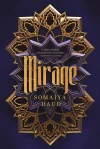
Mirage by Somaiya Daud

Standard
Mirage by Somaiya Daud

mirage+cover.jpg

I don’t read a lot of sci-fi books, ok so maybe I haven’t really ever read one…or maybe a few have snuck through and then been forgotten.  So, I was excited to read this book by a Muslim author with Arabic poetry and Moroccan inspired backdrop sprinkled in, if nothing else it had me intrigued.  The book is a 308 page YA book that came out two months ago and was available in both hardback and on audio at my public library.  I was thinking to listen to the audio version with my kids, but the book was ready first, and the reviews on the back cover by other authors, all mentioned that the book was “romantic” and “sexy,” huh? The synopsis online and even on the inside flap, hinted much more at rebellions and body doubles, and life on a small moon in a distant fictional galaxy.  Needless to say I didn’t check out the audio book and decided I should proof it for my self first.  I started the book, no less than five times.  Like I said, it isn’t a familiar genre and I was a little confused.  I decided to just keep plugging through the fifth time, and sure enough when my eyes started to get sleepy I realized I was more than half way done with the book.  I guess when you are building worlds and culture you have to start somewhere and the confusion worked itself out after that.  I’d say the book is for teens.  The romance isn’t explicit, save some kissing, but a lot is implied and better for kids a little older than middle school.

SYNOPSIS:

Amani is turning 18 and about to attend her majority ceremony, where her cultural daan, facial tattoos will be marked on her face.  Surrounded by her loving family of parents and two older brothers, and close friends, drones from the main planet attack the festivities and kidnap Amani to the palace that the Vathek empire has taken over after conquering the planet and two moons.  The storyline is pretty straightforward, the confusion for me was the world building of establishing the culture, the religion, the symbols and characters all intertwined at the start.  The understanding of what life was like before the occupation and now under Vath rule, about the tribes, the birds, and how so much has changed.  

Once Amani is enslaved in the palace and had her near identical features to the princess, surgically made to match the ruthless half Vathek, half Andalaan ruler, the setting is developed through stories and flashbacks that clear up the confusion and make the book a fast and fairly easy read.  As the princess’ body double Amani must learn to act and carry herself as Princess Maram so as to not be discovered when sent in to complete tasks that would put the real princess in danger.  The job of Amani, however, also develops in to her filling in for Maram, whenever the spoiled princess, doesn’t want to do things.  In the process of these engagements, Amani spends a lot of time with Maram’s fiance, Idris, who is Kushaila and as part of the war truce betrothed to Maram.  Maram and Idris are friends, who understand their roles, but when Idris figures out Amani is playing a role as well, the two of them fall in love, complicating matters considerably.  Throw in some Andalaan cousins, forced to the outskirts under the new rulers, a royal half-sister vying for the crown, and a rebel who looks like a beloved Prophetess recruiting Amani to join them as a spy, and you have a protagonist trying to stay alive while following her conscious as well.

WHY I LIKE IT:

I like that the world created seems plausible and real.  I love that I was engaged and intrigued and able to finish the book (yay!), but ultimately the book reads more like a romance book, than a sci-fi one.  Aside from the planet, droids, holograms, and modes of transport, it could be any culture and religion even here on Earth being fleshed out and established as the back drop for the story.  I love that Amani holds to her culture and the love she feels for her people, their language, poetry, and their history is palpable and descriptive. 

I love that society is focused so much on the strength of women.  Yes Maram’s dad is the evil overlord, but she is the future.  Amani is the protagonist, it is her mom’s strength that she calls on so often in her trials and torture.  The Prophetess that delivers hope is a female, that the poetry comes from women, and is gifted by women.  I love that the leaders of the rebellion are women, that the cousin that has not given up on the true bloodline of rulers is female and that the Dowager is such a strong, yet loving beacon that deserves the truth about Amani’s identity.  At one point, when presenting herself as Maram to Idris’s aunt, the two have a conversation:

“You must eat more,” she says in heavily accented Vathekaar.  “If you are to be any good at bearing daughters.”

“Why daughters?”

“Only your daughters will have the stomach for the future,”  she said.  “It is why your mother had you.”


I don’t really like the love story between Amani and Idris, it seems too easy, even though obviously it is plagued with impossibility, there should have been more tension.  Maybe it isn’t even the relationship, but more that Idris isn’t nearly as developed as Amani and Maram, and it shows.  I’m hoping there will be more books in the series and that he will be given some depth, because a lot is told about him, but the authenticity seems lacking.  The disjointedness of the romance could also be the pacing of the book.  I felt like somethings dragged and climaxes seemed rushed. Again, I’m hoping this is more setting the stage for further adventures, and that the next book will delve more in to the political-warring-rebel story line that the author definitely can delve in to and capitalize on along with Amani and Maram’s relationship.

Maram is my favorite character, how delicious that the antagonist is not one, or even two dimensional.  She is cruel, and scared, and vulnerable and everything in between.  I loved the interactions between the two young women.  I wanted to know more from Maram, how she felt about, well, everything, and I’m really hoping holding back on those insights was intentional for a purpose.  While she evokes both hatred and pity from Amani, she evokes so much curiosity and exasperation from the reader it is refreshing.

There is nothing Islamic in the book, the characters have their own fictionalized religion, and religious texts.  The names are familiar to the Muslim world, and arabic words sprinkled in with no definition, definitely will make Arabic aware children feel a connection to the characters and setting of the book.

TOOLS FOR LEADING THE DISCUSSION:

I think one could do this as a book club book for high school aged students.  And while I dislike labeling books for one gender or another and all the stereotypical tropes that that implies, I feel like because of all the romance and the amount of time spent on Amani and Idris the book might appeal more to girls.  The book spends a lot of time on these two as it is their talking that creates understanding of their world for the reader.  It is more telling than showing, and these two snuggled up or caressing each others faces is the manner in which the information seems to be expressed.  I’m holding out hope that the rest of the series will break away from this set up.

author’s website:  http://www.somaiyabooks.com/

article with excerpts: https://ew.com/books/2018/02/19/mirage-somaiya-daud-preview/

FLAGS:

There is kissing and affection.  There is also some violences broadly as the Andalaan’s are tortured and attacked and specifically, as Amani has a bird sent to attack her, and she is regularly hit and beaten. Nothing too extreme for high schoolers.