
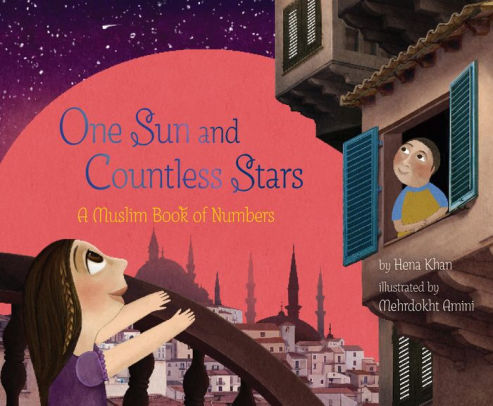
I don’t think that Hena Khan is necessarily a controversial figure, but some days her work feels very polarizing as some praise her ability to share OWN voice desi American Muslim stories while others feel like she waters down the very stories she is sharing to appease the majority. Irregardless of our nuanced views, many of us first were made aware of her when we we were swept away in 2012 by the mainstream book, Golden Domes and Silver Lanterns. Since then she also has published a book about shapes in the same format, and now this counting book that reminds me how beautiful and powerful it is to see Islam so unapologetically presented to all children.
The author’s note at the end is important:
There are many significant numbers in Islam. They include one for God, five for the pillars of the religion and daily prayers, seven for the circles pilgrims and visitors walk around the Ka’aba during hajj and more.
Mathematics and astronomy were among the intellectual pursuits of early Muslims. They helped to develop algebra and used geometry to create the elaborate patterns found in Islamic art.
For this book, I chose concrete and illustratable terms rather than abstract concepts. The representations for each number focus on things we can count in the world around us.


The book counts the diverse and global parts of a practiced faith. The unique and the mundane, all beautifully illustrated and richly conveyed. From cups of tea and shoes taken off for prayer to two hands making dua and four lines of a surah being memorized. The book counts up to nine and then marvels at the countless stars that we see each night.


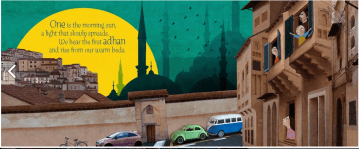
The first page is possibly a bit problematic in accuracy. The tone and framing of starting the day with the sun rising and the sound of the adhan is warm and beautiful, but the adhan is not called at sunrise for the first prayer of the day, fajr. Fajr begins at dawn. There are only 21 words on the first page, so I’m inferring a lot about the correlation of the sun and athan that may or may not be present. It is something frequently misrepresented, so it catches my attention. And yes, the seven tawafs mentioned in the author’s note would also apply to umrah, not just hajj.


Overall, the book is lovely and will remind many of us what made us all celebrate Hena Khan and her stories so many years ago.




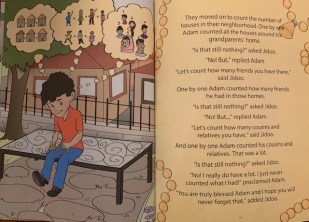
 This 20 page story is endearing and sweet for children aged 4 and up, with a great lesson. At first I thought it was an Islamic fiction book, but after thinking about it, I’m not so sure. Lots of faiths use prayer beads, although maybe only Muslims have 33, and the setting, Lebanon, is a pretty diverse place. Regardless, the character’s names, and the lessons taught are universal and children will benefit from being reminded about how blessed they truly are, in a gentle loving way.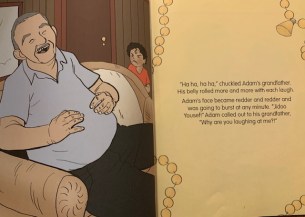








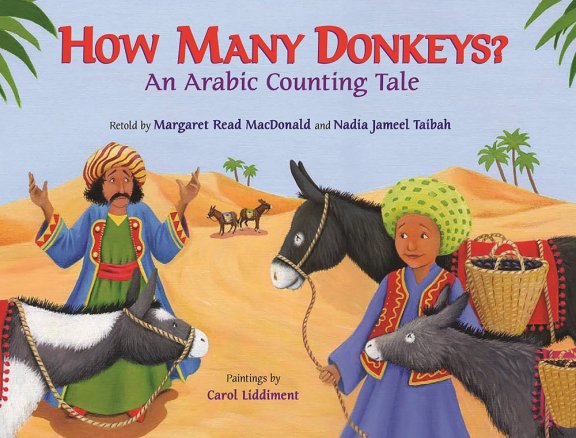
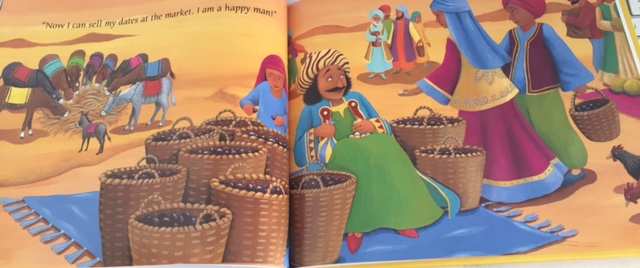
 Even if you know how already, your little one will enjoy figuring out why the main character Jouha can’t figure out how many camels he has in his caravan. While Jouha thinks, it has to do with whether one runs off while he is riding, and comes back when he is walking, hopefully by the second or third time, most kids will realize that he isn’t lucky or unlucky, he is just forgetting to count the one he is riding atop of. Probably good for ages 3-7, the book is silly in its repetition, and the beautiful painted illustrations bring the characters emotions to life.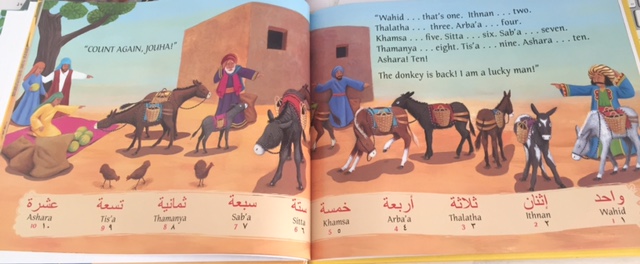
 Islamic School Librarian