Tag Archives: Children’s Islamic Fiction

The Great Race to Sycamore Street by J. Samia Mair

Standard

the great race to sycamore street

A fun book for elementary aged children looking for a fast paced, energetic read, with Islamic morals and lessons.  Overall a great book about character, being a good neighbor, and never giving up, The Great Race to Sycamore Street is not in the AR database, but I estimate it at about a 4.3 level and think even for higher readers there is plenty to learn about archery and peach trees, and plenty to enjoy as Amani and Hude take on bullies, grumpy neighbors, dogs, and making the most of a summer with their grandma in the country.  There are 180 pages followed by acknowledgements, references, and glossaries explaining archery terms, Islamic terms, and where the hadith and Quranic ayats come from, theoretically making the book accessible to Muslim and non Muslims alike.  I however, think the book would be a bit preachy to non Muslims or to those unfamiliar with Islam.

SUMMARY:

Siblings Amani and Hude arrive in Fairfax County, Maryland to spend the summer with their Grandma Hana in the quiet town of Cherry Hill, for what they think will be a slow laid back summer of reading, swimming in the lake, and preparing for the County Fair.  Grandma Hana has the undisputed best peach tree in the county and makes the best pies to enter in the pie competition at the fair, and this year Amani gets to help.  Hude is a budding archer and with his recently deceased grandfather’s journal and old archery regalia he is determined to compete and win the archery competition.  But their simple plans quickly meet twist after twist: from bullies on the train, to swarms of cicadas greeting them on arrival, to a new neighbor who discovers the beloved peach tree is actually on his property and he wants it gone, to the bullies on the train ruling over the lake and proving to be great archers themselves.  Can the  peach tree be saved? Can they be victorious at the fair? With lots of stories about Prophet Muhammad (Peace be upon Him) woven in, and ayats from the Quran used to emphasize points, not only is the book a quick action packed story, but it is also poignant, educational, and memorable as well.

WHY I LIKE IT:

I love that it is clean and requires the brother and sister duo to work together to do something that is bigger than themselves.  I also love the way that Islam is given practical uses for the children, it isn’t taught in the abstract they must pull on their understanding of their deen to decide what to do, how to act and what the next step should be.  I also like how the fast paced story is set in contrast to the slow thematic ideas of a peach tree, baking, archery, and a stereotypical summer with grandma.  Most readers I would assume don’t know that much about fruit trees and county fairs and archery, and I think the author does a good job of introducing the audience to these concepts and weaving Islam into it while keeping the story exciting and moving along.

FLAGS:

Clean, alhumdulillah.

TOOLS FOR LEADING THE DISCUSSION:

The plot is pretty linear, and a quick discussion of what every one liked and perhaps what surprised them would be a sufficient review of the story. From there I would probably go through the reference of hadith and ayats from the Quran to guide the discussion, you can get the online reference of that here:

http://www.kubepublishing.com/the-great-race-to-sycamore-street-free-reference-sheet/

scroll to the bottom and click on the link to download the text.

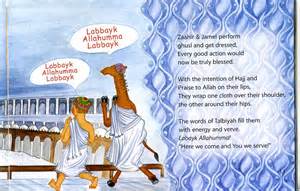
Zaahir & Jamel the Camel: Hajj by Amatullah Almarwani

Standard

hajj

This book is a great read for explaining the different parts of Hajj in a linear, easy to follow, fun way to children.  The author gives facts in a fictionalized setting with Zaahir and his camel, Jamel getting ready for, and performing the hajj.  The illustrations are also engaging and give plenty to talk about in both one-on-one reading scenarios and in larger groups.  For story time the book works well to read a page then reflect upon and discuss what it is showing and telling us. By stopping on each page the rhyme scheme doesn’t get too forced as well, as some lines are forced and awkward, making the rhythm hard to maintain.

hajj inside

Overall the book is effective and enjoyable.  The kids can see from the pictures and the simple words the importance of each step, and get an idea about how they are to be performed.  The book is not an AR book, but there is a quiz at the end to see how much they retained.

The Perfect Gift by J. Samia Mair

Standard

The Perfect Gift

Is there anything sweeter than a little girl feeling sad that she doesn’t have an Eid gift for her mother and then finding the perfect gift in nature? Probably, but it is still a great premise for a sweet story about a young girl named Sarah and how remembering the hadith “Allah is beautiful and loves beauty” starts a new Eid ul-Adha tradition for her family.

The Perfect Gift is simply written with adequate pictures that move the story along.  The text is short and clear leaving the reader or listener with a clear message about Allah’s perfection and gifts, but keeps it on a preschool to first or second grade level.  The book is 28 pages and has a few words defined at the end for clarity.  While the book takes place close to Eid ul Adha, there is no mention about what the holiday is for and how it is celebrated, the focus is on the beauty of nature and perfection of Allah (swt).

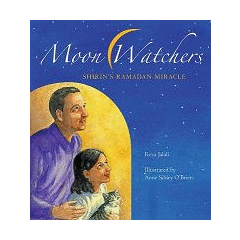
Moon Watchers Shirin’s Ramadan Miracle By Reza Jalali Illustrated by Anne Sibley O’Brien

Standard

moon watchers


This book is similar to Night of the Moon By Hena Khan as it focuses on a young girl experiencing the month of Ramadan and Eid, through the waxing and waning of the moon.  This is an AR book 3.5 and the text is driven by dialogue between nine-year-old Shirin and her Persian American family.

Too young to fast Shirin is feeling left out of the blessed month of Ramadan, her older brother Ali and her bicker until her Grandma encourages her to do “part-time fasts.”  Facts about Islam and Ramadan are slightly peppered in to the story, primarily through vocabulary, and the characters do discuss hijab and why Shirin’s mother doesn’t wear it.  It is important to note that the tale is told from a Shia perspective that is made clear as it explains how the family prays, touching the prayer stone, and kissing it three times.  The illustration here is more peculiar as it shows Shirin praying next to her dad and her brother, mom, and grandma in the row behind.

The pictures show a happy family that most readers or listeners would probably be able to identify with, along with the sibling bickering and excitement felt with the blessed month.  Persian culture is represented in the foods and sweets they prepare as a family and the henna Shirin gets on her hands.  The family prays together, spends time together and they discuss doing good deeds, not just fasting in Ramadan.

The book is beautifully done, but I think because of the brushing aside of hijab being a cultural practice, not a religious one and the presentation of prayer, I don’t know if I would give the book without discussion to a third grader in a Sunni school to read independently.  As for story time, I might simply omit those few sentences, but I’m not sure, it would depend on my audience.

If your children are aware of the differences between Sunni and Shia or you are Shia, this book is wonderful.  If your children would be greatly confused or get hung up on a few lines in a 32 page book, then it would be better to hold off.


I’m learning about Eid-ul-Fitr By Saniyasnain Khan Illustrated by Pulak Biswas

Standard

i'm learning about eid ul fitr

I’m learning about Eid-Ul-Fitr is a really dry book.  It is written as fiction, but it is more educational, than entertaining in nature.  Siblings Farah and Faisal are fasting, then celebrating Eid.  The story is told about them, but not really from their perspective.  They are just secondary vehicles to convey the main components of Ramadan and Eid.  The language is choppy and unimaginative.  My guess is that the story was translated from another language as grammatically it is awkward to read.  A few examples: “Maria’s parents belonged to Kuala Lumpur in Malaysia” and later, “Everyone was in his best clothes.”  The illustrations are adequate, with the exception of the pictures of a couple of Mosques from Delhi, Lahore, Kuala Lumpur, and Samarqand, which are quite nice.  Overall the book is sufficient.  If it is the only book your children have access to, there is nothing wrong with it, there are just a lot better, more engaging picture books, fiction and nonfiction, about Ramadan and Eid out there.


Night of the Moon By Hena Khan Illustrated by Julie Paschkis

Standard

night of the moon

Night of the Moon is a beautiful book both visually and content wise.  The pictures are bright and inviting and consume the entire page, keeping even the youngest of listeners engaged.  The book has an AR level of 4.1 and has 32 pages, making it work great for story time and well for independent readers too.

The book tells of seven-year-old Yasmeen, a Pakistani-American girl experiencing Ramadan. The story is moved along by the ever changing phases of the moon. While this book is adequately called a Muslim Holiday Story, it is very cultural.  The characters go to the mosque, but the focus of the story is not why we fast, the revelation of the Qur’an to Prophet Muhammad (peace be upon him), or even manners.  The story focuses on going to iftar parties, having henna painted on your hands, presents, and the very Pakistani-tradition of celebrating chand-raat, the night of the moon.

I like that this book shows Yasmeen talking about Eid at school with classmates of other backgrounds, I even like that her grandma wears hijab and her mother does not.  I also like that they eat a variety of foods, from kebobs to cupcakes.  Thus far, so many of the Ramadan and Eid books I’ve read contain the same information in a fictionalized setting, this one is definitely different, instead of focusing on what Ramadan is, it shows how it is celebrated.  The book works well for Muslim and non Muslim children from all around the world.  If your audience lives in American and has ties to the Asian subcontinent they will see them selves in this book, and even if they don’t, they will probably want to join Yasmeen and her family is celebrating Ramadan and the Night of the Moon.

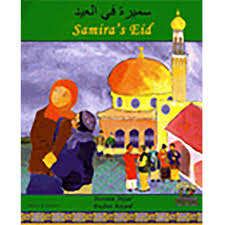
Samira’s Eid By Nasreen Aktar Illustrated By Enebor Attard

Standard

samiras eid

Samira’s Eid is a dual language story (my copy is English and Arabic, other languages are prevalent online as well) about Samira and Hassan, siblings enjoying Ramadan.  It is Hassan’s first time fasting and he is afraid fasting may hurt,  Samira and their mom explain that it won’t and continue to walk him through each step of a Ramadan day as he experiences them.  This point of view allows the reader to see what  Ramadan is like, how it feels, and what it means. The story carries on through Eid and explains as well as shows how Eid ul-Fitr is celebrated by Samira and her family.   The story concludes with a lovely surprise ending involving an Eid Card and Samira’s Nani (grandma), that adds to the book’s appeal at bedtime or story time.

The story is sweet, and level appropriate, it doesn’t get preachy and the dialogue doesn’t seem forced.  It is story driven and would be engaging to both Muslim and non- Muslim children with a little discussion.  The pictures are mediocre. They are colorful and for the most part a good accessory to the story. There are a few pictures however, where the faces are a bit “droopy” and jarring.  Particularly the one of Samira’s teacher, Mrs. Qadir.

It is unclear where the story takes place exactly, presumably the Asian subcontinent as Samira receives a shalwar-kameez to wear for Eid and the use of the term Nani. The author makes a point of following  the moon sighting for Saudi Arabia that may need to be discussed based on personal and community views and practices.

Overall a good story and at 22 pages a nice read-out-loud selection.


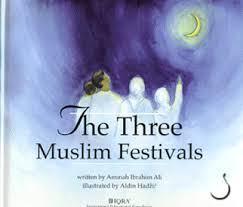
The Three Muslim Festivals By Aminah Ibrahim Ali Illustrated By Aldin Hadzic

Standard

Image

The Three Muslim Festivals is a very informative book about Ramadan, Id al-Fitr, and Id al-Adha, at over 60 pages however, it is a bit long for story time or smaller children.  Broken up into three parts, each told from a different character, the book would work well for second through fourth grade students.  It reads like a very basic chapter book, with information mixed in with a simple story.  The morals are clear, hadith, ayats and dua’as are shared and the illustrations help support the fictionalized portions.  The pictures aren’t engaging, but they do show a variety of ethnic groups and happy families.  The book is content, not character driven, but the families are supportive of the children, there are actively involved moms and dads, grandparents, and siblings.  The mom in one story is a physician and the dads help in the kitchen and around the house, showing some diversity. I like how it serves as both a review of basic Islamic principals while reinforcing elements that a child may not know or may have forgotten in a non condescending manner.  I would imagine the average seven year old could read it independently and comprehend it without being bored.  It isn’t the best written story out there, but it should be engaging enough to convey a lot of good information to an elementary aged reader.  Based on the style it is probably more intended for Muslim readers, but there is a three page glossary of terms in the back.

Eid Kareem Ameer Saab By Fawzia Gilani-Williams

Standard

This book made me laugh. It is essentially the story of Scrooge in the Christmas Carol simplified for a younger audience and switched to an Islamic perspective.  Don’t get me wrong, despite its unoriginal foundation, it is a good story.

The main character is grouchy, wealthy Ameer Saab who we see in a typical day berating his servant Raheem, refusing to help a woman and her young baby, refusing to help the poor, and neglecting his Salah.  Meanwhile Raheem is scrounging up his money with his wife to provide food, while still managing to help a widow, and others.  That night Ameer Saab has three dreams, in the first he is reprimanded by his father, the second by his mother, and in the third his money and jewels strangle him.  He wakes up a changed man on Eid morning.

This book is great for 2nd through 4th graders, with colorful pictures and well spaced text, it invites rather than intimidates this age group.  The morals are also clear and influential as the reader can see clearly which side is more desirable to Allah swt.

There is a verse from the Quran explained, and there are a few Arabic words, nothing off-putting for a newly independent reader and at just 24 pages, I think most elementary age students will enjoy and benefit from the story.

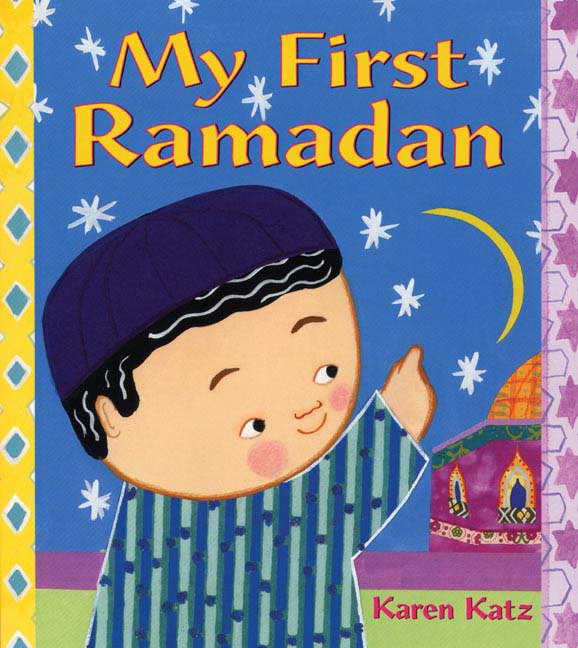
My First Ramadan by Karen Katz

Standard

my first ramadan
With Ramadan here my goal is to round up all my Ramadan and Eid picutre books to share (and hopefully review). Unfortunately school is out for the summer, so it will be mostly just sharing with my own children and nieces and nephews.

Karen Katz, a popular children’s author wrote and illustrated a children’s book about Ramadan and Muslims called My First Ramadan. It is an AR 2.8 and the pictures are done in her signature style, which the kids will recognize and love. Told from a little boy’s perspective he explains Ramadan, Islamic traditions, basics of Islam (Quran, Prophet Muhammad (peace and blessings be upon him)) and some of the five pillars. Words such as iftat, suhoor, fajr, maghrib, are introduced, explained and even have a pronunciation guide in parenthesis.

A few things that I discussed with my kids while reading are that in the picture talking about Prophet Muhammad (peace and blessings be upon him) teaching his followers to break their fast with a date and water, that RasulAllah is NOT pictured and why we don’t picture him. I also explained that each family has traditions, and the one in the book sits on the floor to eat. Islamically it isn’t required. We also talked about why in the book the men and women are in different rooms when they pray and in some Masjids they are in the same room, the men in front and the women in back.

The book mentions and illustrates how happy Ramadan and Eid are, and how Muslims come from all over the world. In the pictures some woman cover, some don’t, but we are all family. All in all a cute book that introduce and reinforces Ramadan.