Tag Archives: bullying

Nusaiba and the 5th Grade Bullies by Asmaa Hussein illustrated by Zul Lee

Standard

Nusaiba.png

As someone who deals a lot with reading and comprehension, I really misread the description of this book and assumed erroneously that it was a chapter book targeting 5th graders.  Oops, alhumdulillah, my confusion and slight disappointment didn’t last long as I got swept up in Nusaiba’s spunky imagination and endearing personality.  The message of the book is powerful.  Not only does Nusaiba have to deal with bullies, but she has to wrangle with accepting herself, even if that means being different.

nuaiba2

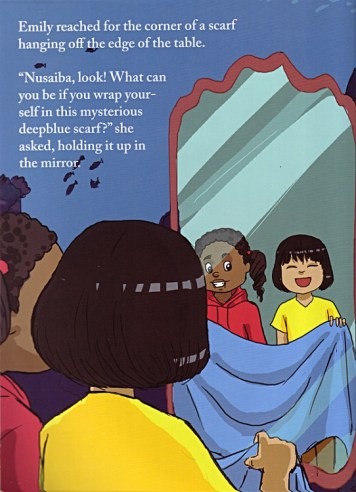
Nusaiba is almost to school when she overhears some 5th grade boys making fun of her mom and what she is wearing.  Nusaiba’s mom is wearing a hijab, and the story is set up to imply that that is what they find “weird.”  This morning encounter bothers Nusaiba all day, and while she doesn’t talk to her teacher about it when asked, she does spill the beans to her best friend Emily.  The next day Nusaiba distances herself from her mom and asks to walk to the school gate alone.  The bullies don’t say anything, but Nusaiba feels guilty about leaving her mom like that. Later that day when Mom picks Nusaiba and Emily up from soccer they swing by a local hijab shop for some clothes shopping.  I don’t know why, but I found the premise for taking the girls clothes shopping a little forced.  It seemed too words of a setup, and I couldn’t help but wonder why Emily would be dragged along.  As mom tries on skirts for work, the girls in their boredom get swept up in using the scarves as costumes and transforming themselves from queens, to underwater divers, to fisherwomen, to mountain climbers, to fantastic cleaners ready to clean up all the scarves on the display.  Her mom lets her pick one to buy, and she decides to wear it to school the next day.  It is noteworthy that Emily doesn’t try on any of the scarves.  She is an amazingly supportive friend, and even in make-believe is right there with Nusaiba, but she doesn’t put one on, and I kind of want to know the author’s reasoning or purpose as to why.  So the next day at school, Nusaiba asks her mom to again walk with her, and when the 5th grade boys call her mom an “odd-ball.” Nusaiba finds her courage to confront them.  Nusaiba and the reader discover the boys are making fun of Nusaiba’s mom, but it isn’t for her hijab.  Nusaiba and her mom set the boys straight and giggle in the process, as Nusaiba realizes she can be anything she dreams.
nusaiba1

The book is 44 pages and probably about a second grade mid year reading level.  The pictures are big and bold and beautiful making it a great option for story time to ages 4 and up.  The pictures do an amazing job complementing the story and going back through to look at them after the “twist” at the end was even more delightful.  The illustrator draws you into Nusaiba’s world and you really do cheer her on when she stands up for herself. The book easily lends itself to discussion, and there is also a question guide at the end, incase you get stumped. It reads more like a school assignment, but it could obviously be re-worded to engage a child at bedtime or in a read-a-loud environment.  The font is a nice size, however, I found it distracting. On some pages it is white on others black, on some it has a shadow and on others it does not.  I’m certain most people would not notice, but for some reason it was jarring to me.  Alhumdulillah, alhumdulillah, if that is the only negative in a book, I think everyone who reads it will be glad to have a copy of their own to read again and again and again and again and….
 

Just a Drop of Water by Kerry O’Malley Cerra

Standard
Just a Drop of Water by Kerry O’Malley Cerra

just-a-drop-of-water-cover

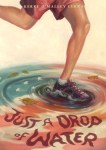
Thankfully the adult in me won out as I resolved to read a book whose cover and title did nothing to tempt me.  I know, I know, never judge a book by its cover, but seriously a kid running on the American flag with major Muslim characters, written by a non-Muslim about September 11th? I was hesitant and nervous to know what messages would be spread in the 304 pages to children on an AR 4.0 grade level.  But alas, I was  nervous for nothing.  The book is wonderful, and I want to read it again with my 5th grade daughter so we can discuss it.  It is hard to believe 9/11 is now taught as history, but as someone who lived through the tragedy as a college student, this book hit on so many of the defining moments of that horrific morning and the days that followed.  The book isn’t overly political, or judgemental, or preachy, and in retrospect, most people on September 11th and the days immediately following, weren’t either.  We were confused, scared, and unsure, a tone the book reflects and magically presents on an elementary level without getting  overwhelming with the enormity of it all .   The book was published two years ago, and I’m very tempted to contact the author or editor and urge them to reconsider a cover and title change because truly the story deserves it.

SYNOPSIS:

Jake and Sam have been friends their whole lives.  They bonded in the sandbox with their little green army men and have been planning battles and missions together ever since.  Told from Jake’s perspective the reader sees what life is like for these two 8th grade boys.  They push each other in cross-country, their parent’s come together for Jake’s 13th birthday, neighborhood boys swing by for pizza and front yard football games.  But there are stresses too: siblings, busy parents, not getting named captain of the team, friends that play dirty.  Then September 11th happens and worlds are shattered.  The boys learn that one of the hijackers, Mohammed Atta, was from their town, and although Sam has only been to the Mosque a few times with his grandparents, and his parents are culturally American not Saudi, the school bully Bobby is determined to get rid of Sam.  Jake makes it his mission to defend his friend with his fists and his words, but when his parents urge him to stay away from Sam, the stakes are raised.  President Bush says, you are either with us or against us.  But what is Jake to do?  Secrets about Sam’s dad come out and the FBI takes him away for questioning.  The town is gripped in fear and 8th grade boys on both side are determined to change the world, to be the drop of water creating ripples of change.  As Sam and Jake pull away from each other, Sam starts going to the mosque to learn about what he is being accused of being and begins to identify as Muslim.  Jake’s frustration with his parents continues to grow as does his impatience with Sam, but when Jake overhears Bobby plotting something serious, Jake will have to decide where he stands and how strong he is.

WHY I LIKE IT:

I like that the author crafts a story that is complex, but not overwhelming.  She sticks to focusing on getting inside Jake’s head and succeeds.  He is frustrated and confused and determined, but alas he is only a kid and can’t foresee his actions or articulate them the way an adult can.  He is likeable and fallible and she doesn’t belittle him, thus making his plight tangible and relatable.  I was a little disheartened when about a quarter of the way in it was made clear that Sam knows nothing of Islam or his culture, but it works so well in the story to show that he was pushed to go learn about his roots, since others were treating him as if he represented Arabs and Muslims.  This is so real, I knew so many non practicing Muslims that suddenly started coming to the mosque or reading books on Islam because they realized they should know where they come from.  Many resumed a secular life over time, but many also became more practicing, a phenomenon, the US media and politicians have seemingly failed to acknowledge as Islamaphobia is rampant and so many people pick up a Quran to see how a religion painted so negatively, can simultaneously be one of the fastest growing religions in the world.  The author doesn’t even touch on what Muslim’s believe, but she does include that they abhor violence and disavow the attacks.  The Sheikh is presented as nice enough and there is no negative judgement or tone from the author, aside from the xenophobic characters.

The title of the book comes from a song that Jake’s grandma likes and she often tells Jake, “just a drop of water.” Jake takes it to mean that something is insignificant, but she has him listen to the song and explains that it makes ripples that grow.  The imagery is great, and the line becomes powerful, I guess I just felt it wasn’t devolved or woven in enough to make a strong, clear statement to be the title of the book.  I’m sure many would disagree with me, but as I stated earlier the title along with the cover photo didn’t pull me in.  The book appeals to both girls and boys as both are presented very positively.  There are a handful of side stories that add depth to the characters and narrative that I haven’t touched on, but they are all charming in their own way.  There is a Boo Radley type character, there is a whole tangent about Jake’s grandfather and the details surrounding his grandfather’s death, and the overall messages about friendship, and doing what’s right that make the book relevant to a wide spectrum of readers of all ages.

FLAGS:

The book is remarkably clean considering it is about an act of terror followed by bigotry.  There is some hate speech and violence, and some lying and cheating, and mention of getting pantsed.  But, overall clean and no concerns for 4th grade and up.

TOOLS FOR LEADING THE DISCUSSION:

There are a lot of resources online and it doesn’t surprise me.  This book would do great as a novel study, as it is historical fiction.  It would also work well as a book club selection for any elementary or middle schoolers, not just those in an Islamic school.

Core Connections: achievethecore.org/file/1602


King For A Day by Rukhsana Khan illustrated by Christiane Krome

Standard

King-for-a-Day1.jpg

Its time for Basant, the Lahore, Pakistan kite flying festival, and Malik and his siblings are ready.  Ready to launch Falcon into the sky, ready to set other kites free, and ready to put the bully next door in his place.  While some kids have huge kites, and some have many, Malik has just Falcon, a speedy little kite that Malik prays can get the job done.

King for a day inside

Once again Rukhsana Khan does a remarkable job of taking a universal theme, adding some culture, and finding artists to empower minorities without making it an issue, all in a 32 page children’s book.  Written on an AR level of third grade ninth month, readers see characters handling a bully by beating him “on the court” so to speak, a character having confidence in his abilities, yet still asking Allah swt for help, and a boy in a wheel chair celebrating a fun spring time festival with his family.

king 1

The illustrations are rich with texture and angles, which contrasts the font and text presentation.  Little kids probably won’t be tempted to pick this book up, but as a read-a-loud first and second graders will enjoy the story and the kite flying action.  Third and fourth graders will enjoy reading the book independently, and find themselves cheering for Malik, appreciating his kindness, and wanting to pick up a kite and head out themselves.  The author includes a note at the back which provides more information about Basant and how it is celebrated.  Although it takes place in Pakistan and is a festival not celebrated in America, there isn’t a “foreign” feeling to the book, as kids can relate to bullies, wanting to be the best and the satisfaction of succeeding and feeling like a “king for a day.”

king2

Ten Things I hate About Me by Randa Abdel-Fattah

Standard

Ten Things I Hate About Me

I’ve read and reviewed a few Randa Abdel-Fattah books and read and reviewed even more cheesy West-meets-East-and-my-parents-are-so-strict-so-I-will-rebel books, that with such a flimsy title referencing a movie which references Shakespeare, I didn’t expect much.  With such minimal standards, the book didn’t disappoint and the surprising warmth of many of the characters actually left a pleasant smile on my face.  I’ve had this book on my to-read list since it came out in 2006, and for some reason it is a bit hard to find now a days.  There seems to be a few covers out there, and I don’t know if they differ, but the one pictured above is the one I read, and it is 297 pages and written on an AR 4.8 level, but probably would appeal and be more content appropriate as a light read to 9th through 12 graders.

SYNOPSIS:

Jamilah Towfeek leads a double life.  At home she is a proud Lebanese Australian that goes to Madrassa, plays the darbuka drums in an Arab band, and identifies as Muslim.  She has recently dyed her hair blond and wears contacts to hide her Arab heritage and doesn’t allow her sister who wears hijab to pick her up from school where she is known as an all Australian girl, Jamie.  Her mother has passed away and her father is pretty strict about who she goes out with and her curfew.  They even have a contract posted on the fridge. Despite this, Jamilah and her dad seem to have an ok relationship and it is definitely something they both are fighting to improve.  Jamilah’s older brother is a bit of a rebel and goes out with girls to bars and the book definitely discusses the double standard.  He however, isn’t painted as “bad” or as presented as an outcast, he just does things differently, and must wage his own path to build a relationship with their father.  At school Jamilah has acquaintances more than friends, as she is constantly pushing people away.  The stage is set that she has to keep lying to her friends, but it is more in her head than in reality.  She doesn’t open up to her friends, nor they to her.  As a result the Jamie at school amongst her peers are presented as incredibly shallow, which is partially intentional I think, and partially, under developed.  She makes up excuses to not attend parties and it isn’t a big deal until the most popular guy at school starts to take an interest in her.  In frustration she starts opening up to someone who has started e-mailing her.  Her user name is Ten_Things_I_Hate_About_Me and the dialogues between her and Rage_Against_The_Machine reveal a lot about how she sees the world.  There is some tension with immigrants in Australian and Jamilah starts to realize that her silence is consent to the bigotry and bullying around her, and that there is no way to stay neutral.  There really aren’t any major plot twists, you can see a mile away who the mystery email boy is, and that he likes her, you can see that her friend Amy will come through, and that she will have to reconcile her two identities.  There are a few minor ones with her dad getting remarried and thankfully with her opting to not “hookup” with anyone in the end despite a climatic kiss in order to stay honest with her father.

WHY I LIKE IT:

I’m obviously older than the target audience and the characters, as is the author, but compared to a lot of the other books of similar content, I feel like this book stays the most grounded.  There are some pop cultural references, and obviously the kids are naive, but there are some universal truths and experiences brushed upon that I think a lot of high schoolers can relate to, not just immigrant Muslim ones.  The idea of having to be two different people at home and at school, family relationships, cultural identity, being true to yourself, dealing with the loss of a parent, taking a stand when you see something wrong, etc.. All that being said there is a huge gaping plot hole.  How her friends that have known her from elementary school when her mom brought Arab food suddenly don’t know she is Arab, or don’t pick up on her ethnic last name is beyond even a 5th grader to over look.  If you can tune out your internal sense of logic for the premise, the book is much more enjoyable, but it really is a stumbling point.

I wish that Jamilah was a bit religious.  She identifies as Muslim and clearly her sister is, but pretty much all of her actions and gripes come more from her culture than from her faith.  Many of her father’s friends drink, as they are either not religious, or Christian, which is fine, but part of me really wanted her to live up to the picture on the cover of the book and discover her religious stance alongside her owning up to her cultural one.  I love that at it’s core it is a book about a girl’s relationship with her dad and being true to her self, but somewhere her religion fizzled out of the narrative and I wish it hadn’t.  I Would have loved that she turned down the prospect of a boyfriend because it wasn’t Islamically permissible, in addition to her wanting to be honest with her father.  But, alas the author didn’t pursue that.  She did however, do a good job of not making it a judgement of culture or faith, just as attributes of her characters.

FLAGS:

There are racial slurs, drinking, dating, and kissing.

TOOLS FOR LEADING THE DISCUSSION:

Surprisingly I wouldn’t completely disregard this book for a Book Club selection.  It would be for older kids, ideally upper High School.  But I think especially in an Islamic School setting the discussion would be so much better than the book.  Many send their children to Islamic Schools to reduce the need for dual identities and I would love to see how the kids view the effectiveness of it.  I would also enjoy hearing students’ perspectives on going to formal dances with siblings or a group of girls, the double standards of boys in girls, and dealing with Uncle’s and Aunty’s constant opinions.

Author’s Website 


Layla Deen and the Case of the Ramadan Rogue by Yahiya Emerick

Standard

layla deen

I remember my 2nd graders reading this many years ago and strongly disliking it.  And I vaguely remember agreeing with them, but perhaps at the time, there weren’t a lot of Islamic fiction options for the age group, so I decided that the pros out weighed the cons and left the book on the classroom bookshelf.  Fast forward to today where mashaAllah there are more options, yet this book is still often a staple on most school and family book shelves.  That being said, I thought a revisit was in order, and yikes I agree with my 2nd graders of so long ago, and I have major issues with this book.  At 42 pages, the clipart illustrations and wide spaced font seems a bit dated, but with the short chapters and Islamic backdrop the book overall would still appeal to 2nd to 4th grade Muslim students. The story is sweet in merit and intention, however, some of the details make me hesitate to recommend this book.

Overall, I feel like the author tries too hard, he is trying unsuccessfully to relate on a students level, trying to sound cool, and ultimately in the process uses unnecessary language in my opinion.  The manner in which siblings Layla and Ahmed speak to one another is incredibly harsh, and while perhaps realistic for some families, there is no reprimand or apologizing.  The name calling and yelling at one another throughout makes their collaboration at the end seem unlikely.  Even how Layla talks to her mom about the homeless man at the store, saying he is dirty and gross and a “stinky bum”, seems jarring to a book that is trying to teach a moral lesson.  Layla’s mom gently reminds Layla that Prophet Muhammad (saw) was kind to those in need, but I feel like the mom doesn’t go far enough in correcting Layla, and Layla dismisses rather arrogantly what her mother has to say.

Later, some bullies taunt Ahmed, and while in her head Layla defends her brother which is nice, out loud she resorts to calling the bullies “idiots” and “freak squad” which seems to be a form of bullying as well, and at the very least don’t empower the students to know how better to deal with bullies.  She then remarks that they smell bad and smoke pot and hopes her brother will “kick their butts.”  If the author wanted to make a comment on the ill effects of recreational drug use ok, but for this reading level to mention it as an insult in passing does little to benefit the story and even less to help the reader grasp what pot is and that children using it (irregardless of how one feels about adults using it) is not a joking matter.  Later when something is stolen Layla assumes it is the bullies who have committed the crime and sets up a sting to catch them.  Needless to say it isn’t them, and I wish the author would have at least had her feel bad that she assumed someone to be guilty when in fact they were innocent. A premise that I feel needed some addressing or reflective growth to benefit the reader.

My next concern, would not have been a concern ten years ago, but with the current situation regarding how police are being treated in response to the actions of a few, I wouldn’t want to perpetuate a stereotype that widens the gap between police and the communities they work for.  In the book when a crime is committed Ahmed dismisses going to the police remarking that the police do little and just sit around eating donuts.

And finally the climax of finding out who stole the food and why is sweet, but I really felt could have been handled so much better.  (SPOILER) The homeless man stole the food to feed it to some kittens he found in a garbage bag.  On the surface that is sweet, but I don’t think that, that justifies theft.  Furthermore he didn’t want to take the cats to the shelter because they would be gassed. Again, like the pot reference, that is a bit heavy to just leave hanging out there without explanation or background for such a young reading audience.  Layla then offers to take the cats to her friends and assures the man they will have good homes.  To me a better option would be to purchase the cats from the man so he can have some income and also assure the cats a good home.  It seemed to me that she took them from him in a rather abrupt fashion as if because he was homeless he didn’t have a right to his property, and getting a meal in exchange didn’t cut it for me as the happy ending I was hoping for.

SUMMARY:

Layla and her family are preparing for Ramadan, which starts in a few days, Layla joins her mom for a trip to the grocery store to stock up and they see a homeless man begging for money.  Disgusted Layla not only can’t stand to be near the man, but it is appalled that her mother stops to talk to him.  When the food set out for the nightly iftaar goes missing from the kitchen window, Layla and her brother take advantage of a night when their parents are out to try and catch the thief or thieves.  They discover the homeless man, and in a change of heart, Layla arranges to meet him at the grocery store the next day with her mom so that they can invite him to dinner.

WHY I LIKE IT:

I appreciate what the book tried to do: blend a fictional story in an Islamic context for a younger elementary aged Muslim child.  I also like that it showed a Muslim family, praying, fasting, and going about their normal life so to speak.

FLAGS:

Pot drug reference, less than ideal handling of bullies, negative unsupported stereotypes.

See beginning of this review for detailed concerns.

 TOOLS FOR LEADING THE DISCUSSION:

For some reason, despite all my concerns with the book, I have been trying to find a way to still utilize it.  And I think the only way I could comfortably convey this story to kids would be to read it aloud and self edit it while reading.  I think there are too  many issues to let a second or third grader read it independently and then discuss, but I think if I were to edit out some of the random comments that have no bearing on the story, and then paused to discuss some of the bigger issues of bullies, assumptions, treatment of the less fortunate, and a better way to help others and animals the book might still be successful.  I think it could be read aloud in less then an hour and if today’s students are as perceptive as my students years ago, they not only will pick up with what is wrong in the story, but also devise ways to make it so much better.

My Name is Bilal by Asma Mobin-Uddin, Illustrated by Barbara Kiwak

Standard

bilal

The other book I discussed during my Story Time theme of bullying was, My Name is Bilal, by Asma Mobin-Uddin,  The book is an AR 3.5 so I summarized parts when reading it aloud, but at bedtime one-on-one my five-year-old was able to grasp what the characters were going through and how best to handle “mean” people.

The premise of this 32 page, fairly content heavy picture book, is a new family starting at a new school.  The main character Bilal does not stand up to some boys teasing and pulling off his sister’s hijab, and then chooses to tell people his name is Bill instead of Bilal so that no one knows he is Muslim.  Fortunately, Bilal has a Muslim teacher who doesn’t jump in to “save” Bilal, but instead shares with him a book about Bilal Ibn-Rabah, the slave who was tortured by the people of Mecca in their attempts to get him to renounce Allah (swt) and Islam.  Young Bilal, finds strength in this story to stand up to the bullies as well as compassion in giving them a second chance.  He even finds there are more Muslim’s around him and being true to yourself is something even those different than you can understand and respect.

Yes, the book is to neat and tidy and it all works out in the end.  But, I think it is a good introduction to being proud of who you are and not backing down.  I like that the kids essentially handle things on their own and that no one is painted singularly as “good” or “bad,” both Bilal and the other kids are flawed and figuring things out. When I read this during Story Time we talked about it from the “bullies” point of view of what a better way to handle someone or something that you don’t understand would be, a scarf in this case, and how asking questions is always more respectful than teasing. We also talked about being the different one in a new environment and how to be prepared if someone does give you a hard time.  The characters in the book are older presumably than 4th or 5th grade allowing this to be a gateway into discussing bullying a bit abstractly, inshaAllah not once it has already begun.

The illustrations are colorful and realistic, not detracting from the seriousness of  the subject matter.  Overall the book serves a purpose and tells a good story.  Plus, the reader learns a little about Bilal and how the early Muslim’s struggled and encourages them to seek out what their own names mean and represent.

Circle of Sandcastles by Mariam Al-Kalby, Illustrated by Yee Von Chan

Standard

circle of sandcastles

The second book by Mariam Al-Kalby in The Prophet Says Series, is just as good, if not better than the first book, The Apple Tree.  Dedicated to her second daughter Maimuna, this story focuses on the hadith, “Whoever amongst you sees an evil, he must change it with his hands; if he is not able to do so, then with his tongue; and if he is not able to do so, then with his heart; and that is the weakest form of Faith” (Sahih Muslim).

The book follows shy Maimuna as she goes from stopping bullies picking on a deaf classmate within her heart, with her tongue and finally as she has to get her hands involved.  Once again the illustrator does a wonderful job bringing the story to life with joyful playful illustrations and detail.  I used this book with the preschoolers at story time when talking about the five senses and with the kindergartners when talking about bullying and being mean, in both scenarios the book had a strong impact on the students.  I’ve had students remind me in passing how we should handle bullies in our heart or with our tongue and even my own 4 year old has referenced the book when seeing people communication in sign language.  Like the first book, the discussion that follows can be different with each reading, which keeps it in regular rotation.  The bullies are not all bad, but one doesn’t feel guilty giving lots for the reader to speculate upon if they so choose. Shy Maimuna has to be courageous and assess the situation if it is something she feels she can get involved with or not.  Mu’min, the child’s whose sandcastles keep getting destroyed, shows us that Allah swt made us each different, but really the same too.

The book has four Urdu words in it, that actually kind of seem awkward and forced, I simply translated them to English when reading to students (there is a glossary in the back), if you are familiar with Urdu they are fine, but rather unnecessary in my opinion.  The book has 32 pages, is hardback and beautiful inside and out. The author’s website has a cute coloring page http://apocketfulofnotes.com/2013/11/14/circle-of-sandcastles-coloring-sheet/ and inshaAllah your kids enjoy the book as much as mine do, I can’t wait to see what she writes next.

The Friendship Matchmaker Goes Undercover

Standard

friendship

I’m posting yet another Randa Abdel-Fattah book that my mom stumbled upon and sent me 10 copies to do for our Book Club. I didn’t love the book, but it is clean and brings up the issue of bullying, friendship and honesty.  So, I’ve decided to do a 3rd- 5th grade Jr. Book Club and use it as a starting point to discuss this critical social realms that they are facing.  The book is a 4.4 Accelerated Reader level and has no Muslim characters or themes.

SYNOPSIS:

This book is the second in the series, and, thankfully, having not read the first book, The Friendship Matchmaker, didn’t hinder my understanding.  Told from the perspective of Lara Zany, a former friendship matchmaker of Potts Middle School, the reader gets to know the major characters at the school and their problems.  Lara now has a best friend and has retired from the matchmaking business, but old habits are hard to kick, and as a new student from Somali out plays the school bully in soccer, Lara is forced to go undercover to help her classmates.

WHY I LIKE IT:

The book doesn’t stand out in the genre, but it is fun because I think 3rd through 5th graders deal with everything in the book, every day.  The book shows restraint where a lot of books over do it.  The characters show growth, they aren’t disrespectful and they aren’t all painted with a simplistic brush stroke.  The bully has redeeming qualities and no one is perfect or hopeless.

FLAGS:

The book is clean in regards to violence, relationships, and language.  The only concern I have is there are two major instances where the characters lie, and there are no consequences.  The smaller breaches of honesty the characters in some way or another must own up to, but there are two scenarios: a forged field trip signature, and an untruthful excuse given for being late to class, that rubbed me the wrong way.  Before allowing students to check it out for the purposes of Book Club, I sent a note to the parents with these two concerns and left it to them to encourage or discourage their student’s from checking it out.  My goal is to discuss why the author included these in the book, and realistic alternatives that would promote honesty, but still allow for a happy ending.