Category Archives: Picture book

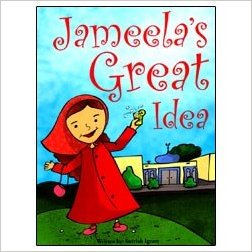
Jameela’s Great Idea by Surriah Igram

Standard

jameela's great idea

Jameela’s Great Idea by Surriah Igram is a good read-a-loud story for small groups.   A simple story of a girl seeing her father give sadaqa, charity, on a nightly trip to the masjid, wants to also give charity.  But, to do so, she must first find a way to acquire some money.  Her ideas are lavish, over the top and  silly, but her ever patient mom let’s her pick one idea to bring to fruition, which luckily, alhumdulillah, is the only reasonable one presented.  I feel like discussion is needed with this story to provide commentary on why the ideas are not practical even though her intention is so noble.  The story is very simple, linear, and age appropriate.  It works well for preschool and kindergarten age groups with big colorful pictures, large font, and its oversized presentation.  The message is beautiful as are the pictures.  Little Jameela has a supportive involved family, they enjoy going to the mosque, they behave in the mosque, yet have fun outside in the yard, and images of covered and uncovered characters are present.  Arabic and English signage decorate the landscape and the book isn’t too long at 30 pages.  After reading it, I think children will enjoy going back to look at the pictures, however, I don’t see it being a high demand repeat read request.  Once through is pretty sufficient in getting the message, chuckling, having a little talk about it, and then moving on.  The book is a great introduction to the importance of charity in Islam, but would need to be supplemented to fully convey to even the little ones, the value of giving to others.
Allah Created Everything by C. Alta

Standard
Allah Created Everything by C. Alta

allah created everything

The version I have is called Allah Created Everything, but it seems that the more common edition is God Created Everything, regardless the book is beautiful, timeless, and a perfect book for story time with the little ones.  The simple words and beautiful illustrations are the perfect level for Daycare through Kindergarten students.  They can gaze at the pictures and absorb the simple text, and even participate in a powerful conversation after about how Allah/God created us all, and everything around us.

The Blades of Grass,
The Oceans and Seas ,
The Rocks-
The Soil-
The Beautiful Trees,
The Majestic Mountains That We See,
Allah Created Everything.
The Dog-
The Cow-
The Whales-
The Birds, The Spiders and Bees,
The Wild-
The Tame-
Allah Created Everything.
The Sun,
The Moon,
The Rainbow-
The Clouds, Tornadoes, Volcanoes,
Lightning Shattering the Skies.
People of the World,
Shapes-
And Colors We See,
Allah Created Them
Just like You and Me.

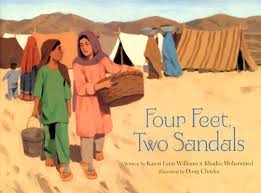
Four Feet Two Sandals by Karen Lynn Williams & Khadra Mohammed Illustrated by Doug Chayka

Standard

four feet

A beautiful hardback picture book I picked up at the Scholastic Warehouse sale, at 32 pages long and an AR level 3.2, Four Feet, Two Sandals, works well as both a story time selection to younger students and as independent reading for up to 5th grade.  The story is about two refugee girls that come to know each other when relief workers throw donated clothes for the people and Lina and Feroza each end up with one sandal each of a beautiful pair.  Rather than fighting or being ungrateful, the girls work out a plan so that they can both enjoy the sandals and in the process, become friends.  The girls share their stories with one another, and thus the reader, about how their families have been affected by war and how they came to be at this refugee camp in Peshawar, Pakistan.  The girls dream of school and their futures and show the readers a bit of their daily struggles getting water and doing chores.  When Lina’s name shows up on a list to go to America, and Feroza’s does not, the friends must part and decide who gets the sandals.

While it probably bothers some that America is seen as the saving grace to sweep Lina to a better life and pander to an American audience. I think it makes sense seeing as the book was co-authored by the executive director of the Pittsburgh Refugee Center and was inspired by a refugee girl who asked “why there were no books about children like her.”  Clearly refugees do get a chance at a new life when other countries open their borders and stories like this that give our children insight into the world they have left behind, with the hopes of fostering compassion, is something that I definitely want to share with my own children and students.

The author’s website and reading guide: http://www.karenlynnwilliams.com/files/sandals_guide.pdf

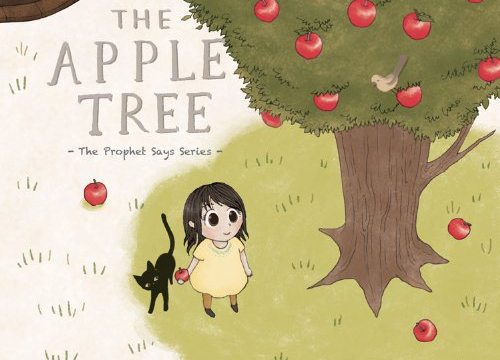
The Apple Tree by Mariam Al-Kalby, Illustrated by Yee Von Chan

Standard

appletree

I have been looking forward to obtaining this book for a while (it was back ordered on Amazon) and over all it was worth the price $16, and worth the wait.  The illustrations are absolutely beautiful.  At story time the kids constantly urge me to take my time in turning the page.  They aren’t incredibly detailed, just very whimsical and engaging, that you want to take a peek and stay a while to play with little Shaima.

The book’s moral comes from two hadiths (sayings of Prophet Muhammad (p.b.u.h.)) “When a Muslim plants a tree, whatever is eaten from it is charity from him, and whatever stolen is charity, and whatever is subtracted from it is charity” (Sahih Muslim), and ” There is no Muslim who plants a tree or sows seeds and then a bird, or a person, or an animal eats from it except that it is regarded as charity for him” (Sahih Bukhari).

The main character, Shaima, wakes up one morning at fajr to find her Baba planting an apple tree.  The two discuss what “reward of charity” means and the value of sharing.  Time presumably passes, although the tree does seem to grow and produce incredibly fast.  Once the apples are ready to be picked, Shaima finds everyone taking her apples: a little boy, a squirrel and her babies, some birds, what can she do?  The solution is both a lesson and inspiration for the character and the reader and makes for a fun book to get the discussion rolling on a wide variety of topics: patience, charity, sharing, generosity, humility and more, alhumdulillah.

The book is not AR, but is relevant to 4 year old children and up.  The book is hardcover and 32 pages. There are six Arabic words which are explained in the glossary and do not impede the story in any way.

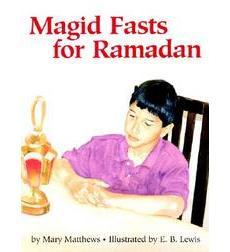
Magid Fasts for Ramadan by Mary Matthews illustrated by E. B. Lewis

Standard
Magid Fasts for Ramadan by Mary Matthews illustrated by E. B. Lewis

Magid Fasts for Ramadan

The intent of this 48 page chapter book is good, however, a few things rubbed me the wrong way about how Ramadan and Islam are presented.

Nearly eight-year-old Magid wants to fast on the first day of Ramadan, but everyone says he is much to young.  He decides to deceive everyone and fast anyway.  I’m actually okay with this main story line, as I could genuinely see a child wanting to do it so much they would lie about it.  The author even has the family sit down after the truth comes out and discuss how honesty is important and this is not how Ramadan should be celebrated.  Lesson learned for Magid and the reader, right? Nope, the author kind of blows it and takes it to the other extreme.

Magid’s sister Aisha is twelve and is “forced” to fast so she isn’t the only girl not fasting at her all girl’s school in Egypt.  What a sad reason to fast, The whole reason Magid wants to fast is to be a “truly obedient Muslim” which sounds great on the surface, but it get’s repeated so often that Magid at one point is judging a classmate who isn’t fasting and isn’t always at Jummah (Friday) prayers.  The parents decide at the end to let Aisha fast until school is out, hence shortening the day for appearance purposes, and Magid can fast til lunch.   He is told he can fast full days when the days are shorter.  Again a really odd reason to wait when fasting has been prescribed for us, to make it an issue of convenience.

So aside from the very negative view of Ramadan and the kids rejoicing at the end that they don’t “have” to fast, the lying, the disobeying your mother, and the judgmental laden diction of being truly obedient, the book does cover a lot of ground well.  The book shows the characters doing wudu and praying, it shows them trying to be kind to one another, it talks about how the Quran was revealed in the month of Ramadan and it does have a plot.

The water color illustrations are nice, and I also like how it showed a bit of Egyptian culture with the lanterns, singing, and food.  Interestingly the author says it is harder for Muslim’s in America to fast, but elsewhere says that Aisha has to watch the girls at school not fasting, eat lunch.

I really wouldn’t recommend this book, for the intended audience of 3rd through fifth graders I think it would do more harm than good in promoting Islamic values in Muslim children and in showing non-Muslims what Ramadan means to Muslims.

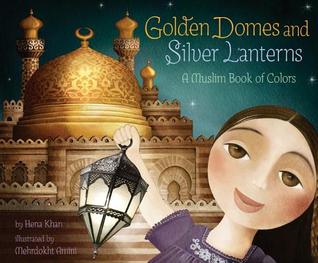
Golden Domes and Silver Lanterns By Hena Khan

Standard
Golden Domes and Silver Lanterns By Hena Khan

Image

As a librarian I do a few story time sessions a week, so I will include the Islamic themed books that the students and I particularly love. Golden Domes and Silver Lanterns: A Muslim Book of Colors by Hena Khan, is currently at the top of the list.  The pictures are beautiful and engaging, the text is simple and poetic, and the fact that the students first saw the book at the Scholastic Book Fair, made it all the more appealing.  For such youngsters to see themselves, their religion, their culture, so simply and beautifully presented elicits smiles from even the youngest story time listener.  Recently the intermediate Language Arts teacher even borrowed it to review adjectives, and the students loved it.  From orange henna, to black ink writing Allah, the book presents, eid, hijab, prayer rugs, mosques, and love.  An absolute must on any book shelf, you won’t regret it.

To see some pages from the book online:

http://www.books4yourkids.com/2012/09/golden-domes-and-silver-lanterns-muslim.html