Category Archives: middle grades

Jannah Jewels by Umm Nura illustrated by Nayzak Al-Hilali

Standard

Strong muslim girls  (check)

Historical fiction (check)

Elementary level chapter book (check)

Beautifully illustrated (check)

Action, adventure, fun (check, check, check)

Really what more can you want from a book, or better yet a series of books?

The premise of Jannah Jewels is four Muslim girls each with specific skills that travel back in time to various places in the world to retrieve artifacts to save the world before the “villians” do.  Along the way they share knowledge of hadith, Quran, and Muslim achievements and advancements while meeting with influential Muslims.  I mean really, what is there not to like.  This is historical Islamic Fiction for 2nd through 5th grade at its finest, yay!

So far there are nine books in the series, and based on the premise that they must find 12 artifacts to put in a golden clock, I would assume there will be 12 books.  I decided to review only the first two as I think they set the stage and give the reader a good feel for the series’ standards, the tone, and direction the consequent books will follow.  The series is to be read in order and they range in length from 69 pages to 165.  Each book has a description of the main characters, a visual of the supporting characters and is followed after the story by a sneak peek at the next book, a glossary, and some manga anime of the heroines.  Some of the books are co authored (Ustadha S. Karim & Tayyaba Syed), but based on the website http://www.jannahjewels.com Umm Nura is the main author and creator of the series.

SYNOPSIS:

Hidayah sees a woman with a bow and arrow and watches her for many days until finally she musters the courage to meet her.  This meeting is the start of Hadiyah’s training in present day with the Master Archer.  The story however, starts with a prologue of the past and how different approaches to archery have lead to a rift between those entrusted to keeping evil at bay.   The collision of those actions and today occur as Hidayah and her friends Jaide, Sarah, and Iman are chosen to retrieve artifacts scattered around the world and throughout time.  They must bring these artifacts and place them in the golden clock before Jaffar and his son Khan do, to obtain a secret locked away inside.  Each girl has incredible skills and strength as well as fears and doubts.  The stories are action pact as well as enlightening and empowering.  The girls are smart, strong, and supportive of one another and they use team work to make for a smart inspiring read.

In the first book the foundation is laid and the details of time travel and the task are put forth, it is a tiny bit cumbersome, but is quickly believable and accepted as the action picks up.  The Jannah Jewels travel to Timbuktu and meet with Mansa Musa to rescue a lost manuscript.  In the second book they journey to China aboard the ships of Chinese Muslim Admiral Zheng He to recover a medicinal plant.  The recap of the first book and the premise of what has to be done is seamless and quick.  Thus allowing the story to move further below the surface to provide more insight into who the four girls are, and understanding into what occurred in the past that made the Jannah Jewel adventures necessary.

WHY I LIKE IT:

I love historical fiction, so Islamic historical fiction is like a gift, when done right.  To give young muslims a glimpse at some of the remarkable accomplishments and contributions Muslims have made throughout time, in a manner they don’t even know they are learning it, is so needed.  Our kids should know about Mansa Musa, Al-Kindi, Fatima Al-Fihri, Sultan Muhammad II, and more, and sadly many are not tempted to pick up a non fiction book to learn about them.

The Jannah Jewels are also admirable and have the ability to inspire our girls to be better Muslimah’s through their examples of intelligence, strength, and deen. Each book reveals more about their hobbies, passions, and past, and does a good job of giving them each their own personalities. That being said, these books are engaging for both boys and girls.  My own children have read the first four multiple times as have I.  Initially I didn’t think my son would be interested as it seems like a very “girl power” type read, but the story is strong enough and the characters have depth that they work well for all kids and their parents.

In addition to the stories, visually the books are absolutely gorgeous and appealing.  The manga anime style of art is bright and colorful on the covers, and detailed and complimentary throughout the text.


FLAGS:

None, alhumdulillah

TOOLS FOR LEADING THE DISCUSSION:

The website is engaging for those wanting to know about the characters and writing team.  The FAQ section is good background as well.  www.jannahjewels.com

The books aren’t complicated as they are for elementary aged children, that anything more than the story is not needed.  If your readers are like mine, however, you will need some reference books or google on hand for those that would like to learn more.  I think these books would be great in a classroom setting to get students reading.  I also think they would work well in 1st grade for read a loud story time.  I don’t know that they would be ideal for book club, but definitely could be used to compliment lessons in Language Arts and Social Studies.

Invincible Abdullah: The Deadly Mountain Revenge by Haji Uthman Hutchinson

Standard
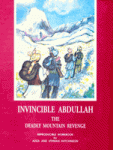
Invincible Abdullah: The Deadly Mountain Revenge by Haji Uthman Hutchinson

invincible-abdullah-the-deadly-mountain-revenge-workbook-aziza-and-uthman-hutchinson-2

I’m pretty sure I’ve seen and handled this book hundreds of times in my involvement in four Islamic Schools, as a teacher, a librarian, and host of book fairs.  So, it is a little embarrassing to admit that this is the first time I actually cracked open the cover and read the book.  Written in 1992 with a less than attention grabbing cover, I had minimal expectations, but with a newborn and down time, I thought I needed to give it a chance, and I’m glad I did.  The book is definitely geared to boys (there isn’t even a female character in it), and is pretty action packed and quick paced.  You know the boys will get out of the predicament at hand, he is “Invincible” after all, and there are three more books in the series, but you don’t feel bad reading it anyway, because it is sufficiently entertaining.  The book isn’t amazing, but it holds its own largely because it doesn’t talk down to the reader.  The characters are independent and thoughtful and yes they are teenagers battling drug carriers in the tribal areas of Pakistan, and yes they are wielding guns and hiking over glaciers, but mind you they never miss their salat or fail to thank Allah (swt) for their success which kind of makes the book that much more fun.  The book is 218 pages with a glossary at the back.  It is not an AR book, but I probably will make it into one at about a fourth grade fifth month level (4.5).  I also am considering doing it for book club, but might wait and read the rest of the series to see which one will have a wider appeal.

SUMMARY:

Abdullah travels to Pakistan from England to visit his cousin Hasan.  At the airport Abdullah’s bag gets switched with someone else’s and the boys find themselves getting accosted by the rightful owners who have a half a million dollars in their suitcase.  The boys talk to the police and learn that the money is part of a heroin operation going on in the tribal areas and that the inadvertent switch messed up the police’s sting to catch the criminals.  The boys run in to the drug runners again in the bazaar, and after an all out brawl decide when an opportunity to go into the tribal areas presents itself, that they should take it and do what they can, to put a stop to the criminal’s drug ring.

WHY I LIKE IT:

There is drugs, violence, and guns, but it is all done for the right reasons, in an action filled manner.  The “good” guys are all religious, and while the “bad” guys have religious sounding names, clearly are not, which lends it self to a decent discussion about what makes a good person and what makes one religious, clearly not just their name or culture.  It also lends itself to a realistic conversation about drugs, their effects on the users, and on drug culture as well.  The guns, well the guns are there to make threats, and to hurt people, at best it gives you a seg-way to discuss your views on guns with your children, but in the book, it is what it is, not a moral or religious issue as the drugs are made out to be.  The boys, the heroes of the book, are all very devout mashaAllah, and their actions, manners, and thoughts reflect this.  I like that this is consistent with their character.  They are respectful to their families, to each other and are ever mindful of themselves as Muslims in all facets of their adventures.

FLAGS:

Just the content of drugs, violence, and death. Mild compared to most TV shows or movies, but present, none-the-less, nothing a third grade and up can’t handle. (Spoiler, only one person dies and it isn’t directly at the hands of anyone, nature steps in to save the day).

TOOLS FOR LEADING THE DISCUSSION:

There is a workbook that apparently can be purchased to accompany and teach the book: http://www.islamicbookstore.com/b9648.html

The author gives pause as the characters have to decide what to do next and to weigh the pros and cons and possible repercussions of their decisions.  These moments would lend themselves well to a book club discussion to find out what the students would do, what they would be willing to risk, and at what cost.

Burning Boats by Zaynab Dawood

Standard
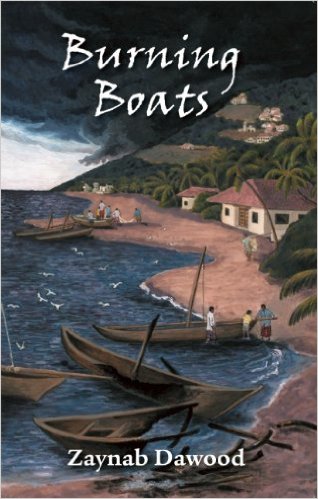
Burning Boats by Zaynab Dawood

burning boats

This book came highly recommended from a friend that read it aloud to her Kindergartener and I ordered a class set based on her raving review.  After trying to get into the book on three separate occasions I concluded that yet again I should have waited and read the book myself before ordering it.  So I handed it over to my avid reading eight-year-old who read it in a day and said it was pretty good, asked a few questions, and continued on her way confused as to why I couldn’t finish it.  So, I started it again determined to get through it and with Ramadan quickly approaching I thought I could motivate myself to do so.  However, I could not, and it sat on the shelf for the entire month with a book mark only a few chapters in.  At the prodding of my guilty conscious to return the book to my friend, I continued reading from where I left off, rather than starting over, again, and found that by dismissing completely who any of the characters are and how they are related, the story does get off the ground and I was able to finish it.  That being said, I think the story might have appeal if read aloud one chapter at a time. To read it in one setting did not help the story that can’t seem to decide it if wants to be character driven or action driven.  The sheer number of characters is completely over the top, there are at least 20 characters mentioned by name and the book is only 137 pages.  And honestly I never bonded with any of them.  There is action in the book, but the details seem misplaced.  The author details characters all saying salam and walaikumasalam to one another and giving moral reproaches based on Quran and Sunah, but I never felt I understood why the main characters were leaving, why the villain was so bad, or how (spoiler alert) a pivotal character in the book died. I guess by never connecting to the characters or feeling an emotional tie, positive or reproachful, the book didn’t live up to it’s potential.  The book is recommended for ages 12 and up, but I think younger children could read it and even younger could listen to it being read to them without any major concerns.  With guidance the book is by no means a waste of time, but if you recommend it to a child and they struggle to get into it, you might just have to let them find something else to read.

SUMMARY:

A small fishing village is being harassed by a corrupt businessman’s attempts to take over the entire industry in Tobay.  The principal of the school and a few close friends are trying to stop him, but have decide they cannot and thus are planning to move elsewhere.  The children are forbidden to go to the harbor as boats are being burned and crimes committed to persuade the local fisherman to abandon their solo endeavors.  With few places to play, the loss of the harbor affects the children greatly as well.  A tropical storm complicates matters as it tears through the village destroying the poor inhabitants meager dwellings as well as the damaging the school and the mosque.  With friends taking in homeless neighbors and the main family planning to leave the children plan one last game that turns dangerous when all the boats in the harbor are set a blaze.

WHY I LIKE IT:

There are some definite good qualities in the book, despite the holes.  It opened up a good discussion between my daughter and I about preparing a body for ghusl and Janaza.  It does show that people can change and that when people are sincerely apologetic and are striving to correct their behaviors, those around them should offer forgiveness in not just their words, but in their actions as well.  It also shows that good kids can make bad choices, and that the consequences can also be very real.  Similarly it shows that adults also don’t always know what to do, and that they can be forced to reconsider as well.

FLAGS:

There is violence in the book and death.  Nothing too graphic, but one might have to explain to younger, more sheltered reader,  that just because someone has a Muslim name doesn’t mean they are practicing Islam and are good people.

TOOLS FOR LEADING THE DISCUSSION:

There aren’t any online tools, but I would suggest having the readers keep a character journal.  Every time a new name appears, write down who they are, (and who they are related to), so later they can look back on it if they become confused.

Because of the “holes” in the story I would probably ask the students to give their thoughts as to what happened or why the characters decided to do what they did and then turn it back on them and ask them what they would do.

Why was Ibrahim leaving? Would you have left? What made Nasser change? Would you have forgiven him? How do you think Ayesha died? Etc.

A Party in Ramadan By Asma Mobin-Uddin Illustrated by Laura Jacobsen

Standard

BMP_8604_JT.indd

This is a great book that works on a variety of levels.  Leena is fasting the whole day for the first time, but is also invited to a friends party.  Her mom gives her the choice to fast or not as it is not yet mandatory at her age, and she decides to fast AND go to the party.  The story takes you through the activities of the party and how some parts are easy and some harder for the fasting Leena.  The end has a wonderful surprise for both Leena and the reader as the author gives us all reason to hope that respect among friends exists, and that in fact one can stay true to their beliefs and have support from their friends.

This book is  great conversation starter for older kids who maybe have tried to fast and felt the temptations of day-to-day life in a non -Islamic environment.  With an AR level of 4.2 and 34 pages the story is strong enough to hold a fourth graders attention and get them to analyze what they would do in a similar situation.  Although the book is about Ramadan and some facets about how fasting is done, what it means, and why Muslims do it, are sprinkled in, the story isn’t overly religious in nature.  The characters are simply Muslim, they pray, they thank Allah, they wear hijab, they make duaas and they also go to friend’s parties. I think non-Muslims would benefit from this book and see the beauty of diversity as Leena and her friends support one another.  The pictures also do a wonderful job of depicting the story: the characters are warm and happy, some cover some do not, they eat chocolate pudding and Baklava and the reader sees how a Muslim family is just like any other family.

The added beauty of this book is that it also works for story time. The younger ones may or may not understand the potential stress of being the only Muslim at a party, let alone being the only one fasting, but they do understand that Leena wanted to eat and drink and she remembered that when her little sister wanted her dessert.  They also understand how sometimes it is hard to do what is right, but inshaAllah the reward is sweet indeed.

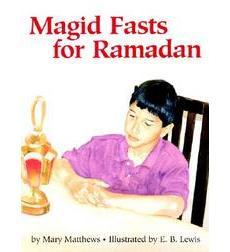
Magid Fasts for Ramadan by Mary Matthews illustrated by E. B. Lewis

Standard
Magid Fasts for Ramadan by Mary Matthews illustrated by E. B. Lewis

Magid Fasts for Ramadan

The intent of this 48 page chapter book is good, however, a few things rubbed me the wrong way about how Ramadan and Islam are presented.

Nearly eight-year-old Magid wants to fast on the first day of Ramadan, but everyone says he is much to young.  He decides to deceive everyone and fast anyway.  I’m actually okay with this main story line, as I could genuinely see a child wanting to do it so much they would lie about it.  The author even has the family sit down after the truth comes out and discuss how honesty is important and this is not how Ramadan should be celebrated.  Lesson learned for Magid and the reader, right? Nope, the author kind of blows it and takes it to the other extreme.

Magid’s sister Aisha is twelve and is “forced” to fast so she isn’t the only girl not fasting at her all girl’s school in Egypt.  What a sad reason to fast, The whole reason Magid wants to fast is to be a “truly obedient Muslim” which sounds great on the surface, but it get’s repeated so often that Magid at one point is judging a classmate who isn’t fasting and isn’t always at Jummah (Friday) prayers.  The parents decide at the end to let Aisha fast until school is out, hence shortening the day for appearance purposes, and Magid can fast til lunch.   He is told he can fast full days when the days are shorter.  Again a really odd reason to wait when fasting has been prescribed for us, to make it an issue of convenience.

So aside from the very negative view of Ramadan and the kids rejoicing at the end that they don’t “have” to fast, the lying, the disobeying your mother, and the judgmental laden diction of being truly obedient, the book does cover a lot of ground well.  The book shows the characters doing wudu and praying, it shows them trying to be kind to one another, it talks about how the Quran was revealed in the month of Ramadan and it does have a plot.

The water color illustrations are nice, and I also like how it showed a bit of Egyptian culture with the lanterns, singing, and food.  Interestingly the author says it is harder for Muslim’s in America to fast, but elsewhere says that Aisha has to watch the girls at school not fasting, eat lunch.

I really wouldn’t recommend this book, for the intended audience of 3rd through fifth graders I think it would do more harm than good in promoting Islamic values in Muslim children and in showing non-Muslims what Ramadan means to Muslims.